






1. Introduction for Validation Plan for Computer System of UV:
The Validation Plan for Computer System of UV defines a structured approach for validating the hardware and software used to control the UV analytical system in the Quality Control/Microbiology area. It establishes validation requirements, responsibilities, documentation practices, acceptance criteria, and controls necessary to demonstrate that the system operates consistently and as intended. The plan follows a GAMP-based lifecycle and includes Risk Assessment, Installation Qualification, Operational Qualification, Performance Qualification, Traceability Matrix, and Validation Summary Report. It also addresses security, audit trails, electronic data protection, backup, change control, maintenance, discrepancy handling, and compliance with applicable GMP and 21 CFR Part 11 requirements.
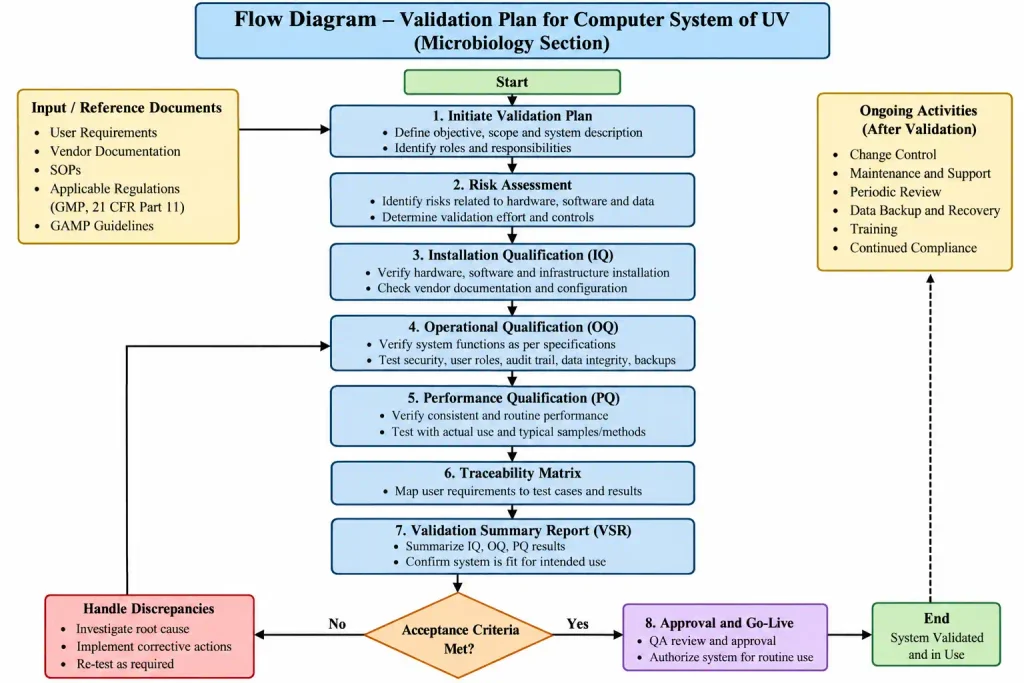
Skip to PDF content2. Flow Diagram – Validation Plan for Computer System of UV:
The flow diagram illustrates the systematic validation lifecycle for the Computer System of UV used in the Microbiology section. The process begins with preparation of the validation plan using system requirements, SOPs, vendor documents, and applicable regulatory requirements. It then proceeds through Risk Assessment, Installation Qualification (IQ), Operational Qualification (OQ), Performance Qualification (PQ), Traceability Matrix, and Validation Summary Report (VSR). Acceptance criteria are reviewed before final approval. Any identified discrepancies are investigated, corrected, documented, and re-tested where required. After successful approval, the validated system is maintained through change control, preventive maintenance, backup, SOPs, and continued compliance activities.
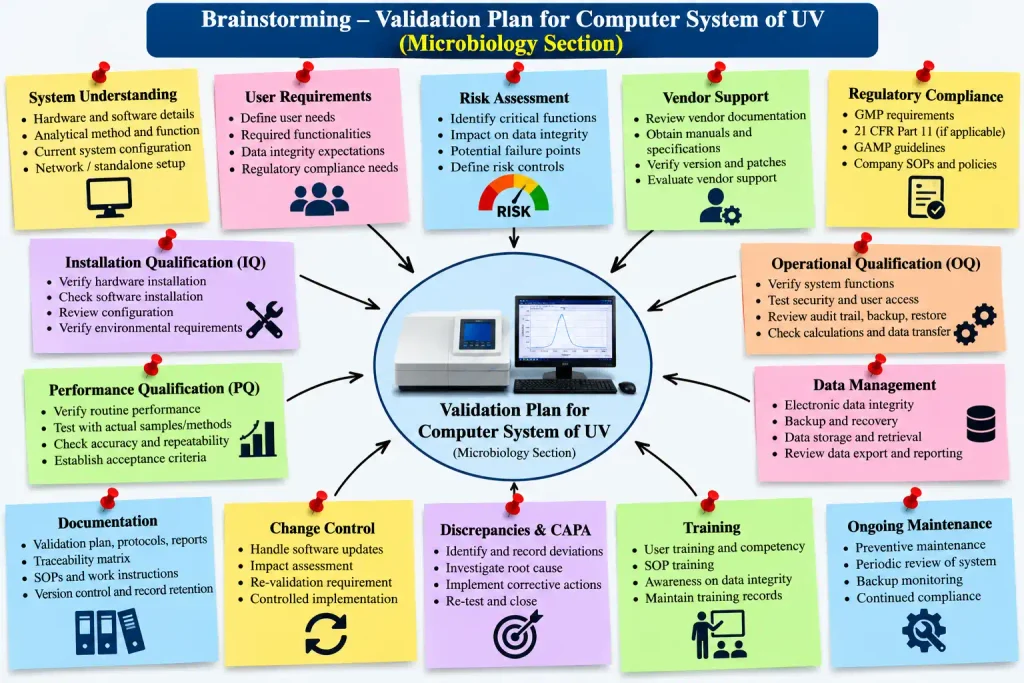
3. Brainstorming – Validation Plan for Computer System of UV:
The brainstorming analysis identifies the major elements required for effective validation of the Computer System of UV. Key areas include system understanding, user requirements, risk assessment, regulatory compliance, vendor support, and qualification activities such as IQ, OQ, and PQ. It also considers data integrity, backup and recovery, documentation, change control, discrepancy handling, CAPA, training, and ongoing system maintenance. The purpose of brainstorming is to ensure that all potential validation requirements, risks, responsibilities, and compliance controls are considered before execution. This structured approach supports complete validation planning and helps maintain the system in a controlled and compliant state.
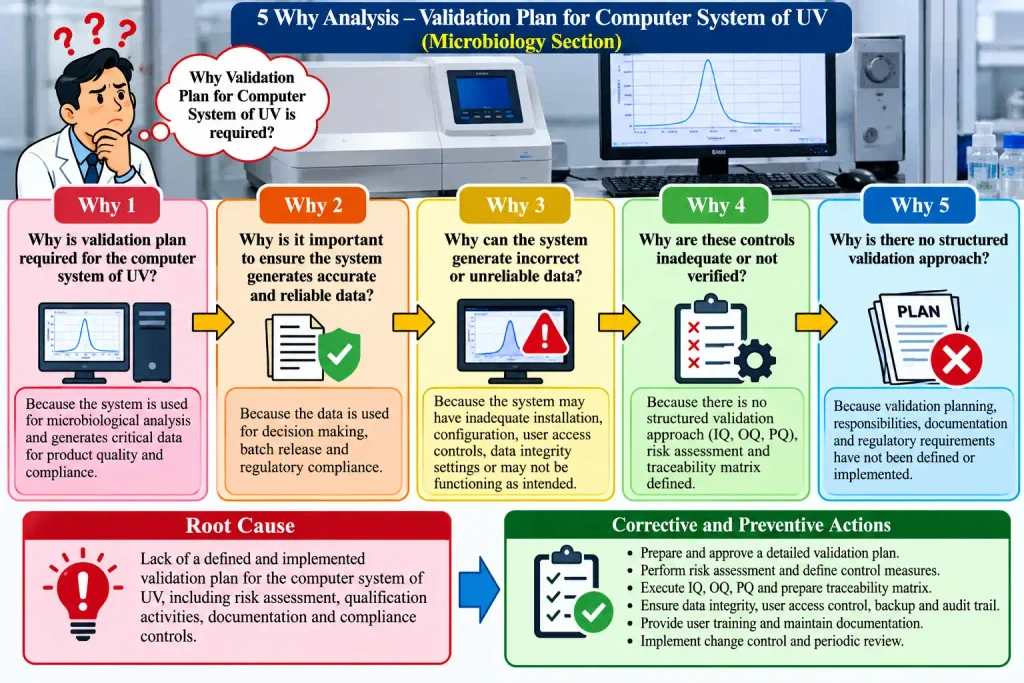
4. 5 Why Analysis – Validation Plan for Computer System of UV:
The 5 Why Analysis identifies the underlying reason for establishing and implementing a Validation Plan for the Computer System of UV. The analysis begins with the need to ensure reliable system performance and accurate analytical data. It then examines risks related to installation, configuration, user access, data integrity, backup, and system controls. Further questioning highlights the need for structured qualification activities such as Risk Assessment, IQ, OQ, PQ, and Traceability Matrix. The root cause is inadequate validation planning and control. Corrective actions include documented qualification, discrepancy management, change control, and continued system compliance.
5. Heatmap Analysis – Validation Plan for Computer System of UV
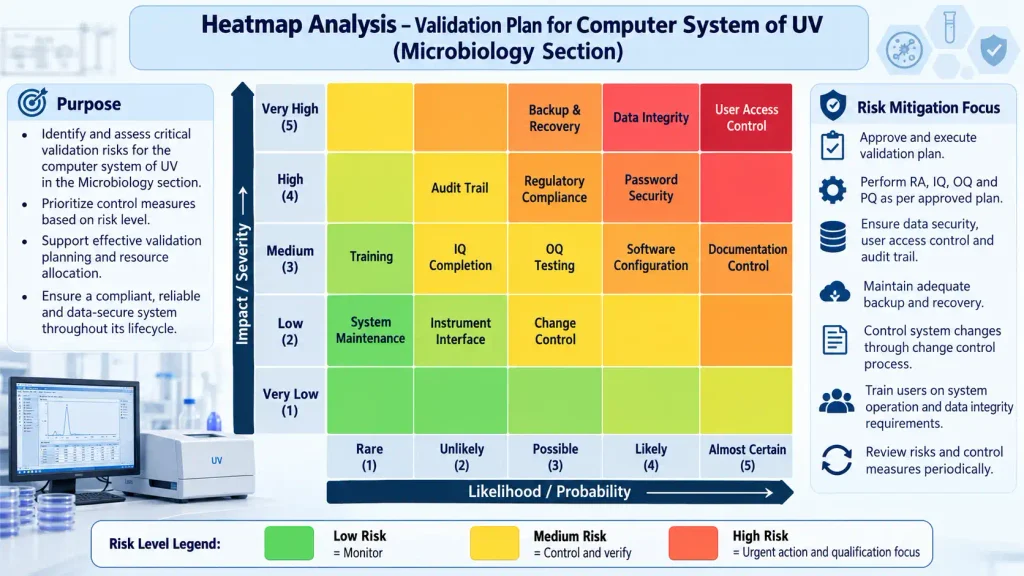
The Heatmap Analysis visually prioritizes validation risks associated with the Computer System of UV according to their severity and likelihood. High-risk areas include data integrity, user access control, password security, backup and recovery, audit trail, and regulatory compliance. Medium-risk areas cover IQ completion, OQ testing, software configuration, documentation control, training, and change control. Lower-risk elements include routine system maintenance and instrument interface controls. The heatmap helps the validation team focus resources on critical risks, implement suitable mitigation measures, and ensure completion of Risk Assessment, IQ, OQ, PQ, documentation, security controls, and ongoing system review.
6. Fishbone Analysis – Validation Plan for Computer System of UV:
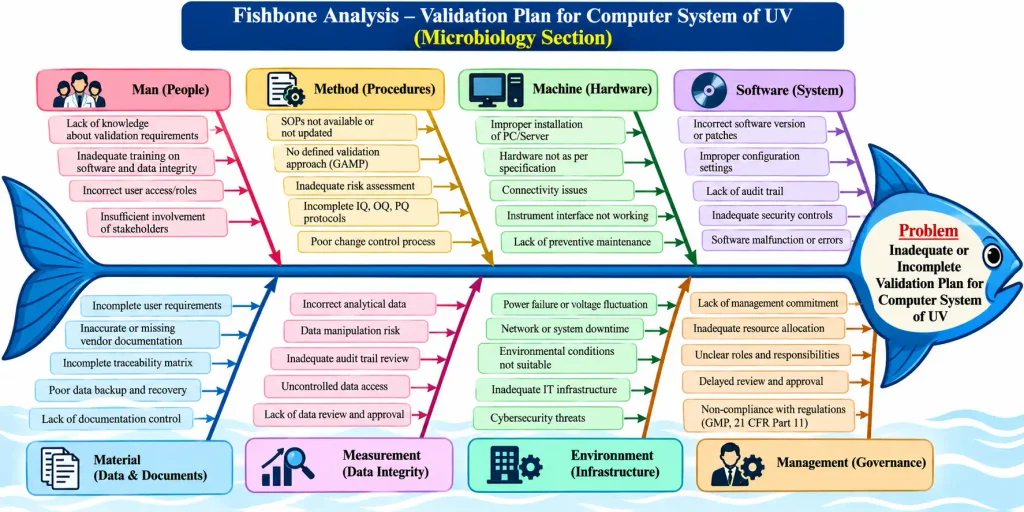
The Fishbone Analysis identifies potential causes that could lead to an inadequate or incomplete Validation Plan for the Computer System of UV. The causes are grouped into major categories such as Man, Method, Machine, Software, Material, Measurement, Environment, and Management. Key issues include inadequate training, undefined validation procedures, incomplete IQ/OQ/PQ activities, incorrect software configuration, weak access control, poor documentation, insufficient backup, inadequate data-integrity review, infrastructure problems, and unclear responsibilities. This analysis supports systematic root-cause identification and helps the validation team establish appropriate controls, documentation, qualification activities, and governance for a compliant and reliable computerized UV system.
7. Fault Tree Analysis – Validation Plan for Computer System of UV:
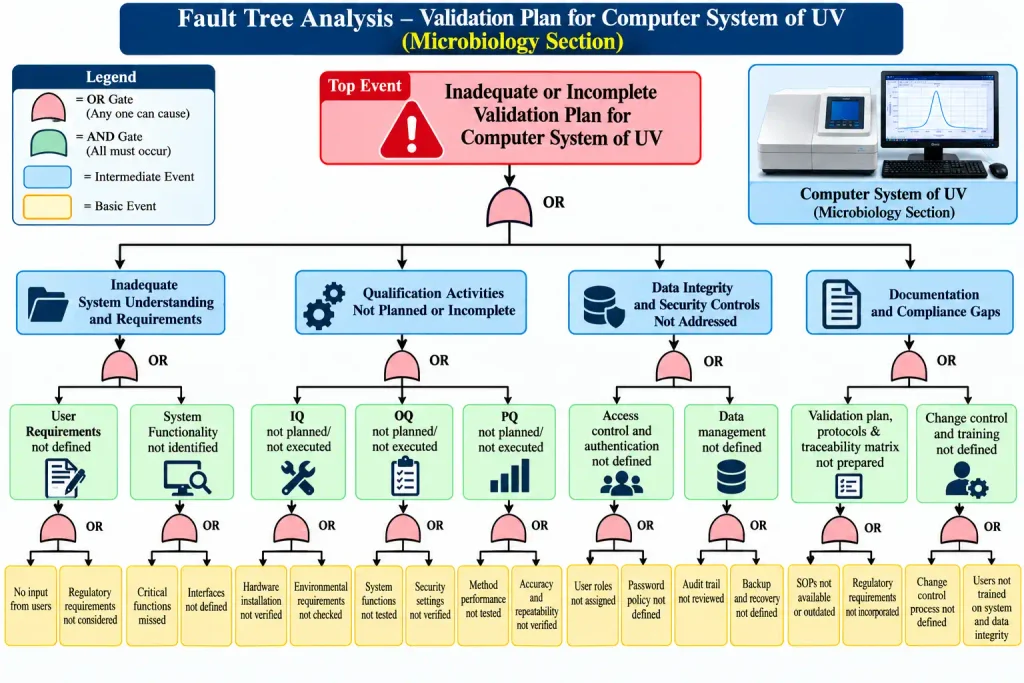
The Fault Tree Analysis (FTA) evaluates possible causes that may result in an inadequate or incomplete Validation Plan for the Computer System of UV. The analysis begins with the top event and divides it into major contributing areas, including inadequate system understanding, incomplete qualification activities, weak data integrity and security controls, and documentation or compliance gaps. Potential causes include undefined user requirements, incomplete IQ/OQ/PQ, poor access control, inadequate audit trail and backup, missing SOPs, insufficient training, and weak change control. FTA helps identify critical failure pathways and supports effective corrective and preventive actions.
8. Pareto Chart Analysis – Validation Plan for Computer System of UV:
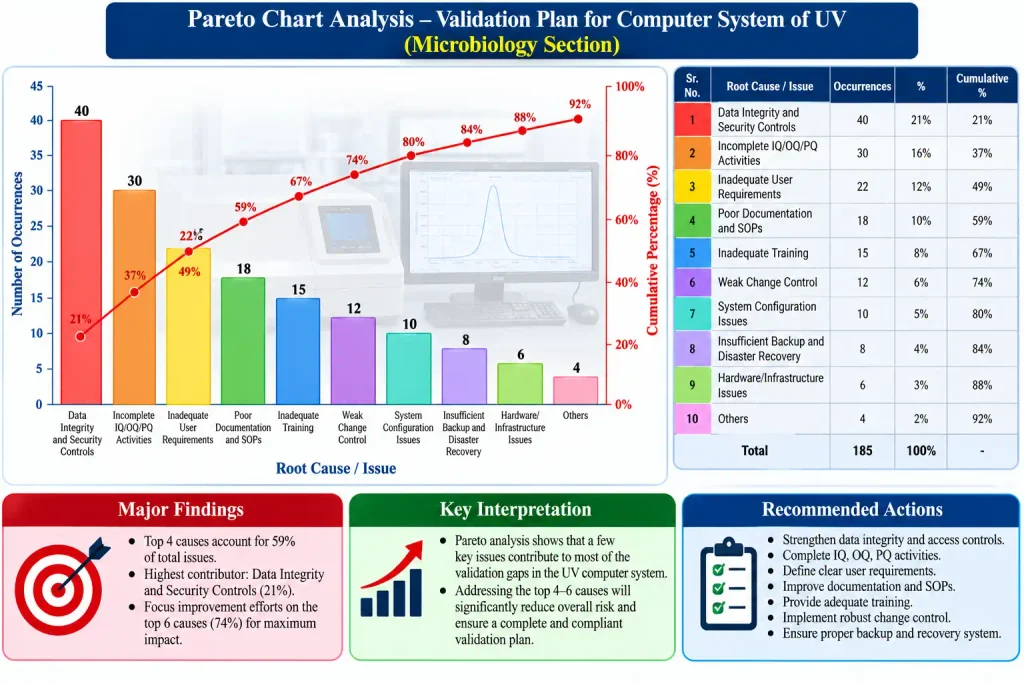
The Pareto Chart Analysis prioritizes the major issues that can affect effective validation of the Computer System of UV. The chart ranks problems according to their frequency and cumulative contribution. Major contributors include data integrity and security controls, incomplete IQ/OQ/PQ activities, inadequate user requirements, poor documentation and SOPs, insufficient training, weak change control, system configuration issues, and inadequate backup and recovery. By highlighting the most significant causes first, the Pareto approach helps the validation team focus resources on high-impact areas. Addressing these priority issues can substantially improve validation completeness, compliance, system reliability, and data integrity.
9. Corrective Action and Preventive Action – Validation Plan for Computer System of UV:
| No. | Identified Issue | Corrective Action | Preventive Action | Effectiveness Check |
|---|---|---|---|---|
| 1 | Incomplete or inadequate validation plan | Prepare, review, and approve a complete Validation Plan covering scope, responsibilities, validation approach, qualification, acceptance criteria, and deliverables. | Establish a controlled CSV procedure requiring an approved validation plan before qualification starts. | Verify approved plan is available and all defined deliverables are completed. |
| 2 | Incomplete Risk Assessment | Perform documented risk assessment for hardware, software, data integrity, security, backup, and system functions. | Make risk assessment mandatory before IQ/OQ/PQ execution and review it after major changes. | Confirm identified risks have appropriate controls and no critical risk remains unaddressed. |
| 3 | Incomplete IQ/OQ/PQ | Execute pending IQ, OQ, and PQ activities against approved protocols and document results. | Use qualification checklists, predefined acceptance criteria, and QA review before stage completion. | Review approved qualification reports and closure of deviations. |
| 4 | Weak user-access/password controls | Review user roles, privileges, password settings, and unauthorized access risks. Correct inappropriate access immediately. | Implement role-based access, periodic user-access review, password policy, and controlled account creation/deactivation. | Periodic access review confirms only authorized users retain appropriate privileges. |
| 5 | Audit trail/data integrity gaps | Enable and verify audit trail functionality and investigate any identified data-integrity deficiency. | Establish SOPs for audit-trail review, electronic records, data review, and ALCOA+ practices. | Periodic audit-trail review shows complete, attributable, and traceable records. |
| 6 | Inadequate backup and recovery | Verify current data backup, restore capability, storage location, and recovery process. | Establish scheduled backup, periodic restore testing, retention requirements, and backup monitoring. | Successful documented restore test demonstrates data recoverability. |
| 7 | Inadequate documentation/SOPs | Prepare or update required SOPs for security, system operation, backup, change control, and laboratory software. VALIDATION PLAN FOR COMPUTER SY… | Introduce periodic SOP review and document-control monitoring. | Current approved SOPs are available and users follow them correctly. |
| 8 | Validation discrepancies not adequately handled | Record, investigate, assess impact, correct, and close all qualification discrepancies with QA involvement. VALIDATION PLAN FOR COMPUTER SY… | Establish a standard discrepancy log and closure workflow for all computerized-system qualification activities. | No open critical discrepancies remain before final validation approval. |
| 9 | Weak change control | Evaluate existing system changes and assess need for requalification or revalidation. | Route future hardware, software, configuration, or operating-system changes through approved change control. VALIDATION PLAN FOR COMPUTER SY… | Review change records and verify required impact assessment and testing were completed. |
| 10 | Inadequate maintenance and lifecycle control | Bring the computer system and associated components under preventive maintenance and controlled support. | Schedule periodic maintenance, review, system-health checks, and controlled upgrades. VALIDATION PLAN FOR COMPUTER SY… | Periodic review confirms the system remains validated, secure, and fit for intended use. |
Overall effectiveness criterion: CAPA may be considered effective when all validation deliverables are approved, critical discrepancies are closed, access and audit-trail controls are satisfactory, backup restoration is successful, SOPs and training are current, and the Computer System of UV remains in a documented validated state.
10. Questions and Answers – Validation Plan for Computer System of UV:
Q1. What is the objective of the Validation Plan for Computer System of UV?
The objective is to establish an organized approach for validating the hardware and software associated with the UV computer system and to define the requirements and standards to be followed during validation activities.
Q2. What is the scope of the Validation Plan?
The scope includes validation of the hardware and software of the Computer System of UV, along with applicable test procedures, documentation, references, and acceptance criteria.
Q3. What is the function of the Computer System of UV?
The Computer System of UV controls the connected analytical instrument through installed software, allows operators to enter required parameters and set points, and supports printing and data backup through the connected server.
Q4. Who is responsible for validation activities?
Validation activities involve the Validation Agency, Engineering, IT, Quality Control, and Quality Assurance, with responsibilities for preparation, review, execution, and approval.
Q5. Which guidelines are referenced in the Validation Plan?
The Validation Plan references GAMP 5, 21 CFR Parts 210, 211 and 11, ICH Q9, EU GMP, and WHO guidance for computerized system validation.
Q6. What are the main validation documents?
The main validation documents include the Validation Plan, System Requirement Specification, Risk Assessment Protocol, Installation Qualification, Operational Qualification, Performance Qualification, Traceability Matrix, and Validation Summary Report.
Q7. What is the purpose of Risk Assessment?
Risk Assessment is performed to identify possible risks related to the use of the Computer System of UV and to define suitable controls or actions to reduce those risks.
Q8. What is verified during Installation Qualification?
Installation Qualification verifies system details, hardware, software, master documents, security controls, calibration status, power supply, environmental conditions, communication links, general installation, and applicable SOPs.
Q9. What is verified during Operational Qualification?
Operational Qualification verifies system functions such as startup and shutdown, password security, user access, software screens, system response, electronic data security, audit trail, report generation, backup, and 21 CFR Part 11-related controls.
Q10. What is the purpose of Performance Qualification?
Performance Qualification is performed to verify that the Computer System of UV performs its intended functions after completion and approval of Operational Qualification.
Q11. What is the purpose of the Traceability Matrix?
The Traceability Matrix provides assurance that system requirements are properly linked with qualification activities and associated test evidence.
Q12. What is the purpose of the Validation Summary Report?
The Validation Summary Report summarizes the executed qualification data and provides documented evidence that the Computer System of UV has been successfully validated.
Q13. How should system changes be managed?
Any change made to the control system during validation activities should be handled through the approved change control procedure.
Q14. How are discrepancies handled during qualification?
Discrepancies are documented, communicated to Engineering, IT, and Quality Assurance, investigated for impact, corrected where necessary, and closed with proper justification and approval.
Q15. What are the acceptance criteria for successful validation?
Successful validation requires proper installation, availability of required documentation, intended system operation under a controlled state, and confirmation that operational features meet defined requirements and specifications.
Q16. Which SOPs support the validated system?
Supporting SOPs include System Security, Desktop Policy, Data Backup, Archiving and Retrieval, Change Control, Software in Laboratory and GMP System, and System Operation.
Q17. Why is data backup important?
Data backup is important because it helps protect electronic records and ensures that system data can be retained and recovered when required.
Q18. Who approves the Validation Plan?
Quality Assurance is responsible for approving and authorizing the Validation Plan.
Q19. What happens after successful validation?
After successful validation, the system and associated components are included in preventive maintenance activities, and future software or hardware changes are controlled through change control.
Q20. What is the final purpose of computer system validation?
The final purpose is to demonstrate through documented evidence that the Computer System of UV is properly installed, functions as intended, meets defined requirements, and remains in a controlled validated state.
11. Reference Guidelines – Validation Plan for Computer System of UV:
The Validation Plan references the following guidelines and regulatory requirements:
- GAMP 5 – Good Automated Manufacturing Practice issued by ISPE, used for the lifecycle and risk-based validation approach for automated and computerized systems.
- 21 CFR Part 210 – Current Good Manufacturing Practice in Manufacturing, Processing, Packing, or Holding of Drugs.
- 21 CFR Part 211 – Current Good Manufacturing Practice for Finished Pharmaceuticals.
- 21 CFR Part 11 – Electronic Records and Electronic Signatures requirements applicable to computerized systems.
- ICH Q9 – Quality Risk Management, referenced for risk assessment of computerized system functions and controls.
- EU GMP Guidelines – Principles and guidelines of Good Manufacturing Practice for medicinal products for human use.
- WHO Guidance – Appendix 5: Validation of Computerized Systems, referenced for computerized system validation requirements.