







Brief Description
This Standard Operating Procedure describes the system for allocating Analytical Report Numbers (A.R. No.) to finished products in the Quality Control Department. Its objective is to establish a consistent and traceable method for assigning a unique identification number to each finished-product consignment received for analysis. The Executive-QC is responsible for executing the procedure, while the Manager-QC and Head QA/QC are responsible for its effective implementation.The A.R. number is structured using defined identification elements representing the company, finished-product category, year, month, and sequential receipt number. This numbering system supports accurate sample identification, laboratory traceability, documentation, and prevention of mix-ups during finished-product testing.The SOP also requires training of Quality Control personnel and includes Annexure-I – Log Book of Finished Product, which records product name, batch number, manufacturing and expiry dates, batch size, A.R. number, sampled quantity, sampling details, release date, analyst, remarks, and receipt information.
Skip to PDF content1. Flow Diagram:
The flow diagram presents the step-by-step process for allocating an A.R. No. to finished products in the Quality Control Department. The process starts with receipt of the finished product for analysis and verification of key product and batch details. The next available serial number is identified from the Finished Product Log Book, after which the A.R. No. is assigned using the defined format consisting of the company identification, finished-product code, year, month, and serial number.
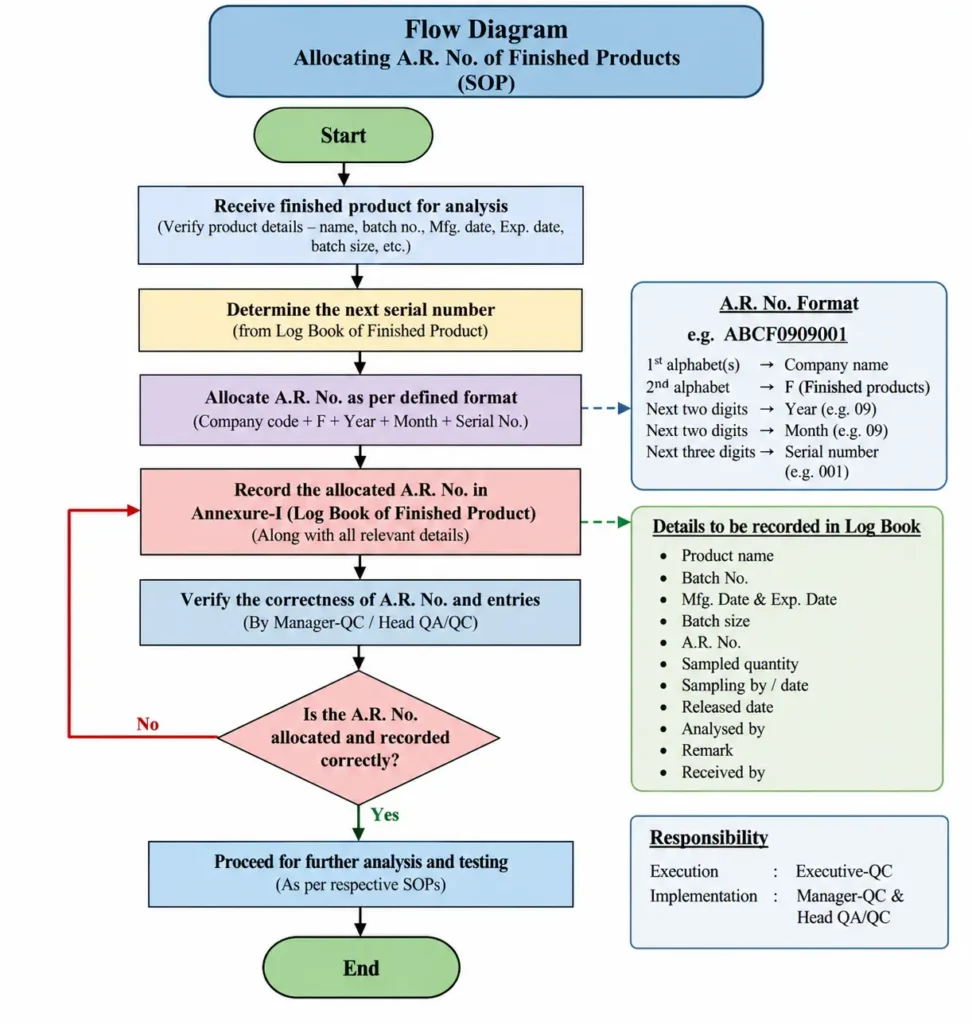
The allocated A.R. No. and related information are then entered in Annexure-I, Log Book of Finished Product, including product name, batch number, manufacturing and expiry dates, batch size, sampled quantity, sampling details, release date, analyst, remarks, and receipt information.The entries are verified for correctness before the sample proceeds for further analysis. This flow ensures traceability, consistency, proper documentation, and prevention of identification errors or mix-ups during finished-product testing.
2. Brainstorming for SOP Failure:
The brainstorming diagram highlights potential reasons for failure in the SOP for allocating A.R. Numbers to finished products. It visually represents key contributing factors such as lack of training, unclear understanding of the A.R. numbering format, failure to update the finished-product logbook, human error, incomplete product details, poor communication, personnel changes, excessive workload, multitasking, inadequate review and verification, low awareness, and lack of accountability.
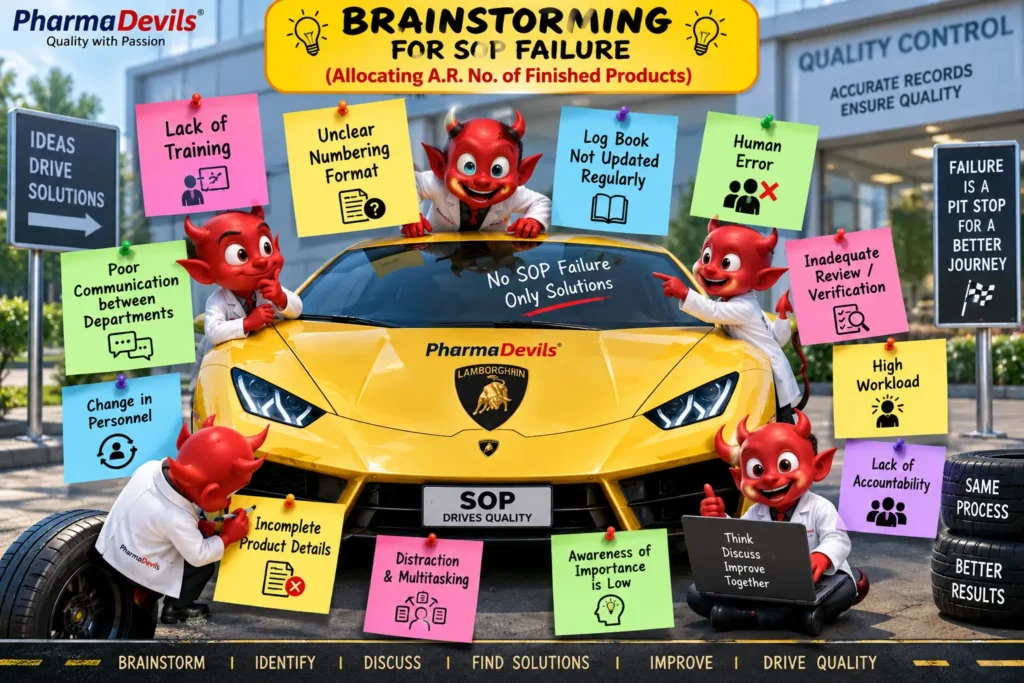
These factors can result in incorrect or duplicate A.R. numbers, missing entries, poor traceability, and documentation errors. The SOP requires a defined numbering format based on company identification, finished-product code, year, month, and serial number, making correct understanding and execution essential.The brainstorming exercise encourages the QC team to identify, discuss, prioritize, and eliminate possible causes of failure, strengthening training, verification, communication, record maintenance, and overall GMP compliance.
3. 5-Why Analysis for SOP Failure:
The 5-Why Analysis identifies the underlying cause of failure in following the SOP for allocating A.R. Numbers to finished products. The analysis begins with the problem that the SOP is not followed correctly. It then progressively identifies possible causes: personnel may not clearly understand the A.R. numbering format, training and awareness may be inadequate, training may not be conducted effectively or regularly, and management follow-up may be insufficient.
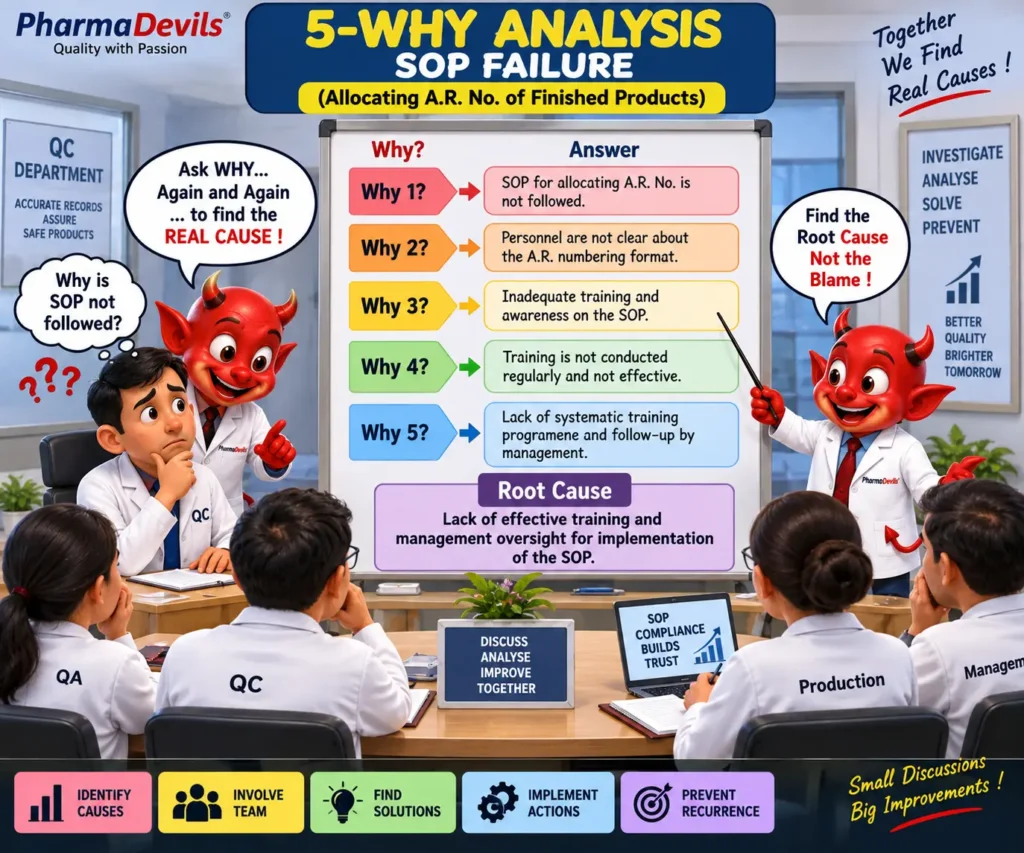
The analysis concludes that the potential root cause is an ineffective systematic training program combined with inadequate management oversight of SOP implementation. The SOP itself assigns execution responsibility to Executive-QC and implementation responsibility to Manager-QC and Head QA/QC, while also requiring training of QC personnel.The diagram emphasizes identifying causes rather than blaming individuals and promotes training, verification, accountability, teamwork, corrective actions, and prevention of recurrence.
4. Fishbone Analysis for SOP Failure:
The Fishbone Analysis illustrates the potential causes of failure in the SOP for allocating A.R. Numbers to finished products. The diagram groups possible causes under major categories such as Man, Machine/System, Method, Material/Records, Management, Environment, and Measurement/Review.
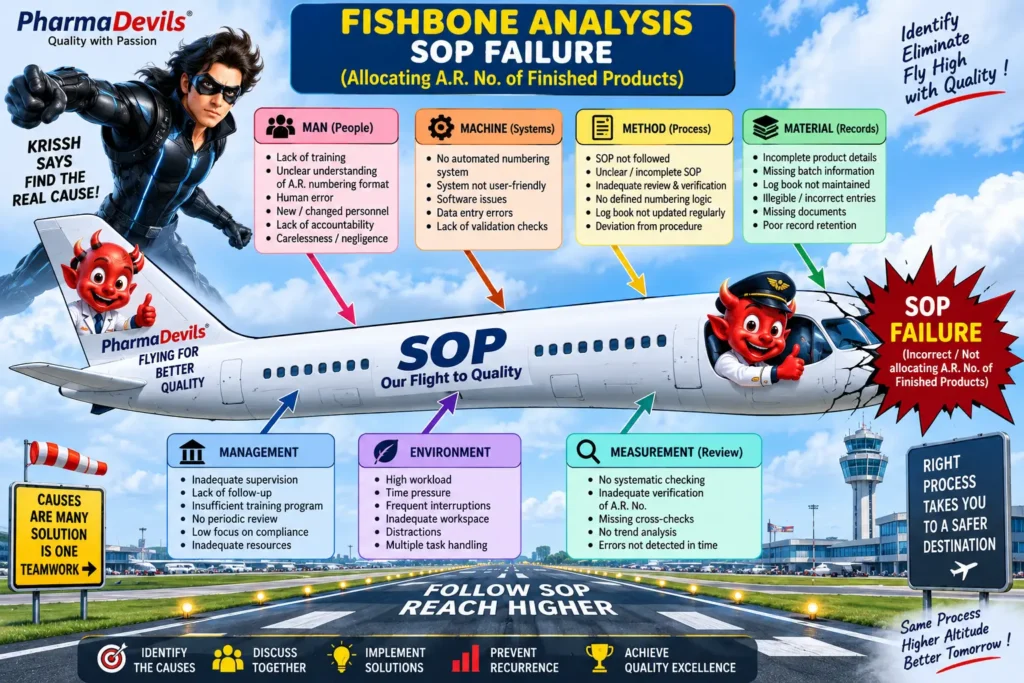
Key causes include inadequate training, unclear understanding of the A.R. numbering format, human errors, incomplete product details, failure to update the finished-product logbook, insufficient supervision, high workload, poor verification, and absence of systematic cross-checking. These factors can result in incorrect, duplicate, or missing A.R. numbers and may affect traceability of finished-product samples.The SOP defines responsibility for execution and implementation and specifies a structured A.R. numbering system using company identification, finished-product designation, year, month, and serial number.The fishbone analysis therefore helps the QC/QA team systematically identify contributing factors, determine the actual root cause, implement corrective actions, and prevent recurrence of SOP failures.
5. Fault Tree Analysis for SOP Failure:
The Fault Tree Analysis illustrates how different causes can lead to failure in the SOP for allocating A.R. Numbers to finished products. The top event is defined as incorrect, missed, or delayed allocation of the A.R. No. The diagram further divides the problem into major failure paths such as A.R. No. not allocated, incorrect A.R. No. allocated, and delayed allocation.
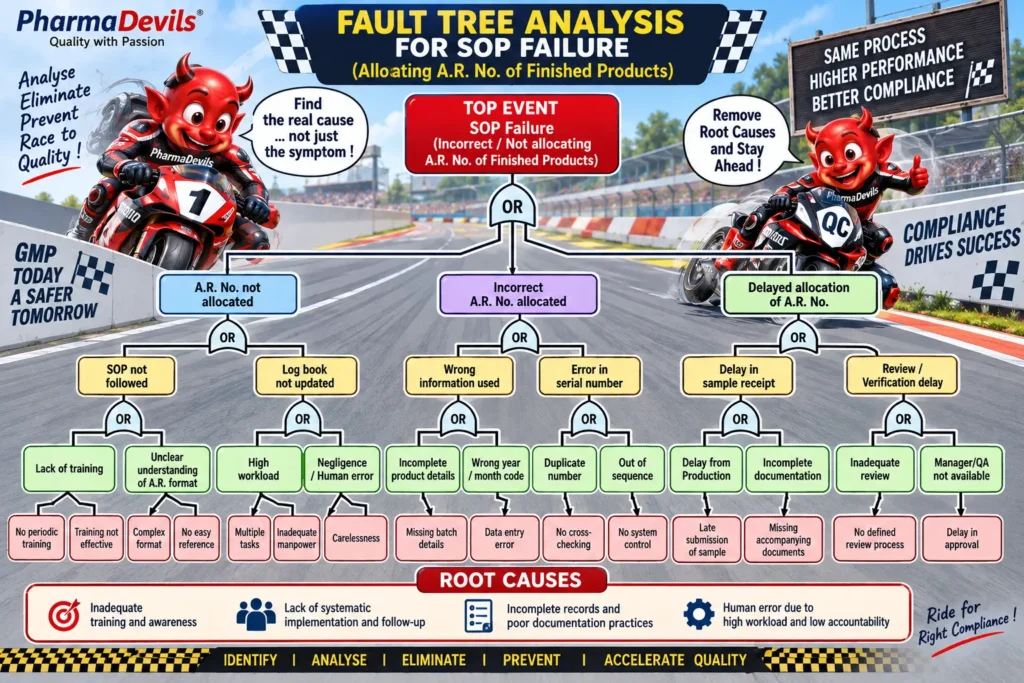
Possible contributing causes include failure to follow the SOP, an unupdated finished-product logbook, incorrect product or batch information, errors in year/month or serial-number coding, duplicate or out-of-sequence numbering, delayed sample receipt, and inadequate review or verification. These risks are relevant because the SOP requires a defined numbering format and recording of the A.R. No. in the finished-product logbook.The analysis helps identify potential root causes such as inadequate training, weak implementation, poor documentation practices, workload-related human error, and insufficient management follow-up, supporting corrective action and prevention of recurrence.
Questions & Answers – SOP for Allocating A.R. No. of Finished Products
- Q: What is the objective of this SOP?
A: To define the procedure for allocating an A.R. No. to finished products. - Q: Which department is covered under this SOP?
A: The Quality Control Department. - Q: Who is responsible for execution of the SOP?
A: Executive-QC. - Q: Who is responsible for effective implementation of the SOP?
A: Manager-QC and Head QC/QA. - Q: What does A.R. No. stand for?
A: Analytical Report Number. - Q: What does the second alphabet in the A.R. No. indicate?
A: It indicates that the sample is a finished product. - Q: What do the two digits after the product code represent?
A: They represent the year of the consignment. - Q: What do the next two digits represent?
A: They represent the month of the consignment. - Q: What do the last three digits such as “001” indicate?
A: They indicate the serial number of receipt of the finished product. - Q: Who conducts training for this SOP?
A: Manager–Quality Control. - Q: Who are the trainees for this SOP?
A: Quality Control personnel. - Q: What is the training duration mentioned in the SOP?
A: Half an hour. - Q: What is Annexure-I of this SOP?
A: Log Book of Finished Product. - Q: What information is recorded in the Finished Product Log Book?
A: Product name, batch number, manufacturing date, expiry date, batch size, A.R. No., sampled quantity, sampling details, release date, analyst, remarks, and received-by details. - Q: What is the reference mentioned in the SOP?
A: In-house reference. - Q: Who holds the controlled copy of the SOP?
A: Head of Department – Quality Control. - Q: Who holds the master copy of the SOP?
A: Head of Department – Quality Assurance. - Q: Why is correct A.R. No. allocation important?
A: Within the SOP’s framework, it provides a defined identification system for finished-product receipts and supports their documentation in the Finished Product Log Book.