







Brief Description
The Analytical Method Validation Protocol for Assay Methods provides a structured approach to demonstrate that an assay method is suitable for its intended analytical application. It applies to new assay procedures and existing methods when changes occur in the analytical procedure, finished-product composition, or drug-substance synthesis. The validation study is performed by trained QC personnel under supervision, while QA reviews and approves the protocol and final validation data. The protocol evaluates key validation characteristics including specificity, accuracy, precision, linearity, range, robustness, and system suitability. Specified criteria include resolution greater than 1.5, recovery of 98.0–102.0%, precision with RSD not more than 2%, and a linearity correlation coefficient greater than 0.98. Samples are evaluated across 80%, 90%, 100%, 110%, and 120% concentration levels with replication and multiple analysts. All results, calculations, deviations, statistical analyses, and conclusions are compiled into a validation report and submitted to QA for final approval.
Skip to PDF content1. Flow Diagram:
The Analytical Method Validation Protocol for Assay Methods flow diagram presents a systematic sequence for establishing that an assay procedure is suitable for its intended analytical use. The process begins with identifying the need for validation, followed by preparation and approval of a validation protocol defining the objective, scope, responsibilities, validation parameters, and acceptance criteria.
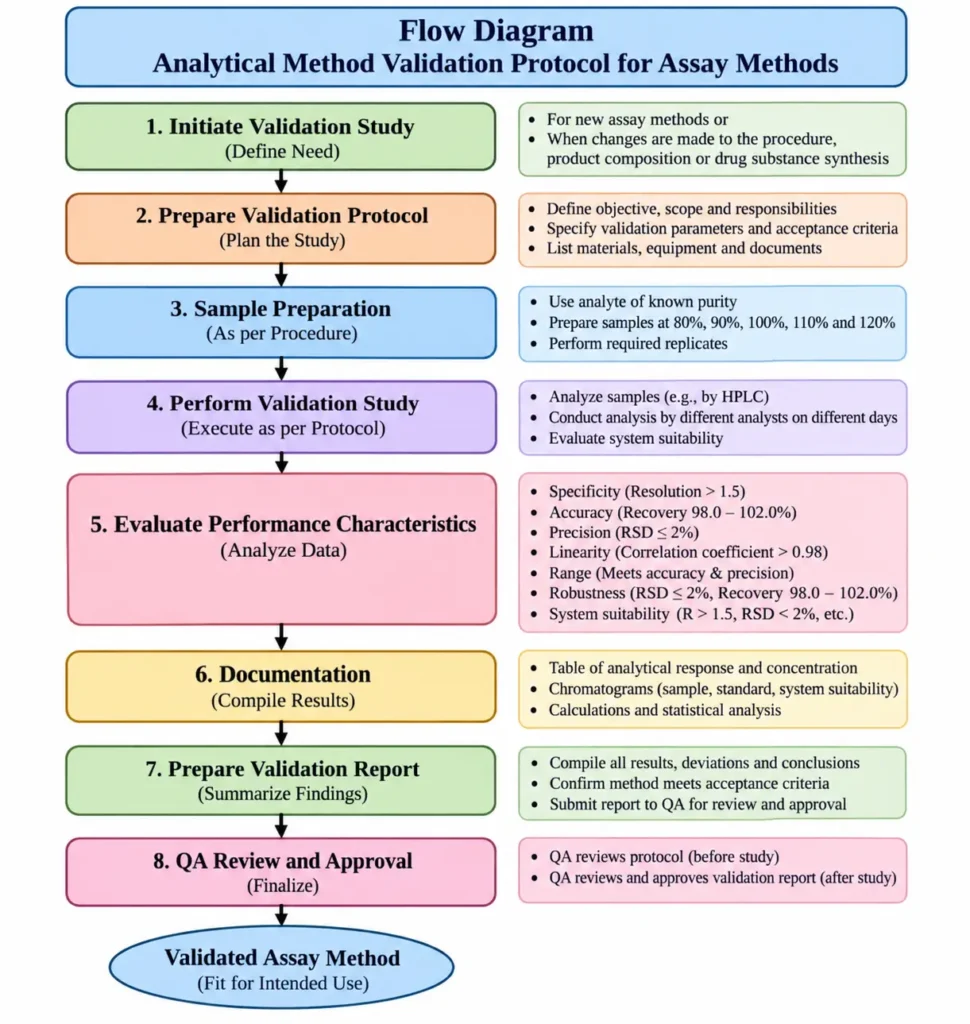
Samples are then prepared at defined concentration levels such as 80%, 90%, 100%, 110%, and 120%, followed by analytical testing using the specified method. The generated data are evaluated for specificity, accuracy, precision, linearity, range, robustness, and system suitability against predetermined criteria. All chromatograms, calculations, statistical evaluations, observations, and deviations are documented. Finally, a validation report is prepared, reviewed, and approved by QA, confirming whether the assay method is acceptable for routine analytical application.
2. Brainstorming for SOP Failure:
The Brainstorming for SOP Failure diagram illustrates a training-centre discussion focused on identifying possible reasons why the Analytical Method Validation Protocol for Assay Methods may not be properly followed. The central problem, “SOP Not Followed / SOP Failure,” is surrounded by colorful sticky notes representing potential contributing factors such as inadequate training, poor understanding of the protocol, absence of QA approval before the study, sample preparation errors, incorrect concentration levels, time pressure, communication gaps, incomplete documentation, unclear acceptance criteria, analyst variation, instrument calibration issues, failure to check system suitability, unrecorded deviations, poor supervision, missing chromatograms, calculation errors, and failure to follow the validation plan.
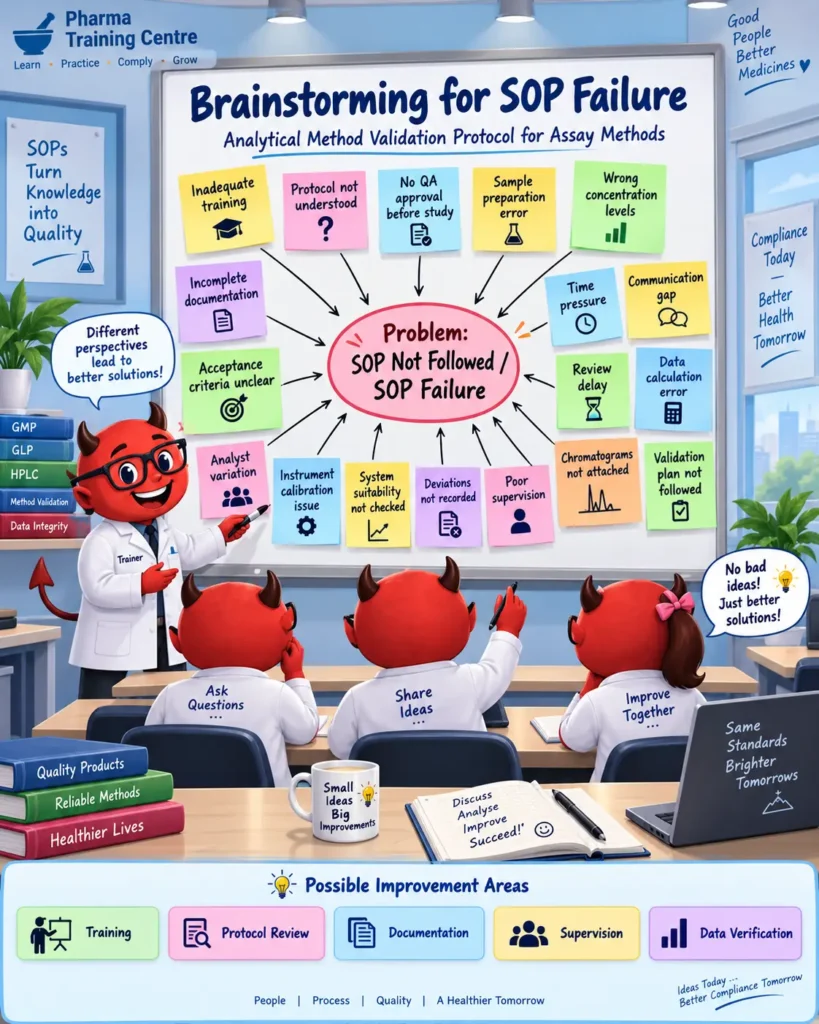
The training-centre setting emphasizes team participation, open discussion, questioning, idea sharing, and collaborative problem-solving. The brainstorming activity helps identify improvement areas related to training, protocol review, documentation, supervision, and data verification, supporting stronger SOP compliance and reliable analytical method validation.
3. 5-Why Analysis for SOP Failure:
The 5-Why Analysis for SOP Failure diagram identifies the progressive causes behind failure to follow the Analytical Method Validation Protocol for Assay Methods. The analysis begins with the problem that required validation steps were not properly executed. It then traces the issue through inadequate analyst understanding, incomplete training and protocol briefing, insufficient supervision and QA review, and finally the absence of an effective system for monitoring SOP compliance and analyst readiness.
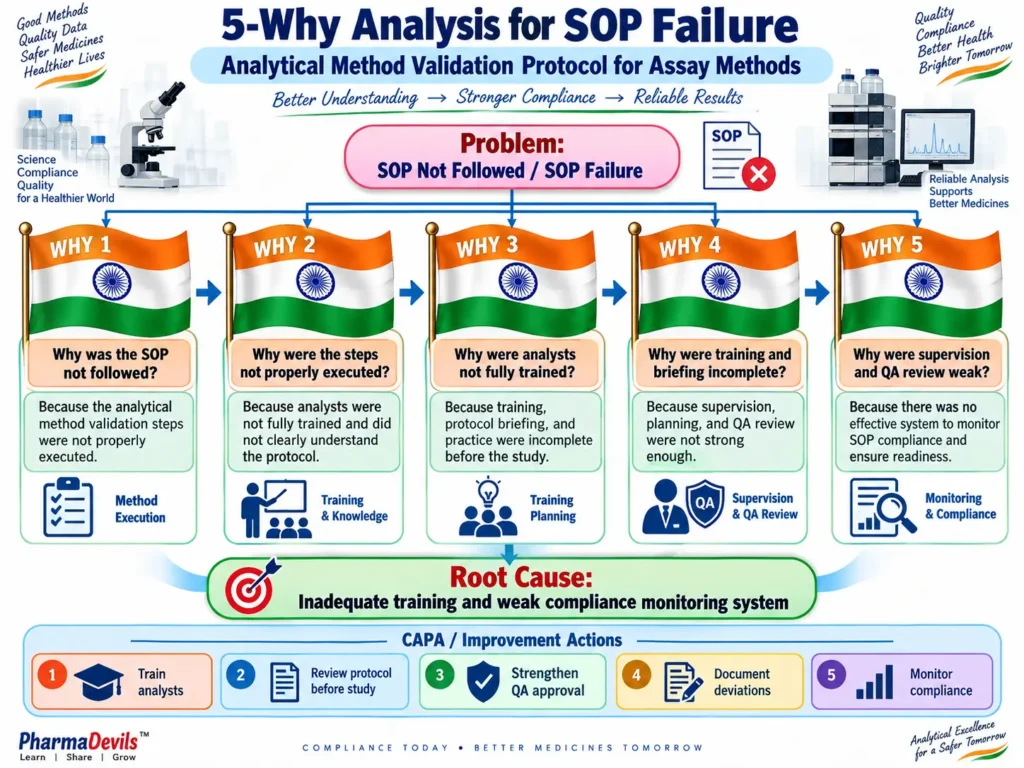
The diagram highlights inadequate training and weak compliance monitoring as the major root causes. The five Indian flags visually represent each stage of the “Why” analysis and make the investigation easy to understand. Recommended improvement actions include proper analyst training, protocol review before starting the study, strengthening QA approval and supervision, documenting deviations, and continuously monitoring SOP compliance. These actions help prevent recurrence, improve data reliability, and ensure consistent execution of analytical method validation activities.
4. Fishbone Analysis for SOP Failure:
The Fishbone Analysis for SOP Failure diagram identifies possible causes for failure to follow the Analytical Method Validation Protocol for Assay Methods. The problem is analyzed under major categories including People, Method, Machine/Instrument, Materials/Samples, Measurement/Documentation, and Environment/Management.
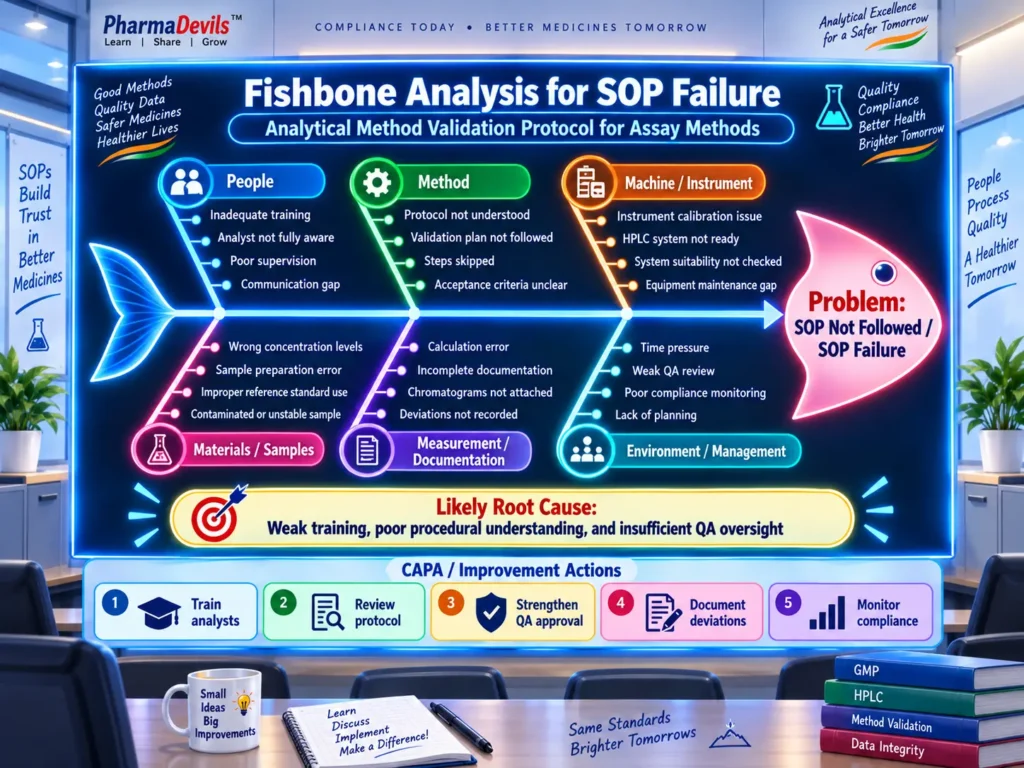
Potential causes include inadequate analyst training, poor supervision, communication gaps, incomplete understanding of the validation protocol, skipped procedural steps, unclear acceptance criteria, instrument calibration issues, failure to verify system suitability, sample preparation errors, incorrect concentration levels, calculation errors, incomplete documentation, missing chromatograms, unrecorded deviations, time pressure, and weak QA review.The analysis indicates that weak training, poor procedural understanding, and insufficient QA oversight are likely major contributors to SOP failure. The diagram also highlights improvement actions such as analyst training, protocol review, stronger QA approval, proper deviation documentation, and continuous compliance monitoring to improve the reliability and consistency of analytical method validation.
5. Fault Tree Analysis for SOP Failure:
The Fault Tree Analysis for SOP Failure diagram systematically traces the possible causes of failure to follow the Analytical Method Validation Protocol for Assay Methods. The top event, “SOP Failure – Validation Protocol Not Followed or Incomplete,” is broken down through OR logic into four major contributing areas: inadequate preparation, incorrect execution, instrument/system issues, and inadequate review & documentation.
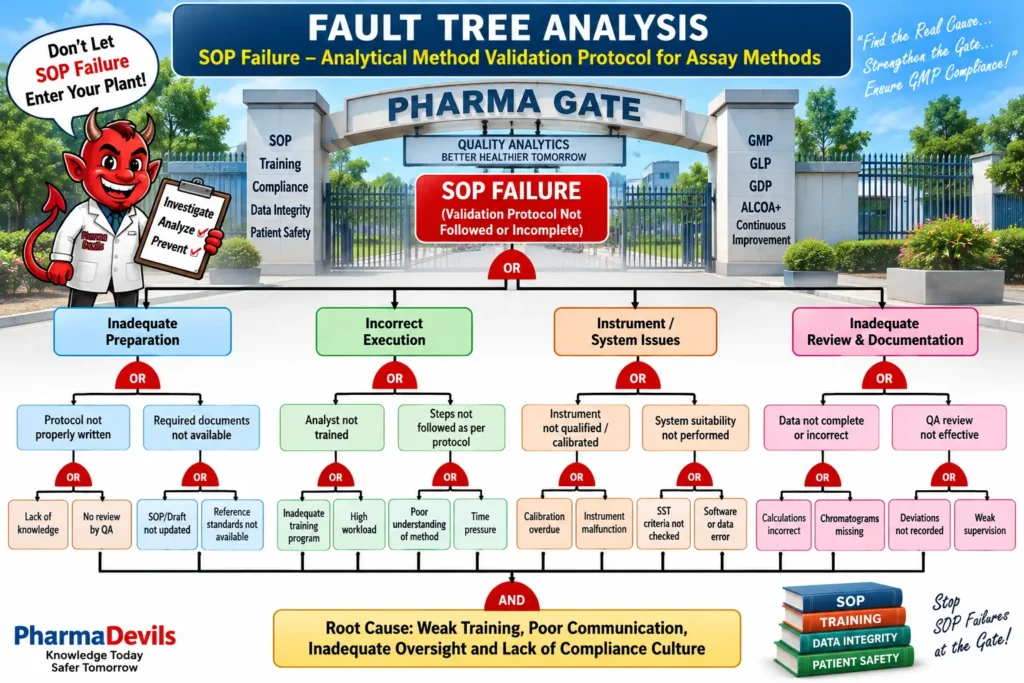
The diagram highlights causes such as poorly prepared protocols, unavailable reference documents, insufficient analyst training, skipped validation steps, unqualified or uncalibrated instruments, failure to perform system suitability, incorrect calculations, missing chromatograms, unrecorded deviations, and weak QA review. These areas align with the protocol’s requirements for trained personnel, calibrated equipment, defined validation activities, proper documentation, statistical evaluation, deviation handling, and QA approval.The pharma gate concept visually represents preventing SOP failures from entering routine operations. The analysis ultimately identifies weak training, poor communication, inadequate oversight, and an insufficient compliance culture as likely root causes requiring CAPA and stronger monitoring.
Questions & Answers – Analytical Method Validation Protocol for Assay Methods
Q1. What is the objective of the analytical method validation protocol?
Answer: The objective is to demonstrate through laboratory study that the assay method has suitable performance characteristics for its intended analytical application and to establish the required performance specifications.
Q2. When should assay method validation be performed?
Answer: Validation should be performed for new assay methods and for existing methods when changes are made to the analytical procedure, finished-product composition, or synthesis of the drug substance.
Q3. Who performs the validation study?
Answer: A trained person responsible for performing the analytical test conducts the validation study and records the required information.
Q4. What is the role of QA in analytical method validation?
Answer: QA reviews and approves the validation protocol before the study and subsequently reviews and approves the validation data and report.
Q5. Which validation parameters are included in the protocol?
Answer: The protocol covers specificity, accuracy, precision, linearity, range, robustness, and system suitability.
Q6. What is the acceptance criterion for accuracy?
Answer: Accuracy is evaluated by percent recovery, with an acceptance range of 98.0% to 102.0%.
Q7. What is the acceptance criterion for precision?
Answer: Precision is evaluated using Relative Standard Deviation, with RSD not more than 2%.
Q8. What concentration levels are used for sample preparation?
Answer: Samples are prepared at 80%, 90%, 100%, 110%, and 120% of the specified level.
Q9. How is specificity assessed?
Answer: Specificity is assessed by chromatographic resolution between adjacent peaks, and the protocol specifies that the resolution should be greater than 1.5.
Q10. How is linearity evaluated?
Answer: Linearity is assessed using the regression equation y = a + bx, and the protocol specifies a correlation coefficient greater than 0.98.
Q11. What documentation should be retained during validation?
Answer: Documentation includes tables of analytical response and analyte concentration, chromatograms of sample, standard and system suitability solutions, calculations, mathematical transformations, and statistical analyses.
Q12. What should be done if a deviation occurs during validation?
Answer: A deviation report should be prepared, including justification and an assessment of its impact on the validity of the assay.
Q13. What is included in the final assay validation report?
Answer: The report includes study dates, observations, problems encountered, completeness of collected information, deviation summary, test results, statistical analyses, acceptance-criteria evaluation, location of original data, and conclusions on assay validity.
Q14. Who gives final approval to the analytical assay validation document?
Answer: The completed analytical assay validation document is submitted to Quality Assurance for evaluation and approval.
Reference Guidelines:
- ICH Q2(R2) – Validation of Analytical Procedures
This should be the primary reference for analytical method validation. It covers validation principles and evaluation of analytical procedure performance, including characteristics such as specificity/selectivity, accuracy, precision, and range, with the objective of demonstrating fitness for intended purpose. (ICH Database)
ICH Q2(R2) Guideline - ICH Q14 – Analytical Procedure Development
Use together with Q2(R2) for analytical procedure development, robustness, control strategy, lifecycle management, risk management, and continual improvement. The final guideline was adopted in November 2023. (ICH Database)
ICH Q14 Guideline - USP General Chapter <1225> – Validation of Compendial Procedures
Provides principles for validating analytical procedures and is particularly relevant when USP/compendial methodology is involved. USP is also revising the chapter to align more closely with ICH Q2(R2). (USP)
USP <1225> Validation of Compendial Procedures - US FDA – Analytical Procedures and Methods Validation for Drugs and Biologics, Guidance for Industry
Provides regulatory recommendations concerning analytical procedures and validation data used to support drug-substance and drug-product quality, strength, purity, and potency. (U.S. Food and Drug Administration)
FDA Analytical Procedures and Methods Validation Guidance - WHO Good Practices for Pharmaceutical Quality Control Laboratories – TRS 1052, Annex 4, 2024
Useful for laboratory quality systems, method-related controls, documentation, equipment, analytical activities, and overall pharmaceutical QC laboratory compliance. (World Health Organization