






Brief Description
This SOP describes the procedure for bioburden analysis of primary packaging materials, FBD bags, gowns, caps, snoods, and cleaned equipment to assess and control microbial contamination. The microbiologist is responsible for performing the testing, while the Head QA/QC ensures effective implementation of the procedure. The SOP covers aseptic sampling, swab/rinse preparation, membrane filtration using 0.45 µm filters, use of sterile saline and peptone water, plating on Soybean Casein Digest Agar, incubation, colony counting, and result recording. Specific procedures are defined for bottles, caps, aluminium/PVC foil, FBD bags, garments, and cleaned equipment. It also includes pathogen testing for E. coli, Salmonella, Pseudomonas aeruginosa, and Staphylococcus aureus, along with positive and negative controls. Acceptance limits, testing frequencies, documentation requirements, training, distribution, and seven annexures for recording microbiological results are specified to support consistent microbial monitoring and GMP compliance.
Skip to PDF content1. Flow Diagram:
The flow diagram presents the stepwise procedure for bioburden analysis of primary packaging materials, FBD bags, gowns, caps, snoods, and cleaned equipment. Testing begins with sample collection, verification, and recording of sample details, followed by preparation of sterile sampling tools and suitable aseptic working conditions. Samples are then processed according to their type. Bottles are rinsed with sterile 0.9% normal saline, while caps, aluminium/PVC foil, FBD bags, garments, and cleaned equipment are tested using specified rinse or swab procedures. Where applicable, the sample solution is filtered through a 0.45 µm membrane filter and rinsed with sterilized 0.1% peptone water.
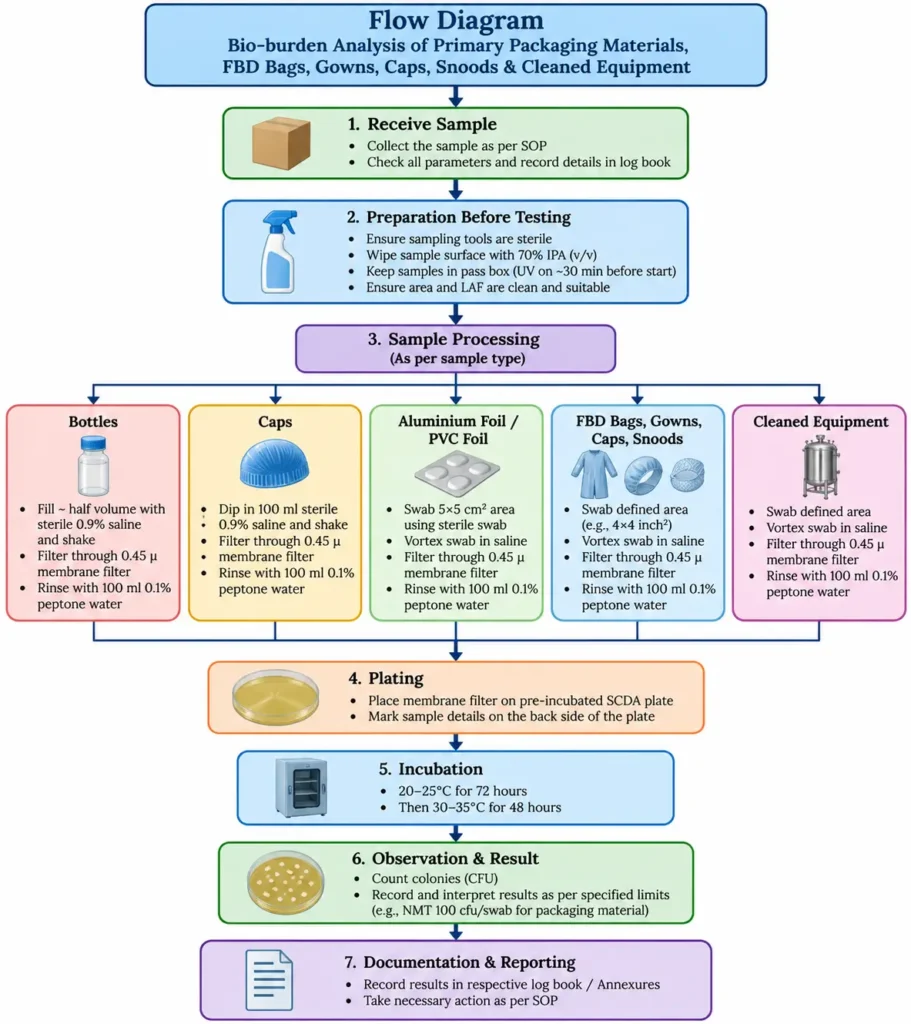
The prepared samples are plated on SCDA media and incubated under specified temperature and time conditions. After incubation, microbial colonies are counted, results are compared with the applicable limits, and observations are documented in the relevant logbooks and annexures.
2. Brainstorming for SOP Failure:
The brainstorming diagram illustrates the major potential causes of SOP failure in a pharmaceutical manufacturing area. The central problem, “SOP Failure in MFG Area,” is surrounded by seven cause categories: Man, Material, Machine, Method, Environment, Measurement, and Management.
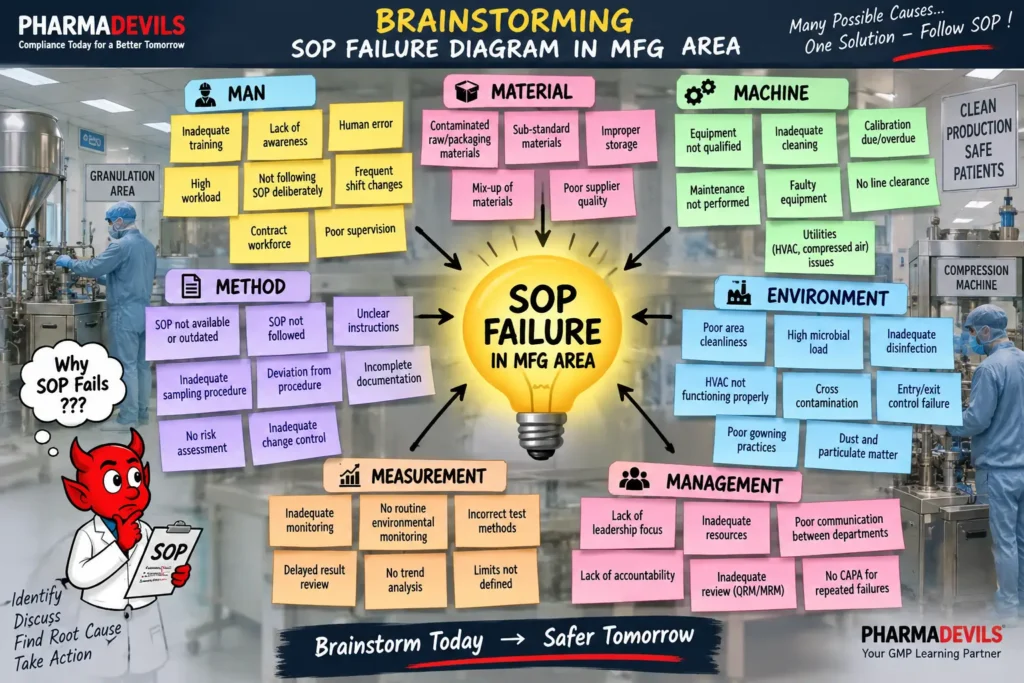
The diagram highlights possible contributors such as inadequate training, lack of SOP awareness, human error, contaminated or substandard materials, equipment qualification or maintenance gaps, unclear or outdated procedures, incomplete documentation, poor area cleanliness, HVAC or cross-contamination issues, weak monitoring, delayed result review, and inadequate management oversight. This visual brainstorming approach helps a cross-functional team systematically identify possible failure points before moving to detailed root-cause analysis. It supports selection of suitable corrective and preventive actions, strengthening SOP compliance, GMP control, manufacturing discipline, and overall product-quality assurance.
3. 5-Why Analysis for SOP Failure:
The 5-Why Analysis diagram evaluates the underlying reasons for SOP failure in the pharmaceutical manufacturing area. It starts with the problem of an SOP not being followed and progressively examines causes through five levels of questioning.
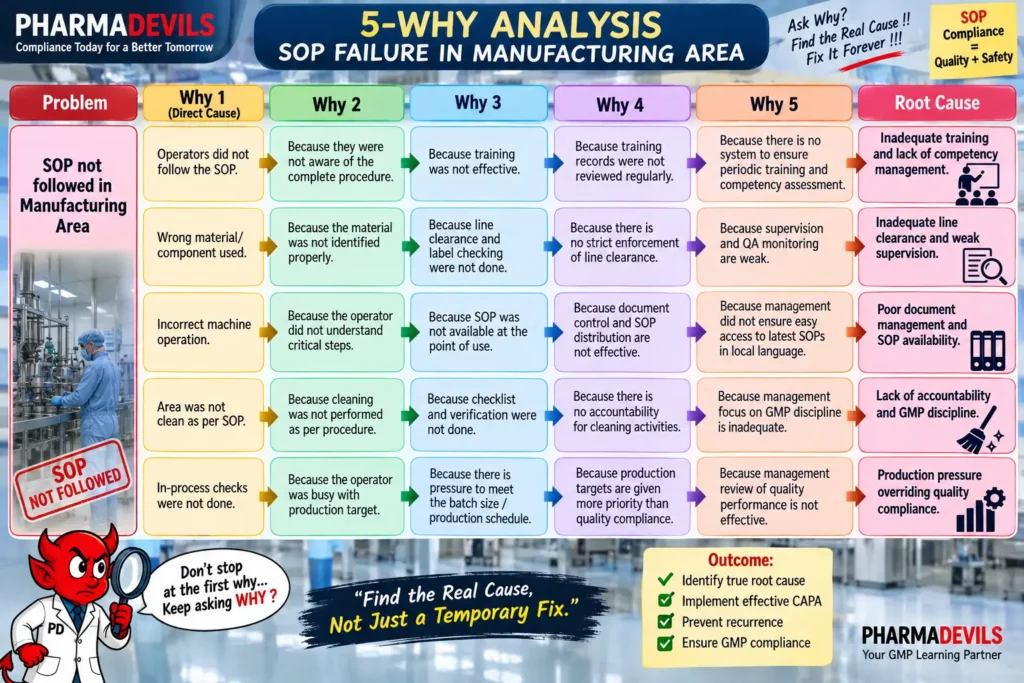
The analysis identifies several direct issues, including operators not following procedures, use of incorrect materials, improper machine operation, inadequate cleaning, and missed in-process checks. Deeper questioning links these failures to poor awareness, ineffective training, inadequate line clearance, weak supervision, unavailable or poorly controlled SOPs, insufficient verification, and production pressure. The final root causes highlighted include inadequate training and competency management, weak line-clearance controls, poor document management, lack of accountability and GMP discipline, and production targets overriding quality requirements. This structured approach helps distinguish superficial causes from true systemic causes so that appropriate CAPA, training improvements, document-control measures, supervision, and compliance monitoring can be implemented to prevent recurrence.
4. Fishbone Analysis for SOP Failure:
The Fishbone Analysis diagram identifies the potential causes of SOP failure in the manufacturing area by grouping them into seven major categories: Man, Machine, Material, Method, Measurement, Environment, and Management. The diagram highlights issues such as inadequate training, lack of SOP awareness, equipment breakdowns, overdue calibration, wrong or contaminated materials, unclear procedures, incomplete documentation, inadequate in-process checks, poor area cleanliness, HVAC problems, weak supervision, production pressure, and ineffective CAPA.
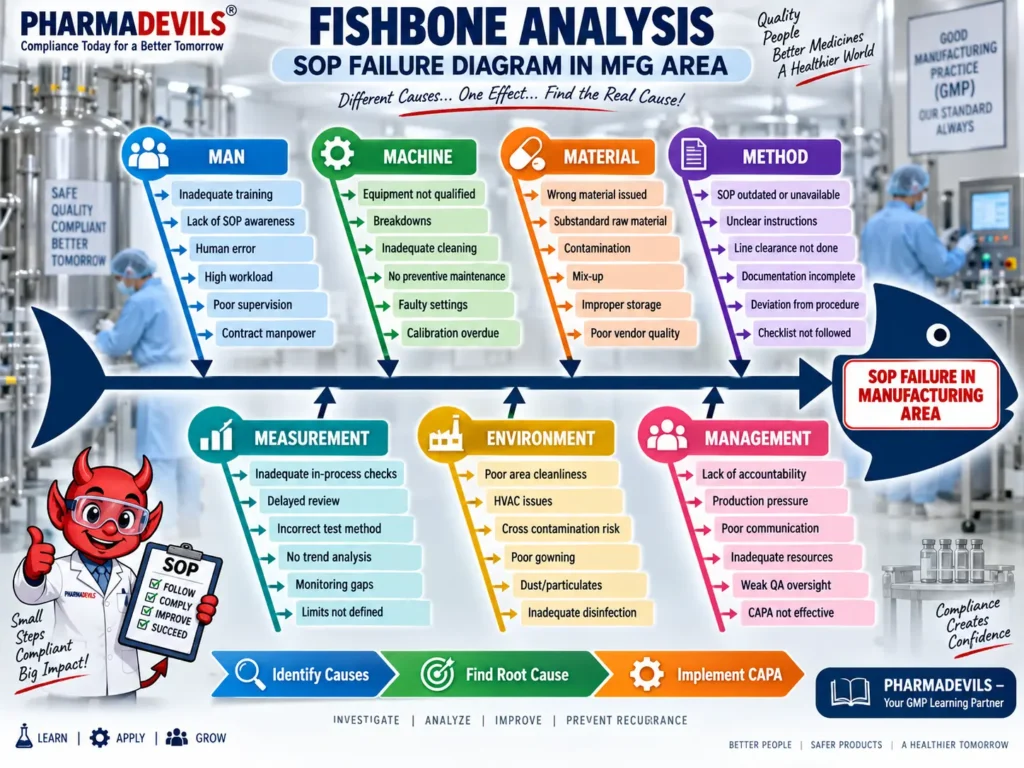
This structured cause-and-effect approach helps the investigation team systematically evaluate possible contributors to SOP non-compliance instead of focusing only on the immediate error. By reviewing each category, the team can identify the most probable root causes, define appropriate corrective and preventive actions, strengthen GMP controls, and reduce the risk of recurrence in the manufacturing area.
5. Fault Tree Analysis for SOP Failure:
The Fault Tree Analysis diagram evaluates SOP failure in the pharmaceutical manufacturing area by breaking the top event into major logical cause pathways. The analysis groups potential failures under Personnel, Procedure/Documentation, Machine/Equipment, Material/Line Clearance, and Environment/Monitoring.
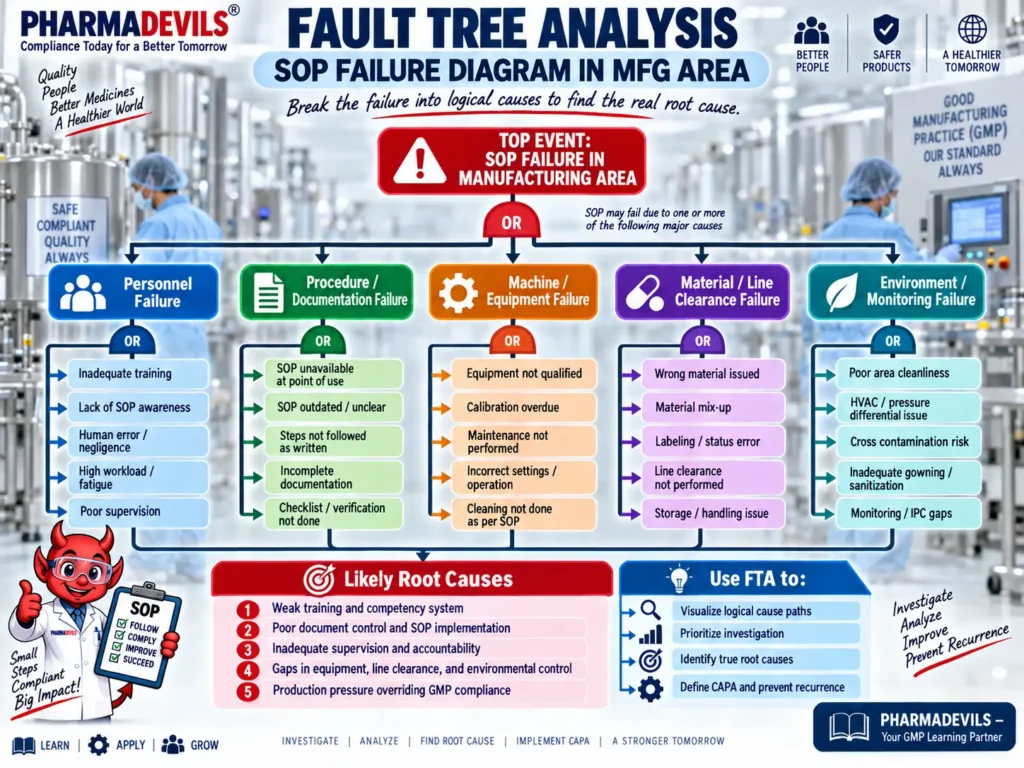
Possible contributing factors include inadequate training, lack of SOP awareness, human error, outdated or unavailable SOPs, incomplete documentation, unqualified equipment, overdue calibration, improper machine settings, wrong material issuance, material mix-up, inadequate line clearance, poor area cleanliness, HVAC issues, cross-contamination risk, and monitoring gaps. Using logical OR relationships, the diagram shows how one or more of these failures may lead to overall SOP non-compliance. The analysis helps investigators trace failure pathways, prioritize probable root causes, define effective CAPA, improve supervision and controls, and prevent recurrence while strengthening GMP compliance in the manufacturing area.
Questions & Answers – Bio-Burden Analysis SOP
- Q: What is the objective of this SOP?
A: To define the procedure for bioburden analysis of primary packaging materials, FBD bags, gowns, caps, snoods, and cleaned equipment. - Q: Who is responsible for performing the bioburden analysis?
A: The Microbiologist is responsible for execution of the SOP, while the Head QA/QC is responsible for its effective implementation. - Q: What precautions are required before starting packaging-material testing?
A: Sampling tools should be sterile, sample details should be recorded, the sample surface should be wiped with filtered 70% IPA where applicable, and the test area and LAF should be suitable for aseptic work. - Q: How is a bottle tested for bioburden?
A: The bottle is partially filled with sterile 0.9% normal saline, shaken to rinse the internal surface, and the rinse is filtered through a sterile 0.45 µm membrane filter. The membrane is then rinsed with sterilized 0.1% peptone water and placed on SCDA. - Q: How are caps tested?
A: Caps are dipped in 100 mL sterile 0.9% normal saline, shaken properly, and the solution is filtered through a sterile 0.45 µm membrane filter followed by rinsing with 100 mL sterilized 0.1% peptone water. - Q: How are aluminium foil and PVC foil sampled?
A: A sterilized 5 × 5 cm² template is placed on the inner surface and the area is swabbed using a pre-sterilized swab moistened with 0.9% normal saline. - Q: What is the testing frequency for primary packaging material?
A: The SOP specifies testing of the initial three consignments from every new vendor and thereafter on a quarterly basis. - Q: What bioburden limit is specified for packaging-material swab testing?
A: The specified limit is NMT 100 CFU/swab. - Q: Which specified microorganisms are included in pathogen testing of FBD bags?
A: The SOP includes testing for Escherichia coli, Salmonella, Pseudomonas aeruginosa, and Staphylococcus aureus. - Q: What is the test frequency for pathogen testing of FBD bags?
A: The SOP specifies a frequency of once every six months. - Q: How are gowns, caps, and snoods tested?
A: A sample is selected randomly, its internal surface is swabbed aseptically, the swab is processed in sterile 0.9% normal saline, filtered through a 0.45 µm filter, rinsed with 0.1% peptone water, and tested on SCDA. - Q: What limit is specified for gowns, caps, and snoods?
A: The SOP specifies a limit of less than/NMT 100 CFU per 25 cm² swab. - Q: How is bioburden of cleaned equipment assessed?
A: A defined equipment surface is sampled aseptically using a sterile saline-moistened swab. The sample is processed under microbiological controls, plated on SCDA, incubated, and colonies are counted and recorded. - Q: What is the frequency for cleaned-equipment bioburden testing?
A: The SOP specifies testing once every six months, after any major change, and for new installation. - Q: What is the bioburden limit for cleaned equipment?
A: The specified total microbial count limit is NMT 400 CFU/swab. - Q: Why are positive and negative controls included?
A: The SOP specifies positive control with reference to the GPT test report and a negative control using sterile media incubated under the same conditions, supporting verification of test validity. - Q: Where are the test results documented?
A: Results are recorded in the respective logbooks and annexures provided for packaging materials, FBD bags, MLT analysis, gowns/caps/snoods, and cleaned equipment.
Reference Guidelines:
- USP General Chapter <61> – Microbiological Examination of Nonsterile Products: Microbial Enumeration Tests
Provides procedures for quantitative enumeration of aerobic bacteria, yeasts, and moulds. (USP)
USP <61> official page - USP General Chapter <62> – Microbiological Examination of Nonsterile Products: Tests for Specified Microorganisms
Relevant to detection of specified microorganisms and supports pathogen-testing principles used in the SOP. (USP)
USP <62> official page - USP <1111> – Microbiological Examination of Nonsterile Products: Acceptance Criteria for Pharmaceutical Preparations and Substances for Pharmaceutical Use
Useful for establishing microbiological acceptance criteria in conjunction with product/material risk assessment. USP identifies <61>, <62>, and <1111> among its principal microbiological quality-control chapters. (USP) - European Pharmacopoeia 2.6.12 and 2.6.13 – Microbial Enumeration Tests and Tests for Specified Micro-organisms. These chapters cover microbial enumeration, negative controls, growth promotion, method suitability, and specified-microorganism testing. (EDQM)
- WHO TRS 1052, Annex 4 – Good Practices for Pharmaceutical Quality Control Laboratories
Relevant for microbiology laboratory operations, documentation, equipment, methods, personnel, and quality-system controls. (World Health Organization)
WHO QC Laboratory Guideline - WHO TRS 1044, Annex 2 – WHO GMP for Sterile Pharmaceutical Products
Useful where the SOP is applied to controlled/sterile manufacturing areas, particularly for contamination-control, personnel, premises and microbiological monitoring principles. (World Health Organization)
WHO Sterile GMP Guideline - EU GMP, EudraLex Volume 4, Annex 1 – Manufacture of Sterile Medicinal Products
Applicable for contamination-control and environmental/microbiological monitoring expectations in sterile manufacturing. (Public Health)
EU GMP Volume 4