







1. Introduction – SOP for BMR & BPR Requisition:
The Standard Operating Procedure for BMR & BPR Requisition is established to define a controlled and systematic process for requesting, receiving, issuing, cancelling, and converting Batch Manufacturing Records (BMR) and Batch Packing Records (BPR) used during pharmaceutical manufacturing and packing operations. The SOP applies to requisitions generated by the Production Department and processed through the Quality Assurance Department. The procedure requires production personnel to complete the prescribed BMR/BPR requisition form with relevant information such as date and time, product details, batch size, manufacturing and expiry dates, packing details, and applicable batch numbers. The requisition is signed by the requesting Production person and forwarded to QA for acknowledgement and issuance of the required controlled records. The SOP also provides provisions for batch cancellation and batch conversion, ensuring that changes in production planning, material availability, or customer orders are formally documented and traceable. Proper implementation of this SOP supports document control, batch traceability, data integrity, accountability, and GMP compliance throughout manufacturing and packing activities.
Skip to PDF content2. Flow Diagram – SOP for BMR & BPR Requisition:
The Flow Diagram for SOP for BMR & BPR Requisition illustrates the controlled sequence followed for requesting and issuing Batch Manufacturing Records (BMR) and Batch Packing Records (BPR) in the manufacturing area. The process begins with preparation of the prescribed requisition form, followed by entry of the date, time, product details, batch information, manufacturing and expiry dates, and packing details. The Production person signs the requisition as “Requested By” and forwards it to the Quality Assurance Department. QA acknowledges receipt by signing “Received By” with date and time and issues the required BMR/BPR within the defined period.
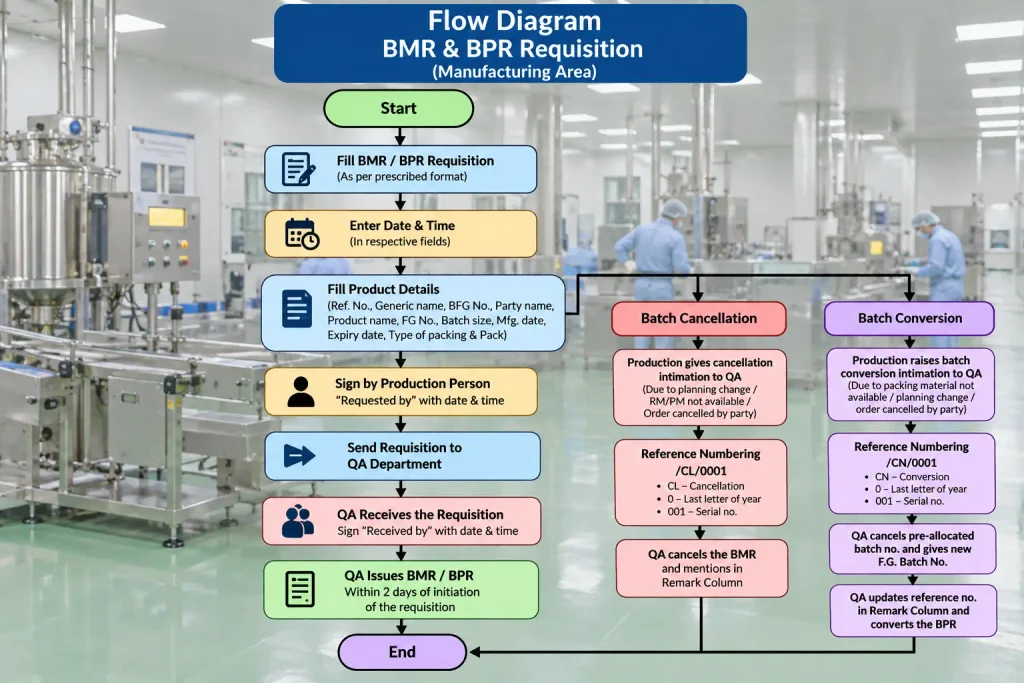
The flow also includes provisions for batch cancellation and batch conversion. Cancellation may be initiated due to planning changes, non-availability of raw or packing materials, or cancellation of an order, while batch conversion is handled through documented intimation and QA-controlled reference numbering. This structured workflow supports document traceability, accountability, controlled issuance, and proper coordination between Production and Quality Assurance.
3. Benefits of Following SOP – BMR & BPR Requisition:
Following the SOP for BMR & BPR Requisition ensures that Batch Manufacturing Records and Batch Packing Records are requested, received, issued, cancelled, and converted through a defined and controlled documentation process. The SOP requires completion of relevant product and batch details, appropriate signatures by Production and QA personnel, and documented acknowledgement of the requisition.
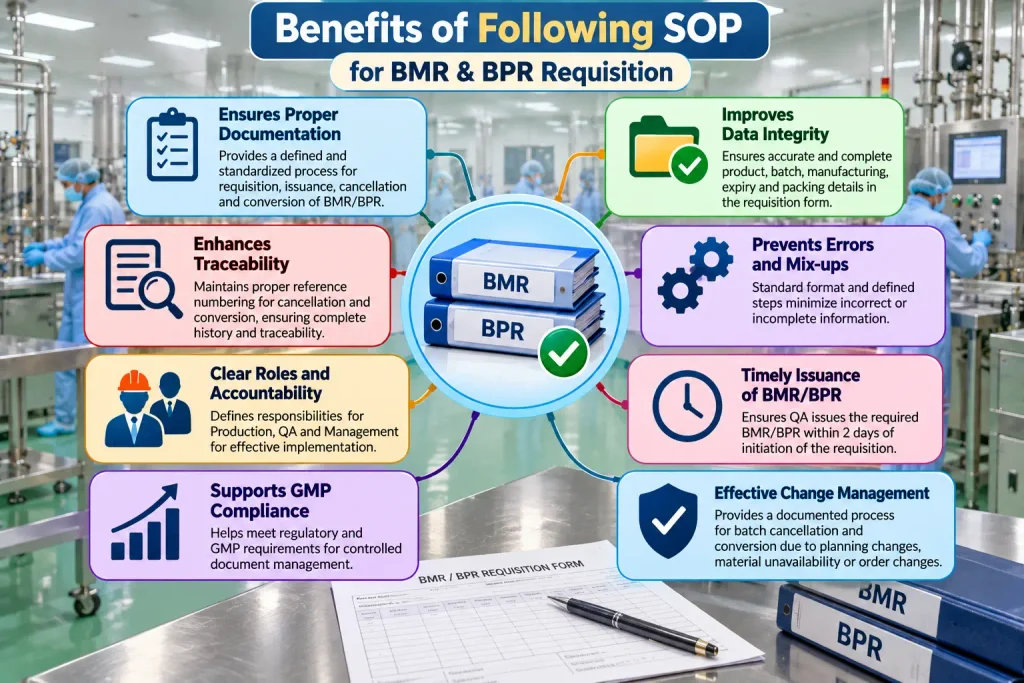
Compliance with this SOP improves document traceability, accountability, data accuracy, and coordination between Production and Quality Assurance. The prescribed requisition format helps reduce the possibility of incomplete information, incorrect batch details, and documentation mix-ups. The SOP also establishes specific procedures for batch cancellation and batch conversion, including documented reasons and reference numbering, thereby maintaining a traceable history of changes. Overall, proper implementation of the BMR & BPR Requisition SOP supports controlled batch documentation, timely availability of records, effective change handling, and consistent GMP documentation practices throughout manufacturing and packing operations.
4. Brainstorming for SOP Failure – BMR & BPR Requisition:
The Brainstorming Analysis for SOP Failure – BMR & BPR Requisition identifies potential reasons why the requisition, issuance, cancellation, or conversion of Batch Manufacturing Records and Batch Packing Records may not be performed as defined. The SOP requires completion of the prescribed requisition form, entry of date and time, correct product and batch details, signature by the Production person, forwarding to QA, acknowledgement by QA, and issuance of BMR/BPR within the specified period.
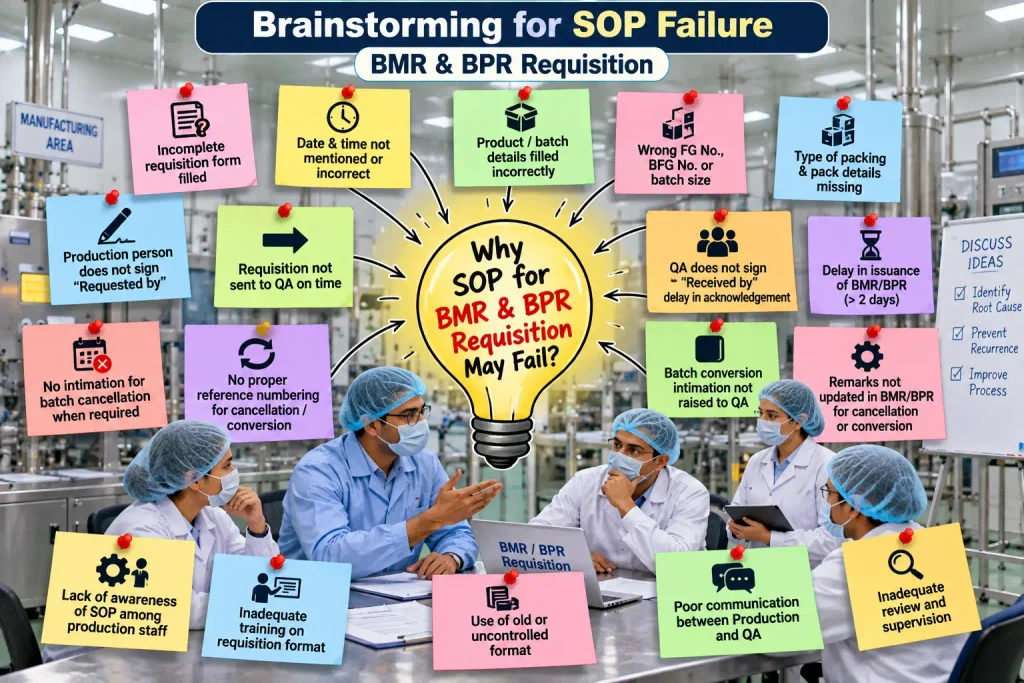
Possible failure points include incomplete requisition forms, incorrect batch or product details, missing signatures, delayed submission to QA, delayed QA acknowledgement, and delayed issuance of BMR/BPR. The SOP also requires documented handling of batch cancellation and batch conversion, so failures may arise when cancellation/conversion intimation is not raised, reference numbering is incorrect, or remarks are not updated properly. Brainstorming these causes helps the Production and QA teams identify weaknesses related to training, communication, document control, supervision, and procedural compliance, enabling appropriate corrective and preventive actions to reduce recurrence and improve overall batch-document management.
5. 5-Why Analysis for SOP Failure – BMR & BPR Requisition:
The 5-Why Analysis for SOP Failure – BMR & BPR Requisition is used to identify the underlying cause of delays or errors in the requisition and issuance of Batch Manufacturing Records and Batch Packing Records. The SOP requires Production to complete the prescribed requisition form with the correct date, time, product details, batch information, packing details, and signature before sending it to Quality Assurance. QA is then required to acknowledge receipt and issue the BMR/BPR within the specified period. The analysis begins with the problem of a BMR/BPR not being issued on time or an incorrect document being issued. Successive “Why” questions may identify incomplete requisition details, incorrect product or batch information, inadequate understanding of the requisition format, insufficient training, and weak monitoring of SOP implementation as contributing causes.
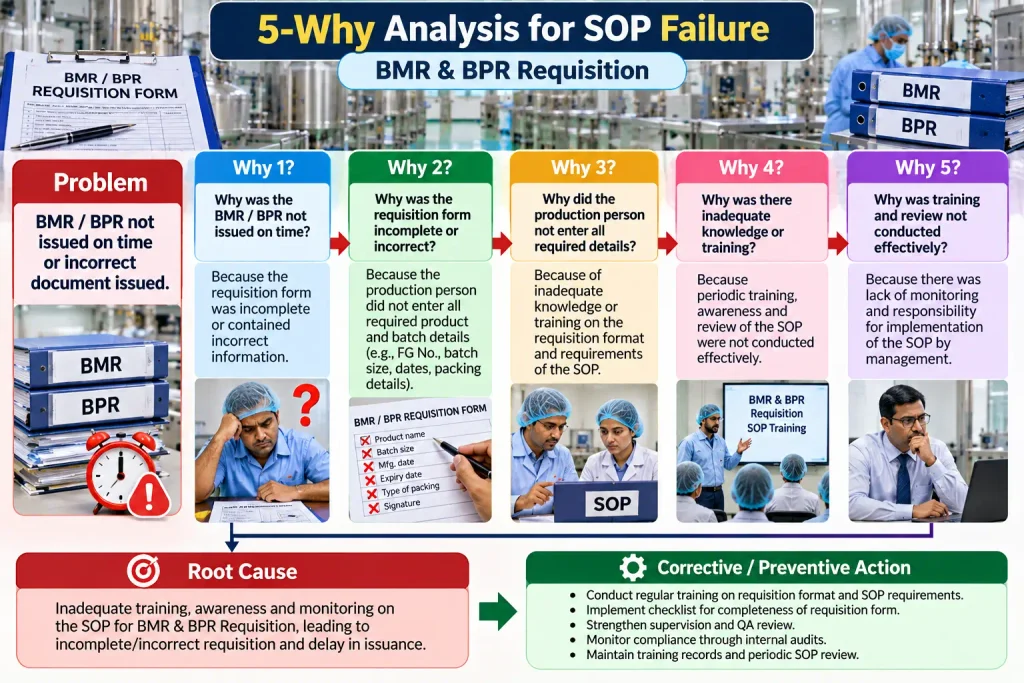
The 5-Why approach helps identify the root cause beyond the immediate documentation error and supports actions such as refresher training, use of requisition completeness checklists, stronger Production and QA review, periodic SOP compliance checks, and improved supervision. This helps reduce recurrence and strengthens control over BMR/BPR issuance and batch documentation.
6. Fishbone Analysis for SOP Failure – BMR & BPR Requisition:
The Fishbone Analysis for SOP Failure – BMR & BPR Requisition is used to systematically identify possible causes that may lead to delayed, incomplete, or incorrect issuance of Batch Manufacturing Records and Batch Packing Records. The SOP requires Production personnel to complete the requisition with the correct date, time, product details, batch information, packing details, and signature before forwarding it to QA for receipt and subsequent issuance.
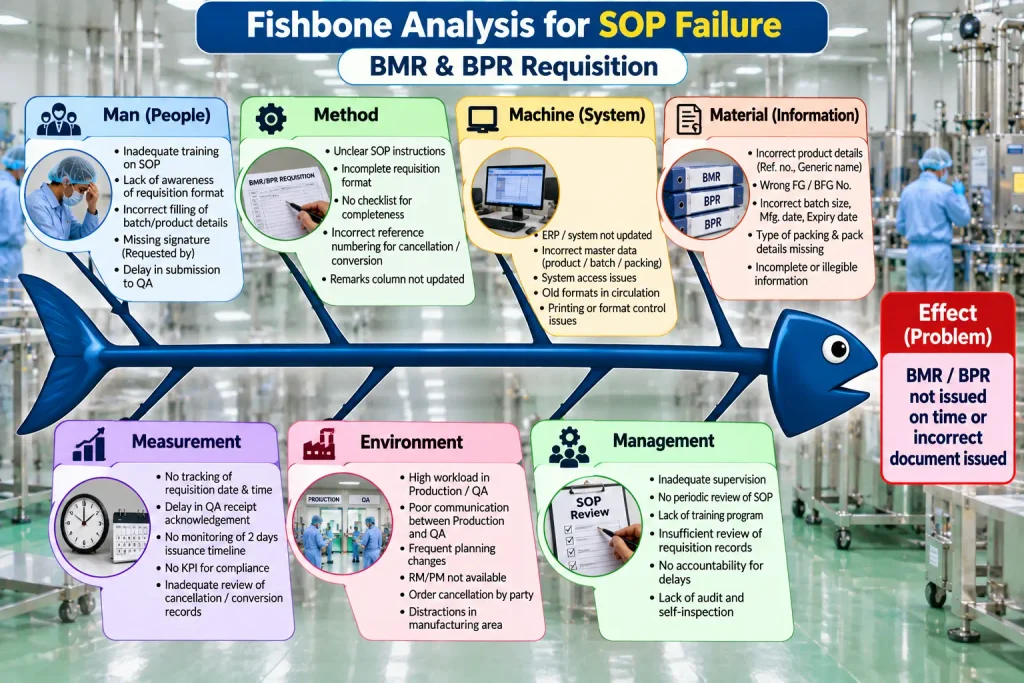
The analysis groups potential causes into major categories such as Man, Method, Machine/System, Material/Information, Measurement, Environment, and Management. Typical causes may include inadequate training, incomplete requisition forms, incorrect product or batch details, missing signatures, delayed submission to QA, poor monitoring of the issuance timeline, communication gaps between Production and QA, and inadequate supervision. For batch cancellation and conversion, failures may also occur due to incorrect reference numbering or failure to update the remarks appropriately. This Fishbone Analysis helps the organization identify contributing factors in a structured manner so that suitable corrective and preventive actions can be implemented to improve document accuracy, traceability, timely issuance, accountability, and overall SOP compliance.
7. Fault Tree Analysis for SOP Failure – BMR & BPR Requisition:
The Fault Tree Analysis for SOP Failure – BMR & BPR Requisition evaluates how different documentation and process failures can combine to result in the top event: BMR/BPR not issued on time or an incorrect document being issued. The SOP requires Production to complete the requisition with correct product and batch details, sign it as “Requested By,” forward it to QA, and obtain QA acknowledgement before issuance.
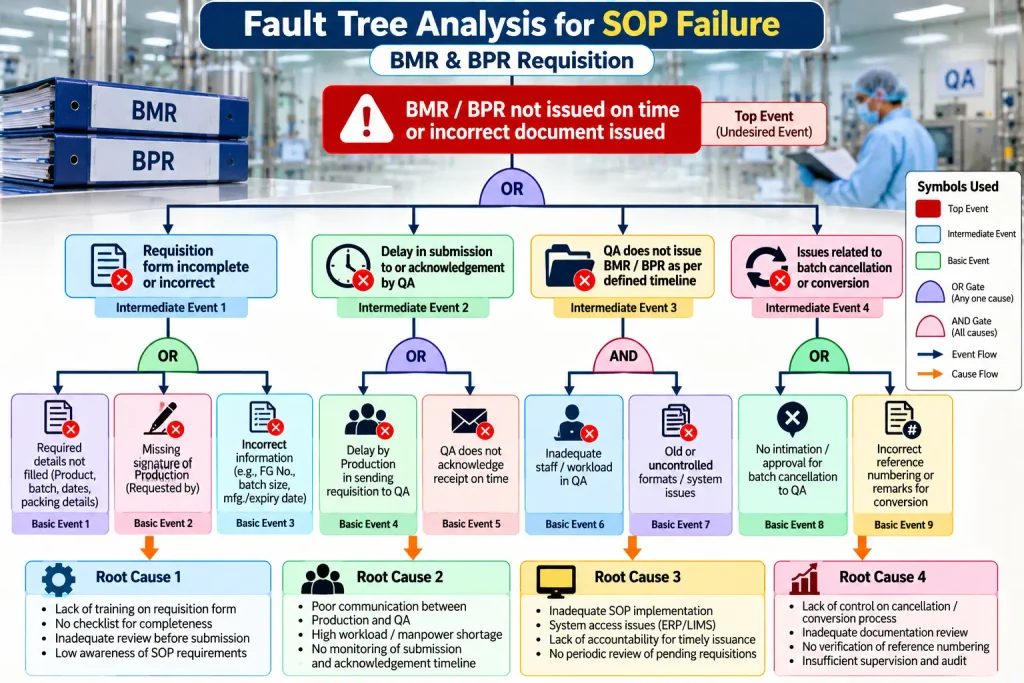
The fault tree breaks this top event into contributing branches such as incomplete or incorrect requisition forms, delay in submission or QA acknowledgement, failure to issue BMR/BPR within the defined timeline, and errors in batch cancellation or conversion handling. Possible basic causes include missing information, absent signatures, incorrect batch details, delayed communication between Production and QA, inadequate manpower, use of uncontrolled formats, and weak review or supervision. The SOP also specifies documented controls for batch cancellation and batch conversion, including intimation to QA and defined reference numbering. Failure to follow these steps can create traceability and documentation errors.This analysis helps identify critical failure pathways so that targeted controls can be implemented to improve timely issuance, documentation accuracy, traceability, and SOP compliance.
8. Impact Assessment – SOP for BMR & BPR Requisition:
The Impact Assessment for SOP for BMR & BPR Requisition evaluates the consequences that may arise when the requisition, receipt, issuance, cancellation, or conversion of Batch Manufacturing Records and Batch Packing Records is not performed as defined. The SOP requires Production to complete the prescribed requisition form with correct date, time, product details, batch information, packing details, and signature before forwarding it to QA for acknowledgement and issuance.
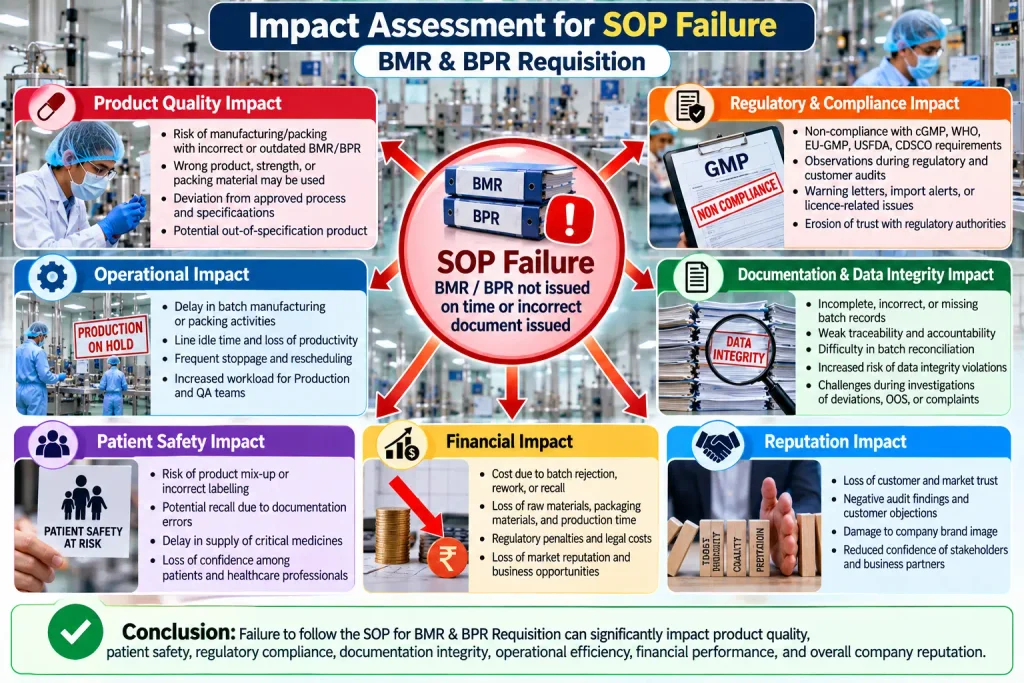
Failure to follow these requirements may result in incorrect or delayed issuance of BMR/BPR, incomplete batch documentation, weak traceability, and interruptions to manufacturing or packing activities. Errors in batch cancellation or conversion may also lead to incorrect reference numbering, unrecorded changes, or inadequate documentation of the reason for cancellation or conversion. Such failures can adversely affect documentation control, data integrity, operational efficiency, accountability, audit readiness, and GMP compliance. In serious cases, use of an incorrect or uncontrolled batch record may increase the risk of processing or packing errors. Therefore, timely requisition, QA review, controlled issuance, accurate recordkeeping, and proper handling of cancellation and conversion are essential for maintaining reliable batch documentation and effective pharmaceutical quality-system control.
9. CAPA for SOP Failure – BMR & BPR Requisition:
The CAPA for SOP Failure – BMR & BPR Requisition is intended to correct deficiencies in the requisition, receipt, issuance, cancellation, and conversion of Batch Manufacturing Records and Batch Packing Records and to prevent recurrence. The SOP requires Production to complete the prescribed requisition form with the date, time, product and batch details, packing information, and authorized signature before forwarding it to QA. QA is required to acknowledge receipt and issue the BMR/BPR within the defined period. Corrective actions may include completion or correction of incomplete requisition forms, verification of product and batch details, obtaining missing signatures, timely forwarding to QA, and correction of cancellation or conversion records. Preventive actions should include refresher training, a requisition completeness checklist, periodic review of pending requisitions, strengthened Production–QA communication, and supervisory verification before submission.
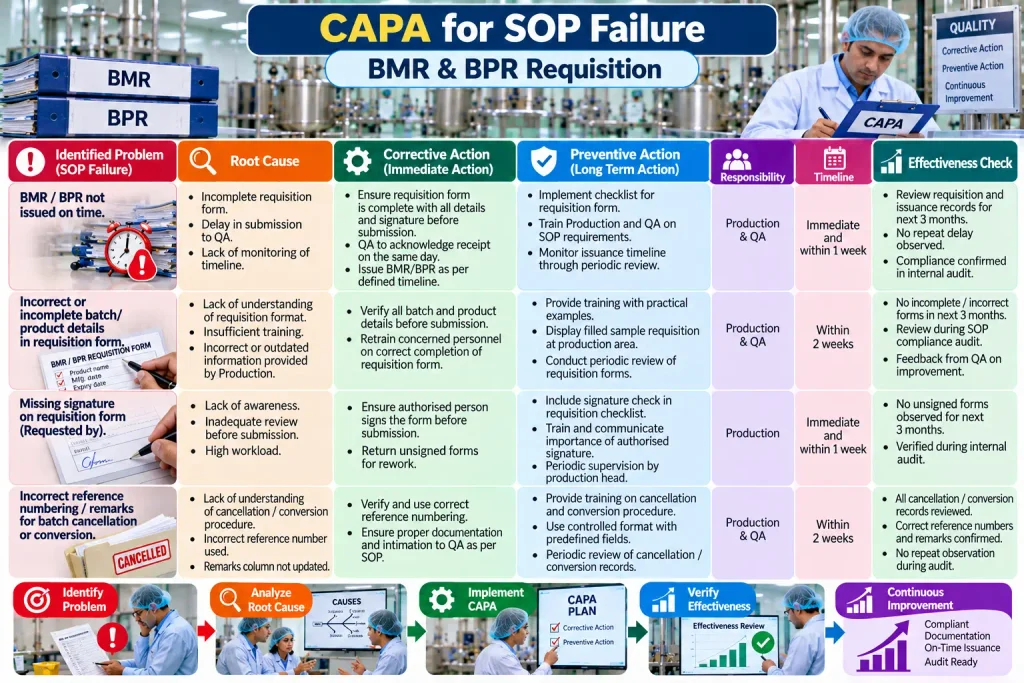
The SOP also defines controls for batch cancellation and batch conversion, including intimation to QA, reference numbering, and updating relevant remarks. CAPA should therefore verify these controls whenever failures occur. Effectiveness can be checked through periodic review of requisition records, on-time BMR/BPR issuance, absence of incomplete forms or missing signatures, correct reference numbering, and confirmation during internal audits that similar deviations have not recurred.
Questions & Answers – SOP for BMR & BPR Requisition:
- What is the purpose of the SOP for BMR & BPR Requisition?
The purpose is to define the procedure for preparation and processing of requisitions for Batch Manufacturing Records and Batch Packing Records. - Which departments are mainly involved in the BMR/BPR requisition process?
The Production Department prepares and submits the requisition, while the Quality Assurance Department receives the requisition and issues the required BMR/BPR. - Who is responsible for execution of this SOP?
The Production Chemist is responsible for execution of the SOP. - Who is responsible for effective implementation of the SOP?
The Senior Manager–Production, Head-QA/QC, and GM-Production are responsible for effective implementation. - What information should be entered in the BMR/BPR requisition form?
The form should include date and time, reference number, generic name, BFG number, party name, product name, FG number, batch size, manufacturing date, expiry date, type of packing, and pack details. - Who signs the requisition as “Requested By”?
The Production person signs the requisition as “Requested By” with date and time. - Where is the completed requisition sent?
The completed requisition is sent to the Quality Assurance Department for receiving and further processing. - Who signs the requisition as “Received By”?
QA signs the requisition as “Received By” with date and time. - Within what period should QA issue the BMR/BPR?
According to the SOP, QA should issue the BMR/BPR within 2 days of initiation of the requisition. - When can a batch cancellation be initiated?
Batch cancellation may be initiated when a batch is not dispensed due to planning changes, raw or packing materials are unavailable, or the party cancels the order. - What is the reference numbering concept for batch cancellation?
The SOP provides a cancellation reference number format using the company identifier, “CL” for cancellation, the last letter/digit representing the year, and a serial number. - What happens to the BMR after batch cancellation?
QA cancels the BMR and records the cancellation in the remarks column. - What is batch conversion?
Batch conversion is the documented conversion of an allotted batch/BPR when circumstances such as packing material unavailability, planning changes, or order cancellation require a change. - Who initiates batch conversion?
The Production Department raises the Batch Conversion Intimation to the Quality Assurance Department. - What does QA do during batch conversion?
QA cancels the particular pre-allotted batch number, issues a new FG batch number where applicable, and updates the relevant reference number in the remarks column before converting the BPR. - What annexures are included in the SOP?
The SOP includes a BMR Request Form, BMR & BPR Request Form, Batch Cancellation Record, and Batch Conversion Record. - What does BMR stand for?
BMR stands for Batch Manufacturing Record. - What does BPR stand for?
BPR stands for Batch Packing Record. - What does BFG stand for?
BFG stands for Bulk Finish Good as stated in the SOP. - Why is proper BMR/BPR requisition important?
It helps ensure that batch records are requested and issued through a documented, traceable process with defined Production and QA responsibilities, including controls for cancellation and conversion.
Reference Guidelines – SOP for BMR & BPR Requisition:
- WHO Good Manufacturing Practices (GMP) for Pharmaceutical Products – requirements for batch documentation, controlled records, and documentation practices.
- EU GMP, Part I – Chapter 4: Documentation – controls for preparation, issuance, review, approval, use, and retention of GMP documents.
- EU GMP, Part I – Chapter 5: Production – requirements for controlled manufacturing and packaging documentation.
- US FDA 21 CFR Part 211.186 – Master Production and Control Records.
- US FDA 21 CFR Part 211.188 – Batch Production and Control Records.
- US FDA 21 CFR Part 211.192 – Production Record Review.
- PIC/S Guide to GMP, PE 009 – Chapter 4: Documentation – document control and batch-record requirements.
- Schedule M of the Drugs Rules, India – GMP requirements concerning manufacturing, documentation, batch records, and quality-system controls.
- ICH Q10 – Pharmaceutical Quality System – supports controlled documentation, responsibilities, change management, and continual improvement.
Reference Guidelines – SOP for BMR & BPR Requisition:
- WHO Good Manufacturing Practices (GMP) for Pharmaceutical Products – requirements for batch documentation, controlled records, and documentation practices.
- EU GMP, Part I – Chapter 4: Documentation – controls for preparation, issuance, review, approval, use, and retention of GMP documents.
- EU GMP, Part I – Chapter 5: Production – requirements for controlled manufacturing and packaging documentation.
- US FDA 21 CFR Part 211.186 – Master Production and Control Records.
- US FDA 21 CFR Part 211.188 – Batch Production and Control Records.
- US FDA 21 CFR Part 211.192 – Production Record Review.
- PIC/S Guide to GMP, PE 009 – Chapter 4: Documentation – document control and batch-record requirements.
- Schedule M of the Drugs Rules, India – GMP requirements concerning manufacturing, documentation, batch records, and quality-system controls.
- ICH Q10 – Pharmaceutical Quality System – supports controlled documentation, responsibilities, change management, and continual improvement.