







Brief Description
The SOP for Calculation of Bar Code describes the procedure for verifying the pharma/bar code printed on product cartons. Its objective is to ensure that the calculated pharma code value matches the standard value specified in the respective product SPMS. The QC Chemist is responsible for performing the verification, while QC and QA/QC management are responsible for effective implementation of the SOP.During verification, each bar is numbered from right to left, beginning with position 0. The numerical value of each bar depends on its position and whether the bar is thick or thin. A thick line is calculated using 2ⁿ⁺¹, whereas a thin line is calculated using 2ⁿ. The calculated total is compared with the standard pharma code value.The SOP requires verification on 5 cartons, and all printed positions must be checked when the pharma code appears at multiple locations. Results are reported as “Complies” or “Does not comply.”
Skip to PDF content1. Flow Diagram:
The flower-shaped flow diagram presents the complete barcode calculation and verification process in a simple and attractive sequence. The process begins with selecting the product carton and checking the corresponding pharma code value in SPMS. Each bar is then numbered from right to left, starting with position 0.
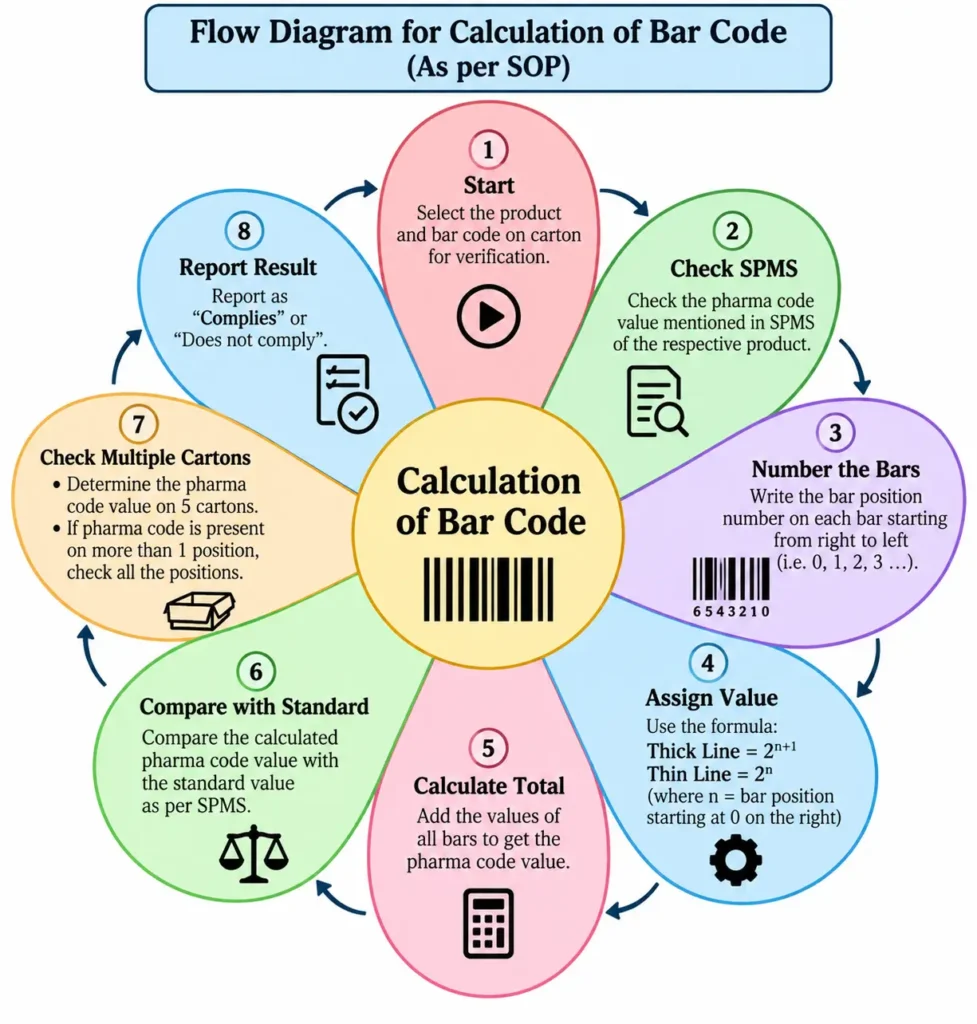
The value of each bar is calculated according to its thickness and position: Thick Line = 2ⁿ⁺¹ and Thin Line = 2ⁿ. The individual values are added to obtain the total pharma code value, which is then compared with the standard value specified in SPMS.Verification is performed on 5 cartons, and if the pharma code appears at more than one position, all positions are checked. The final result is reported as “Complies” or “Does not comply.
2. Brainstorming for SOP Failure:
The brainstorming diagram for SOP failure in barcode calculation identifies possible causes that may lead to incorrect verification or reporting of the pharma code. Key causes include inadequate training, failure to check the SPMS value, incorrect bar-position numbering, misidentification of thick and thin bars, calculation errors, failure to follow the specified formula, poor documentation, inadequate review or supervision, checking only one carton, and failure to verify all barcode positions on the carton.
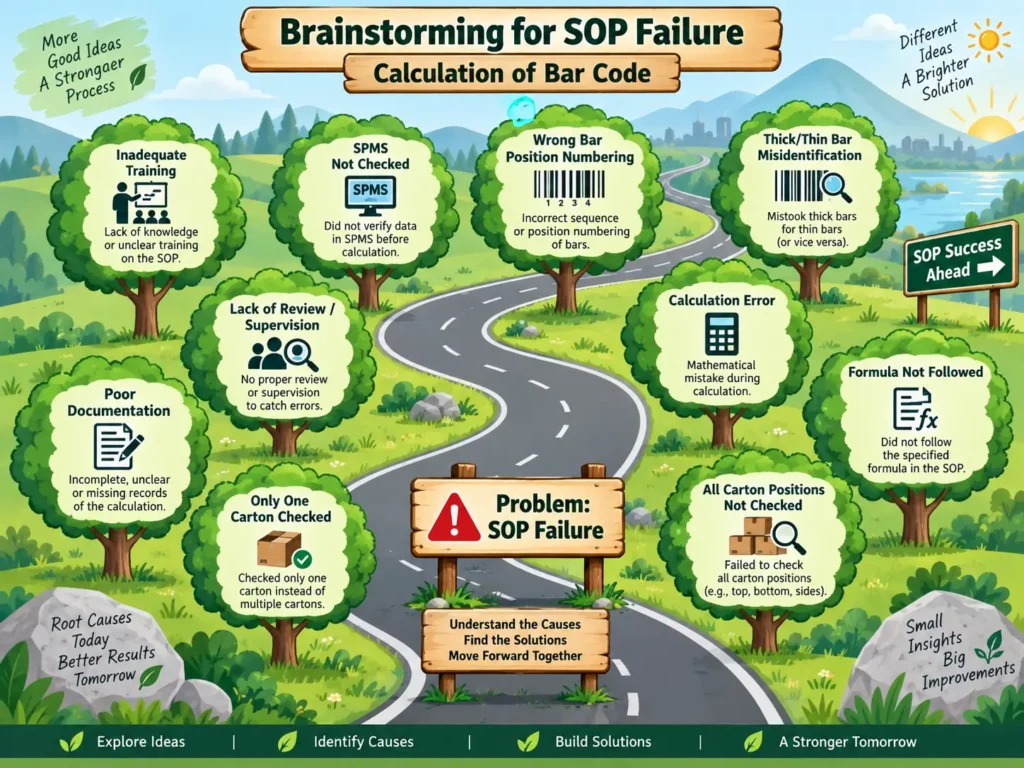
The road and green-tree design represents the journey from problem identification to SOP success. Each tree highlights a potential failure point that should be discussed during investigation. The purpose of brainstorming is to collect different ideas, identify probable root causes, and develop suitable corrective and preventive actions. By addressing these causes systematically, the organization can improve barcode verification accuracy, reduce human error, strengthen documentation, and ensure consistent compliance with the SOP.
3. 5-Why Analysis for SOP Failure:
The 5-Why analysis diagram identifies the probable root cause of failure in the SOP for Calculation of Bar Code. The investigation begins with the problem that the calculated pharma code value does not match the standard value given in SPMS. The analysis then traces the failure through incorrect numerical value assignment, wrong bar-position numbering, or misidentification of thick and thin bars. The SOP requires bars to be numbered from right to left starting at position 0, with different calculation formulas for thick and thin lines.
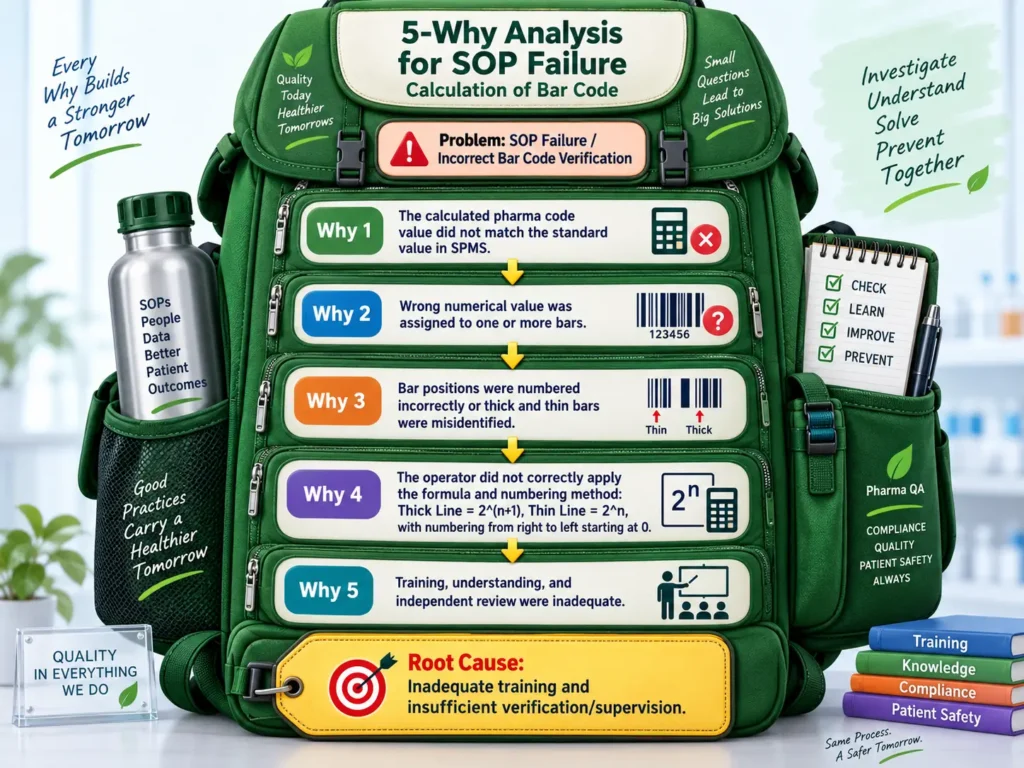
The bag-style diagram visually shows how each “Why” leads to the next level of investigation. The final probable root cause is inadequate training, insufficient understanding of the calculation method, and weak independent review or supervision. Addressing these causes through retraining, competency assessment, calculation checklists, and stronger verification can reduce recurrence and improve SOP compliance.
4. Fishbone Analysis for SOP Failure:
The Fishbone Analysis diagram identifies the possible causes of failure in the SOP for Calculation of Bar Code. The main problem considered is an incorrect pharma code calculation or verification result. Potential causes are grouped under six categories: Man, Method, Measurement, Material/Data, Machine/System, and Management/Review.
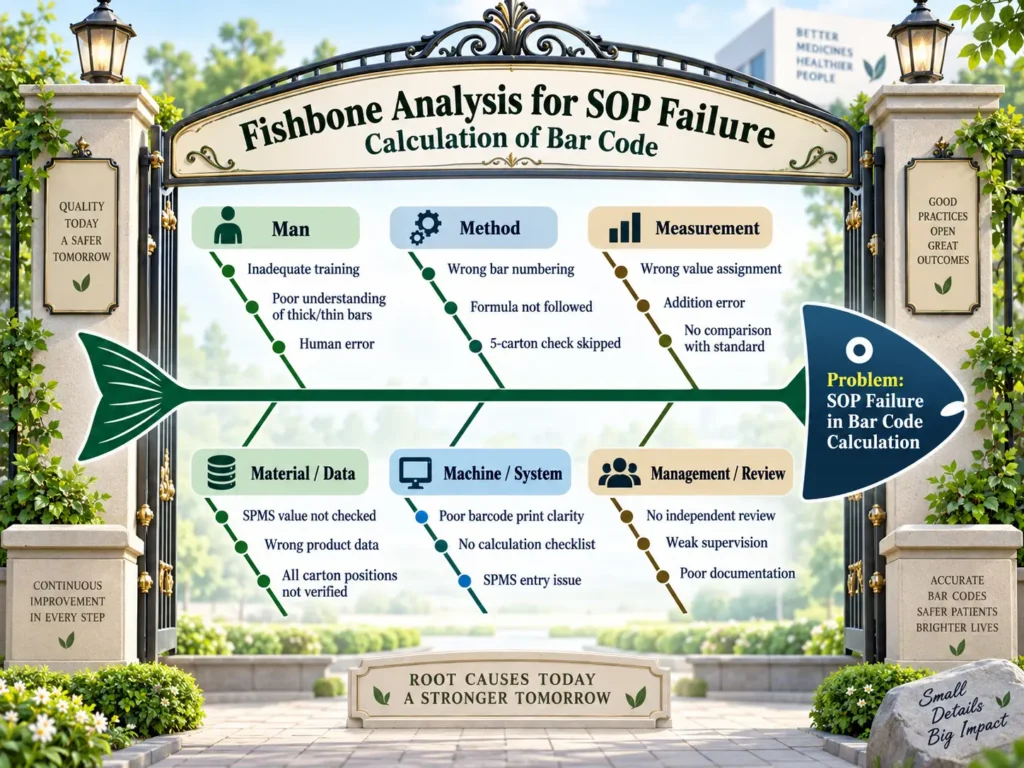
Key causes include inadequate training, poor understanding of thick and thin bars, incorrect bar numbering, failure to follow the calculation formula, calculation or addition errors, failure to compare the result with the SPMS standard, incorrect product data, poor barcode print clarity, SPMS entry issues, weak supervision, inadequate documentation, and lack of independent review. The SOP requires bar positions to be numbered from right to left and values to be calculated according to the specified thick- and thin-line formulas.This analysis helps the investigation team systematically identify probable root causes, implement suitable CAPA, strengthen training and review controls, and prevent recurrence of barcode verification failures.
5. Fault Tree Analysis for SOP Failure:
The Fault Tree Analysis (FTA) diagram evaluates how different failures can lead to the top event: SOP Failure in Bar Code Calculation. The diagram groups the possible failure paths into three main areas: incorrect calculation, improper verification, and documentation/review failure. Incorrect calculation may result from wrong bar-position numbering, misidentification of thick and thin bars, failure to follow the prescribed formula, or addition/totaling errors. Verification failure can occur when the SPMS value is not checked, only one carton is verified, all barcode positions are not checked, or the calculated result is not compared with the standard value. The SOP specifically requires checking the pharma code value in SPMS, verifying 5 cartons, and checking all positions where the code appears.
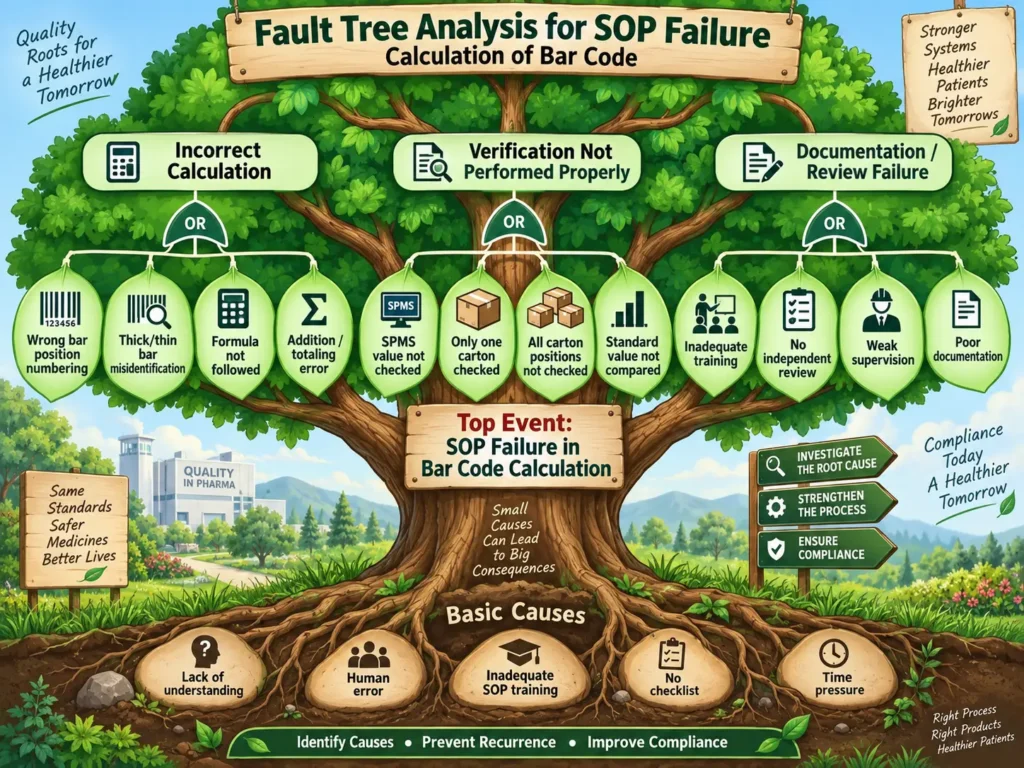
The analysis also highlights basic causes such as lack of understanding, human error, inadequate SOP training, absence of a checklist, weak supervision, and poor documentation. This structured approach helps identify critical failure paths, determine root causes, and implement CAPA to prevent recurrence.
Questions & Answers – SOP for Calculation of Bar Code
Q1. What is the objective of this SOP?
Answer: The objective is to lay down a procedure for verification of the bar code/pharma code.
Q2. What is the scope of the SOP?
Answer: This SOP is applicable to verification of the bar code.
Q3. Who is responsible for execution of the SOP?
Answer: The QC Chemist is responsible for execution of the SOP.
Q4. Who is responsible for effective implementation of the SOP?
Answer: Assistant Manager-QC, Manager-QC and Head-QA/QC are responsible for effective implementation.
Q5. What should be checked before starting the calculation?
Answer: The pharma code value mentioned in the respective product SPMS should be checked.
Q6. How are the bar positions numbered?
Answer: Bar positions are numbered from right to left, starting with 0, 1, 2, 3, and so on.
Q7. On what does the value of each bar depend?
Answer: It depends on the type of bar (thick or thin) and its position in the pharma code.
Q8. What formula is used for a thick line?
Answer: Thick Line = 2ⁿ⁺¹, where n is the bar position starting at 0 on the right.
Q9. What formula is used for a thin line?
Answer: Thin Line = 2ⁿ.
Q10. How is the final pharma code value obtained?
Answer: The calculated values of all individual bars are added together to obtain the total pharma code value.
Q11. How is the calculated value verified?
Answer: The observed pharma code value is compared with the standard pharma code value as per product SPMS.
Q12. How is the result reported?
Answer: The result is reported as “Complies” or “Does not comply.”
Q13. How many cartons should be checked?
Answer: The pharma code value should be determined on 5 cartons.
Q14. What should be done if the pharma code is printed at more than one position on the carton?
Answer: All positions where the pharma code is present should be checked.
Q15. Who is the trainer for this SOP?
Answer: The trainer is the Head-QA/QC.
Q16. Who are the trainees?
Answer: The trainees are Quality Control Chemists.
Q17. What is the training period?
Answer: The training period is one day.
Q18. What is the reference for this SOP?
Answer: The reference is In House.
Q19. What does SOP stand for?
Answer: SOP stands for Standard Operating Procedure.
Q20. What does QC stand for?
Answer: QC stands for Quality Control.