






1. Brief Description:
The Protocol Cum Report for Powder Escape Study in the Blending Area is designed to establish documented evidence that powder or active drug residues do not migrate from the blending room into the adjacent production corridor. The study is particularly important because the area has no air lock between the blending room and corridor, creating a potential cross-contamination risk. The protocol defines responsibilities of Quality Assurance, Production, Quality Control, and Engineering for planning, execution, review, and approval. Containment is evaluated through direct surface swab sampling and air sampling at selected worst-case corridor locations. Samples are analyzed for trace drug residues, with an acceptance criterion of less than 10 ppm. The study also considers preventive controls such as closed material transfer, secondary gowning, pressure differentials, adequate air changes, closed equipment, and electromagnetic door locking. Any deviations observed during execution must be investigated, documented, and supported by appropriate corrective and preventive actions.
Skip to PDF content2. Flow Diagram:
The Flow Diagram for Powder Escape Study in the Blending Area presents the study in a simple step-by-step sequence. It begins with planning, where the objective, scope, sampling locations, and protocol approval are defined. The next step is preparation, including instrument readiness, sampling materials, personnel training, and cleaning of the blending area. During execution, the blending operation is performed and both swab and air samples are collected from selected worst-case locations. These samples are then sent for analysis to detect active drug residues and the results are compared with the acceptance limit of less than 10 ppm.
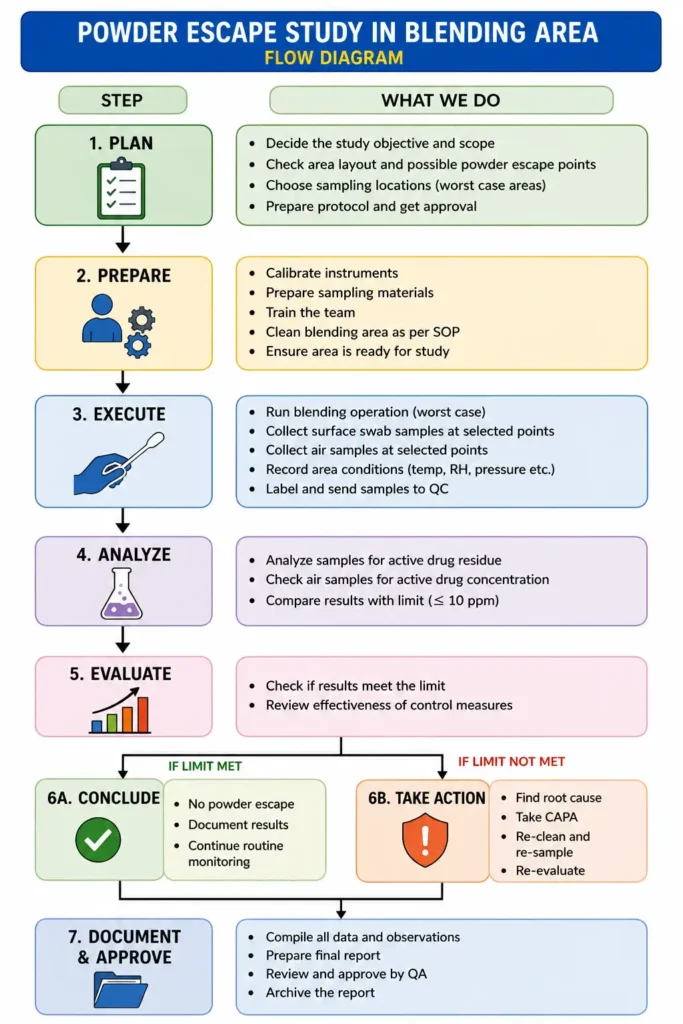
The results are then evaluated. If the acceptance criteria are met, the study is concluded with no powder escape identified. If the criteria are not met, investigation, CAPA, re-cleaning, re-sampling, and re-evaluation are performed. Finally, all observations, results, and deviations are compiled into a report for QA review, approval, and archival.
3. Brainstorming:
The brainstorming diagram for protocol failure of the Powder Escape Study in the Blending Area helps identify possible reasons why the study may not be executed or completed successfully. The causes are grouped into major categories such as planning, personnel, equipment/materials, execution, analysis, documentation, environment, and other operational factors. Possible failures include unclear objectives, incorrect sampling locations, inadequate risk assessment, insufficient training, human error, uncalibrated instruments, unsuitable reagents, improper sampling, poor cleaning, inadequate line clearance, incomplete records, and deviations not being documented. Environmental factors such as improper pressure differential, AHU malfunction, open doors, poor housekeeping, and excessive corridor movement may also affect study reliability.
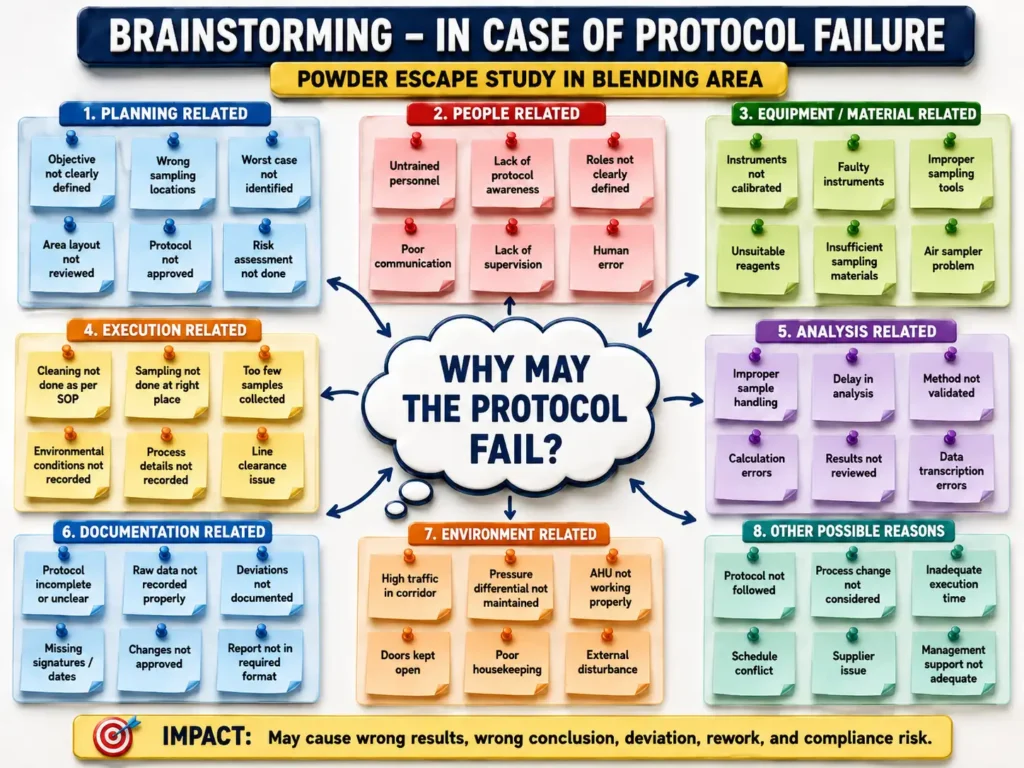
The brainstorming exercise supports systematic identification of potential weaknesses before determining the actual root cause. It helps the investigation team prioritize critical issues, perform further root-cause analysis, implement suitable CAPA, and improve the reliability, compliance, and effectiveness of the powder escape study.
4. 5-Why Analysis:
The 5-Why Analysis for Protocol Failure of the Powder Escape Study in the Blending Area is a simple root-cause investigation tool used to identify why the study may not be executed successfully. The analysis starts with the main problem—protocol failure—and repeatedly asks “Why?” until the underlying cause is identified.
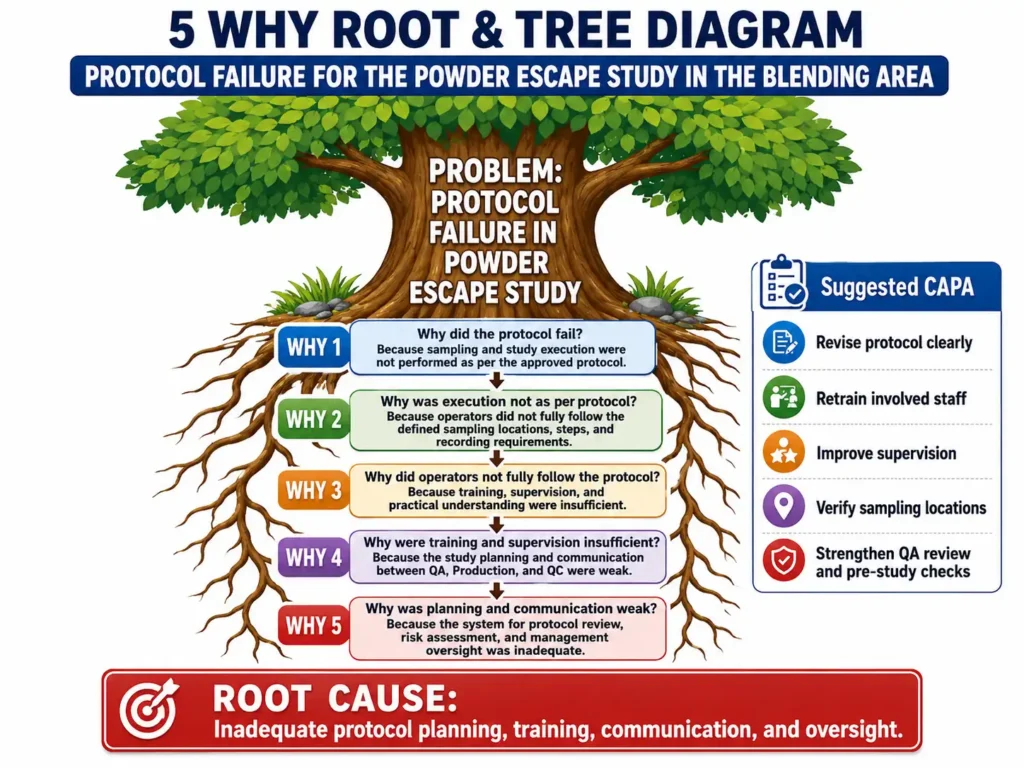
In this illustrative analysis, the failure may begin with improper sampling or execution, followed by failure to follow defined protocol steps, insufficient operator understanding, inadequate training or supervision, and finally weak planning, communication, risk assessment, or management oversight. The protocol itself requires controlled sampling, defined locations, proper execution, documentation, and evaluation of results. The identified root cause can then be addressed through suitable CAPA such as protocol revision, retraining, improved supervision, verification of sampling locations, and stronger QA review. This 5-Why approach helps prevent recurrence and improves study reliability and GMP compliance.
5. HEAT MAP (FMEA)
Failure Mode and Effects Analysis (FMEA) is a systematic risk-assessment tool used to identify potential failures that could affect the Powder Escape Study in the Blending Area. The assessment considers possible failure modes such as inappropriate sampling locations, improper swab or air sampling, uncalibrated instruments, inadequate cleaning or line clearance, uncontrolled environmental conditions, delayed analysis, data-recording errors, and incomplete documentation.
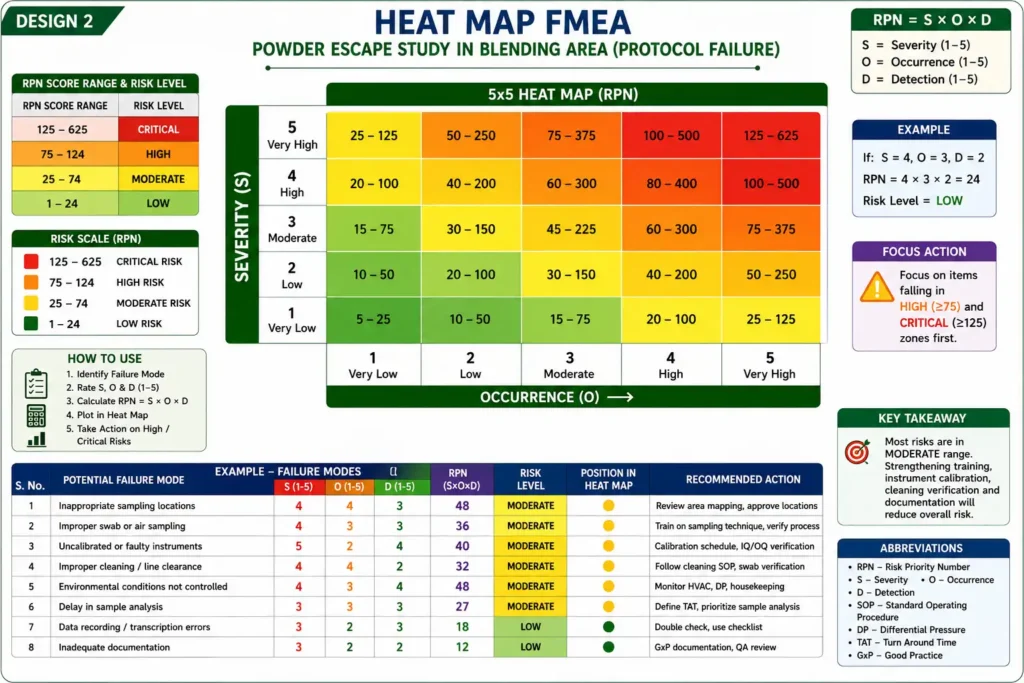
Each failure mode is evaluated using Severity (S), Occurrence (O), and Detection (D) scores. These values are multiplied to calculate the Risk Priority Number (RPN = S × O × D). The heat map then classifies the risk as Low, Moderate, High, or Critical, helping the team prioritize corrective actions. Recommended controls may include improved training, calibration, sampling verification, HVAC and pressure monitoring, cleaning verification, and stronger QA documentation review. FMEA helps reduce study errors, improve protocol compliance, prevent recurrence, and increase confidence in the final study results.
Questions & Answers
Q1. What is the purpose of the Powder Escape Study?
The purpose is to establish documented evidence that cross-contamination does not occur from the blending area to the adjacent production corridor.
Q2. Why is this study important?
The study is important because there is no air lock between the blending room and the production corridor, which creates a potential risk of powder migration and cross-contamination.
Q3. Which departments are involved in the study?
Quality Assurance, Production, Quality Control, and Engineering are involved in planning, execution, review, testing, and approval activities.
Q4. Which sampling methods are used?
Two sampling methods are used: direct surface swab sampling and air sampling.
Q5. When should sampling be performed?
Swab and air sampling are performed during operation and after completion of the blending activity.
Q6. What area is used for swab sampling?
Approximately 25 cm² of the defined surface is swabbed using the specified sampling technique.
Q7. What is the acceptance criterion for drug residue?
The amount of drug residue detected at the sampling location should be less than 10 ppm.
Q8. How much air is sampled during air sampling?
The protocol specifies sampling of 1000 litres of air at each selected sampling point.
Q9. What are the sampling locations?
Sampling locations include the door outside the blending area, floor near the blending-room door opening, Granulation-I material air lock, Granulation-II material air lock door, bulk quarantine door, and corridor return riser.
Q10. How are the samples analyzed?
Swab and air samples are submitted to QC or an external laboratory and analyzed using an appropriate analytical method for detection of trace drug residues; the protocol refers to HPLC for trace-level determination.
Q11. What controls help prevent powder escape?
Controls include closed material containers, secondary gowning, fresh gowns for each process, proper air changes, pressure differential, closed blending equipment, covered in-process containers, and an electromagnetic door lock.
Q12. When is revalidation required?
Revalidation should be considered after facility-design changes, major utility modifications such as AHU changes, or infrastructural changes that could influence cross-contamination risk.
Q13. What should be done if a deviation occurs?
The deviation should be investigated and documented according to the current deviation SOP, and appropriate corrective and/or preventive actions should be taken where necessary.
Q14. What is the expected outcome of the study?
The study should demonstrate that the blending area is adequately contained and that drug residues are not escaping into the adjacent corridor above the defined acceptance criterion.