





1. INTRODUCTION- SOP CLEANING & SANITIZATION PROCEDURE IN THE PLANT:
The Cleaning & Sanitization Procedure in the Plant establishes a systematic approach for maintaining cleanliness and hygienic conditions throughout pharmaceutical manufacturing and support areas. The SOP covers cleaning and sanitization activities for non-process areas, process areas, critical areas, warehouse areas, microbiology laboratory, drains, waste bins, racks, lifts, exhaust fans, walls, floors, doors, ceilings and associated utilities. The procedure defines the preparation and use of cleaning and disinfectant solutions, including Teepol and scheduled sanitizing agents, along with specified frequencies and disinfectant rotation practices. It also provides requirements for unidirectional floor cleaning, cleaning of equipment surroundings, drain sanitation, waste handling and maintenance of cleaning records. Effective implementation of this SOP helps maintain controlled environmental conditions, minimize contamination and cross-contamination risks, and ensure that manufacturing areas remain suitable for pharmaceutical operations. The SOP assigns execution responsibilities to concerned Production, Warehouse and QC personnel, while departmental heads are responsible for its effective implementation.
Skip to PDF content2. FLOW DIAGRAM – SOP CLEANING & SANITIZATION PROCEDURE IN THE PLANT:
The flow diagram illustrates the systematic sequence for carrying out cleaning and sanitization activities within the pharmaceutical plant. The process begins with reviewing the cleaning schedule and identifying the area classification, followed by preparation of the required cleaning and disinfectant solutions and verification of cleaning materials.
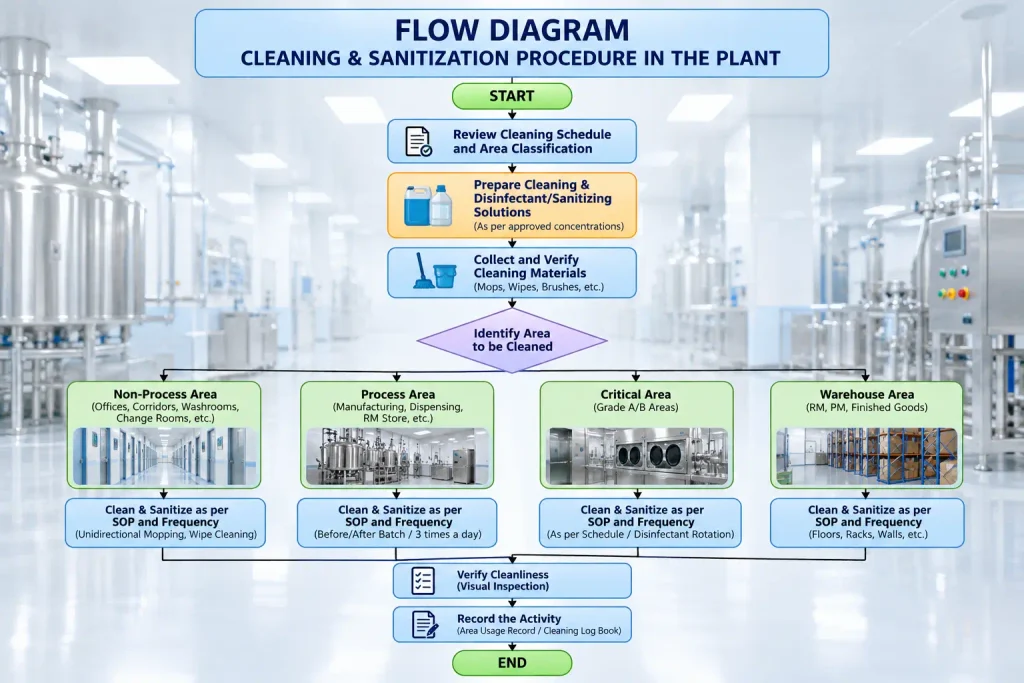
The area is then categorized as a non-process area, process area, critical area, or warehouse area, and cleaning is performed according to the applicable SOP, defined frequency, and prescribed method. The SOP includes unidirectional cleaning practices, scheduled disinfectant use, and specific cleaning frequencies for different areas. After completion, cleanliness is visually verified and the activity is documented in the relevant cleaning or area usage record to maintain traceability and GMP compliance.
3. BENEFITS OF FOLLOWING SOP – CLEANING & SANITIZATION PROCEDURE IN THE PLANT:
Following the Cleaning & Sanitization Procedure in the Plant helps maintain pharmaceutical manufacturing and support areas in a clean, hygienic, and controlled condition. The SOP establishes defined cleaning frequencies, disinfectant preparation and rotation, unidirectional cleaning practices, drain sanitation, waste-bin cleaning, and documentation requirements for different plant areas.
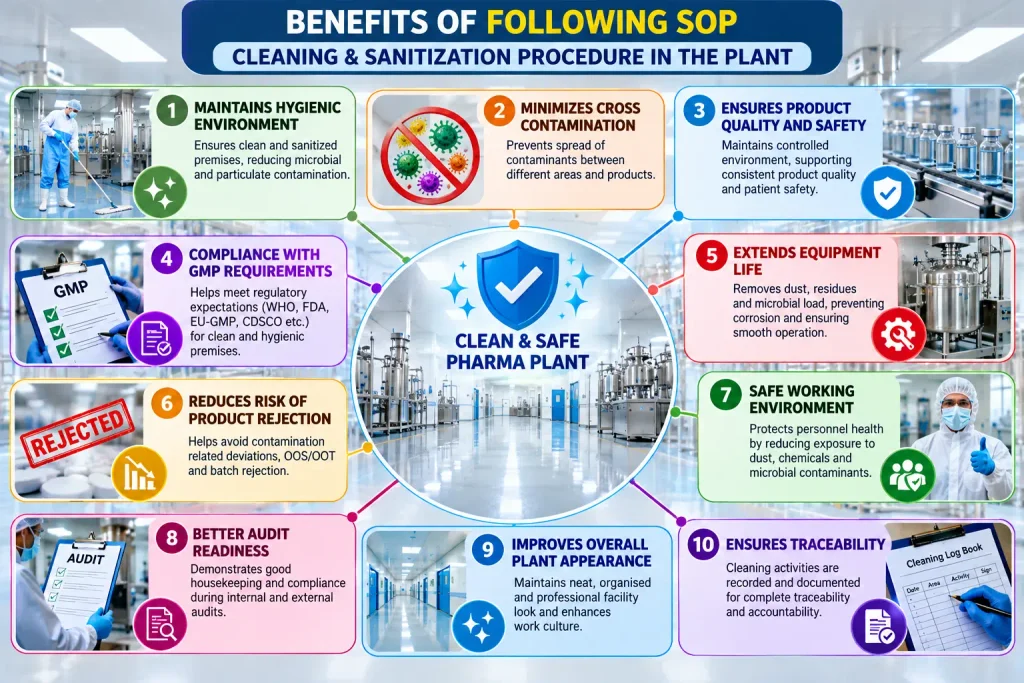
Proper implementation reduces the risk of dust, residue, microbial contamination, and cross-contamination between areas and products. It also supports consistent housekeeping, safer working conditions, protection of equipment and utilities, and better control of process environments. The procedure additionally requires cleaning records and area usage documentation, which improves traceability, accountability, deviation investigation, and audit readiness. Overall, adherence to this SOP supports GMP compliance, product quality, patient safety, orderly plant conditions, and reliable pharmaceutical operations.
4. BRAINSTORMING FOR SOP FAILURE – SOP CLEANING & SANITIZATION PROCEDURE IN THE PLANT:
The brainstorming analysis identifies potential reasons that may lead to failure in effective implementation of the Cleaning & Sanitization Procedure in the Plant. Major contributing factors include inadequate personnel training, failure to follow the approved cleaning schedule, incorrect dilution of cleaning or disinfectant solutions, improper disinfectant rotation, insufficient supervision, unavailable or unsuitable cleaning tools, missed drain and waste-bin cleaning, poor documentation, and inadequate housekeeping practices.
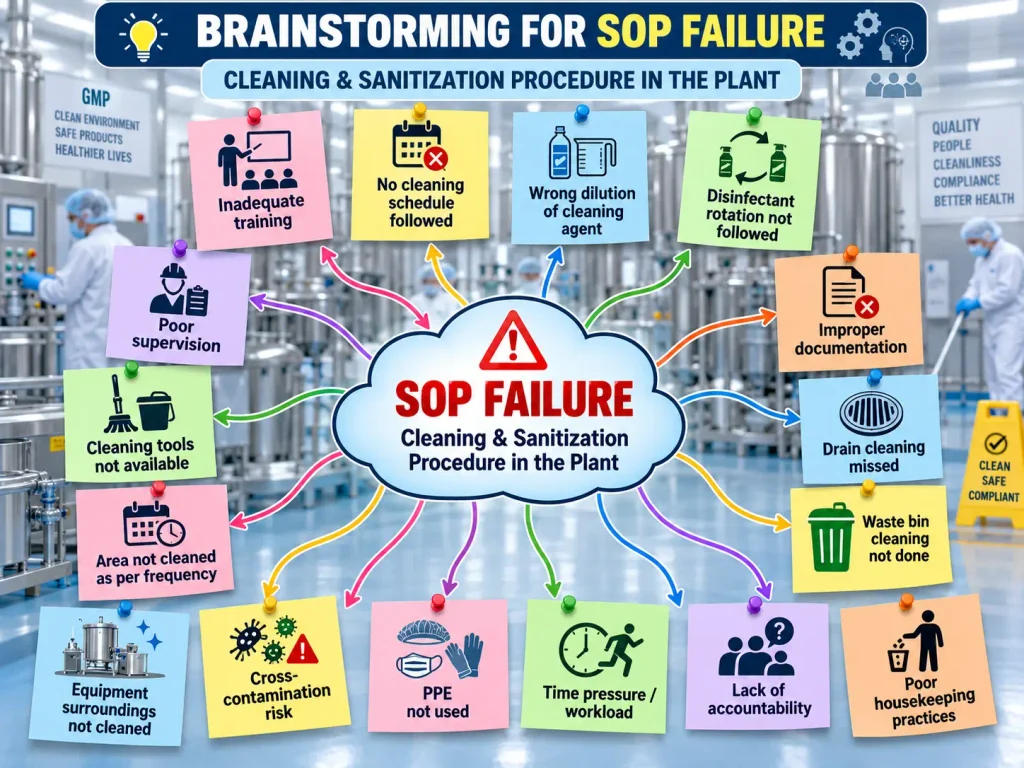
Additional concerns may include failure to clean equipment surroundings, non-use of required PPE, excessive workload or time pressure, and lack of accountability among responsible personnel. These failures can result in incomplete cleaning and sanitization, increased contamination or cross-contamination risk, poor environmental control, and weak traceability of cleaning activities. The SOP itself specifies defined cleaning methods, frequencies, disinfectant use, precautions, and documentation requirements that must be consistently followed.
5. 5-WHY ANALYSIS FOR SOP FAILURE – SOP CLEANING & SANITIZATION PROCEDURE IN THE PLANT:
The 5-Why Analysis evaluates the underlying reasons for failure in implementation of the Cleaning & Sanitization Procedure in the Plant. The first level identifies that cleaning and sanitization activities were not performed according to the approved SOP. Further analysis indicates that required cleaning frequency, prescribed cleaning methods, and disinfectant rotation were not consistently followed. The next causes relate to gaps in operator training, supervision, and understanding of cleaning requirements.
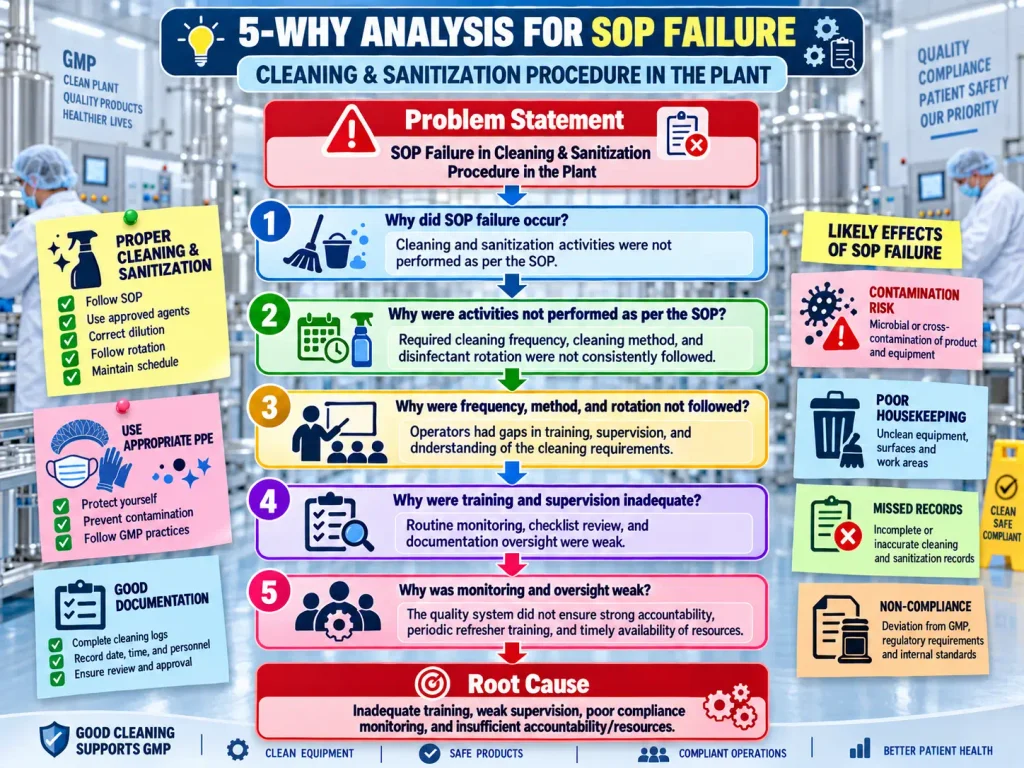
Deeper investigation points toward weak routine monitoring, inadequate checklist review, and poor documentation oversight. The probable root cause is therefore a combination of insufficient training, weak supervision, inadequate compliance monitoring, limited accountability, and poor availability or control of required resources. These failures may increase the risk of contamination, poor housekeeping, incomplete records, and GMP non-compliance. The SOP defines responsibilities, cleaning frequencies, disinfectant preparation, cleaning methods, precautions, and documentation requirements that should be consistently implemented.
6. FISHBONE ANALYSIS FOR SOP FAILURE – SOP CLEANING & SANITIZATION PROCEDURE IN THE PLANT:
The Fishbone Analysis identifies the major potential causes that can lead to failure in implementation of the Cleaning & Sanitization Procedure in the Plant. The causes are grouped under key categories such as Manpower, Method, Material, Machine/Tools, Measurement/Documentation, and Environment/Management. Manpower-related causes include inadequate training, poor supervision, and non-use of required PPE. Method-related failures may involve missed cleaning frequency, incorrect cleaning sequence, and failure to follow disinfectant rotation. Material causes include incorrect dilution of cleaning agents, unavailable disinfectants, or unsuitable cleaning aids. Machine and tool issues may involve missing cleaning accessories or failure to clean equipment surroundings. Documentation-related causes include incomplete records and unchecked cleaning activities, while management-related factors include workload pressure, poor housekeeping culture, and weak accountability.
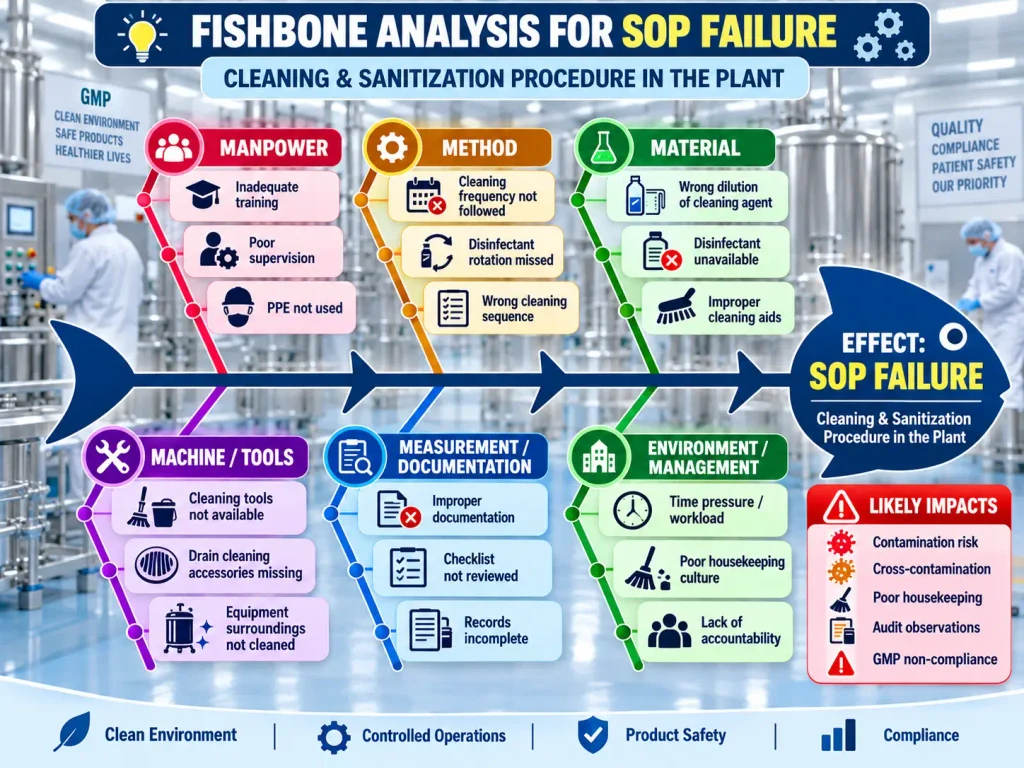
These factors may result in contamination, cross-contamination, poor housekeeping, audit observations, and GMP non-compliance. The SOP defines specific cleaning methods, frequencies, disinfectant preparation, precautions, and recording requirements intended to control these risks.
7. FAULT TREE ANALYSIS FOR SOP FAILURE SOP CLEANING & SANITIZATION PROCEDURE IN THE PLANT:
The Fault Tree Analysis (FTA) evaluates the possible causes that can lead to failure in implementation of the Cleaning & Sanitization Procedure in the Plant. The top event is failure of effective cleaning and sanitization, which can arise from one or more major branches such as inadequate personnel execution, incorrect cleaning methods, problems with cleaning materials, poor monitoring and documentation, and environmental or management-related factors.
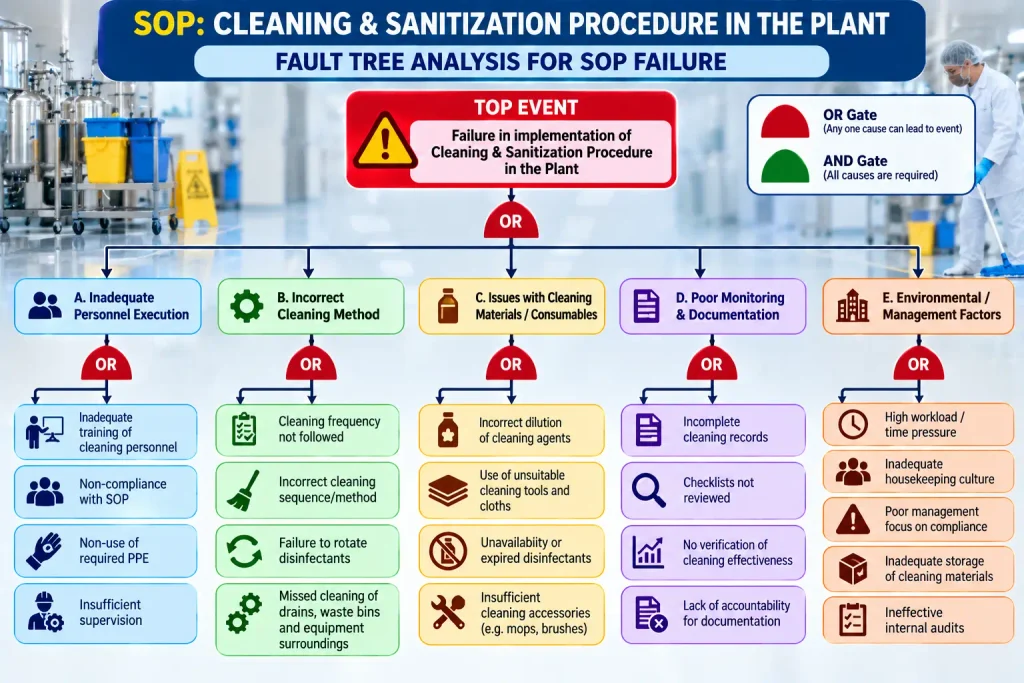
Personnel-related causes may include inadequate training, insufficient supervision, non-compliance with the SOP, and non-use of required PPE. Method failures can involve missed cleaning frequencies, incorrect cleaning sequence, failure to rotate disinfectants, and incomplete cleaning of drains, waste bins, or equipment surroundings. Material-related failures may include incorrect dilution, unsuitable cleaning aids, or unavailable disinfectants. Monitoring failures include incomplete records, unchecked cleaning activities, and weak verification. Management factors such as workload pressure, poor housekeeping culture, and weak compliance oversight can further contribute to SOP failure. These factors can ultimately increase the risk of contamination, poor housekeeping, incomplete traceability, and GMP non-compliance.
8. IMPACT ASSESSMENT FOR SOP FAILURE SOP CLEANING & SANITIZATION PROCEDURE IN THE PLANT:
The Impact Assessment evaluates the possible consequences arising from failure to follow the Cleaning & Sanitization Procedure in the Plant. Since the SOP covers cleaning of process and non-process areas, drains, waste bins, microbiology areas, racks, lifts, equipment surroundings, walls, floors, and other facility surfaces, failure in these activities can adversely affect overall plant hygiene and control.
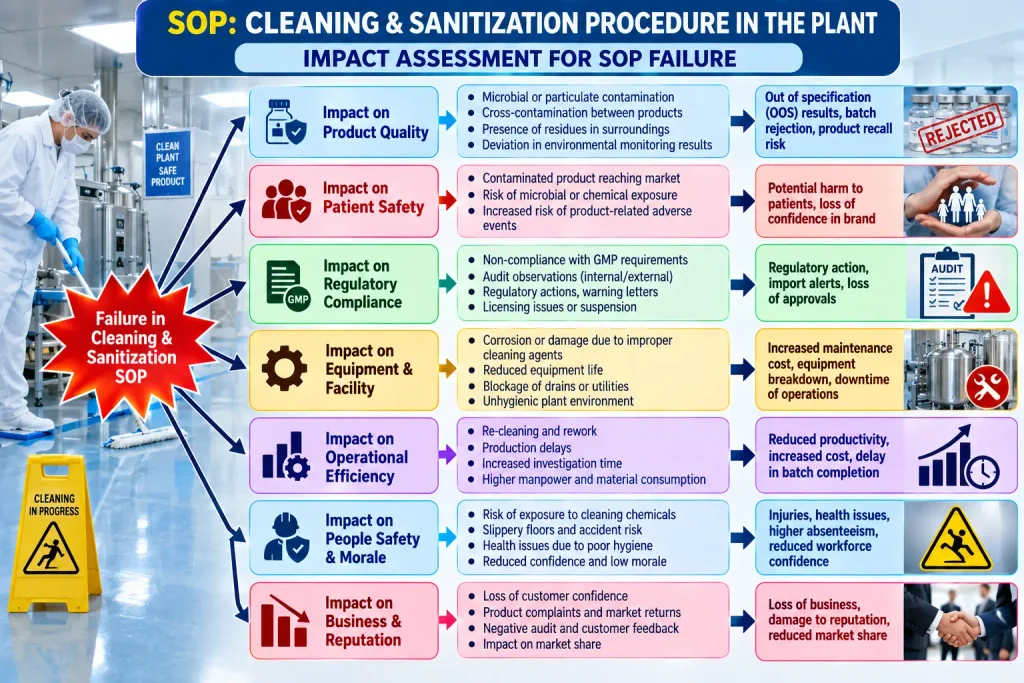
Potential impacts include increased risk of residue accumulation, microbial contamination, cross-contamination, poor housekeeping, blocked or unhygienic drains, and inadequate environmental control. Improper execution may also lead to incomplete cleaning records, weak traceability, repeated cleaning, operational delays, and audit observations. The SOP specifically requires defined cleaning frequencies, disinfectant rotation, suitable cleaning aids, PPE during solution preparation, and recording of completed activities. Overall, SOP failure can negatively influence product quality, GMP compliance, facility condition, operational efficiency, and confidence in the effectiveness of the plant cleaning program.
9. CORRECTIVE AND PREVENTIVE ACTION (CAPA) SOP CLEANING & SANITIZATION PROCEDURE IN THE PLANT:
The Corrective and Preventive Action (CAPA) process for failure of the Cleaning & Sanitization Procedure in the Plant focuses on correcting observed deficiencies and preventing their recurrence. Immediate corrective actions include cleaning and sanitizing the affected area, removing residues and waste, using approved cleaning or disinfectant solutions at the required concentration, completing missed records, retraining concerned personnel, and increasing supervision until compliance is restored.
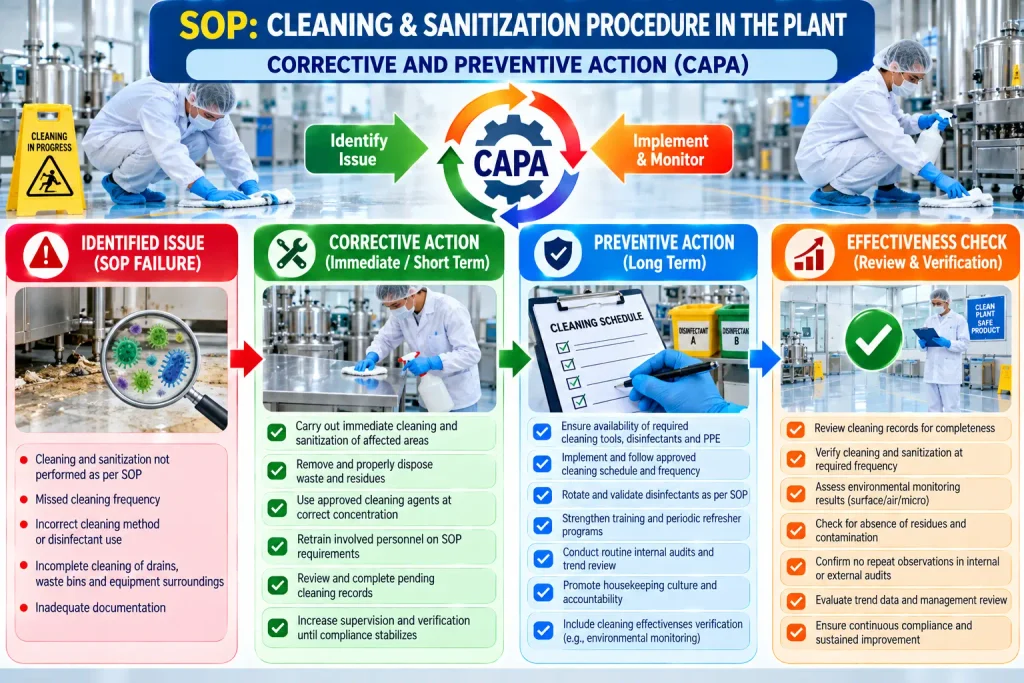
Preventive actions should strengthen the cleaning system through adherence to approved cleaning frequencies, proper disinfectant rotation, availability of suitable cleaning tools and PPE, periodic refresher training, routine review of cleaning records, and improved accountability. The SOP itself requires defined disinfectant preparation, area-specific cleaning frequencies, drain and waste-bin cleaning, PPE during solution preparation, and documentation of cleaning activities. CAPA effectiveness should be verified by reviewing cleaning records, confirming completion of scheduled activities, checking for absence of repeated deficiencies, and ensuring sustained compliance with the SOP.
QUESTION & ANSWER SOP CLEANING & SANITIZATION PROCEDURE IN THE PLANT:
- Q: What is the objective of this SOP?
A: The objective is to lay down the procedure for cleaning and sanitization in the plant. - Q: Which areas are covered under this SOP?
A: The SOP covers non-process areas, process areas, critical areas, and warehouse areas. - Q: Who is responsible for execution of the SOP?
A: Concerned Production, Warehouse, and QC personnel are responsible for execution of the SOP. - Q: Who is responsible for effective implementation of the SOP?
A: The Head of the concerned department is responsible for effective implementation. - Q: What concentration of Teepol is used as the cleaning solution?
A: A 0.1% Teepol solution is used for cleaning. - Q: How should floors be cleaned and sanitized?
A: Floors should be cleaned and sanitized using a sponge mop or mopping cloth soaked in disinfectant solution in a unidirectional direction. - Q: How frequently should process-area cleaning be performed?
A: Process-area cleaning is carried out three times a day and/or after completion of the batch, as specified in the SOP. - Q: What should be ensured before wet cleaning of a process area?
A: The Air Handling System should be ON before starting wet cleaning. - Q: What is Type-A cleaning?
A: Type-A cleaning is performed during batch changeover of the same product and strength or ascending strength, provided the colour is the same. - Q: What is Type-B cleaning?
A: Type-B cleaning is performed during changeover of products having different actives, colour, or descending potency. - Q: How often should drains be cleaned and sanitized?
A: Drain points should be cleaned and sanitized at the end of the shift. - Q: Which solution is used for sanitization of drain pots?
A: The SOP specifies filling the drain pot with approximately 300 mL of 4% sodium hypochlorite solution. - Q: How frequently should waste bins be cleaned?
A: Waste bins should be cleaned daily. - Q: How frequently should the microbiology laboratory be cleaned and sanitized?
A: Cleaning and sanitization should be performed at the start of the shift and at the end of the shift, with disinfectant rotation after 10 days. - Q: What is the required sequence for floor and wall cleaning?
A: The floor should be cleaned unidirectionally from the core area to the non-core area, while walls should be cleaned from top to bottom. - Q: What precautions should be followed during cleaning?
A: Containers and equipment should remain closed or covered, cleaning aids should be clean, drain covers should be closed when not in use, solid waste should not be put into drains, and gloves and masks should be used during preparation of cleaning and sanitizing solutions. - Q: Why is disinfectant rotation important in this SOP?
A: The SOP requires rotation of disinfectants according to the defined schedule to support effective sanitization practices. - Q: Why is documentation of cleaning activities important?
A: Cleaning activities are required to be recorded in the prescribed area cleaning, drain cleaning, waste-bin, rack, and other associated records to maintain traceability and verification.
REFERENCE GUIDELINE – SOP CLEANING & SANITIZATION PROCEDURE IN THE PLANT:
- WHO Good Manufacturing Practices (GMP) for Pharmaceutical Products – requirements related to sanitation, hygiene, premises, contamination control, and cleaning.
- EU Guidelines for Good Manufacturing Practice, EudraLex Volume 4 – particularly Chapter 3: Premises and Equipment and Chapter 5: Production.
- PIC/S Guide to Good Manufacturing Practice for Medicinal Products, PE 009 – requirements for premises cleanliness, prevention of contamination, and controlled manufacturing practices.
- Schedule M of the Drugs Rules, 1945, India – GMP requirements related to premises, sanitation, hygiene, manufacturing areas, and housekeeping.
- US FDA 21 CFR Part 211 – especially requirements covering buildings and facilities, equipment cleaning and maintenance, and production controls.
- ISO 14644 Series – where applicable to classified clean areas and contamination control.
- Company-approved SOP for Collection and Disposal of Waste and Rejected Material from Plant.
- Company-approved SOP for Area Usage Record.