







Brief Description
The SOP for Cleaning & Storage of Sampling Utensils defines a controlled procedure to ensure that utensils used for material sampling are properly cleaned, dried, stored, and maintained before reuse. It applies to reusable sampling equipment such as sampling rods, scoops, spatulas, pipettes, and liquid sampling devices, with responsibility assigned to QC personnel. After sampling, utensils are dismantled where possible, flushed with potable water, and cleaned using 0.1% Teepol detergent solution. Suitable solvents such as acetone may be used for water-immiscible residues, while oily or sticky pipettes may be rinsed with hot water. The utensils are then rinsed with potable water followed by purified water, dried at about 60°C, visually inspected, and reassembled. Cleaned utensils are stored in labeled polythene bags, sterilized where microbiological sampling requires it, and generally used within 7 days of cleaning. Damaged, rusted, or contaminated utensils must be rejected and replaced. The SOP also includes an annexure for documenting utensil cleaning activities.
Skip to PDF content1. Flow Diagram:
The tree-style flow diagram for Cleaning & Storage of Sampling Utensils visually presents the complete SOP sequence from collection of used sampling utensils through cleaning, drying, storage, sterilization, and reuse. After sampling, reusable utensils are transferred to the washing area, dismantled where possible, and initially rinsed with potable water. Depending on the residue type, suitable solvent or hot-water rinsing may be used, followed by cleaning with 0.1% Teepol solution and a final rinse with potable and purified water. The utensils are then dried at about 60°C, visually inspected, and reassembled.
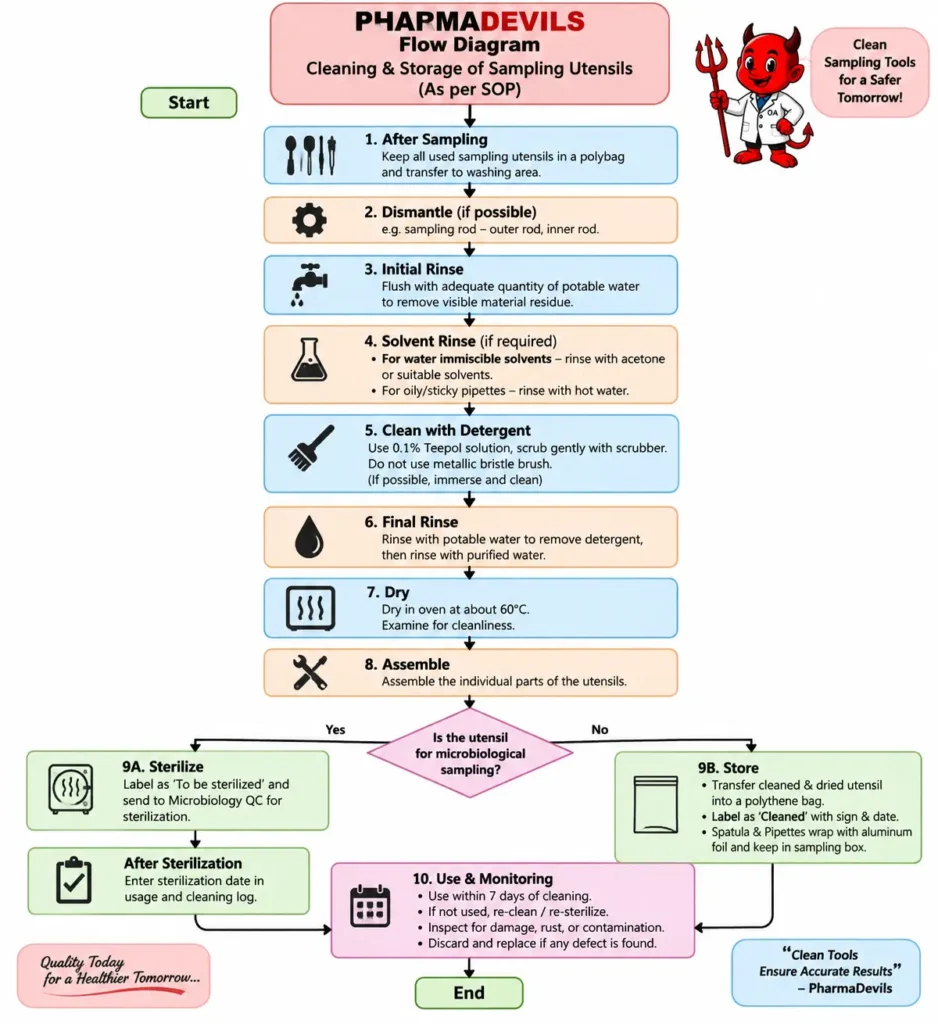
A decision branch identifies utensils required for microbiological sampling, which are sent for sterilization and recorded appropriately. Cleaned utensils are labeled and stored properly, and they should generally be used within 7 days of cleaning. Damaged, rusted, or contaminated utensils are discarded and replaced. The Devils-themed tree design makes the SOP easier to understand, remember, and use during QC training.
2. Brainstorming for SOP Failure:
The brainstorming tree diagram for SOP failure in Cleaning & Storage of Sampling Utensils visually identifies potential causes that may lead to ineffective cleaning, contamination, incorrect storage, or unreliable sampling results. The sticky notes highlight failures such as utensils not being cleaned after use, incomplete dismantling, inadequate initial rinsing, use of an unsuitable solvent, incorrect preparation of 0.1% Teepol solution, poor scrubbing, missed final rinsing, improper drying at about 60°C, and skipped cleanliness inspection. These points directly reflect critical steps defined in the SOP.
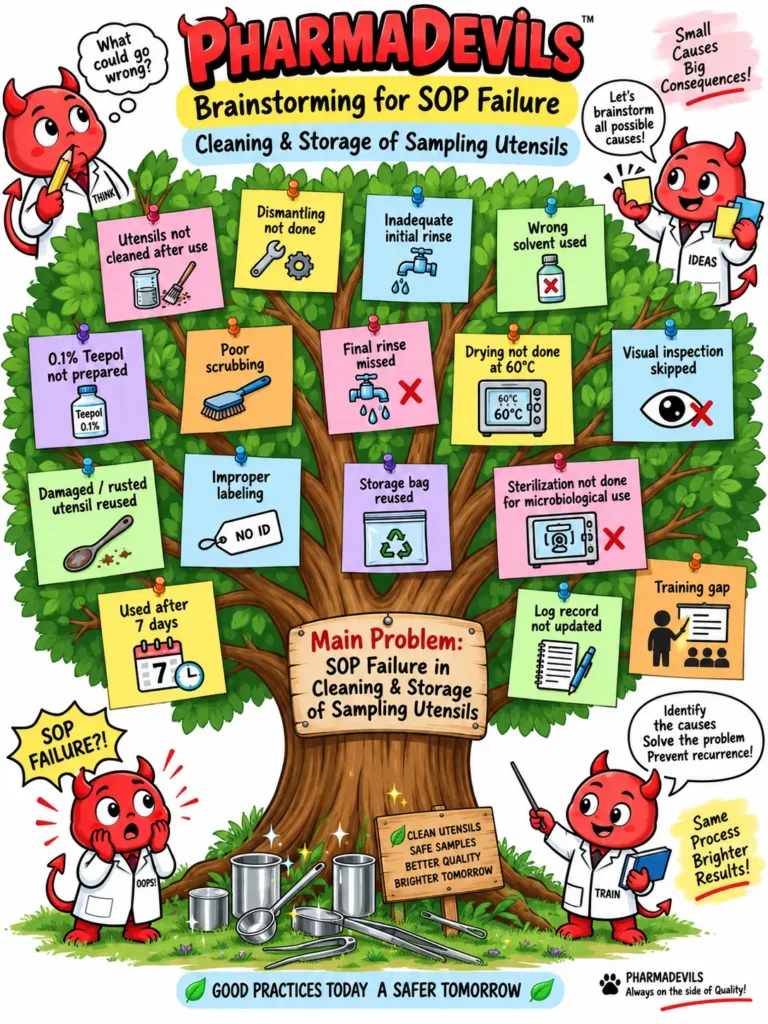
Additional risks include reusing damaged or rusted utensils, incorrect labeling, reuse of storage bags, failure to sterilize accessories required for microbiological sampling, use beyond the defined 7-day period, incomplete logbook entries, and inadequate personnel training.The comic Devils and sticky-note tree format makes the brainstorming process easy to understand and supports root-cause identification, CAPA development, training, and prevention of repeated SOP failures.
3. 5-Why Analysis for SOP Failure:
The 5-Why Analysis for SOP Failure in Cleaning & Storage of Sampling Utensils identifies the underlying reasons why the defined cleaning and storage procedure may not be followed correctly. The analysis starts with the immediate failure—sampling utensils are not cleaned and stored as required—and progressively examines operator awareness, understanding of cleaning steps, effectiveness of SOP training, maintenance of training records, and management oversight.
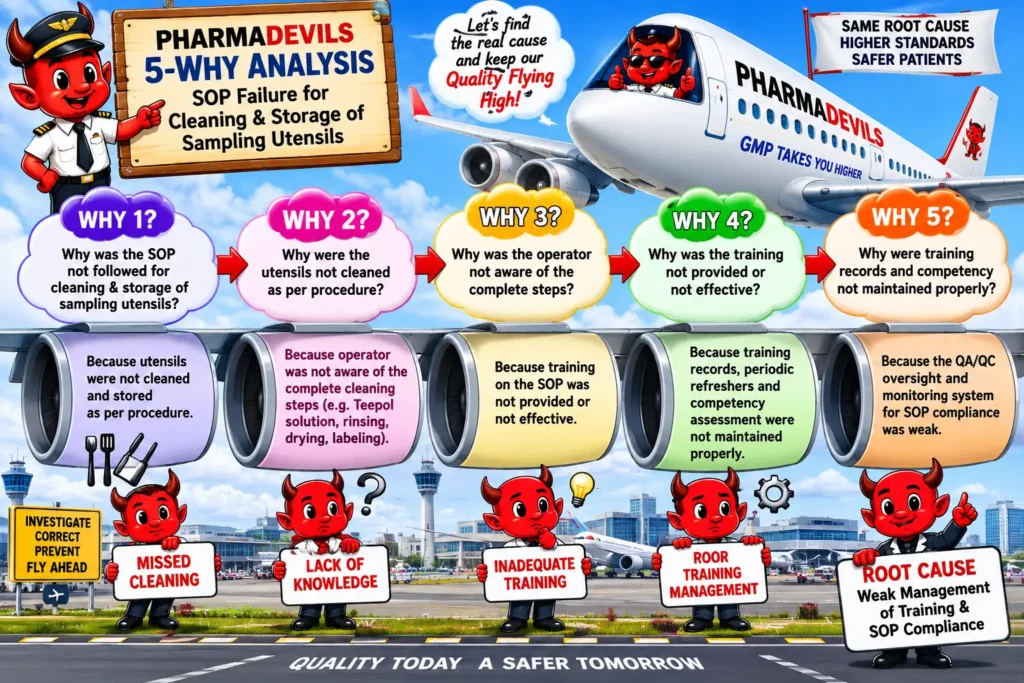
The SOP requires proper dismantling, rinsing, cleaning with 0.1% Teepol solution, final rinsing with purified water, drying at about 60°C, inspection, assembly, labeling, and appropriate storage of sampling utensils. It also specifies training responsibilities for QC personnel.The analysis concludes that the likely root cause is weak training management and inadequate monitoring of SOP compliance. The aeroplane-and-Devils design makes the investigation easy to understand and supports CAPA development, retraining, competency assessment, and stronger supervisory controls.
4. Fishbone Analysis for SOP Failure:
The Fishbone Analysis for SOP Failure in Cleaning & Storage of Sampling Utensils identifies possible causes of failure under major categories such as Man, Method, Machine/Tools, Material, Measurement/Documentation, and Environment/Management.
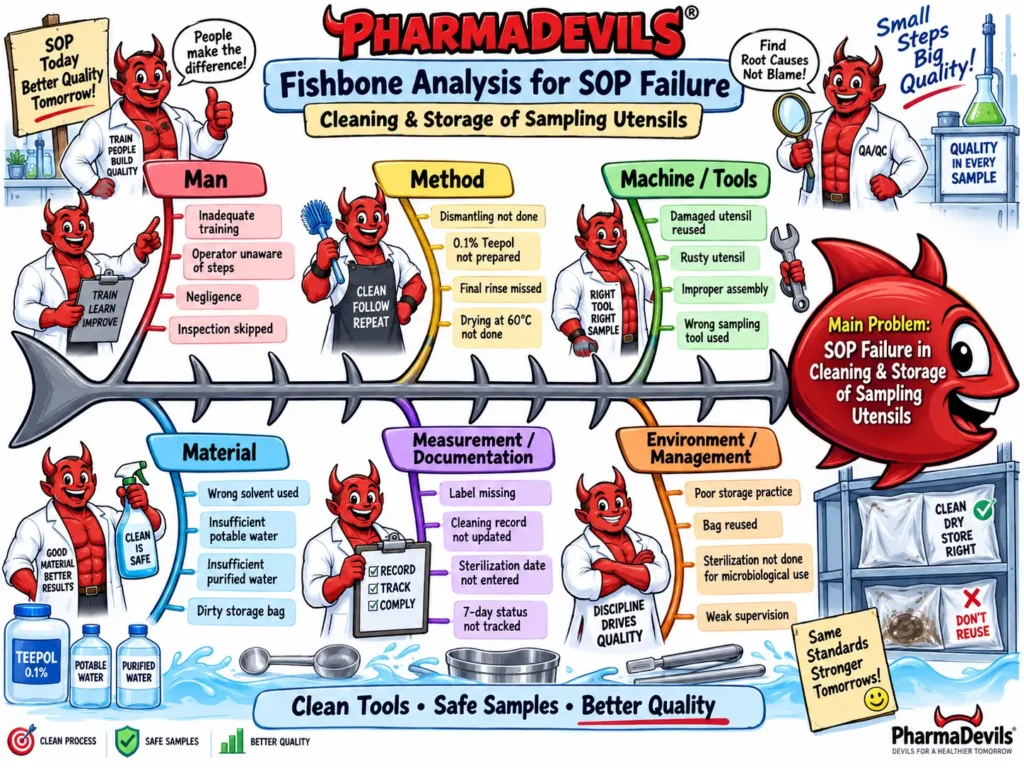
Key causes include inadequate training, operator negligence, incomplete dismantling, missed rinsing, incorrect preparation of 0.1% Teepol solution, improper drying at about 60°C, use of damaged or rusty utensils, unsuitable solvents, insufficient potable or purified water, missing labels, incomplete cleaning records, failure to document sterilization, poor storage practices, and weak supervision. These causes relate directly to critical cleaning, inspection, storage, sterilization, and documentation requirements defined in the SOP.The 6-pack Devils and tools-themed fishbone design makes root-cause identification visually engaging and supports systematic investigation, CAPA planning, employee training, and prevention of repeated SOP failures.
5. Fault Tree Analysis for SOP Failure:
The Fault Tree Analysis for SOP Failure in Cleaning & Storage of Sampling Utensils systematically breaks down the main failure event into possible contributing causes. The top event is the failure to follow the SOP, which may result from improper cleaning, inadequate drying, incorrect storage or labeling, and failure to sterilize utensils required for microbiological sampling.
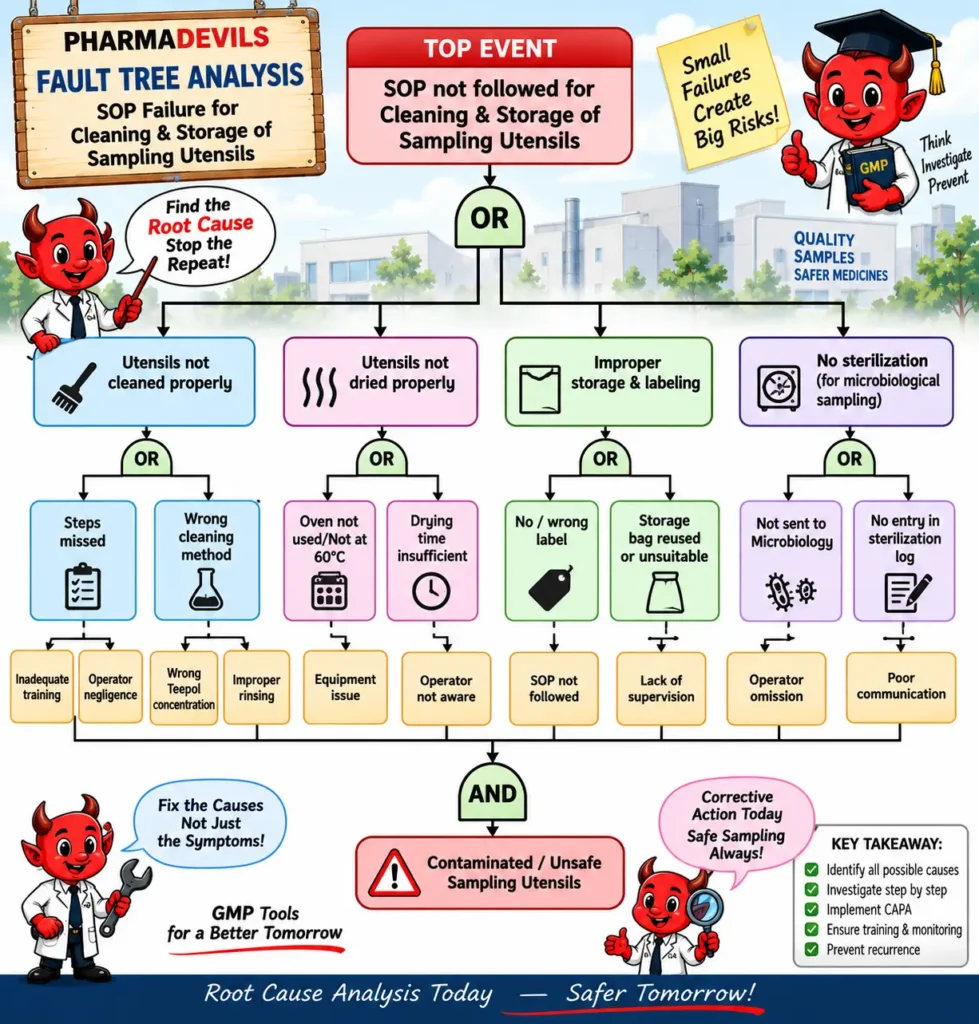
The SOP requires dismantling where possible, potable-water rinsing, cleaning with 0.1% Teepol solution, final rinsing with purified water, drying at about 60°C, inspection, assembly, labeling, and controlled storage. It also requires microbiological sampling accessories to be sterilized and the sterilization details recorded. The fault tree further highlights underlying causes such as missed steps, incorrect cleaning method, inadequate training, operator negligence, insufficient drying, wrong labeling, reused storage bags, weak supervision, and poor communication. The Devils-themed design provides short, easy-to-understand learning points and supports investigation, CAPA, training, and prevention of recurrence.
Questions & Answers – Cleaning & Storage of Sampling Utensils
- Q: What is the objective of this SOP?
A: To ensure proper procedures for cleaning and storage of sampling utensils. - Q: Where is this SOP applicable?
A: It is applicable to utensils used for sampling of materials. - Q: Who is responsible for this SOP?
A: Chemist QC and Assistant Manager QC. - Q: What are examples of sampling equipment?
A: Scoop, spatula, pipettes, sampling rods, and liquid sampling devices. - Q: Are disposable sampling accessories required to be cleaned?
A: No. The SOP states that cleaning is not required for disposable accessories. - Q: What should be done before cleaning reusable sampling equipment?
A: Dismantle the equipment wherever possible and transfer used utensils in a polybag to the washing area. - Q: What is used for the initial rinsing of sampling equipment?
A: An adequate quantity of potable water is used to remove visible material residue. - Q: What should be used for water-immiscible solvent residues?
A: Acetone or another suitable solvent should be used for rinsing. - Q: How should oily or sticky pipettes be rinsed?
A: They should be rinsed with hot water. - Q: What detergent solution is specified for cleaning?
A: A 0.1% Teepol solution prepared in water. - Q: Why should metallic-bristle brushes not be used vigorously?
A: Because they may scratch the utensil surface and create crevices. - Q: What is the final rinsing sequence?
A: First rinse with potable water to remove detergent, then rinse with purified water. - Q: At what temperature are sampling utensils dried?
A: In an oven at about 60°C. - Q: How should cleaned and dried utensils be stored?
A: They should be transferred into a polythene bag and labeled “Cleaned” with signature and date. - Q: Can the polythene bag used for dirty sampling utensils be reused?
A: No. It should be discarded after washing the utensils. - Q: What is required for utensils used in microbiological sampling?
A: After cleaning, they should be labeled “To be sterilized” and sent to the Microbiology QC Laboratory for sterilization. - Q: Where should sterilization details be recorded?
A: The sterilization date should be entered in the usage and cleaning log of sampling accessories. - Q: Within how many days should cleaned or sterilized utensils be used?
A: Within 7 days from the date of cleaning. - Q: What should be checked before using sampling utensils?
A: Ensure they are clean and free from blackening, rust, particles, or oil. - Q: What should be done if a utensil is damaged, dented, or has crevices?
A: It should be discarded and replaced with a new coded accessory.