





1. Introduction for Cleaning Validation for Oral Liquid (Mefenamic Acid):
This Cleaning Validation Protocol and Report describes how the cleaning procedure for equipment used to manufacture mefenamic acid oral liquid is evaluated. It covers tanks, transfer pumps, filters, a homogeniser, and the filling machine. The document assigns responsibilities to Production, Quality Assurance, Quality Control, and Engineering. It sets out worst-case product selection, maximum allowable carryover calculations, acceptance criteria, and a sampling plan. After cleaning, equipment is assessed by visual inspection and swab testing for product residue, detergent residue, and microbial burden. Analytical results are documented and reviewed to determine whether the cleaning procedure consistently meets the specified limits and prevents cross-contamination during product changeover.
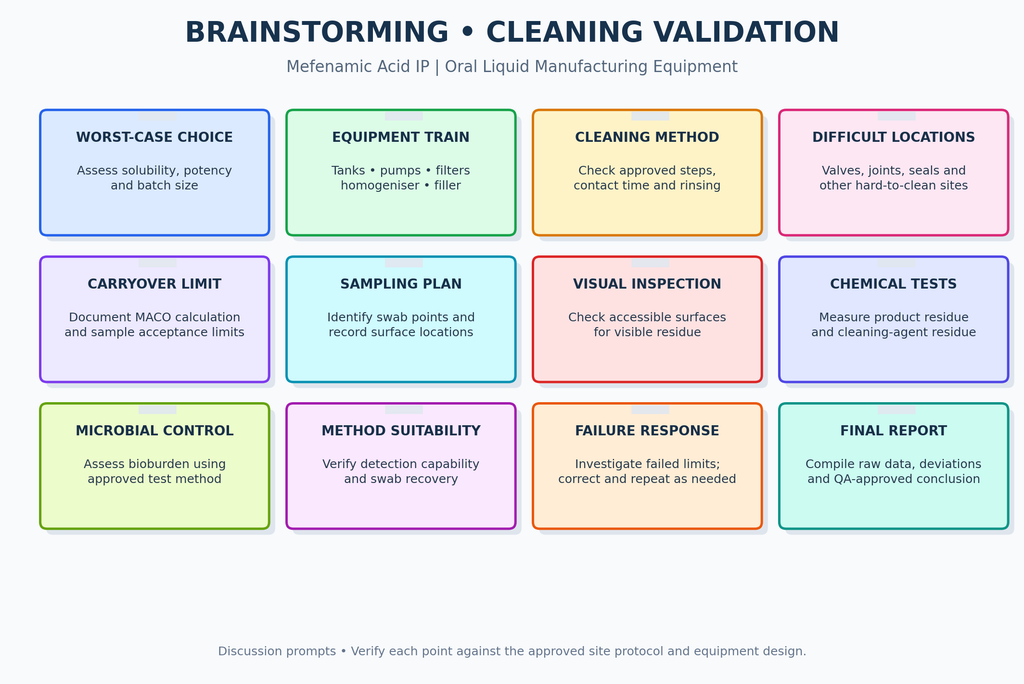
Skip to PDF content2. Flow Diagram for Cleaning Validation for Oral Liquid (Mefenamic Acid):
The flow diagram shows how the cleaning procedure for mefenamic acid oral liquid equipment is validated. First, the protocol is approved, the worst-case product and equipment are selected, and MACO limits and sampling points are defined. Equipment is then cleaned using the approved procedure. Visual inspection and swab sampling check hard-to-clean locations. Samples are tested for product residue, detergent residue, and microbial burden. If all results meet the predefined acceptance criteria, the findings are compiled and the validation report is approved. Any failure is investigated, corrective action is taken, and the affected activities are repeated before a conclusion is reached.
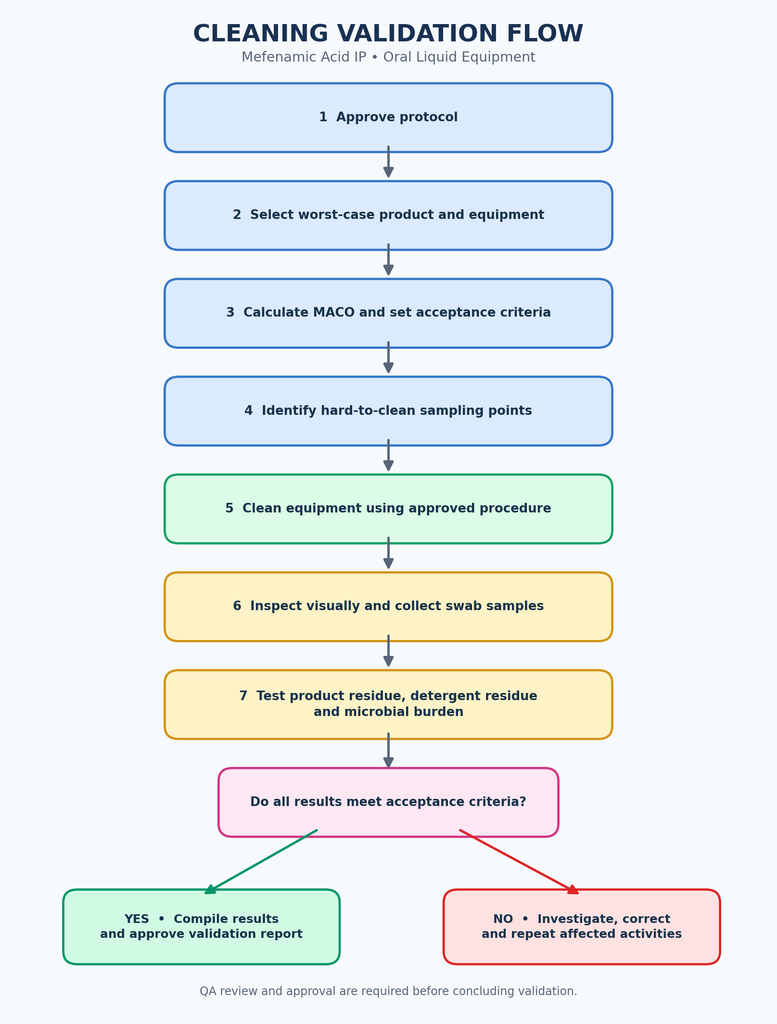
3. Brainstorming Diagram for Cleaning Validation for Oral Liquid (Mefenamic Acid):
The sticky-note diagram highlights key discussion points for cleaning validation of mefenamic acid oral liquid equipment. It covers worst-case selection, the equipment train, approved cleaning steps, and hard-to-clean locations. The team defines maximum allowable carryover (MACO), acceptance limits, and swab sampling points before execution. Visual inspection and laboratory testing assess product residue, cleaning-agent residue, and microbial burden. Method suitability, including detection capability and swab recovery, supports reliable results. Failed limits require investigation, correction, and appropriate repeat work. Finally, the team compiles raw data and deviations in a report for Quality Assurance review and approval.
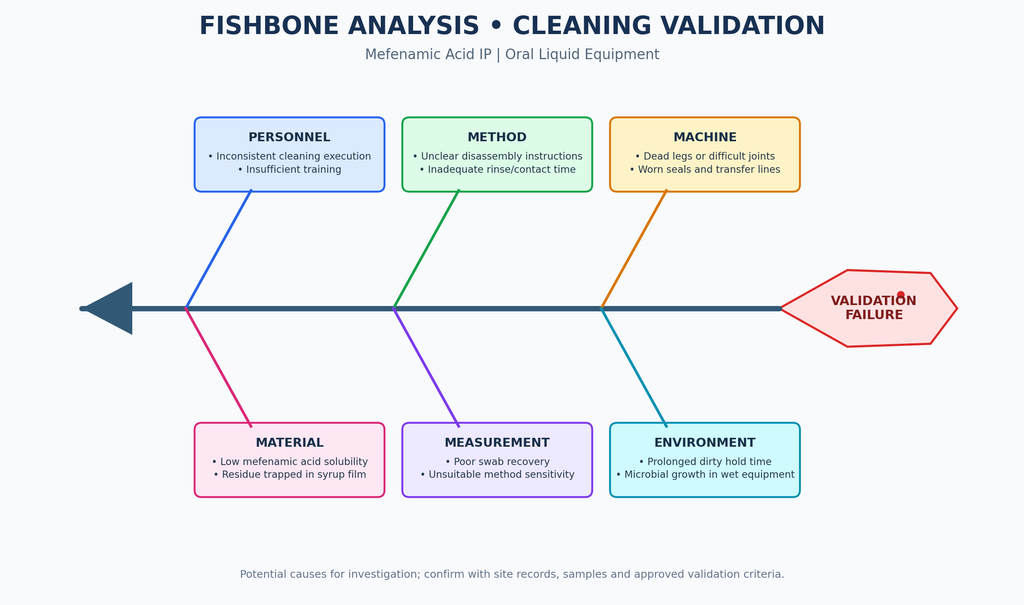
4. Fishbone Analysis for Cleaning Validation for Oral Liquid (Mefenamic Acid):
The fishbone diagram organizes potential causes of cleaning validation failure for mefenamic acid oral liquid equipment into six categories. Personnel factors include inconsistent cleaning and inadequate training. Method factors include unclear disassembly instructions and insufficient rinsing or contact time. Machine factors cover difficult joints, dead legs, and worn seals. Material factors include poorly soluble residue and syrup films. Measurement factors address swab recovery and analytical sensitivity, while environmental factors include prolonged dirty hold time and microbial growth in wet equipment. These are investigation prompts, not confirmed root causes. Site records, inspection findings, and test results must establish the actual cause.
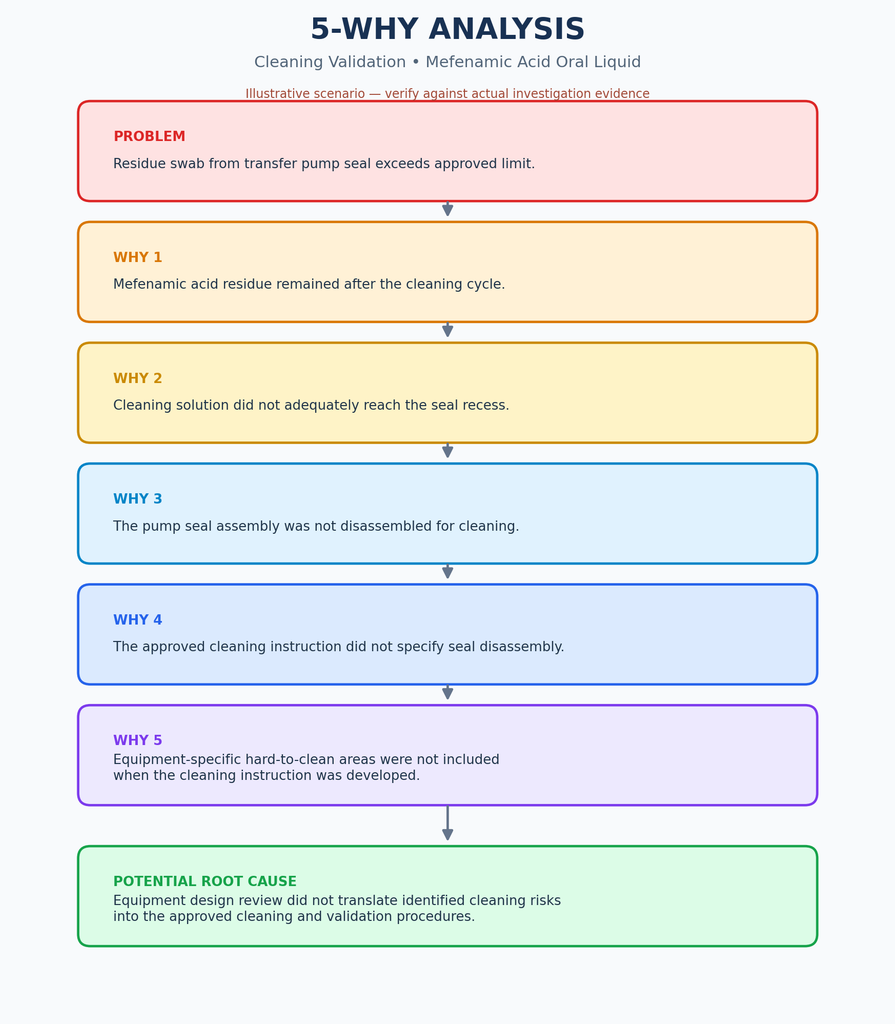
5. 5-Why Analysis for Cleaning Validation for Oral Liquid (Mefenamic Acid):
The 5-Why diagram examines an illustrative cleaning validation failure in which a swab from a transfer pump seal exceeds the approved mefenamic acid residue limit. It traces the result to residue remaining in a seal recess that cleaning solution did not adequately reach. The seal was not disassembled because the approved cleaning instruction did not require that step. The analysis suggests that equipment-specific cleaning risks may not have been incorporated into the procedure. This is a proposed cause, not a confirmed finding. Investigators must verify each link using equipment drawings, cleaning records, operator interviews, sampling details, and analytical results.
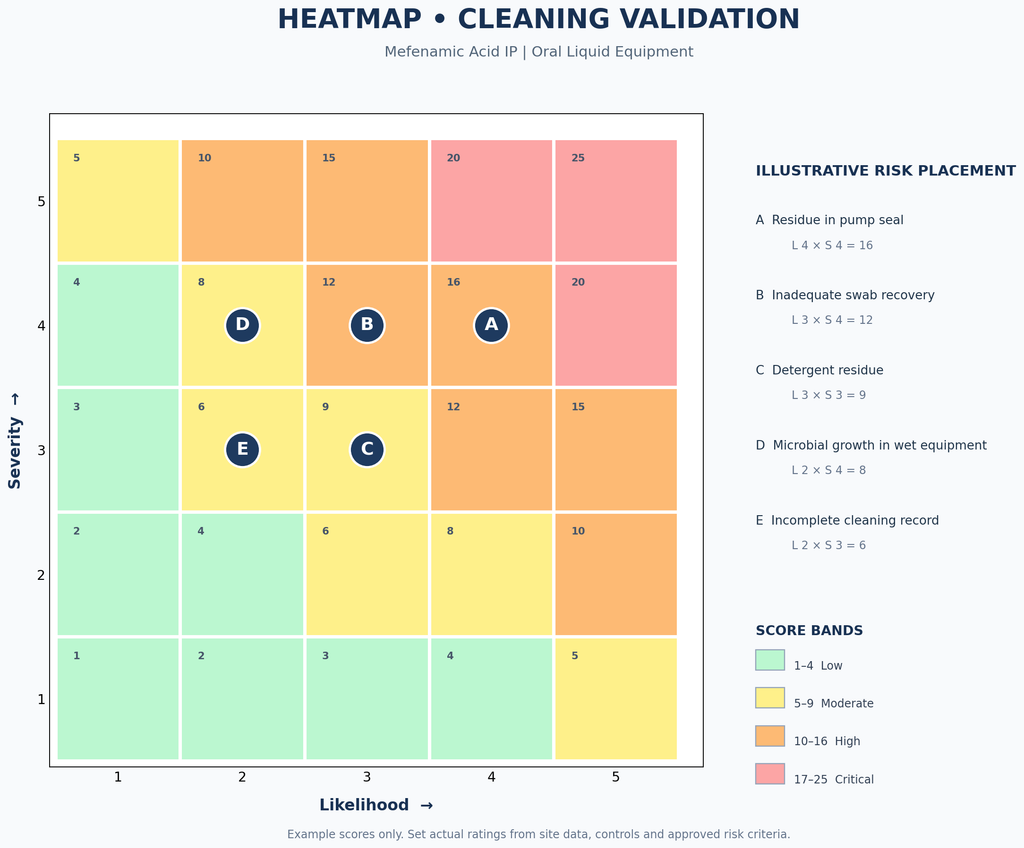
6. Heatmap Analysis for Cleaning Validation for Oral Liquid (Mefenamic Acid):
The heatmap illustrates potential cleaning validation risks for mefenamic acid oral liquid equipment using likelihood and severity scores from 1 to 5. Its example placements show residue trapped in a pump seal as the highest-rated risk, followed by inadequate swab recovery. Detergent residue, microbial growth in wet equipment, and incomplete cleaning records are also plotted. Colours distinguish low, moderate, high, and critical score bands, helping the team prioritize investigation and controls. These ratings are illustrative, not measured findings. Final scores must be justified using equipment design, cleaning history, sampling results, existing controls, and the site’s approved risk criteria.
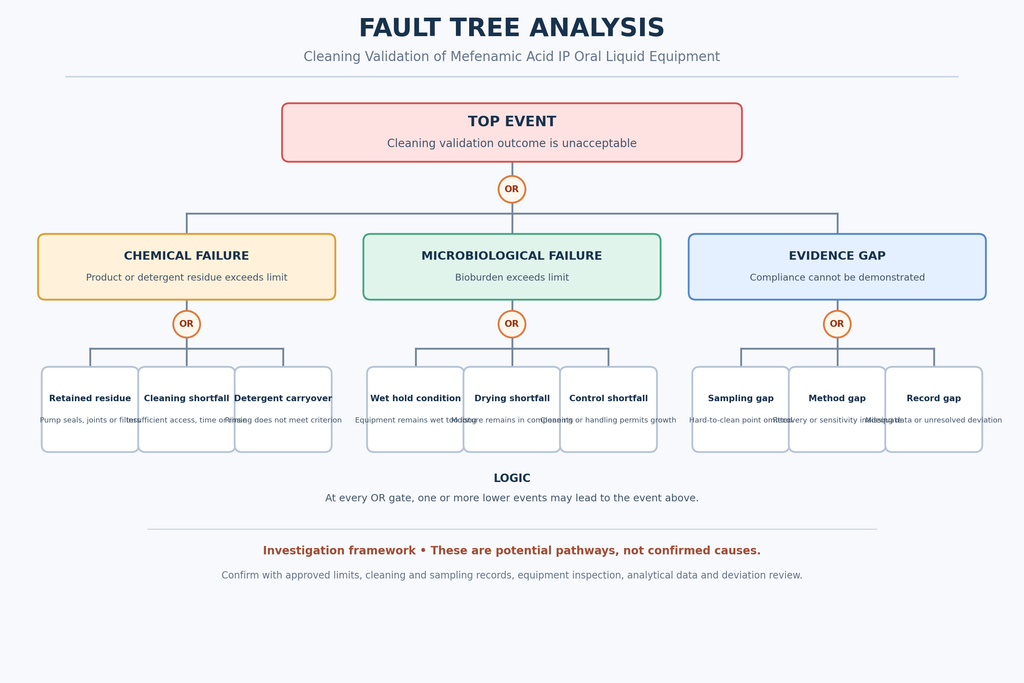
7. Fault Tree Analysis for Cleaning Validation for Oral Liquid (Mefenamic Acid):
The fault tree shows how cleaning validation for mefenamic acid oral liquid equipment could produce an unacceptable outcome. Three main routes are considered: product or detergent residue above its limit, microbial burden above its limit, or insufficient evidence to demonstrate a valid result. Possible contributing events include residue trapped in pump seals, incomplete rinsing, prolonged wet storage, inadequate drying, missed sampling locations, poor swab recovery, and incomplete records. Each OR gate means that any connected event could contribute to the outcome above it. These pathways are hypotheses; investigators must confirm them using equipment inspection, cleaning records, sampling data, and test results.
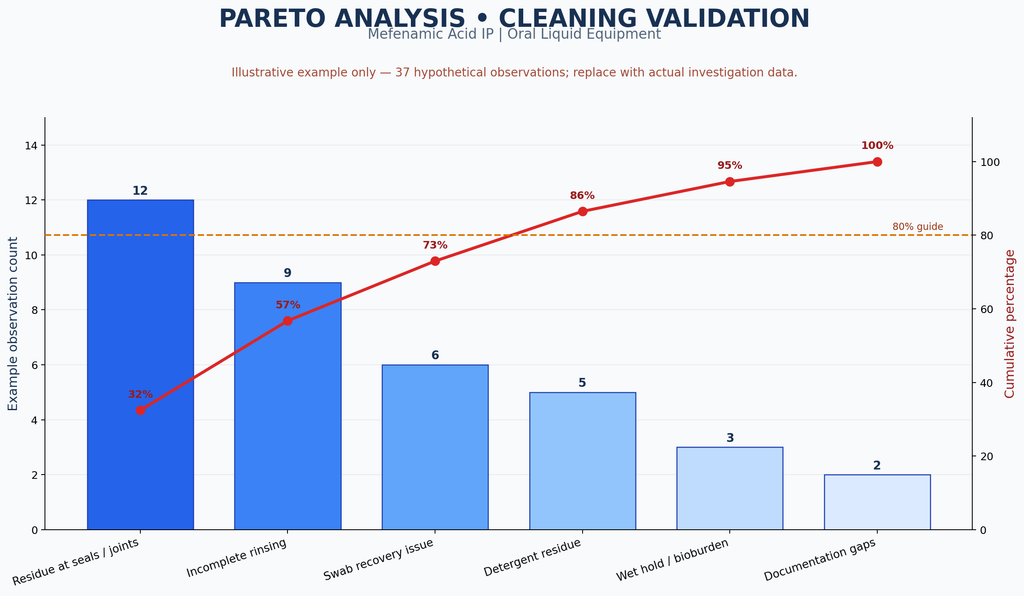
8. Pareto Chart for Cleaning Validation for Oral Liquid (Mefenamic Acid):
The Pareto chart ranks illustrative observations associated with cleaning validation of mefenamic acid oral liquid equipment. Residue at seals or joints appears most frequently, followed by incomplete rinsing and swab recovery issues. The bars show the number of observations in each category, while the red line shows their cumulative percentage. The dashed 80% guide helps identify which categories may deserve attention first. The chart uses 37 hypothetical observations and does not represent measured site performance. Replace these counts with actual deviation, inspection, and test records before drawing conclusions or prioritizing corrective actions for the facility.
9. Corrective and Preventive Action (CAPA)
Cleaning Validation of Mefenamic Acid Oral Liquid Equipment
This is a proposed CAPA framework for a failed residue, detergent, or microbial result. The earlier diagrams used illustrative causes; the final actions must follow the documented investigation.
| Stage | Proposed action | Evidence for closure |
|---|---|---|
| Immediate containment | Identify the affected equipment and prevent its use for the next product until QA assesses and authorizes its status. Open a deviation. Identify batches manufactured since the last acceptable cleaning verification and assess possible carryover impact. | Equipment status record, deviation, batch impact assessment, QA decision |
| Investigate | Review the failed result and raw data; confirm sample identity, location, swab recovery, method suitability, and calculations. Examine cleaning records, operator execution, equipment drawings, seals, joints, filters, and relevant hold times. Document the supported root cause. | Approved investigation with evidence for each conclusion |
| Corrective action | Correct the confirmed issue. For example, if residue is retained at a pump seal, assess whether seal disassembly, access, cleaning steps, or rinsing need revision. Clean affected equipment using an approved instruction, then resample and test against the existing approved limits. | Approved procedure or work record, cleaning record, passing results |
| Preventive action | Update the cleaning SOP, equipment-specific instructions, sampling plan, and training where the investigation identifies gaps. Assess comparable pumps, seals, and other product-contact equipment for the same issue. Manage changes through change control and determine the required validation work. | Approved revisions, training records, documented equipment review, change control |
| Effectiveness review | Review the next cleaning validation or verification results and subsequent routine cleaning records over a QA-approved monitoring period. Confirm that critical sampling points meet residue, detergent, visual, and microbial criteria, with no repeat of the same cause. | Effectiveness report and QA-approved CAPA closure |
Acceptance rule: A passing result after repeat cleaning does not, by itself, establish that the original failure has been resolved. QA should close the CAPA only after the cause, affected-product impact, procedure changes, and effectiveness evidence have been evaluated. FDA guidance emphasizes predetermined cleaning standards and scientifically sound sampling and analytical methods; EU GMP Annex 15 addresses cleaning validation within qualification and validation requirements. FDA cleaning validation guide, FDA equipment CGMP Q&A, EU GMP Volume 4
10. Questions and Answers: Cleaning Validation of Mefenamic Acid Oral Liquid:
1. What is the purpose of this cleaning validation?
To demonstrate that the approved cleaning procedure consistently reduces product residue, cleaning-agent residue, and microbial burden to their predefined acceptance limits on shared oral liquid equipment.
2. Which equipment is covered by the attached protocol?
The protocol covers tanks, transfer pumps, filters, a homogeniser, and the filling machine used in oral liquid manufacturing.
3. Why is a worst-case product selected?
A justified worst-case selection challenges the cleaning procedure under demanding conditions. The attached protocol considers factors including solubility, potency, and batch size.
4. What is MACO?
Maximum allowable carryover (MACO) is the calculated maximum quantity of residue permitted to carry from one product into the next. The approved calculation is used to establish relevant acceptance limits.
5. Why are hard-to-clean locations sampled?
Residue may remain in locations such as seals, joints, valves, or other difficult-to-access product-contact areas even when accessible surfaces look clean. Sampling these points helps challenge the cleaning procedure.
6. Is visual inspection alone sufficient?
No. Visual inspection is one check in the protocol. Swab samples and the specified chemical and microbiological tests provide further evidence against the approved limits.
7. What is tested after cleaning?
The protocol describes assessment of earlier-product residue, detergent residue, and microbial burden, along with visual inspection.
8. What should happen if a swab result exceeds its limit?
Document the failure, control the equipment’s use, investigate the result and its potential impact, and determine corrective action. Repeat cleaning or sampling under approved instructions as appropriate. QA should assess the complete evidence before accepting the validation outcome.
9. Why must swab recovery and analytical sensitivity be considered?
The sampling and test methods must be capable of detecting residue at the established limit. Poor recovery or insufficient sensitivity could make an apparently passing result unreliable.
10. When can the cleaning validation report be approved?
After the required activities and results have been reviewed against the protocol, deviations have been assessed, and the documented evidence supports the conclusion. Approval should reflect the actual study results, including any failures and their resolution.
11. Reference Guidelines — Cleaning Validation of Mefenamic Acid Oral Liquid:
| Reference | Relevant use |
|---|---|
| EU GMP Annex 15 — Qualification and Validation | Primary reference for planning, executing, documenting, and reviewing cleaning validation, including acceptance criteria, sampling, and deviations. |
| FDA — Validation of Cleaning Processes | FDA inspection reference for written cleaning procedures, protocols, residue limits, sampling, analytical methods, and final reports. Its stated scope is chemical residues. |
| FDA — CGMP Questions and Answers: Equipment | Explains the purpose of cleaning validation and the need for scientifically sound sampling and analytical methods. |
| EU GMP Annex 9 — Manufacture of Liquids, Creams and Ointments | Dosage-form context for manufacturing oral liquids and controlling contamination. |
| ICH Q9(R1) — Quality Risk Management | Framework for documenting the rationale behind worst-case selection, sampling priorities, and risk review. |