







1. Introduction – Clobetasol Propionate, Neomycin Sulphate, Miconazole Nitrate & Chlorocresol Cream:
The Batch Manufacturing Record (BMR) of Clobetasol Propionate, Neomycin Sulphate, Miconazole Nitrate & Chlorocresol Cream is a comprehensive pharmaceutical manufacturing document designed to ensure the consistent production, quality, safety, and traceability of a topical semisolid formulation in accordance with Good Manufacturing Practices (GMP).
The formulation contains four important ingredients:
- Clobetasol Propionate IP (0.05% w/w): A potent topical corticosteroid that helps reduce inflammation, redness, itching, and swelling.
- Neomycin Sulphate IP (0.5% w/w): An antibiotic used to control susceptible bacterial infections.
- Miconazole Nitrate IP (2.0% w/w): An antifungal agent used against susceptible fungal infections.
- Chlorocresol IP (0.1% w/w): A preservative that helps protect the formulation against microbial contamination.
The BMR provides systematic instructions for manufacturing the cream, including raw material dispensing, material verification, equipment clearance, water-phase preparation, oil-phase preparation, emulsification, active pharmaceutical ingredient addition, homogenization, cooling, pH adjustment, and final bulk quality control. The manufacturing process involves controlled heating of the water and oil phases, emulsion formation using a homogenizer, and sequential incorporation of the active ingredients at specified temperatures. Critical manufacturing parameters include mixing speed, homogenization time, temperature control, and the final pH specification of 5.0–7.0. The document also incorporates GMP requirements for personnel safety, equipment cleaning, line clearance, in-process monitoring, batch yield calculation, material reconciliation, and Quality
Skip to PDF content2. Flow Diagram – Clobetasol Propionate, Neomycin Sulphate, Miconazole Nitrate & Chlorocresol Cream (BMR):
The manufacturing flow diagram illustrates the systematic production of Clobetasol Propionate, Neomycin Sulphate, Miconazole Nitrate and Chlorocresol Cream under Good Manufacturing Practices (GMP). The process begins with raw material dispensing and verification, followed by separate preparation of water and oil phases at 70–75°C. Both phases undergo emulsification and homogenization to achieve a uniform cream base.
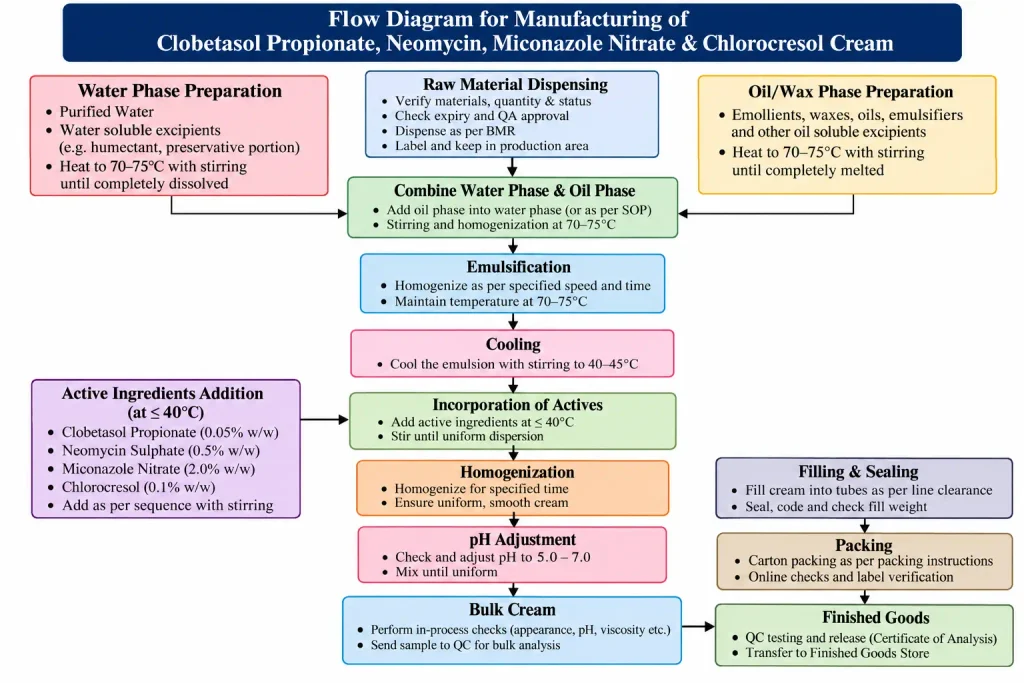
Active ingredients are incorporated sequentially at specified temperatures with controlled mixing. The formulation undergoes pH adjustment within 5.0–7.0, followed by in-process quality checks, bulk sampling and transfer. Subsequent filling, sealing, packing and quality assurance activities ensure product consistency, traceability and compliance with approved specifications.
3. Critical Process Parameters (CPP) and Critical Quality Attributes (CQA) of Clobetasol Propionate, Neomycin Sulphate, Miconazole Nitrate & Chlorocresol Cream (BMR):
The Critical Process Parameters (CPP) and Critical Quality Attributes (CQA) diagram illustrates essential manufacturing controls and quality requirements for Clobetasol Propionate, Neomycin Sulphate, Miconazole Nitrate and Chlorocresol Cream. Critical process parameters include water and oil phase temperatures of 70–75°C, controlled mixing speed, homogenization time, sequential addition of active ingredients, cooling conditions, and pH adjustment. These parameters are monitored to ensure consistent emulsification, uniform distribution of ingredients, and product stability.
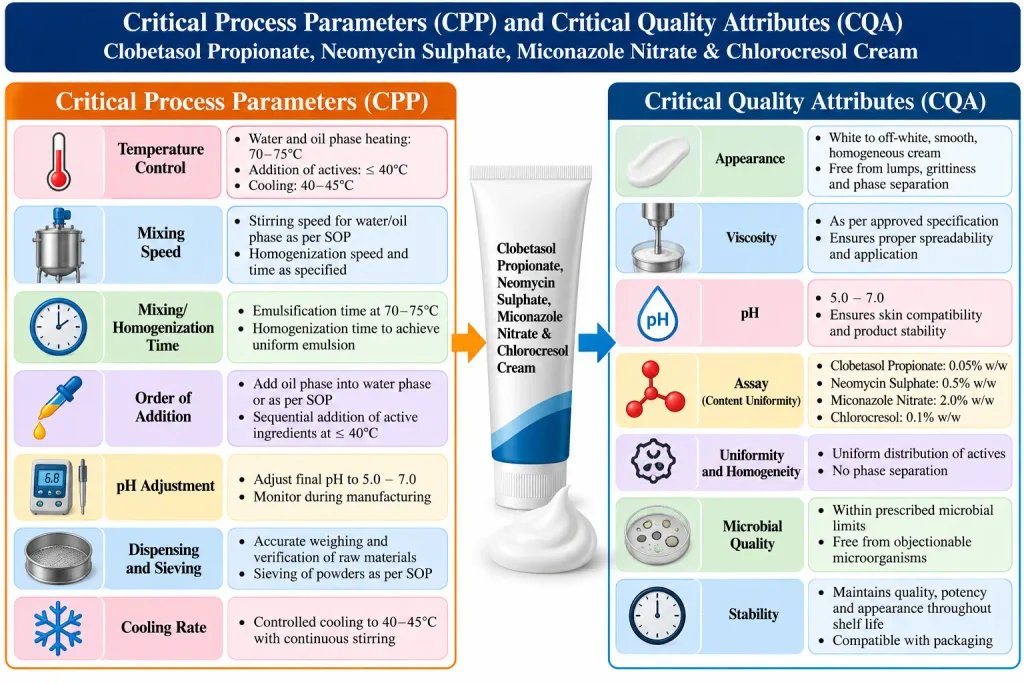
Critical Quality Attributes include physical appearance, viscosity, pH, assay, content uniformity, microbial quality, homogeneity, and stability. The finished cream should exhibit a smooth, homogeneous consistency without lumps, grittiness, or phase separation. The specified pH range is 5.0–7.0, while active ingredient content must comply with approved specifications. Effective CPP monitoring and CQA evaluation help minimize manufacturing variability, maintain batch-to-batch consistency, ensure product quality, and support compliance with Good Manufacturing Practices (GMP) and regulatory requirements.