






1. Introduction – SOP for Collection and Disposal of Waste and Rejected Material from Plant:
The SOP for Collection and Disposal of Waste and Rejected Material from Plant provides a controlled system for the proper collection, segregation, handling, reconciliation, destruction, and disposal of waste and rejected materials generated during pharmaceutical manufacturing activities. Waste materials such as polythene bags, gloves, masks, shoe covers, papers, drums, cable ties, and disposable caps are collected in labeled polybags and transferred to the scrap yard. Rejected materials including tablets, capsules, blends, placebo, dust, and other non-recoverable products are separately collected and disposed of through designated waste containers or the Effluent Treatment Plant, as applicable. The procedure also includes handling of oral liquid rejects, printed packing materials, aluminum foil, blisters, and containers through recovery, defacing, shredding, or destruction. Proper documentation, reconciliation, approval, and retention of destruction records ensure traceability, accountability, GMP compliance, and prevention of mix-ups, contamination, and unauthorized reuse of rejected materials.
Skip to PDF content2. Flow Diagram – SOP for Collection and Disposal of Waste and Rejected Material from Plant:
The SOP for Collection and Disposal of Waste and Rejected Material from Plant describes a systematic process for segregation, collection, handling, reconciliation, destruction, and final disposal of waste generated from manufacturing and non-process areas. General waste such as gloves, masks, shoe covers, papers, polybags, and disposable items is collected in labeled polybags and transferred to the scrap yard. Rejected materials such as tablets, capsules, blends, placebo, dust, and oral liquid rejects are collected separately and disposed of through designated waste containers or the ETP as applicable.
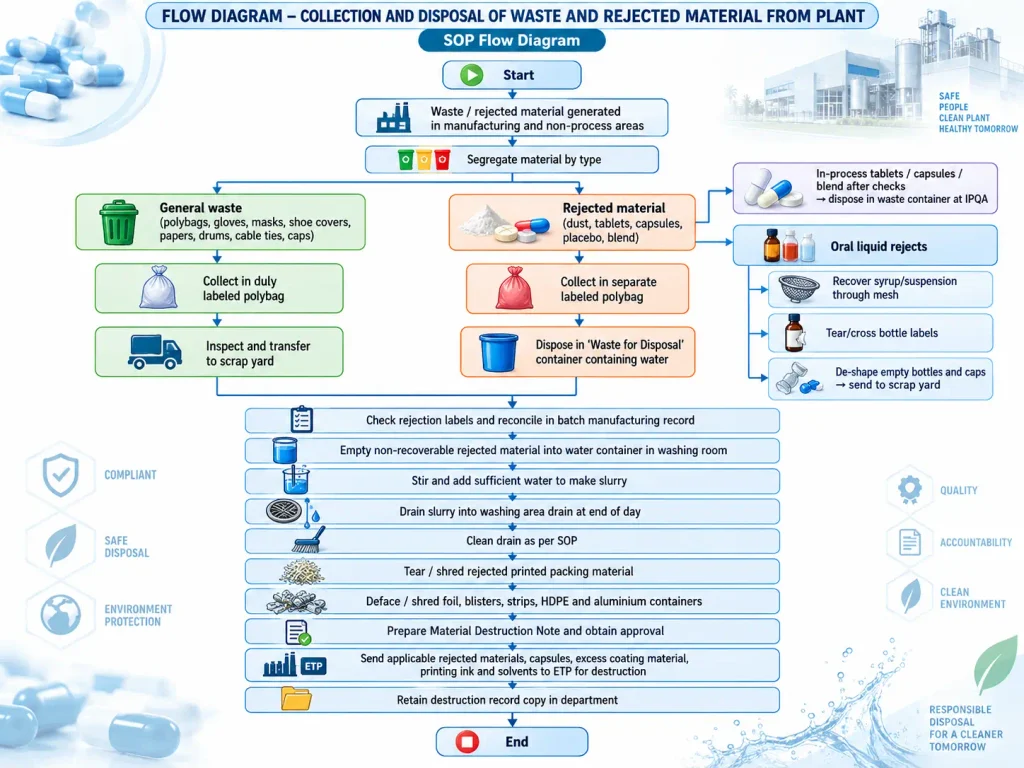
The procedure also includes reconciliation of rejected material in the batch manufacturing record, preparation of slurry for non-recoverable materials, shredding or defacing of rejected printed packaging components, and preparation of the Material Destruction Note before approved destruction. Proper documentation and controlled disposal help maintain GMP compliance, traceability, environmental protection, and prevention of unauthorized reuse.
3. Benefits of Following SOP for Collection and Disposal of Waste and Rejected Material from Plant:
Following the SOP for Collection and Disposal of Waste and Rejected Material from Plant ensures that waste and rejected materials are handled in a controlled, safe, and traceable manner. Proper segregation of general waste, rejected tablets, capsules, blends, oral liquids, and packaging components helps prevent cross-contamination and mix-ups. The SOP also requires reconciliation, defacing or shredding of rejected packaging materials, controlled destruction, and transfer of applicable waste to the scrap yard or ETP, reducing the possibility of unauthorized reuse.
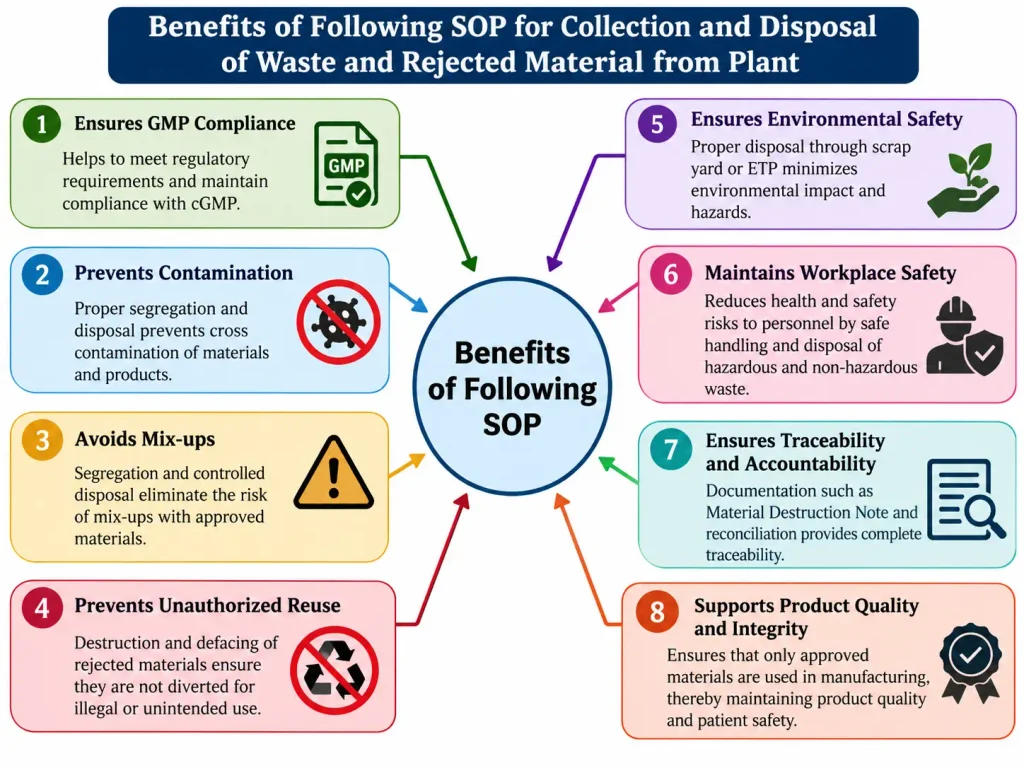
Approved Material Destruction Notes and retained destruction records improve accountability and traceability. Overall, adherence to this SOP supports GMP compliance, workplace cleanliness, environmental protection, product quality, and safe waste-management practices throughout the pharmaceutical plant.
4. Brainstorming for SOP Failure – Collection and Disposal of Waste and Rejected Material from Plant:
The Brainstorming for SOP Failure – Collection and Disposal of Waste and Rejected Material from Plant identifies potential reasons why the waste disposal procedure may not be followed effectively. Major causes include inadequate training, unclear SOP instructions, improper segregation of waste, use of incorrect or unlabeled containers, poor housekeeping, insufficient supervision, non-reconciliation of rejected materials, incomplete documentation, and failure to deface or shred rejected packaging materials.
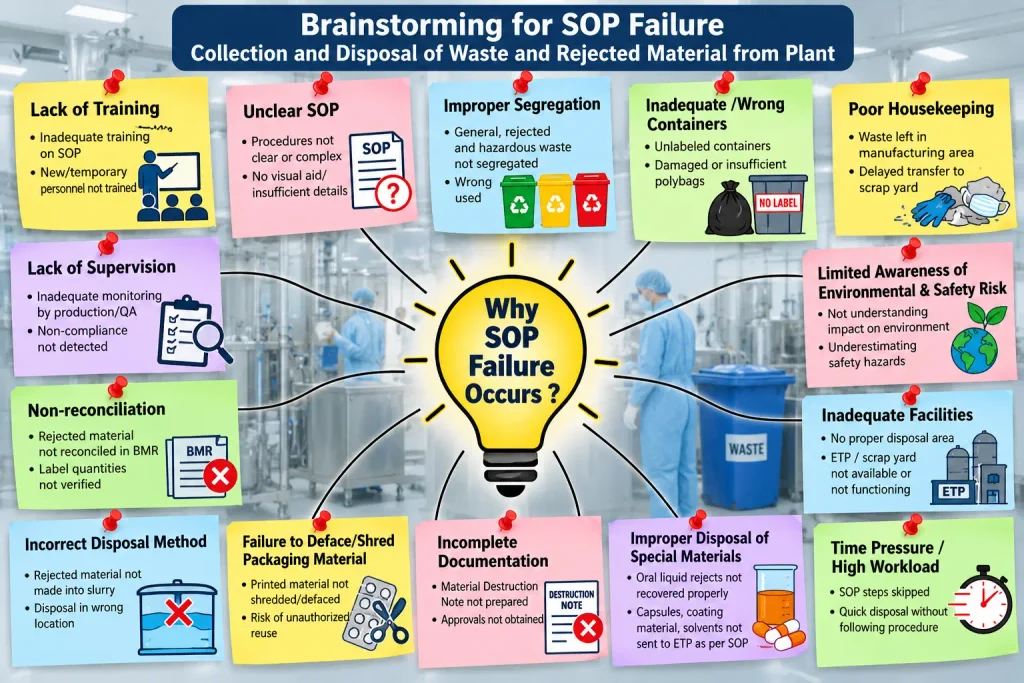
The SOP requires rejected materials to be properly collected, labeled, reconciled in batch records, disposed of through designated waste containers, and applicable materials to be sent for controlled destruction. Weak control of these steps can lead to contamination, mix-ups, traceability gaps, unauthorized reuse, environmental hazards, and GMP non-compliance. The brainstorming exercise helps identify these failure modes so that appropriate training, supervision, documentation control, infrastructure, and CAPA can be implemented.
5. 5-Why Analysis for SOP Failure – Collection and Disposal of Waste and Rejected Material from Plant:
The 5-Why Analysis for SOP Failure – Collection and Disposal of Waste and Rejected Material from Plant is used to identify the underlying root causes behind failures in waste segregation, labeling, reconciliation, destruction, documentation, and final disposal. The analysis begins with visible problems such as mixing waste categories, using unlabeled containers, failing to dispose of rejected material correctly, not defacing rejected printed packaging material, missing BMR reconciliation, incomplete Material Destruction Notes, or failure to send applicable waste to the ETP.
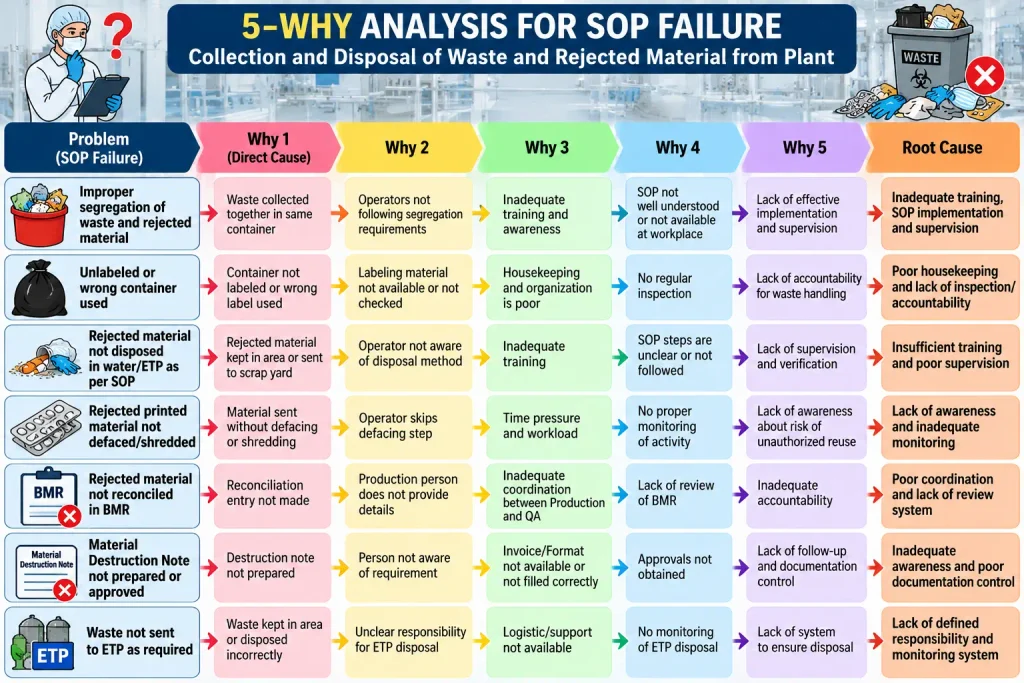
These issues are progressively traced through repeated “Why” questions to deeper causes such as inadequate training, poor SOP understanding, weak supervision, insufficient monitoring, poor housekeeping, unclear responsibilities, lack of coordination between Production and QA, and ineffective documentation control. The SOP itself requires controlled collection, reconciliation, defacing or shredding, documented destruction, and approved disposal routes, making these root causes critical areas for corrective and preventive action.
6. Fishbone Analysis for SOP Failure – Collection and Disposal of Waste and Rejected Material from Plant:
The Fishbone Analysis for SOP Failure – Collection and Disposal of Waste and Rejected Material from Plant identifies the major categories of causes that can lead to ineffective waste and rejected-material handling. These causes are grouped under Man/Personnel, Method/Procedure, Material, Machine/Tools/Containers, Environment/Area, and Management/Measurement/Documentation. Personnel-related causes include inadequate training, poor awareness, and failure to follow instructions. Method-related causes include unclear procedures, missed reconciliation, improper destruction practices, and failure to prepare the Material Destruction Note.
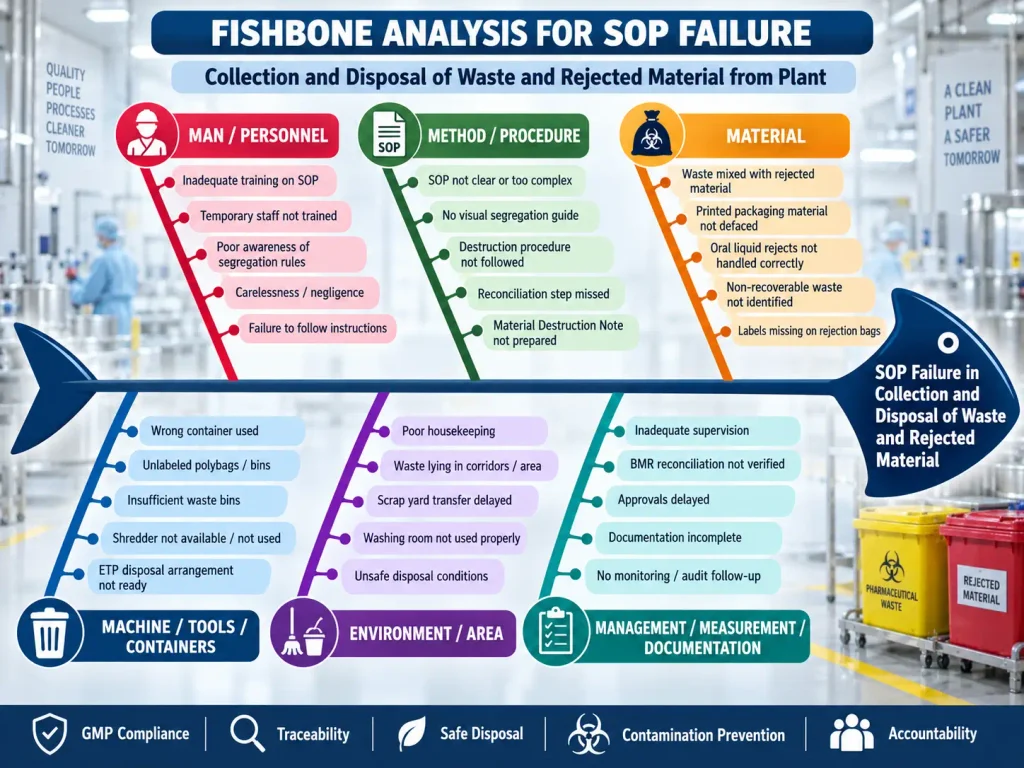
Material and equipment-related causes include mixed waste, missing labels, incorrect containers, insufficient bins, and non-use of shredding or ETP arrangements. Environmental and management causes include poor housekeeping, delayed scrap-yard transfer, inadequate supervision, incomplete documentation, and lack of audit follow-up. The analysis helps identify systematic weaknesses so that focused CAPA can be implemented to strengthen GMP compliance, traceability, safe disposal, contamination prevention, and accountability.
7. Fault Tree Analysis for SOP Failure – Collection and Disposal of Waste and Rejected Material from Plant:
The Fault Tree Analysis for SOP Failure – Collection and Disposal of Waste and Rejected Material from Plant evaluates how different failures can combine to result in improper waste and rejected-material handling. The top event is failure of correct collection and disposal, which may arise from incorrect segregation, incomplete reconciliation or documentation, failure to deface or shred rejected packaging material, use of the wrong disposal route, or ineffective SOP implementation. The SOP requires waste and rejected materials to be separately collected, appropriately labeled, reconciled, destroyed or defaced where applicable, and routed to the scrap yard or ETP according to the defined procedure.
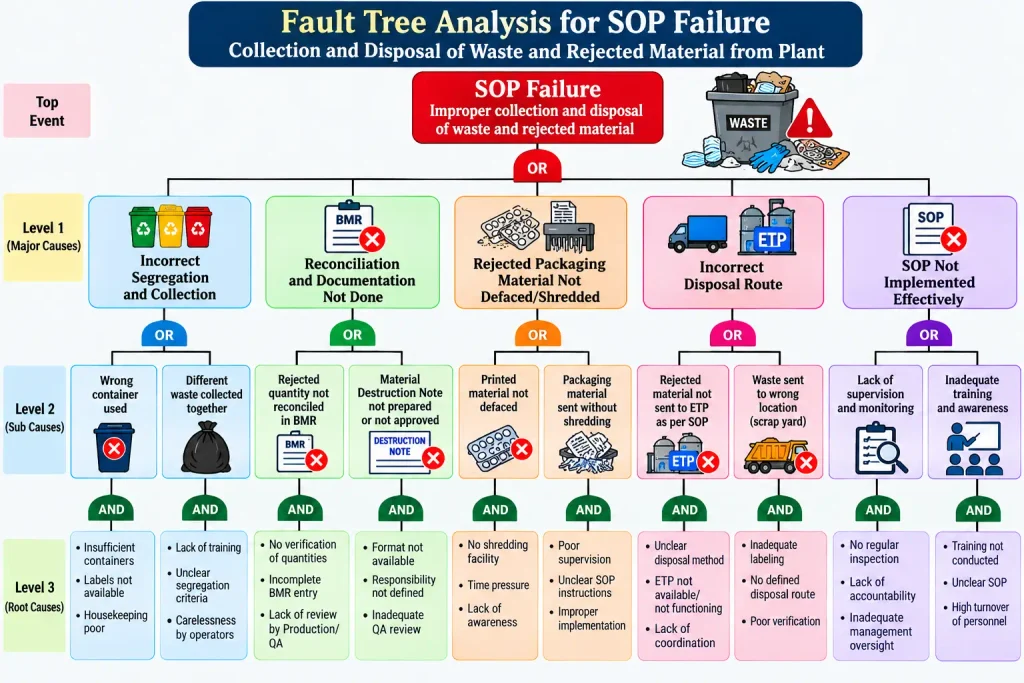
The fault tree further traces these events to root causes such as inadequate training, lack of supervision, unclear responsibilities, unavailable labels or containers, incomplete BMR entries, missing Material Destruction Notes, poor monitoring, and insufficient coordination. Identifying these causes helps establish focused CAPA and strengthens GMP compliance, traceability, safe disposal, and accountability.
8. Impact Assessment for SOP Failure – Collection and Disposal of Waste and Rejected Material from Plant:
The Impact Assessment for SOP Failure – Collection and Disposal of Waste and Rejected Material from Plant evaluates the possible consequences when waste and rejected materials are not properly segregated, labeled, reconciled, destroyed, documented, or transferred through the approved disposal route. The SOP requires controlled collection of general and rejected waste, reconciliation of non-recoverable material, shredding or defacing of rejected printed packaging, preparation of a Material Destruction Note, and transfer of applicable material to the ETP.
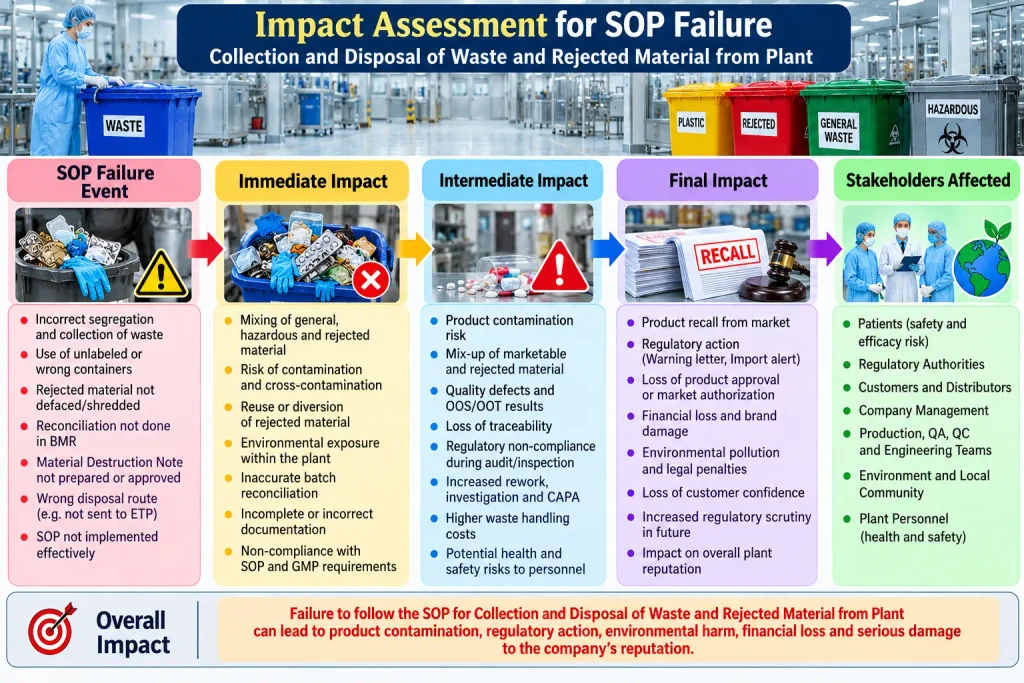
Failure in these controls may result in contamination, mix-ups, unauthorized reuse, traceability gaps, incomplete documentation, unsafe waste handling, and environmental concerns. Such failures can also increase investigation and CAPA requirements and may adversely affect GMP compliance, product quality, personnel safety, and plant operations. The assessment helps determine the seriousness of each failure and supports appropriate corrective and preventive actions.
9. CAPA for SOP Failure – Collection and Disposal of Waste and Rejected Material from Plant:
The CAPA for SOP Failure – Collection and Disposal of Waste and Rejected Material from Plant focuses on correcting existing waste-handling deficiencies and preventing their recurrence through systematic controls. Corrective actions may include immediate segregation of mixed waste, proper labeling of containers, completion of rejected-material reconciliation, defacing or shredding of rejected printed packaging materials, preparation of pending destruction records, and transfer of applicable waste to the approved disposal route or ETP. These actions directly support the SOP requirements for controlled collection, reconciliation, destruction, and disposal.
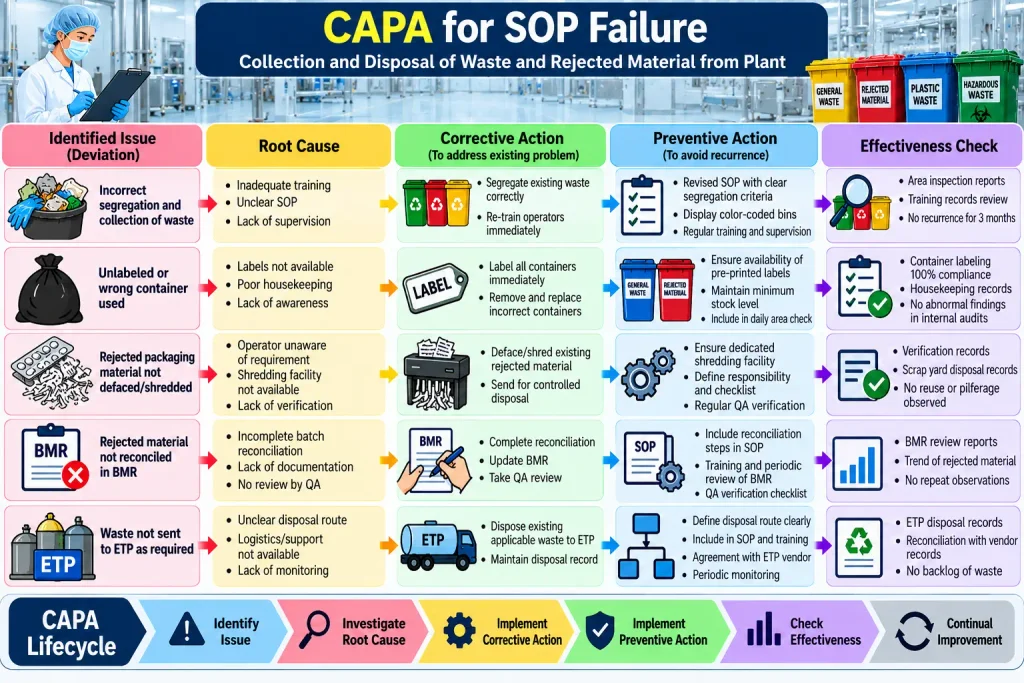
Preventive actions should include refresher training, clear segregation criteria, availability of labeled containers, defined responsibilities, strengthened QA verification, periodic area inspections, improved documentation control, and regular monitoring of disposal activities. Effectiveness can be checked through BMR review, destruction records, waste-area inspections, ETP disposal records, and confirmation that similar deviations do not recur.
Questions & Answers – SOP for Collection and Disposal of Waste and Rejected Material from Plant:
- What is the objective of this SOP?
The objective is to define the procedure for collection and disposal of waste and rejected material generated from the manufacturing area. - What is the scope of this SOP?
It covers the collection and disposal of waste and rejected material from the manufacturing area. - Who is responsible for execution of this SOP?
Concerned Production personnel and the Production Chemist are responsible for execution of the SOP. - How should general waste be collected?
General waste such as polythene bags, gloves, papers, shoe covers, masks, disposable caps, cable ties, and drums should be collected in a duly labeled polybag and transferred to the scrap yard. - How should rejected tablets, capsules, blend, dust, and placebo be handled?
They should be collected separately in a duly labeled polybag and disposed of in the designated “Waste for Disposal” container containing water. - How should waste from non-process areas be handled?
Waste from packing halls, change rooms, and external corridors should be collected in a separate polybag and transferred to the scrap yard. - How should in-process tablets, capsules, and blend samples be disposed of?
They should be disposed of in the “Waste for Disposal” container containing water provided in IPQA. - How are rejected syrup and suspension bottles handled?
Syrup and suspension should be recovered through an appropriate mesh, bottle labels should be torn or crossed, and caps and empty bottles should be de-shaped and sent to the scrap yard. - Why is reconciliation of rejected material necessary?
Non-recoverable rejected material must be reconciled in the Batch Manufacturing Record to maintain proper accountability and traceability. - How is non-recoverable rejected material converted into slurry?
It is emptied into a container containing water in the washing room, stirred, and sufficient water is added to form slurry. - How should rejected printed packing material be handled?
Rejected printed packing material should be torn or shredded, while printed aluminum foil, empty blisters, strips, HDPE, and aluminum containers should be defaced or shredded. - What document is required before destruction of rejected material?
A Material Destruction Note must be prepared and approved before applicable rejected material is sent for destruction. - Where are certain rejected materials finally sent for destruction?
Applicable rejected materials, placebo, product-development batches, expired materials, capsule waste, coating material, printing ink, and solvents are sent to the ETP for destruction as specified in the SOP. - What records are provided as annexures in this SOP?
The annexures include the Material Destruction Note and the Non-Recoverable Waste Destruction Record.
Reference Guidelines – SOP for Collection and Disposal of Waste and Rejected Material from Plant:
- WHO Good Manufacturing Practices (GMP) – requirements for prevention of contamination, mix-ups, and controlled handling of rejected and waste materials.
- Schedule M of the Drugs and Cosmetics Rules, India – GMP requirements for pharmaceutical manufacturing premises, sanitation, waste handling, rejected materials, and documentation.
- PIC/S Guide to Good Manufacturing Practice (PE 009) – expectations for handling rejected, recovered, returned, and waste materials under controlled conditions.
- EU GMP, Part I – particularly requirements related to premises, production, documentation, and rejected materials.
- ICH Q7 – Good Manufacturing Practice Guide for Active Pharmaceutical Ingredients – relevant principles for waste control, rejected materials, labeling, and documentation where applicable.
- Environmental Protection and Biomedical/Industrial Waste Rules applicable in India – for lawful segregation, storage, transport, treatment, and disposal of waste depending on waste classification.