







1. Introduction – Collection and Storage of Purified Water Before Sanitisation or Stoppage of the Loop:
The SOP for Collection and Storage of Purified Water Before Sanitisation or Stoppage of the Loop describes the controlled procedure for collecting, storing, handling, using, and disposing of purified water when the purified water circulation loop is planned for sanitisation or temporary shutdown. During sanitisation or planned stoppage, purified water cannot be drawn directly from the loop; therefore, sufficient water is collected beforehand after receiving information from the Maintenance Department. Purified water is collected in a clean stainless-steel container with a lid, after rinsing the container and lid with purified water. The filled container is properly closed, identified with a status label, and stored at the designated location. When required for rinsing activities, the water is handled using a cleaned stainless-steel scoop or mug while minimizing contamination risk. Any remaining stored purified water is discarded at the end of the day’s operation. This SOP supports controlled water handling and GMP compliance during temporary loop unavailability.
Skip to PDF content2. Flow Diagram – SOP for Collection and Storage of Purified Water Before Sanitisation or Stoppage of the Loop:
The SOP for Collection and Storage of Purified Water Before Sanitisation or Stoppage of the Loop provides a controlled sequence for ensuring availability of purified water when the water loop is under sanitisation or planned shutdown. The process begins with receiving intimation from the Maintenance Department, followed by selection of a clean stainless-steel container with lid. The container and lid are rinsed with purified water before collection. Purified water is then filled into the container, the lid is closed, and a duly completed status label is affixed before storage in the washing room or other applicable area.
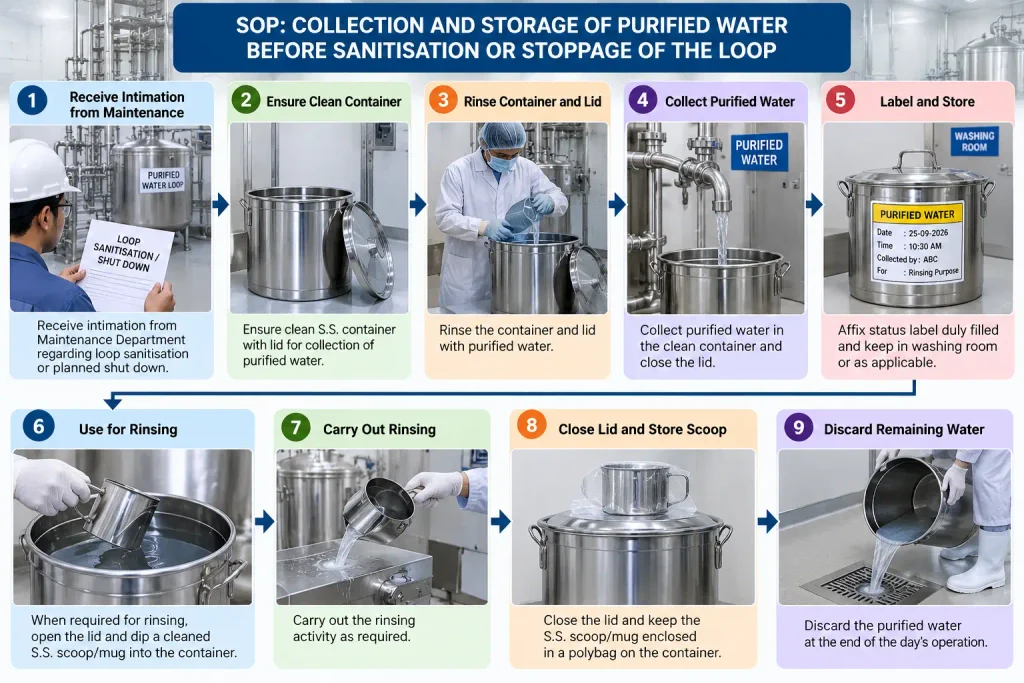
When required for rinsing activities, a cleaned stainless-steel scoop or mug is used to withdraw the water. After use, the container is reclosed and the scoop or mug is protected in a polybag. Any remaining purified water is discarded at the end of the day’s operation.
3. Benefits of Following SOP for Collection and Storage of Purified Water Before Sanitisation or Stoppage of the Loop:
Following the SOP for Collection and Storage of Purified Water Before Sanitisation or Stoppage of the Loop helps ensure that purified water remains available for required rinsing activities during planned sanitisation or temporary shutdown of the loop. The procedure requires use of a clean stainless-steel container with lid, rinsing of the container before collection, proper closure, status labeling, and controlled storage.
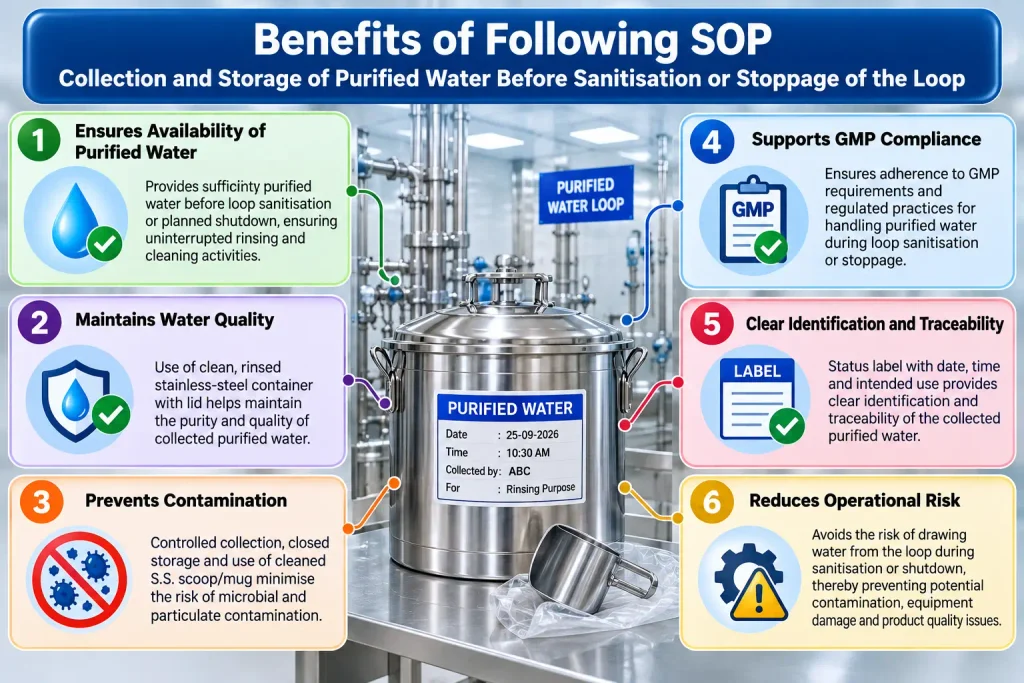
These controls help maintain the quality of collected purified water, minimize the possibility of contamination, and provide clear identification of the stored water. The SOP also specifies use of a cleaned stainless-steel scoop or mug for withdrawal, followed by proper closure and protected storage of the utensil. Remaining purified water is discarded at the end of the day, reducing the risk of prolonged storage or unintended reuse. Overall, following the SOP supports consistent operations, traceability, controlled handling, and GMP-compliant practices during loop sanitisation or stoppage.
4. Brainstorming for SOP Failure – Collection and Storage of Purified Water Before Sanitisation or Stoppage of the Loop:
The Brainstorming Analysis for SOP Failure of Collection and Storage of Purified Water Before Sanitisation or Stoppage of the Loop identifies possible causes that may lead to failure of the defined procedure. Potential issues include inadequate training, failure to receive maintenance intimation, use of an unclean or unsuitable stainless-steel container, damaged lids, improper rinsing, incorrect labeling, and use of an unclean scoop or mug. The SOP specifically requires collection before sanitisation, use of a clean S.S. container with lid, rinsing of the container and lid, proper labeling, controlled storage, use of a cleaned S.S. scoop or mug, and disposal of remaining water at the end of the day.
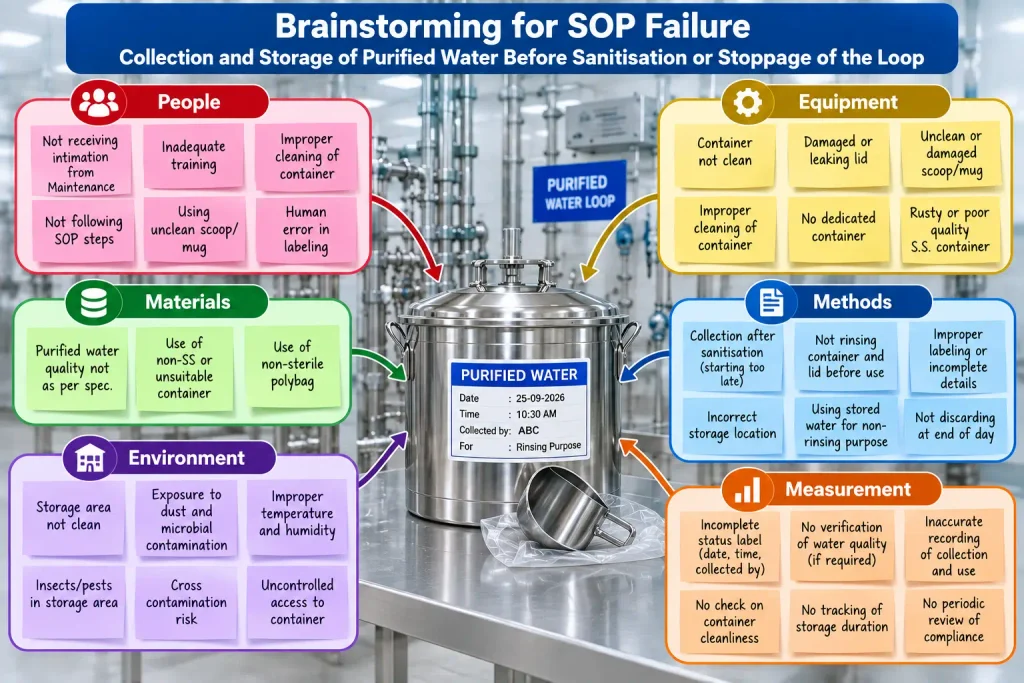
Brainstorming also considers environmental and documentation-related risks such as poor storage conditions, cross-contamination, incomplete status labels, and failure to verify compliance. Identifying these potential failure points helps the team focus on training, equipment condition, hygiene, documentation, and procedural discipline to maintain purified-water quality and GMP compliance.
5. 5-Why Analysis for SOP Failure – Collection and Storage of Purified Water Before Sanitisation or Stoppage of the Loop:
The 5-Why Analysis for SOP Failure – Collection and Storage of Purified Water Before Sanitisation or Stoppage of the Loop is used to identify the underlying causes that may result in purified water not being collected and stored as required before loop sanitisation or shutdown. The SOP requires Production to collect purified water before sanitisation after receiving intimation from the Maintenance Department and to store it in a clean, rinsed stainless-steel container with a lid.
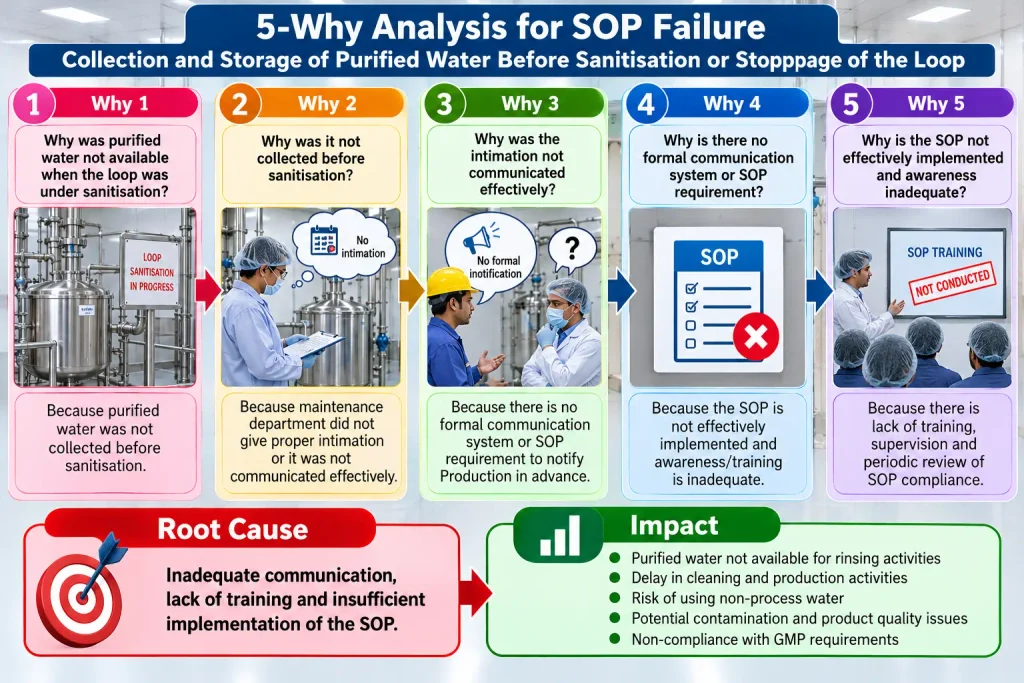
The analysis traces the failure from non-availability of purified water to delayed or missed collection, inadequate communication of maintenance intimation, and ineffective implementation of the SOP. It further highlights possible gaps in training, supervision, and periodic compliance review. Identifying these causes helps establish focused corrective actions such as strengthening communication, improving SOP training, ensuring timely collection, and verifying adherence to the approved procedure. These controls help prevent disruption of rinsing activities and reduce the risk of procedural non-compliance.
6. Fishbone Analysis for SOP Failure – Collection and Storage of Purified Water Before Sanitisation or Stoppage of the Loop:
The Fishbone Analysis for SOP Failure – Collection and Storage of Purified Water Before Sanitisation or Stoppage of the Loop identifies potential causes that can lead to failure in collecting, storing, labeling, handling, or using purified water during planned loop sanitisation or stoppage. The analysis groups possible causes under People, Equipment, Materials, Methods, Environment, and Measurement. Key causes include inadequate SOP training, failure to receive maintenance intimation, use of unclean or damaged containers, improper lid closure, unsuitable scoops or mugs, incorrect labeling, failure to rinse the container and lid, improper storage, and incomplete records. The SOP specifically requires purified water to be collected before sanitisation, stored in a clean rinsed stainless-steel container with lid, properly labeled, and handled using a cleaned S.S. scoop or mug.
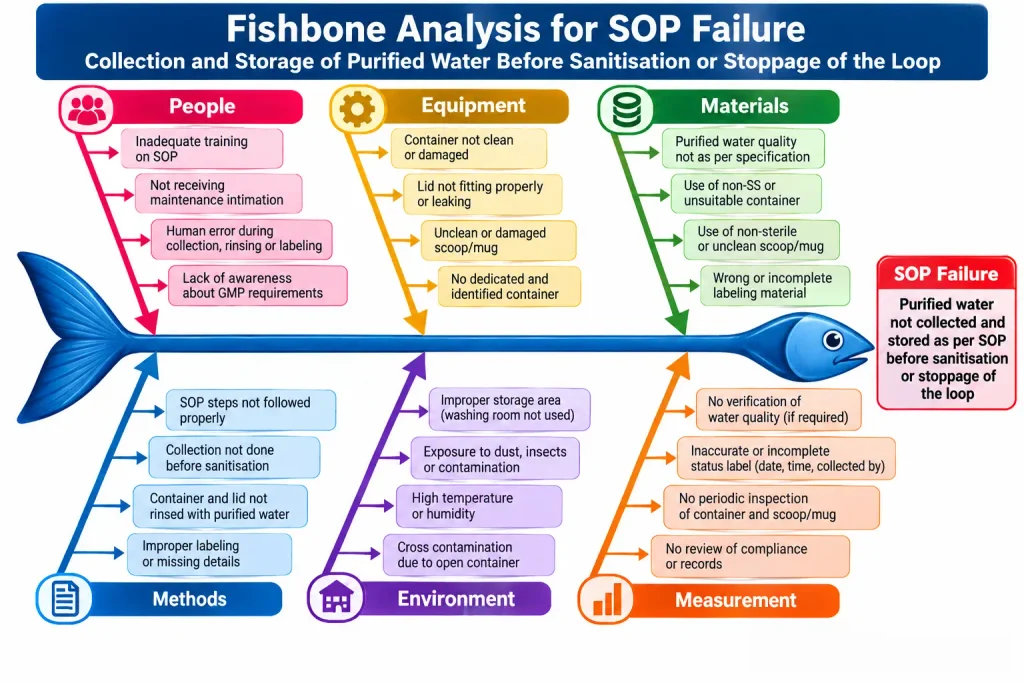
This fishbone analysis helps systematically identify contributing factors so that targeted corrective and preventive actions can be established to improve SOP compliance, contamination control, traceability, and reliable availability of purified water.
7. Fault Tree Analysis for SOP Failure – Collection and Storage of Purified Water Before Sanitisation or Stoppage of the Loop:
The Fault Tree Analysis for SOP Failure – Collection and Storage of Purified Water Before Sanitisation or Stoppage of the Loop identifies the main events that may lead to failure of the approved procedure. The top event is considered as purified water not being collected and stored as required before sanitisation or planned stoppage of the loop. The SOP requires prior collection after intimation from Maintenance, use of a clean stainless-steel container with lid, rinsing of the container and lid, proper labeling, controlled storage, use of a cleaned S.S. scoop or mug, and disposal of remaining water at the end of the day.
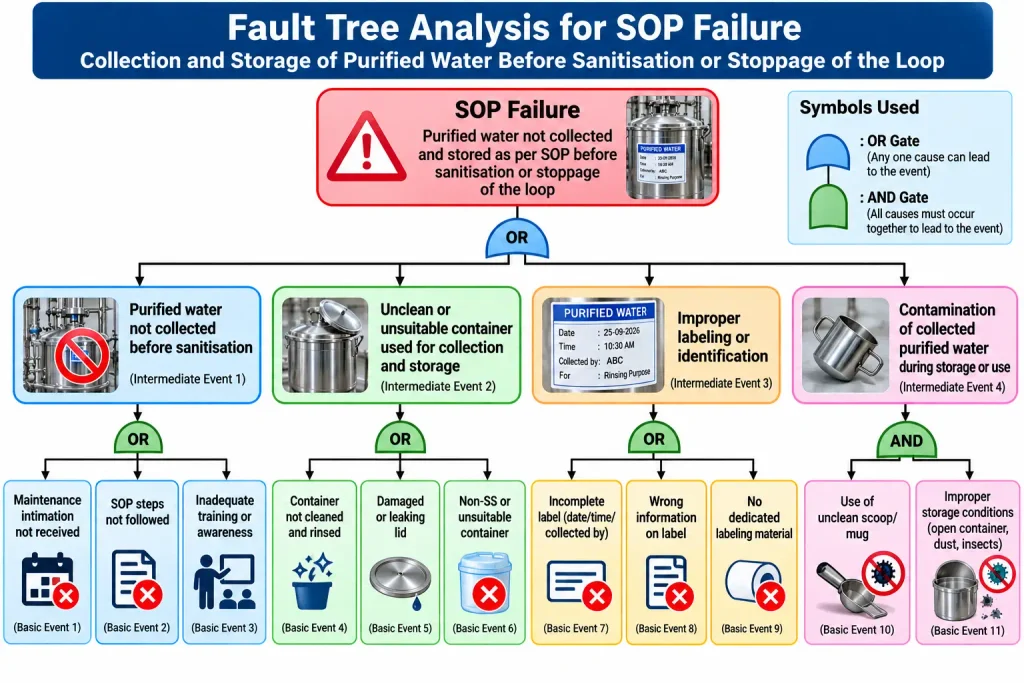
The fault tree further breaks the failure into possible causes such as missed maintenance intimation, SOP steps not being followed, inadequate training, use of an unsuitable or unclean container, damaged lid, incomplete labeling, improper storage, and contamination during handling. This analysis helps identify critical failure paths and supports focused CAPA to strengthen communication, training, equipment condition, labeling, storage control, and procedural compliance.
8. Impact Assessment – Collection and Storage of Purified Water Before Sanitisation or Stoppage of the Loop:
Failure to follow the SOP for Collection and Storage of Purified Water Before Sanitisation or Stoppage of the Loop may affect the availability, quality, and controlled use of purified water during sanitisation or planned shutdown of the loop. If purified water is not collected in advance, required rinsing activities may be delayed or interrupted. The SOP specifically requires collection before sanitisation, use of a clean stainless-steel container with lid, rinsing of the container and lid, proper status labeling, controlled storage, and disposal of remaining water at the end of the day.
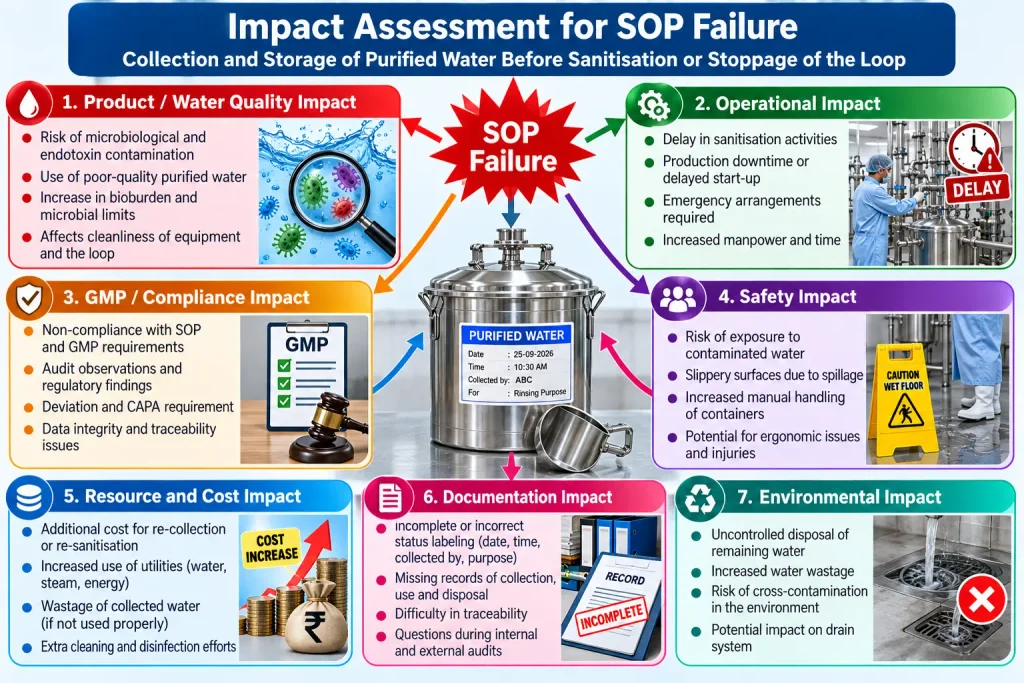
Potential impacts include increased risk of contamination, use of improperly stored water, labeling or traceability errors, operational delays, and non-compliance with the approved procedure. Improper handling with an unclean scoop or mug may further compromise water quality. Overall, SOP failure can affect hygiene control, documentation reliability, production support activities, and GMP compliance, and therefore requires prompt assessment and appropriate corrective and preventive actions.
9. CAPA for SOP Failure – Collection and Storage of Purified Water Before Sanitisation or Stoppage of the Loop:
The CAPA for SOP Failure – Collection and Storage of Purified Water Before Sanitisation or Stoppage of the Loop is intended to correct identified deficiencies and prevent recurrence of failures associated with purified-water collection, storage, labeling, handling, and use. The SOP requires purified water to be collected before sanitisation after intimation from Maintenance, stored in a clean stainless-steel container with lid, properly rinsed, labeled, handled with a cleaned S.S. scoop or mug, and discarded at the end of the day.
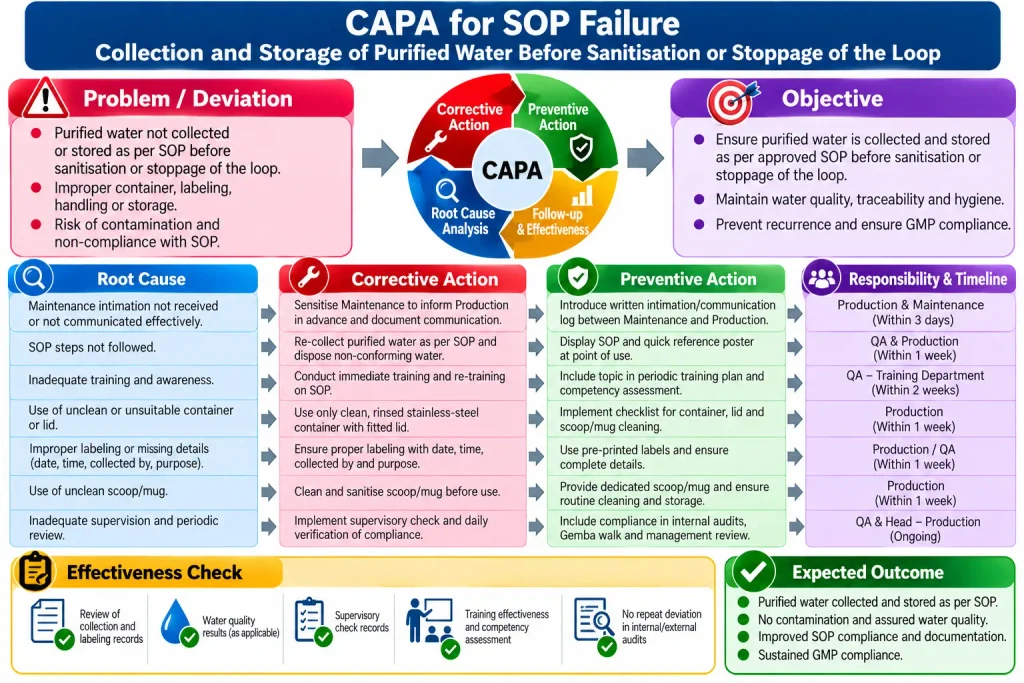
Corrective actions may include immediate retraining, proper communication between Maintenance and Production, use of suitable clean containers, correct labeling, and replacement of contaminated or improperly stored water. Preventive actions should strengthen written communication, training effectiveness, supervisory checks, cleaning verification, and periodic compliance review. Effectiveness should be confirmed through review of records, training assessments, supervisory verification, and absence of repeat deviations. These measures support sustained GMP compliance, traceability, and controlled purified-water handling.
Questions & Answers – SOP for Collection and Storage of Purified Water Before Sanitisation or Stoppage of the Loop:
- Q: What is the objective of this SOP?
A: To describe the procedure for collection and storage of purified water before sanitisation or stoppage of the loop. - Q: When should purified water be collected?
A: Purified water should be collected before sanitisation after receiving intimation from the Maintenance Department. - Q: Can purified water be taken from the loop during sanitisation?
A: No. Purified water cannot be taken from the loop during sanitisation or during a planned loop shutdown. - Q: In which type of container should purified water be collected?
A: It should be collected in a clean stainless-steel container provided with a lid. - Q: What should be done before collecting purified water in the container?
A: The container and its lid should be rinsed with purified water. - Q: What should be done after collecting purified water?
A: The lid should be closed, a duly filled status label should be affixed, and the container should be stored in the washing room or applicable designated area. - Q: How should purified water be withdrawn for rinsing?
A: The lid should be opened and a cleaned stainless-steel scoop or mug should be dipped into the container. - Q: What should be done with the scoop or mug after use?
A: The container lid should be closed and the S.S. scoop or mug should be kept enclosed in a polybag on the container. - Q: How long can the collected purified water be retained?
A: The SOP states that remaining purified water should be discarded at the end of the day’s operation. - Q: Who is responsible for preparation and execution of this SOP?
A: Concerned Production personnel and the Production Chemist are responsible for preparation and execution of the SOP. - Q: What is the reference specified in the SOP?
A: The SOP states the reference as GMP. - Q: What is the main purpose of following this procedure?
A: The procedure ensures controlled collection, storage, use, and disposal of purified water when the loop is unavailable due to sanitisation or planned stoppage.
Reference Guidelines – SOP for Collection and Storage of Purified Water Before Sanitisation or Stoppage of the Loop:
- WHO Good Manufacturing Practices (GMP) for pharmaceutical products, particularly requirements related to utilities, sanitation, contamination control, and documentation.
- EU Guidelines for Good Manufacturing Practice, EudraLex Volume 4, including relevant requirements for pharmaceutical water systems, hygiene, equipment, and controlled procedures.
- PIC/S Guide to Good Manufacturing Practice for Medicinal Products, PE 009, for GMP control of utilities, sanitation, equipment, and documentation.
- USP General Chapter <1231> – Water for Pharmaceutical Purposes, for principles related to pharmaceutical water generation, distribution, storage, monitoring, and use.
- European Pharmacopoeia – Purified Water monograph, for quality requirements applicable to Purified Water.
- Indian Pharmacopoeia – Purified Water monograph, for applicable compendial quality requirements.
- WHO Technical Report Series guidance on water for pharmaceutical use, for design, operation, sanitisation, storage, distribution, and control of pharmaceutical water systems.