







Brief Description
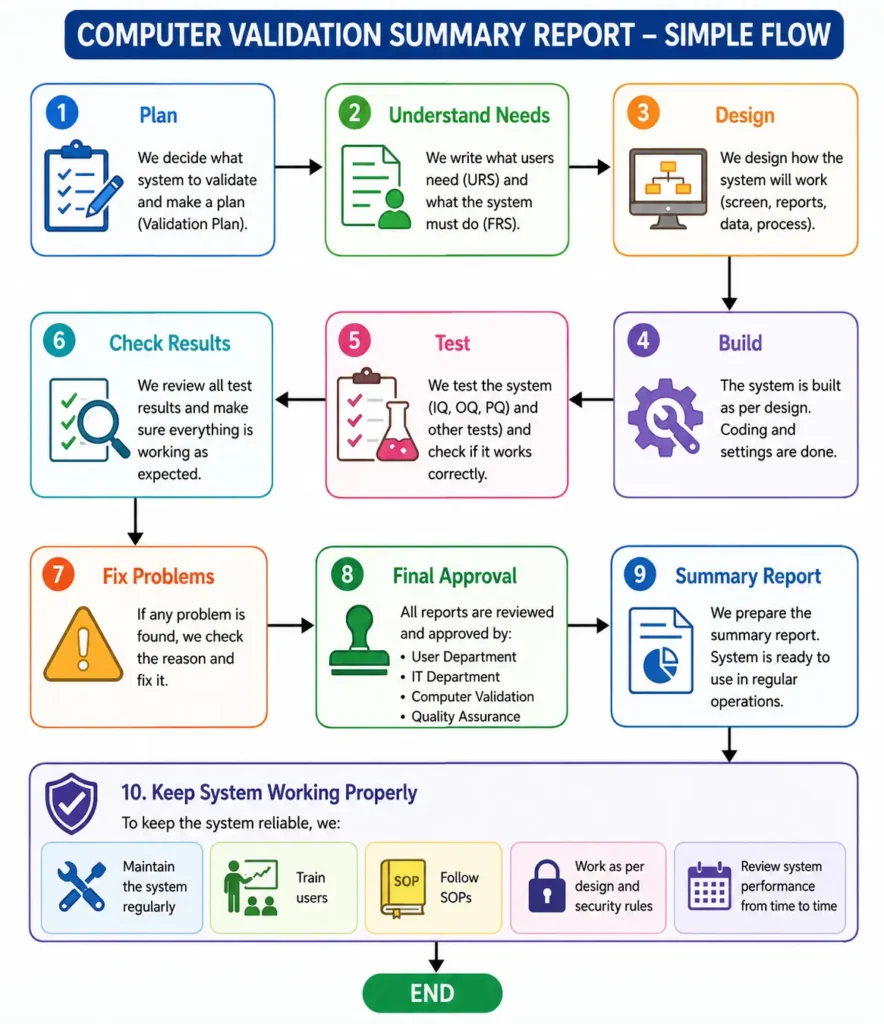
The Computer Validation Summary Report provides a clear summary of all activities completed during the validation of a computerized system. It explains the validation documents prepared, testing performed, results obtained, and how any incidents or deviations were resolved. The report may include important validation documents such as the Validation Plan, User Requirements Specification (URS), Functional Requirements Specification (FRS), Installation Qualification (IQ), Operational Qualification (OQ), and Performance Qualification (PQ). These documents help confirm that the system is properly installed and works according to approved requirements. All test results are recorded and reviewed. Any failures, limitations, or incidents are documented along with their resolutions. After successful review and approval, the system is considered suitable for use in regulated operations. To maintain its validated status, the system must be maintained properly, users must be trained, applicable SOPs must be followed, security controls must be maintained, and periodic reviews should be performed.
Impact Assessment
This Computer Validation Summary Report will have a positive impact on the organization by ensuring that computerized systems are properly planned, designed, built, tested, approved, and maintained. The validation process confirms that the system works as intended and meets user and business requirements. Activities such as URS, FRS, IQ, OQ, PQ, test review, and problem correction help identify errors before routine use. Final approval by the User Department, IT, Computer Validation, and Quality Assurance provides documented confidence that the system is suitable for operation. Proper training, SOP compliance, system maintenance, security controls, and periodic performance review will support continued reliability. This approach will improve data accuracy, traceability, system security, and regulatory compliance. It will also reduce the risk of system failure, incorrect data, unauthorized access, and operational errors. Overall, the validated system will support consistent work, better control, reliable records, and smooth day-to-day operations throughout the complete computerized system lifecycle
Questions & Answers
1. What is Computer System Validation (CSV)?
Computer System Validation is a documented process used to confirm that a computerized system works correctly and performs as required.
2. Why is a Validation Plan prepared?
A Validation Plan defines what system will be validated, how validation will be performed, responsibilities, and required documents.
3. What is URS?
URS means User Requirement Specification. It describes what the users need from the computerized system.
4. What is FRS?
FRS means Functional Requirement Specification. It explains how the system will perform the functions required by users.
5. Why is system design reviewed?
System design is reviewed to ensure that screens, reports, data handling, workflows, and processes meet approved requirements.
6. What happens during the Build stage?
During the Build stage, the computerized system is developed, configured, coded, and set according to the approved design.
7. What is IQ?
IQ means Installation Qualification. It confirms that the system, software, and related components are installed correctly.
8. What is OQ?
OQ means Operational Qualification. It confirms that the system functions correctly under defined operating conditions.
9. What is PQ?
PQ means Performance Qualification. It confirms that the system performs consistently during actual or simulated routine use.
10. Why are test results reviewed?
Test results are reviewed to confirm that all functions have passed and the system works as expected.
11. What should be done if a problem is found during testing?
The problem should be investigated, its root cause identified, corrected, documented, and retested where required.
12. Who approves the computerized system before use?
Approval may involve the User Department, IT Department, Computer Validation team, and Quality Assurance.
13. What is a Computer Validation Summary Report?
It is the final report that summarizes validation activities, test results, deviations, corrective actions, approvals, and system readiness.
14. When can the computerized system be released for routine use?
The system can be released after successful testing, resolution of critical issues, completion of required documents, and final approval.
15. Why is user training important?
Training ensures that users operate the system correctly and follow approved procedures.
16. Why should SOPs be followed after validation?
SOPs help maintain controlled, consistent, and compliant operation of the computerized system.
17. Why is system security important?
System security helps prevent unauthorized access, data changes, misuse, and loss of important information.
18. Why is periodic system review required?
Periodic review confirms that the system continues to remain suitable, secure, reliable, and compliant.
19. Is validation complete after the Summary Report is approved?
No. The system must continue to be maintained, monitored, reviewed, and controlled throughout its lifecycle.
20. What is the main benefit of Computer System Validation?
The main benefit is to ensure that the computerized system provides reliable results, accurate data, controlled operation, and continued regulatory compliance.