







1. Introduction of Decontamination of Steroid Residue from the Ointment Facility:
This protocol-cum-report describes the planned decontamination of steroid residues from an ointment manufacturing facility before its conversion for general product manufacture. It covers warehouse, manufacturing, service-floor and utility areas, with emphasis on preventing cross-contamination from potent steroid products. The document defines responsibilities, risk-based area and equipment selection, sampling locations, acceptance criteria, analytical methods, and decontamination strategy. It includes worst-case product selection, solvent and decontaminating-agent studies, HPLC testing, swab and rinse sampling, recovery studies, and phased decontamination. The protocol also requires documented cleaning, residue verification, evaluation of sodium hypochlorite effectiveness, and a final conclusion confirming successful facility decontamination before subsequent operations.
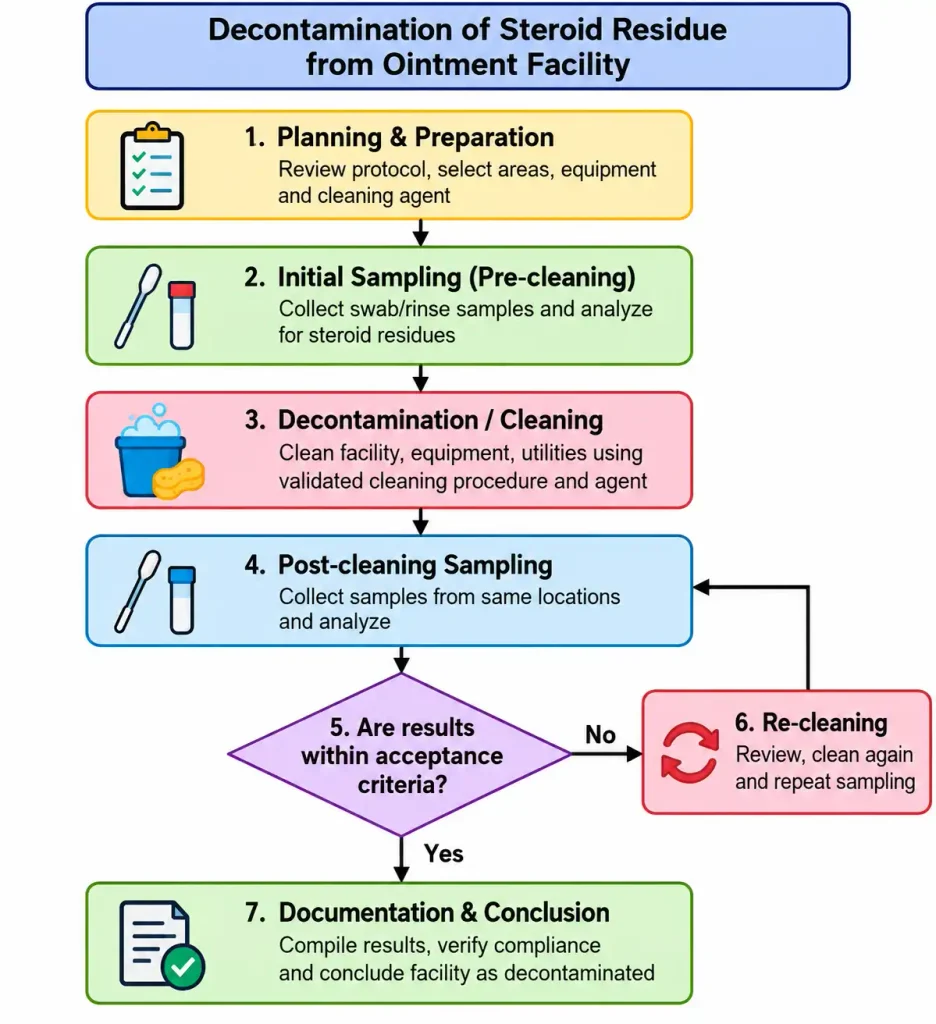
Skip to PDF content2. Flow Diagram – Decontamination of Steroid Residue from Ointment Facility:
The flow diagram presents the systematic approach for decontaminating steroid residues from the ointment facility. It begins with planning, risk assessment, selection of areas, equipment, worst-case steroid, and required materials. Initial swab or rinse sampling is performed to establish residue levels. The approved decontamination procedure is then executed using a validated cleaning agent, followed by post-cleaning sampling and analysis. Results are compared with predefined acceptance criteria. If results fail, re-cleaning and repeat sampling are performed. When results comply, analytical data and cleaning activities are documented, deviations are reviewed, and the facility is finally concluded as decontaminated and suitable for subsequent operations.
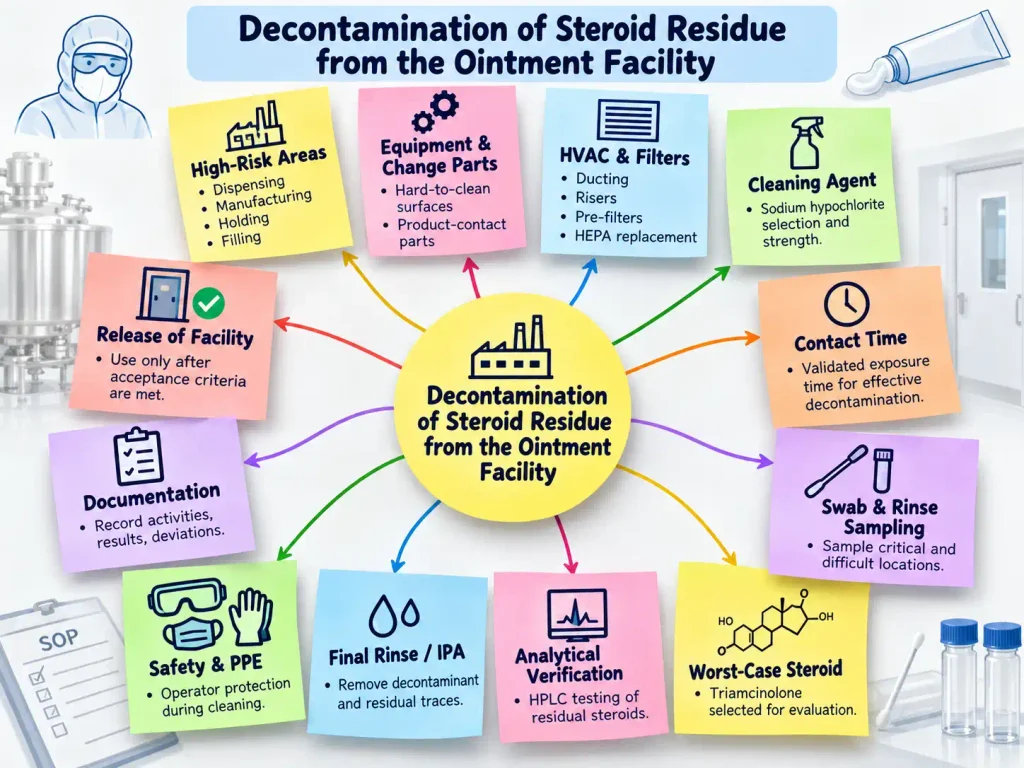
3. Brainstorming – Decontamination of Steroid Residue from the Ointment Facility:
The brainstorming analysis identifies the major factors requiring attention during decontamination of steroid residues from the ointment facility. Key considerations include high-risk areas such as dispensing, manufacturing, holding and filling zones; equipment and difficult-to-clean change parts; HVAC ducts, risers and filters; selection of a suitable decontaminating agent; and validated contact time. It also includes swab and rinse sampling, final rinse or IPA cleaning, HPLC-based analytical verification, worst-case steroid selection, operator safety and PPE, documentation, and final facility release. The purpose is to ensure all possible contamination sources are systematically addressed before the facility is used for subsequent manufacturing activities.
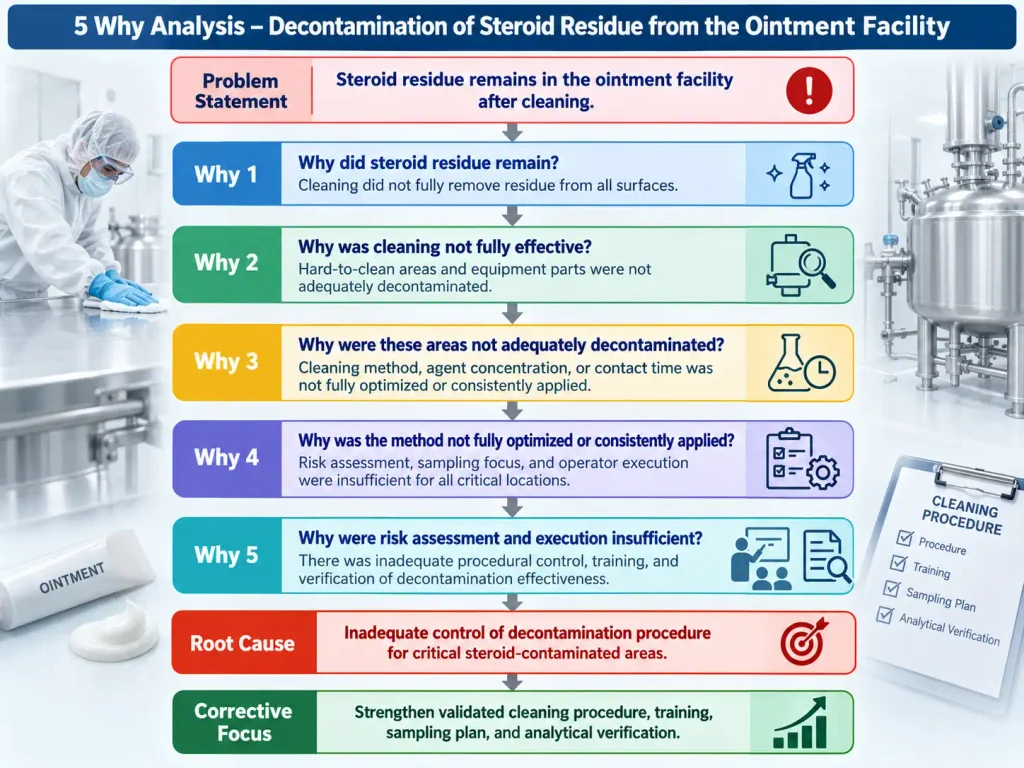
4. 5 Why Analysis – Decontamination of Steroid Residue from the Ointment Facility:
The 5 Why Analysis identifies the underlying reasons why steroid residues may remain in the ointment facility after cleaning. It begins with incomplete residue removal and examines hard-to-clean areas, equipment parts, cleaning-agent concentration, contact time, sampling focus, and operator execution. The analysis further links these issues to insufficient risk assessment, procedural control, training, and verification of cleaning effectiveness. The protocol emphasizes risk-based identification of vulnerable locations and comprehensive decontamination to prevent cross-contamination. The root cause is inadequate control of the decontamination process, requiring strengthened procedures, training, sampling plans, and analytical verification.
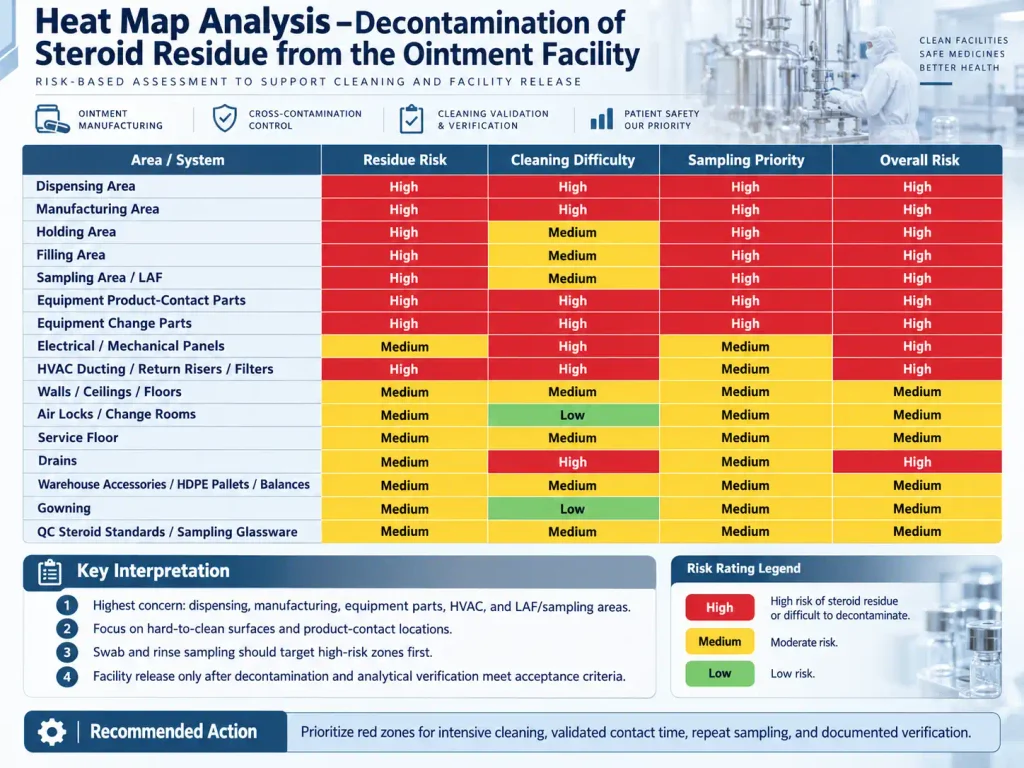
5. Heat Map Analysis – Decontamination of Steroid Residue from the Ointment Facility:
The heat map analysis classifies facility areas and systems according to residue risk, cleaning difficulty, sampling priority, and overall risk. High-risk zones include dispensing, manufacturing, holding, filling, sampling/LAF areas, equipment product-contact parts, change parts, HVAC ducting, return risers, filters, and drains. Medium-risk areas include walls, ceilings, floors, airlocks, change rooms, service floors, warehouse accessories, gowning, and QC-related items. The analysis helps prioritize intensive cleaning, validated contact time, targeted swab and rinse sampling, and analytical verification. High-risk locations require greater attention before the facility can be considered successfully decontaminated and suitable for subsequent manufacturing operations.
6. Fishbone Analysis – Decontamination of Steroid Residue from the Ointment Facility:
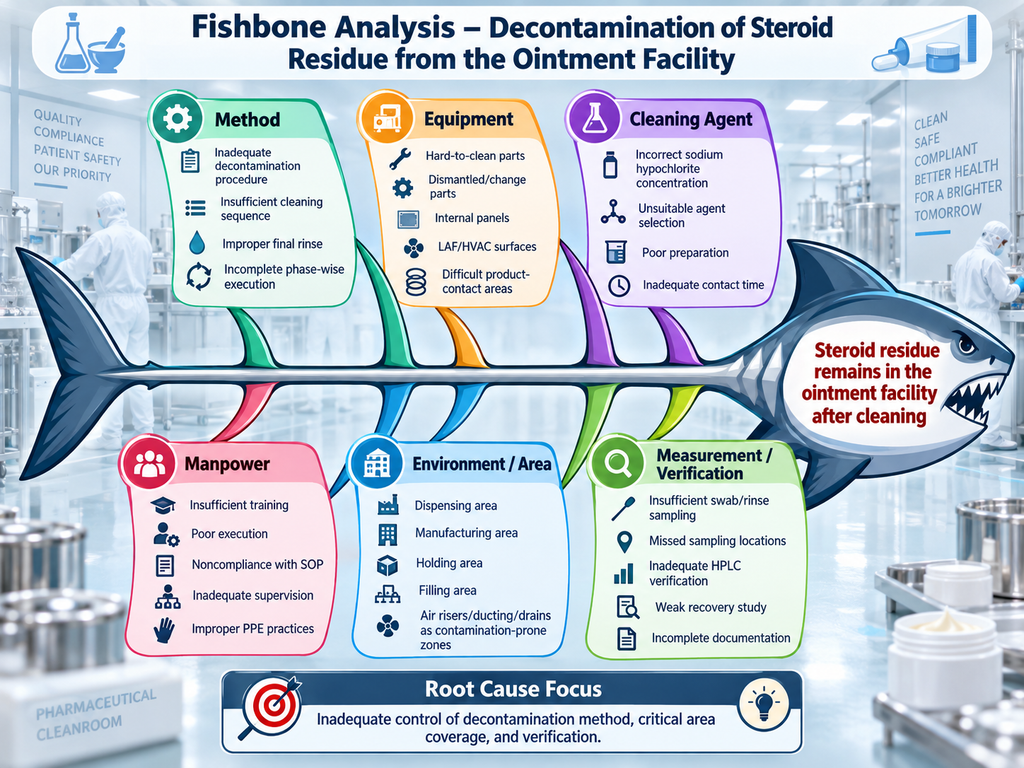
The Fishbone Analysis identifies potential causes for incomplete removal of steroid residues from the ointment facility. Major categories include Method, Equipment, Cleaning Agent, Manpower, Environment/Area, and Measurement/Verification. Key causes include inadequate cleaning procedures, hard-to-clean equipment parts, improper sodium hypochlorite concentration or contact time, insufficient operator training, contamination-prone areas such as HVAC ducts and drains, and inadequate swab/rinse sampling or analytical verification. The protocol specifically emphasizes vulnerable surfaces, equipment parts, airflow systems, and critical manufacturing areas. This analysis supports identification of root causes and helps strengthen decontamination controls, sampling, training, and verification activities.
7. Fault Tree Analysis – Decontamination of Steroid Residue from the Ointment Facility:
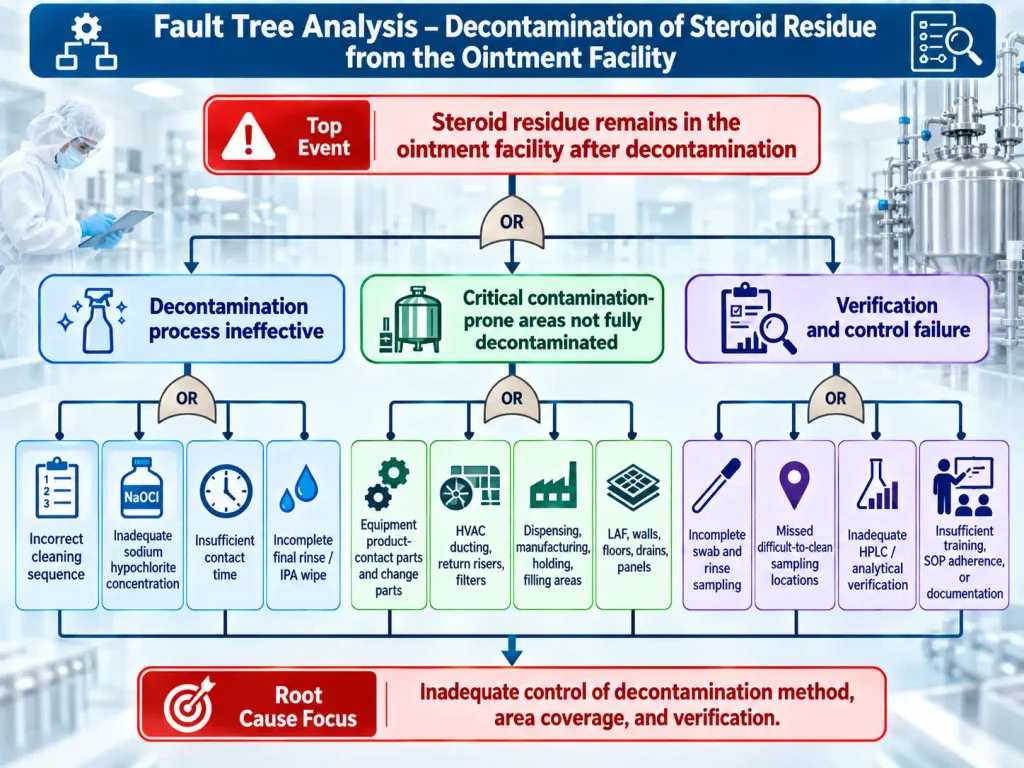
The Fault Tree Analysis identifies the possible causes that may lead to steroid residue remaining in the ointment facility after decontamination. The main contributing branches include an ineffective decontamination process, incomplete cleaning of critical contamination-prone areas, and failure of verification and control. Possible causes include incorrect cleaning sequence, inadequate sodium hypochlorite concentration, insufficient contact time, incomplete final rinsing, difficult-to-clean equipment parts, HVAC ducting and filters, missed sampling locations, inadequate swab/rinse sampling, weak analytical verification, and insufficient training or documentation. The analysis helps focus corrective actions on cleaning effectiveness, area coverage, sampling, and documented verification.
8. Pareto Chart Analysis – Decontamination of Steroid Residue from the Ointment Facility:
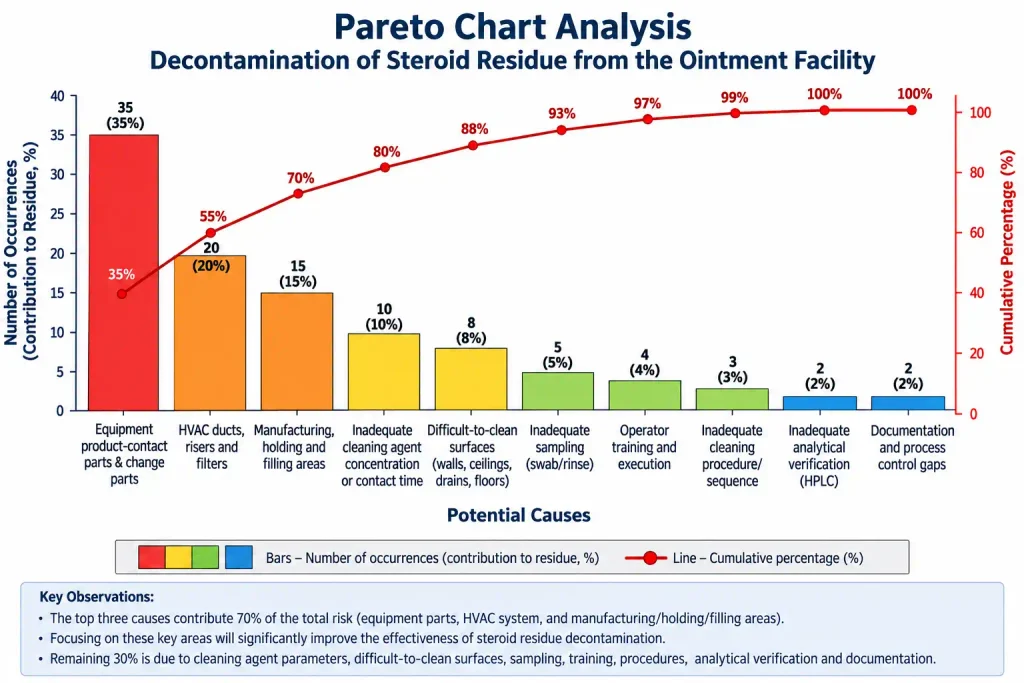
The Pareto Chart Analysis prioritizes the major potential causes contributing to steroid residue remaining in the ointment facility after decontamination. The highest contributors are equipment product-contact and change parts, followed by HVAC ducts, risers and filters, and manufacturing, holding and filling areas. Together, these dominant causes represent the major portion of the identified risk. Other contributing factors include unsuitable cleaning-agent concentration or contact time, difficult-to-clean surfaces, inadequate swab/rinse sampling, operator training gaps, weak cleaning procedures, insufficient analytical verification, and documentation deficiencies. The chart helps focus corrective actions on the most significant causes first to improve overall decontamination effectiveness.
9. Corrective Action, Preventive Action & Effectiveness Check:
Decontamination of Steroid Residue from the Ointment Facility
Based on the uploaded protocol, the CAPA should focus on high-risk areas, equipment/change parts, HVAC systems, validated sodium hypochlorite concentration and contact time, swab/rinse sampling, analytical verification, and documented facility release. The protocol specifically identifies dispensing, manufacturing, holding and filling areas as high-risk locations and requires attention to equipment parts, panels, ducting and filters.
| No. | Identified Issue | Corrective Action | Preventive Action | Effectiveness Check |
|---|---|---|---|---|
| 1 | Steroid residue detected after cleaning | Re-clean affected area/equipment using the validated decontamination procedure and repeat swab/rinse sampling. | Establish a risk-based cleaning and sampling plan covering all critical and hard-to-clean locations. | Review repeat analytical results and confirm compliance with protocol acceptance criteria. |
| 2 | Inadequate cleaning of equipment/change parts | Dismantle applicable parts and decontaminate internal, external and difficult-to-clean surfaces using validated sodium hypochlorite concentration/contact time. | Include critical equipment parts and change parts in approved cleaning checklists and periodic verification. | Verify satisfactory visual inspection and compliant swab/rinse results from worst-case locations. |
| 3 | Inadequate HVAC decontamination | Clean AHU panels, ducting and return-air systems; remove residues and replace applicable pre-filters/HEPA filters after decontamination. | Include HVAC, risers, filters and service-floor areas in facility decontamination procedures and risk assessments. | Verify completion records and obtain satisfactory sampling/qualification results before facility release. |
| 4 | Cleaning-agent concentration/contact time not established | Perform efficacy studies using the defined sodium hypochlorite concentrations and exposure times to establish effective conditions. | Maintain an approved preparation procedure specifying concentration, preparation, contact time and handling requirements. | Review study results demonstrating acceptable steroid degradation/removal under established conditions. |
| 5 | Inadequate sampling coverage | Collect additional swab/rinse samples from missed or vulnerable locations, including hard-to-clean surfaces. | Maintain an approved risk-based sampling plan covering facility design, equipment surfaces and HVAC systems. | QA/QC review confirms all predefined sampling locations were tested with acceptable results. |
| 6 | Weak swab recovery/analytical verification | Repeat or complete recovery and analytical-method verification where required. | Periodically verify recovery capability and suitability of the analytical method for low-level steroid detection. | Swab recovery should meet the protocol requirement of NLT 70%, and analytical results should meet predefined criteria. |
| 7 | Residual decontaminating agent remaining | Perform post-cleaning with purified water/WFI as applicable and verify removal of sodium hypochlorite residue. | Define final rinsing, wiping and residue-testing requirements within the decontamination procedure. | Confirm sodium hypochlorite residue testing is satisfactory; where applicable, rinse pH should be 5–7 as specified in the protocol. |
| 8 | Incomplete documentation/training | Complete missing records, investigate deviations and retrain involved Production, Engineering, QA and QC personnel. | Establish training, execution checklists, QA review and controlled documentation for each decontamination phase. | Review training records, executed checklists, deviations and final report; no recurring documentation gaps during subsequent verification. |
Overall Effectiveness Check
CAPA may be considered effective when Phase I, II and III decontamination activities are completed as applicable, swab/rinse results comply with established acceptance criteria, cleaning-agent residues are adequately removed, critical areas and equipment are verified, deviations are closed, and the final decontamination report is approved. The protocol specifies that successful Phase III results should support compilation of the final report and declaration of the facility as decontaminated.
10. Questions and Answers – Decontamination of Steroid Residue from the Ointment Facility:
- Q: What is the main objective of the decontamination protocol?
A: The objective is to define the background, regulatory requirements, strategy and methodology for decontaminating steroid residues from the ointment facility, including area selection, equipment selection, sampling, acceptance criteria and analytical verification. - Q: What areas are covered under the protocol?
A: The protocol applies to the warehouse, manufacturing facility, service floor and utility areas of the ointment section. - Q: Why is steroid decontamination required before manufacturing general products?
A: Steroids are potent products and residual traces may create a cross-contamination risk when the facility is converted for general product manufacturing. - Q: Which areas are considered high-risk zones?
A: Dispensing, manufacturing, holding and filling areas are categorized as high-risk zones requiring thorough decontamination. - Q: Which areas are categorized as medium-risk zones?
A: Airlocks, change rooms and service-floor areas are considered medium-risk zones. - Q: Which steroid is selected as the worst-case product?
A: Triamcinolone is selected as the worst-case molecule because of its lowest claim and lowest MAR value of 89.28 mg. - Q: Which decontaminating agent is evaluated in the protocol?
A: Sodium hypochlorite solution is evaluated at 2% and 5% concentrations to determine its effectiveness against steroid residues. - Q: How is the suitable contact time for sodium hypochlorite established?
A: Samples are evaluated at specified time intervals, including 15, 30, 60, 90 and 120 minutes, to establish the effective concentration and exposure time. - Q: Which sampling methods are used to verify steroid residue removal?
A: Both swab sampling and rinse sampling are used. Swab sampling targets hard-to-clean surfaces, while rinse sampling is applied where equipment or surfaces can be effectively rinsed. - Q: What is the swab sampling area specified in the protocol?
A: The protocol specifies a swab template of 5 cm × 5 cm, corresponding to 25 cm². - Q: Which analytical technique is used for detecting residual steroids?
A: HPLC-based analytical methods are used for detecting and quantifying residual steroids such as Triamcinolone Acetonide, Mometasone Furoate and Clobetasol Propionate. - Q: What is the acceptance criterion for swab recovery?
A: The protocol specifies a minimum swab recovery of NLT 70%. - Q: Why is IPA used during the decontamination process?
A: The solubility study concluded that the three steroids have some solubility in IPA; therefore, based on safety, efficacy and solubility, IPA may be used for final rinsing or mopping after cleaning. - Q: How is the HVAC system decontaminated?
A: AHU panels, doors, filters and ducting are cleaned, the ducting is vacuumed, applicable filters are replaced, sodium hypochlorite is applied for the validated contact time, and post-cleaning with purified water is performed before residue testing and sampling. - Q: When can the facility be declared successfully decontaminated?
A: After completion of the decontamination phases, compliant swab/rinse results, satisfactory analytical verification and successful Phase III results, the final report is compiled and the facility may be declared decontaminated.
11. Reference Guidelines – Decontamination of Steroid Residue from the Ointment Facility:
The uploaded protocol cites the following references for the steroid-residue decontamination study:
- Indian Pharmacopoeia, 2014.
- WHO – Quality Assurance of Pharmaceuticals: A Compendium of Guidelines and Related Materials, Volume 2, Second Updated Edition – Good Manufacturing Practices and Inspection, Geneva, 2007.
- WHO Technical Report Series No. 957, 2010, Annex 3 – WHO Good Manufacturing Practices for Pharmaceutical Products Containing Hazardous Substances.