







1. Brief Description:
The Design Qualification (DQ) of the Autoclave Cum Bung Processor is performed to confirm that the proposed equipment design meets the User Requirement Specification (URS), purchase order, cGMP requirements, process needs, and safety requirements before installation. The equipment is a jacketed pressure vessel designed for steam sterilization and processing of rubber bungs, garments, filtration accessories, media, filling-machine components, and other manufacturing accessories.
The sterilization process includes vacuum steam pulsing, heat-up, sterilization hold, vacuum drying, sterile-air entry, and exhaust, depending on the selected cycle. The DQ verifies critical process parameters, utility requirements, equipment dimensions, construction materials, piping, valves, instrumentation, control system, PLC, temperature and pressure monitoring, safety interlocks, alarms, and door operation. It also confirms that steam distribution is uniform and that all loaded articles can be sterilized using validated cycles.
Skip to PDF content2. Flow Diagram:
The flow diagram of the Autoclave Cum Bung Processor shows the complete sequence of sterilization from loading to unloading. Materials such as rubber bungs and accessories are loaded into the chamber, followed by door closing and interlocking. The cycle then proceeds through vacuum pulsing, steam admission and heating, sterilization hold, vacuum drying, sterile air entry/cooling, and unloading. The equipment uses steam to achieve uniform heat distribution and penetration inside the chamber, while vacuum assists in air removal and drying.
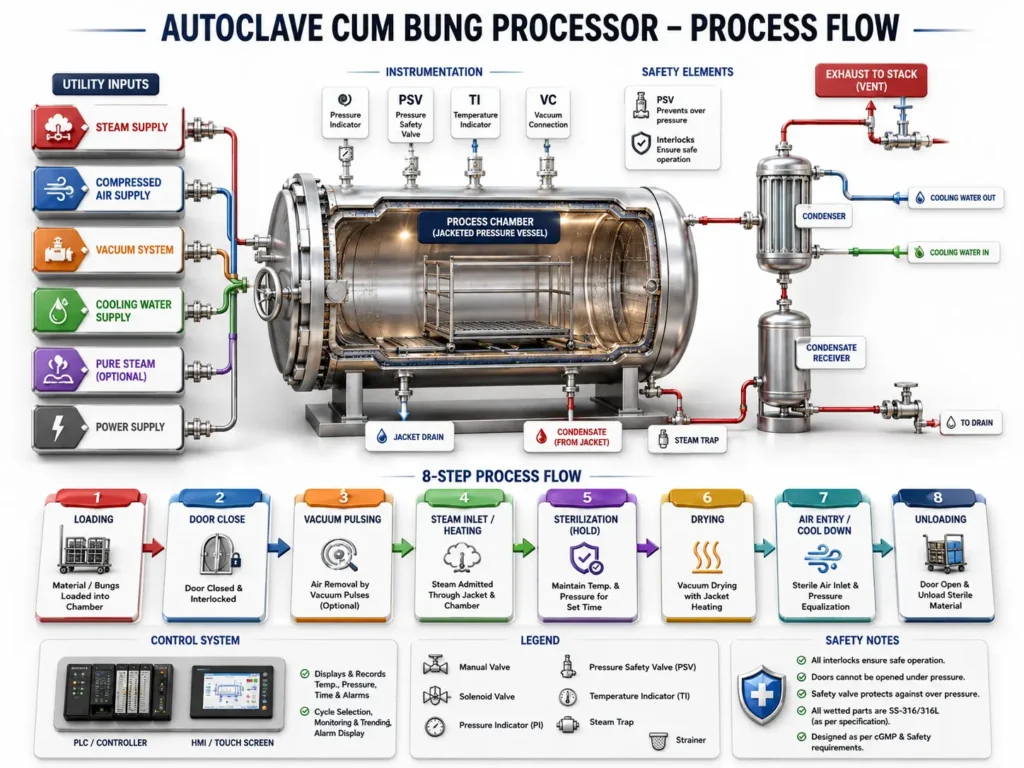
The diagram also highlights supporting utilities such as pure steam, plant steam, compressed/process air, WFI, purified water, vacuum, and electrical supply. Safety devices, temperature and pressure monitoring, alarms, door interlocks, PLC/HMI controls, condensate removal, and exhaust arrangements help ensure a controlled, safe, and reproducible sterilization process.
3. Brainstorming:
Brainstorming for Design Qualification (DQ) failure of the Autoclave Cum Bung Processor is a structured activity used to identify all possible reasons why the proposed equipment design may fail to meet the approved requirements. The DQ is intended to confirm that critical process, product, cGMP, and safety aspects are adequately considered during equipment design.
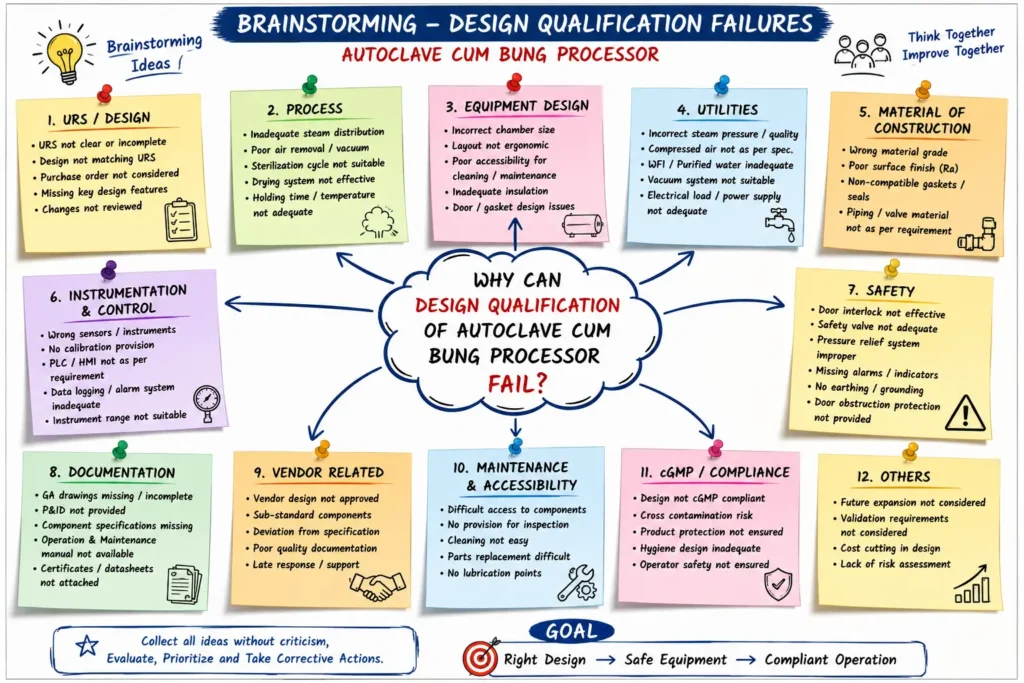
During brainstorming, possible causes are grouped under areas such as URS/design, process requirements, equipment design, utilities, material of construction, instrumentation and control, safety, documentation, vendor-related issues, maintenance, and cGMP compliance. Particular attention is given to steam distribution, vacuum performance, sterilization requirements, utility suitability, sensors, alarms, PLC controls, door interlocks, material grades, and supporting drawings or documents. The purpose is to collect ideas without immediate judgment, evaluate potential risks, prioritize critical concerns, and initiate suitable corrective actions so that the final equipment design is safe, reliable, compliant, and suitable for intended pharmaceutical use.
4. 5-Why Analysis:
The 5-Why Analysis is used to identify the root cause of a Design Qualification (DQ) failure of the Autoclave Cum Bung Processor by repeatedly asking “Why?” until the underlying reason is determined. The analysis may begin with the equipment design not fully meeting the approved URS and process requirements. Further investigation can reveal incomplete definition of critical requirements related to steam, vacuum, utilities, instrumentation, safety, materials, and control systems. Weak verification of drawings, specifications, vendor documents, and technical details can further contribute to the failure.
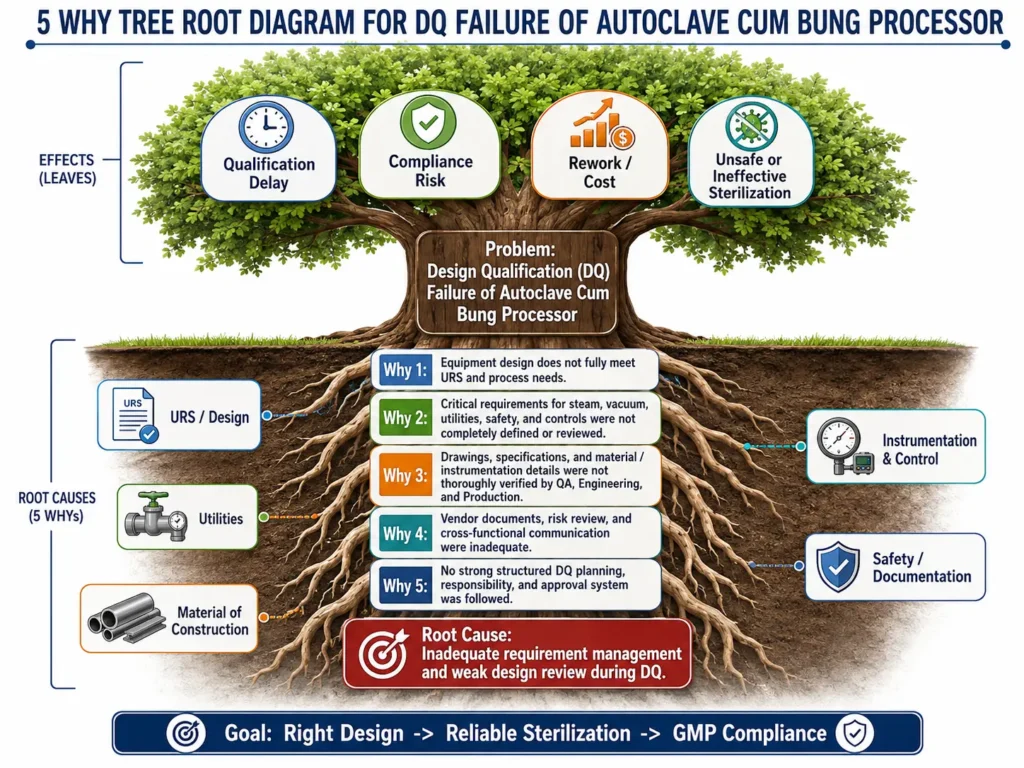
The final root cause may be linked to inadequate requirement management, insufficient cross-functional design review, or weak DQ planning and approval controls. This systematic approach helps prevent repeated design errors, qualification delays, rework, increased cost, and compliance risks, while ensuring the autoclave design supports safe, reliable, and GMP-compliant sterilization.
5. Heat Map (FMEA):
The FMEA Heat Map for Design Qualification failure of the Autoclave Cum Bung Processor is used to identify, evaluate, and prioritize potential design-related risks before equipment approval and installation. Each possible failure mode is assessed using Severity (S), Occurrence (O), and Detection (D), and the Risk Priority Number (RPN) is calculated as:
RPN = Severity × Occurrence × Detection
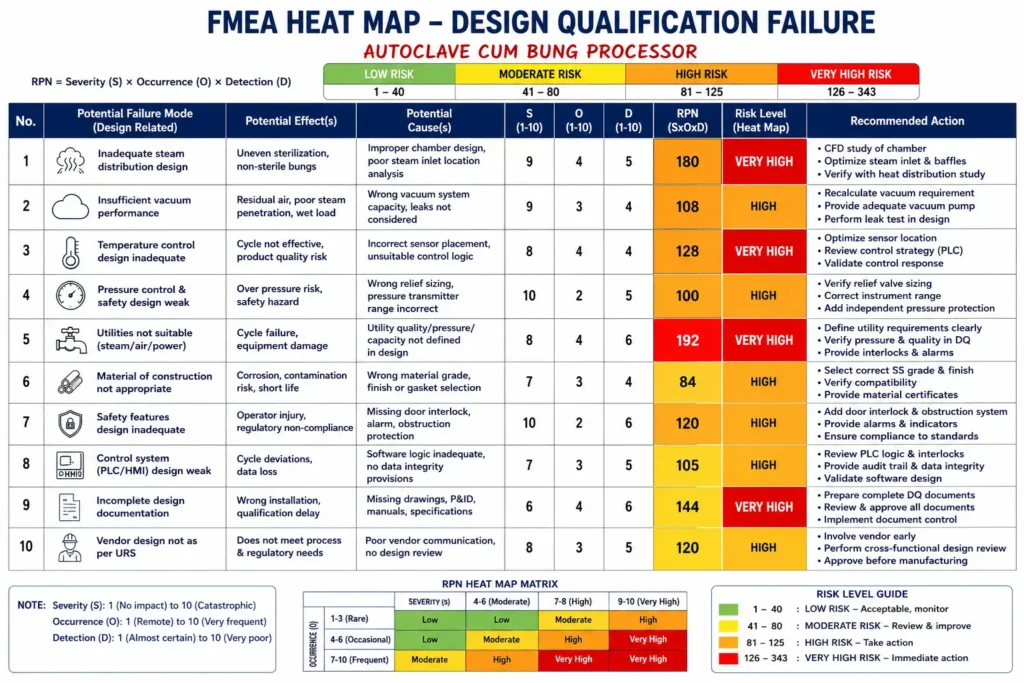
The heat map visually classifies risks as Low, Moderate, High, or Very High, helping the qualification team focus on the most critical concerns. Typical risks include inadequate steam distribution, poor vacuum performance, unsuitable utilities, incorrect materials of construction, inadequate temperature or pressure controls, weak safety interlocks, incomplete documentation, PLC/HMI design issues, and non-compliance with URS requirements. Corrective actions are then prioritized to reduce risk and ensure safe, reliable, GMP-compliant, and effective sterilization performance.
Critical Process Parameters (CPP’s) & Critical Quality Attributes (CQA’s):
Autoclave Cum Bung Processor
Based on the Design Qualification, the Autoclave Cum Bung Processor is intended to sterilize rubber stoppers, articles, and supporting manufacturing accessories using controlled steam sterilization cycles. The DQ requires uniform steam distribution and sterile output after validated cycles.
| Critical Process Parameters (CPPs) | Critical Quality Attributes (CQAs) |
|---|---|
| Sterilization Temperature | Required sterility of bungs/components |
| Sterilization Hold Time | Effective microbial inactivation |
| Chamber Pressure | Uniform steam penetration |
| Jacket Pressure/Temperature | Uniform chamber heating |
| Vacuum Level | Effective air removal from chamber/load |
| Vacuum Pulsing | Elimination of trapped air |
| Steam Quality | Consistent sterilization performance |
| Steam Distribution | Uniform temperature throughout load |
| Heat-Up Time | Proper achievement of sterilization conditions |
| Vacuum Drying Time | Dryness of sterilized load |
| Sterile Air Entry | Protection of sterilized material during pressure equalization |
| WFI/Purified Water Quality & Pressure | Cleanliness and contamination control |
| Process/Compressed Air Pressure | Proper operation and drying/fluidization |
| Door/Gasket Pressure | Chamber sealing and cycle integrity |
| Temperature Sensor Performance | Accurate temperature monitoring |
| Pressure Measurement | Accurate cycle-pressure control |
| PLC/Control System Function | Reproducible and controlled sterilization cycle |
The defined sterilization sequence includes vacuum steam pulsing, heat-up, sterilization hold, vacuum drying, and sterile-air entry; the standard cycle includes heat-up, sterilization hold, and exhaust.
Major CQAs
The most important quality outcomes are sterility of rubber bungs and loaded components, uniform steam penetration, adequate drying, absence of contamination, and maintenance of load integrity after processing. The DQ explicitly requires loaded articles and supporting accessories to be sterile after validated cycles and requires uniform steam distribution within the chamber.
Questions & Answers – Design Qualification of Autoclave Cum Bung Processor
Q1. What is the purpose of Design Qualification of the Autoclave Cum Bung Processor?
Answer: The purpose is to confirm that critical process/product requirements, cGMP requirements, and safety considerations are incorporated into the equipment design and properly documented.
Q2. What is the scope of this Design Qualification?
Answer: The DQ covers the design of the Autoclave Cum Bung Processor, including verification of vendor drawings, P&IDs, technical requirements, and suitability for operation under cGMP conditions.
Q3. What is an Autoclave Cum Bung Processor?
Answer: It is a jacketed pressure vessel designed for steam sterilization and processing of rubber bungs and other pharmaceutical components.
Q4. What are the major phases of the high-pressure, high-vacuum sterilization cycle?
Answer: The major phases are vacuum steam pulsing, heat-up, sterilization hold, vacuum drying, and sterile-air entry.
Q5. What materials can be processed in the autoclave?
Answer: It can be used for rubber bungs, flip-off seals, garments, filtration accessories, media, filling-machine components, manufacturing accessories, and blender components.
Q6. Why is uniform steam distribution important?
Answer: Uniform steam distribution is necessary to provide effective steam penetration and ensure that loaded rubber stoppers, articles, and supporting accessories are sterilized during validated cycles.
Q7. What are the major utilities required for the equipment?
Answer: Utilities include pure steam, plant steam, process air, WFI, compressed air, purified water, softened water for the vacuum system, and electrical power.
Q8. What is the chamber capacity mentioned in the DQ?
Answer: The chamber volume is 972 litres, with a stated capacity of approximately 50,000 stoppers of 20 mm diameter.
Q9. What material is used for the chamber?
Answer: The chamber is constructed of SS316L, while several supporting parts such as the jacket and insulation cover use SS304 as specified.
Q10. What safety features are considered during DQ?
Answer: Safety provisions include proper earthing, equipment leveling, door interlocks, door obstruction protection, pneumatic door locking, safety valves, and alarm systems.
Q11. Can both autoclave doors open simultaneously?
Answer: No. The design requires that both doors cannot open simultaneously, and the process should not start when either door is open.
Q12. What alarms are specified for the system?
Answer: Alarms include high temperature and pressure, temperature-drop related sterilization timer alarms, excessive vacuum creation time, excessive heat-up time, vacuum-pump trip, and utility failure.
Q13. What is the role of the PLC?
Answer: The PLC controls the process automatically and receives digital and analog inputs to manage the sterilization cycle.
Q14. What is the function of the MMI/HMI?
Answer: The MMI is used to start the process and display online process parameters for operator monitoring.
Q15. What documents should be attached to the DQ?
Answer: Supporting documents include technical equipment details, engineering drawings, approved designs and specifications, supplier meeting minutes where applicable, the purchase order, and other relevant documents.