






1. Brief Description:
The Design Qualification (DQ) Protocol cum Report for the Sterilizing & Depyrogenating Tunnel is prepared to verify that the proposed equipment design complies with the approved User Requirement Specification (URS), cGMP requirements, process needs, safety requirements, and vendor specifications. The qualification confirms that critical process and product requirements are adequately considered and documented before installation. The tunnel is an automatic PLC-controlled system designed for sterilization and depyrogenation of glass containers. It incorporates drying, sterilizing, stabilizing, and cooling zones, operating under controlled clean conditions with a positive pressure gradient. The system is intended to achieve sterility and a minimum 3-log reduction in endotoxin. The DQ evaluates utilities, equipment construction, HEPA filtration, air velocity, temperature controls, conveyor arrangement, instrumentation, materials of construction, safety interlocks, vendor selection, engineering drawings, and supporting documentation.
Skip to PDF content2. Flow Diagram:
The flow diagram presents the systematic approach for performing Design Qualification (DQ) of a Sterilizing & Depyrogenating Tunnel before installation and operational use. The process begins with preparation of the DQ Protocol cum Report, followed by review of the User Requirement Specification (URS) and supplier information to confirm that critical process, product, cGMP, and safety requirements have been incorporated into the equipment design. The assessment covers equipment specifications, process/product parameters, utility and location suitability, technical design features, materials of construction, instrumentation, HEPA filtration, temperature control, and safety interlocks. The tunnel design incorporates drying, sterilizing, stabilizing, and cooling zones and is intended to achieve a minimum 3-log endotoxin reduction.
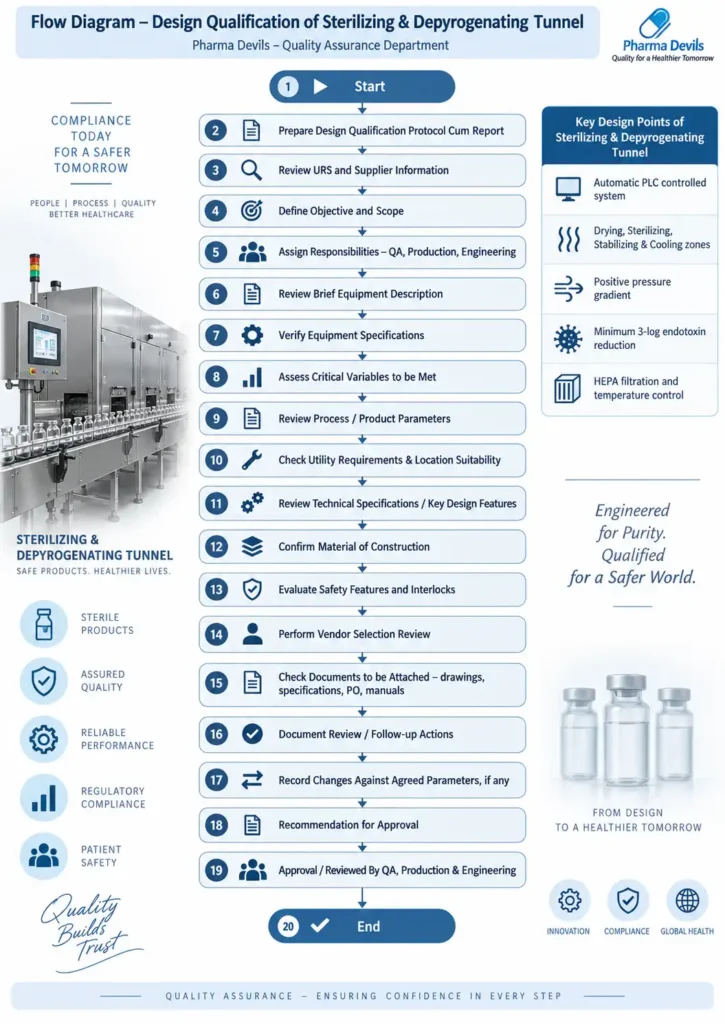
The flow further includes vendor evaluation, verification of supporting drawings and documents, review of deviations or design changes, recommendations, and final approval by Quality Assurance, Production, and Engineering. This structured approach provides documented assurance that the proposed tunnel design is suitable for its intended pharmaceutical application before proceeding to subsequent qualification stages.
3. Brainstorming:
The brainstorming diagram identifies potential reasons why the Design Qualification (DQ) of the Sterilizing & Depyrogenating Tunnel was not performed before progressing to subsequent qualification activities. The central issue is surrounded by sticky notes representing possible gaps such as URS not reviewed, incomplete supplier information, undefined objective and scope, unclear departmental responsibilities, unverified equipment specifications, unchecked utilities, missing technical drawings, unconfirmed materials of construction, inadequate safety/interlock evaluation, weak vendor review, and incomplete supporting documentation. These areas correspond to key elements expected to be addressed during DQ.
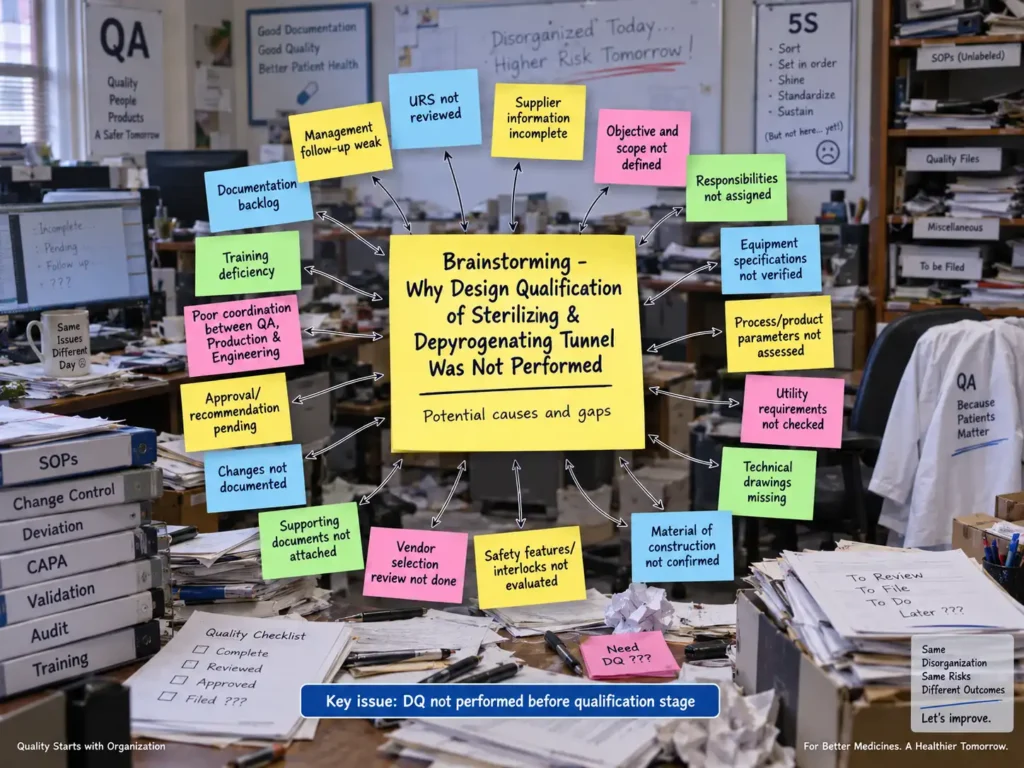
The poor 5S condition in the QA office visually represents weak document organization, housekeeping, filing discipline, and follow-up systems that may contribute to qualification delays. Additional brainstorming factors include training deficiencies, poor coordination between QA, Production, and Engineering, documentation backlog, pending approvals, and weak management follow-up. The exercise helps identify areas requiring investigation before establishing the actual root cause and implementing appropriate CAPA.
4. 5 Why Analysis:
The 5 Why Analysis identifies the underlying reasons why the Design Qualification (DQ) of the Sterilizing & Depyrogenating Tunnel was not performed before proceeding with qualification activities. The analysis starts with the immediate issue that the DQ activity was not initiated on time. Further investigation indicates that the URS, supplier inputs, and design documents were not adequately reviewed, while responsibilities among Quality Assurance, Production, and Engineering were not clearly assigned.
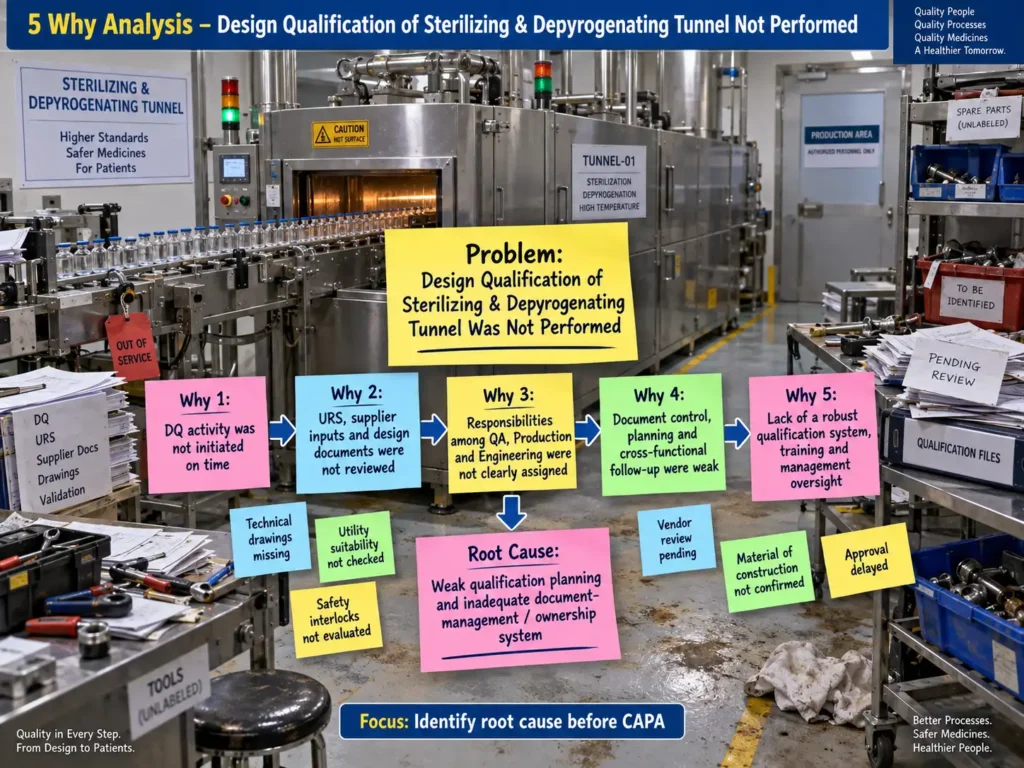
The analysis further highlights weaknesses in document control, qualification planning, cross-functional coordination, training, and management oversight. Supporting gaps include missing technical drawings, unchecked utility suitability, incomplete safety interlock evaluation, pending vendor review, unconfirmed material of construction, and delayed approvals. The probable root cause is identified as weak qualification planning combined with inadequate document-management and ownership systems. The analysis supports development of appropriate CAPA to strengthen qualification governance, departmental accountability, documentation control, and timely execution of DQ activities.
5. Heat Map analysis:
The Heat Map Analysis provides a visual risk-ranking of potential gaps resulting from the Design Qualification (DQ) of the Sterilizing & Depyrogenating Tunnel not being performed. Risks are prioritized according to their severity and likelihood, ranging from low-risk green zones to critical red zones. The highest-risk concerns include URS not reviewed, equipment specifications not verified, process/product parameters not assessed, and safety interlocks not evaluated. Major risks include incomplete supplier information, undefined objective and scope, unchecked utility suitability, and unconfirmed material of construction. Moderate and lower-ranked issues include missing technical drawings, pending vendor review, unclear responsibilities, delayed approvals, weak document control, training deficiencies, and incomplete supporting documentation.
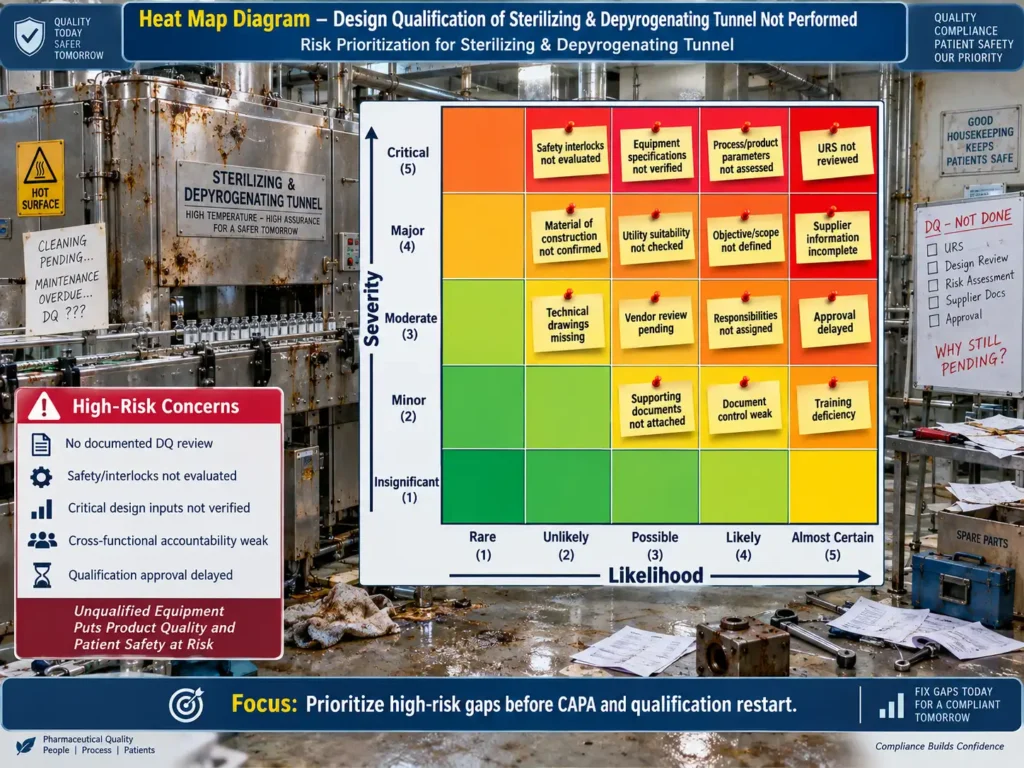
The rusted and poorly maintained tunnel background visually reinforces the potential consequences of inadequate design review and qualification control. The heat map helps management prioritize critical and major gaps for immediate CAPA, ensuring that equipment design, safety, GMP requirements, and qualification documentation are satisfactorily addressed before the qualification process is restarted.
Critical Process Parameters (CPP) & Critical Quality Attributes (CQA)
Sterilizing & Depyrogenating Tunnel
For this tunnel, the CPPs are the operating conditions that directly influence sterilization/depyrogenation performance, while the CQAs are the quality outcomes expected from the processed glass containers and controlled tunnel environment.
| Category | Parameter / Attribute | Why Critical | Acceptance / Expectation from DQ |
|---|---|---|---|
| CPP | Sterilization zone temperature | Directly affects sterilization and endotoxin destruction | Adjustable up to 350°C; zone variation ±5°C |
| CPP | Conveyor speed / residence time | Determines exposure time of containers to required heat | Controlled through VFD; exact qualified speed range is not specified in the DQ document |
| CPP | HEPA air velocity | Maintains controlled unidirectional airflow over containers | 0.45 ± 0.1 m/s at 200 mm below HEPA |
| CPP | Sterilization-zone temperature uniformity | Prevents under-processing at cold locations | Temperature variation ±5°C |
| CPP | Positive pressure | Protects tunnel from ingress of less-clean air | Positive pressure to be maintained, particularly relative to the vial washing area |
| CPP | Drying-zone performance | Ensures containers enter hot zone without excess moisture | Drying zone with controlled blower/airflow system |
| CPP | Cooling-zone conditions | Controls safe reduction of vial temperature after heating | Cooling temperature maintained throughout the cycle |
| CPP | Stabilization-zone conditions | Prevents thermal shock and vial cracking | Temperature is reduced progressively to avoid cracking |
| CPP | HEPA filtration efficiency | Controls particulate contamination in tunnel zones | HEPA: 0.3 µm, 99.997% efficiency, H13 |
| CPP | Blower operation | Maintains required airflow and protects HEPA system | Heater operation is interlocked with blower operation |
| CPP | Temperature-control interlock | Prevents overheating / unsafe operation | Heater supply cuts off if temperature exceeds set limit |
| CPP | Temperature sensor / RTD performance | Ensures accurate monitoring and control | PT100 RTDs used for zone temperature monitoring |
Critical Quality Attributes
| CQA | Quality Requirement |
|---|---|
| Endotoxin reduction | Minimum 3-log endotoxin reduction after depyrogenation |
| Sterility / sterilization effectiveness | Processed glass containers should achieve the intended sterilization condition; the DQ describes the tunnel as designed for sterilization and depyrogenation of glass containers. |
| Particulate cleanliness | Containers should remain protected under HEPA-filtered controlled airflow during processing. |
| Container integrity | Vials should remain free from cracking or thermal damage during heating, stabilization, and cooling. |
| Acceptable discharge temperature | Containers should leave the cooling zone at a controlled temperature suitable for subsequent filling operations; the DQ requires controlled cooling, but does not specify a numeric discharge-temperature limit. |
| Protection from recontamination | Positive pressure and HEPA-filtered airflow should protect sterilized containers from environmental contamination. |
Most Critical CPP–CQA Relationship
Sterilization temperature + exposure time/conveyor speed + airflow/HEPA performance → Minimum 3-log endotoxin reduction + sterilized, particle-controlled, physically intact glass containers.
Questions & Answers:
- What is the purpose of Design Qualification for a Sterilizing & Depyrogenating Tunnel?
The purpose is to verify and document that the proposed tunnel design meets the URS, process/product requirements, cGMP expectations, and safety requirements before installation. - What is the primary application of the tunnel?
The tunnel is intended for sterilization and depyrogenation of glass containers used for sterile dosage forms. - Which departments are responsible for Design Qualification?
The DQ is a cross-functional activity involving Quality Assurance, Production, and Engineering. QA coordinates and monitors the qualification, while Production and Engineering assist in reviewing process parameters, drawings, utilities, materials, and equipment specifications. - What are the major zones of the tunnel?
The tunnel consists of drying, sterilizing, stabilizing, and cooling zones. - What endotoxin reduction is specified in the DQ document?
The tunnel is designed to achieve a minimum 3-log reduction in endotoxin content. - What air velocity is specified below the HEPA filter?
The document specifies an air velocity of 0.45 ± 0.1 m/s measured 200 mm below the HEPA filter. - What HEPA filter efficiency is specified?
The HEPA filters are specified for 0.3-micron particle retention, 99.997% separation efficiency, and H13 classification. - Why is positive pressure important in the tunnel?
Positive pressure helps protect the tunnel and processed containers from ingress of less-clean surrounding air. The DQ requires positive pressure particularly with respect to the vial washing area. - What temperature-related design requirement is specified for the sterilization zone?
The document lists a maximum adjustable temperature of 350°C and a sterilization-zone temperature variation of ±5°C. - Why is conveyor speed critical?
Conveyor speed controls the time glass containers remain within the tunnel zones and therefore influences heat exposure. The DQ states that conveyor speed is controlled through a variable frequency drive (VFD). - What is the purpose of the stabilizing zone?
The stabilizing zone allows the vial temperature to decrease progressively so that rapid heating and cooling do not cause vial cracking. - What materials of construction are specified for the major tunnel components?
The document specifies SS304 for the conveyor belt, drying zone, sterilizing zone, cooling zone, stabilizing zone, and electrical panel; the sterilizing-zone blower is specified as SS316. - What important safety interlocks are included in the tunnel design?
Heater operation is interlocked with blower operation to protect the HEPA filters, and the conveyor is designed to stop when the adjustable temperature falls below the set value. - How is temperature monitored and controlled?
The tunnel uses PT100 RTD sensors, thermostatic control, PLC, and HMI systems for temperature monitoring and control. - What documents should be reviewed or attached during Design Qualification?
Supporting documents include engineering drawings, approved designs and specifications, supplier meeting records where applicable, purchase order copies, and other relevant documents. - Why must vendor selection be reviewed during DQ?
Vendor review should consider the supplier’s background, technical capability, quality standards, site inspection, cost, and feedback from existing users of the equipment. - What may happen if Design Qualification is not performed?
Critical design requirements such as utilities, materials, safety features, process parameters, filtration, instrumentation, and drawings may remain unverified, increasing the possibility of qualification failures or later design changes. - What should be done if the DQ was not performed before equipment installation?
A documented assessment should be performed to compare the installed equipment against the URS and approved design requirements, identify gaps, assess their impact and risk, implement required CAPA or modifications, and complete documented qualification before routine GMP use. - What is the relationship between CPPs and CQAs for this tunnel?
CPPs such as temperature, conveyor speed/exposure time, airflow, HEPA performance, and pressure control influence CQAs such as endotoxin reduction, sterilization effectiveness, particulate protection, and vial integrity. - What is the final objective of Design Qualification?
The final objective is to establish documented assurance that the tunnel design is suitable for its intended pharmaceutical application and can proceed appropriately to subsequent qualification stages such as IQ, OQ, and PQ.
Reference Guidelines:
- EU GMP – EudraLex Volume 4, Annex 15: Qualification and Validation
This is the primary reference for URS, DQ, IQ, OQ, PQ, qualification planning, lifecycle approach, change control, and risk-based qualification. Annex 15 requires critical aspects of facilities, equipment, utilities, and processes to be controlled through qualification and validation.
EU GMP Volume 4 – Annexes - EU GMP – Annex 1: Manufacture of Sterile Medicinal Products
Applicable to sterile manufacturing facilities, clean environments, sterilization and depyrogenation processes, HEPA filtration, airflow, contamination control, and qualification. The current Annex 1 is fully applicable in the EU.
EU GMP Annex 1 / Volume 4 - WHO TRS 1044, Annex 2 – GMP for Sterile Pharmaceutical Products
This is highly specific to depyrogenation tunnels. WHO identifies important tunnel parameters including belt speed/dwell time, minimum and maximum temperature, heat penetration, heat distribution/uniformity, airflow and pressure differentials. It also specifies validation demonstrating at least 3-log₁₀ endotoxin reduction for thermal depyrogenation.
WHO TRS 1044 Annex 2 - FDA Guidance for Industry – Sterile Drug Products Produced by Aseptic Processing — CGMP
FDA recommends validation of dry-heat sterilization/depyrogenation through heat-distribution and heat-penetration studies, worst-case cycles, representative container configurations, and endotoxin challenge studies. A validated depyrogenation process should demonstrate at least 99.9% (3-log) endotoxin reduction.
The guidance also specifically states that belt-speed measurement devices on dry-heat depyrogenation tunnels should be routinely calibrated.
FDA Aseptic Processing Guidance - USP General Chapter <1228.1> – Dry Heat Depyrogenation
A key compendial reference for dry-heat depyrogenation. USP identifies time and temperature as the fundamental parameters controlling dry-heat depyrogenation and discusses qualification, validation, monitoring, and control of the process.
USP <1228.1> Dry Heat Depyrogenation - ISO 14644-1:2015 – Cleanrooms and Associated Controlled Environments
Applicable for classification of airborne particulate cleanliness in cleanrooms and clean zones associated with the tunnel, washing area, and sterile filling interface.
ISO 14644-1:2015 - ICH Q9(R1) – Quality Risk Management
Useful for the risk assessment/FMEA/heat-map approach during DQ and qualification. It covers risk assessment, control, communication, review, FMEA, FTA, HACCP and risk-ranking tools.
ICH Quality Guidelines - ICH Q10 – Pharmaceutical Quality System
Supports lifecycle management, management responsibility, change management, CAPA and continual improvement associated with qualification activities.
ICH Quality Guidelines - Indian Drugs Rules – Schedule M / GMP Requirements
For Indian pharmaceutical facilities, Schedule M requirements should also be considered. The CDSCO text addresses dry-heat sterilization, recording of time/temperature cycles, probe positioning during validation, load heating time, contamination protection during cooling, and maintenance of sterilization records.