







1. Brief Introduction:
A Design Qualification Protocol for a Bacteriological Incubator is a controlled document used to confirm that the proposed equipment design is suitable for microbiological laboratory activities. A bacteriological incubator provides a stable and controlled temperature environment for incubating culture media, microorganisms, and microbiological test samples. Reliable temperature control is essential because unsuitable or uneven temperatures may affect microbial growth and lead to inaccurate laboratory results. The protocol verifies whether all critical design requirements have been considered before the incubator is purchased, installed, and operated. It evaluates important features such as chamber capacity, operating temperature range, temperature accuracy, temperature uniformity, construction material, insulation, heating system, air circulation, sensor probe, controller, alarms, electrical supply, and safety arrangements. The internal chamber is generally made of SS 304 with a smooth or mirror-polished surface to support effective cleaning and reduce the possibility of contamination. The incubator may include forced-air circulation, a microprocessor-based temperature controller, RTD temperature sensors, over-temperature protection, audio alarms, stainless-steel trays, illumination, and PC communication facilities. Suitable software may also be provided for continuous monitoring, recording, and reviewing temperature data at defined time intervals.
During Design Qualification, the user requirements are compared with the specifications offered by the equipment manufacturer. Any difference, deficiency, change, or deviation identified during this comparison must be documented, justified, reviewed, and approved by authorized personnel. Supporting documents such as the purchase order, vendor comparison sheet, risk assessment, operating manual, and deviation list are attached to the protocol. Successful completion of Design Qualification provides documented evidence that the incubator design meets GMP, laboratory, operational, maintenance, cleaning, utility, and safety requirements. It also establishes a strong foundation for subsequent Installation Qualification, Operational Qualification, and Performance Qualification before routine laboratory use. This systematic review helps prevent unsuitable equipment selection, supports data integrity, improves temperature reliability, protects microbiological samples, and ensures consistent operation throughout the equipment lifecycle.
Skip to PDF content2. Flow Diagram for Design Qualification Protocol for Bacteriological Incubator:
The flow diagram explains the systematic process for completing the Design Qualification of a Bacteriological Incubator. The process begins by defining the objective and scope of qualification. The User Requirement Specification (URS) is then reviewed, and the equipment manufacturer’s design and technical specifications are collected. Critical design parameters are checked, including chamber capacity, operating temperature range, accuracy, temperature uniformity, SS 304 construction, insulation, and ease of cleaning. The controller, RTD temperature sensor, alarm, safety system, air circulation, heating system, and electrical supply are also verified. PC communication and temperature-recording software are reviewed to ensure reliable monitoring and data management.
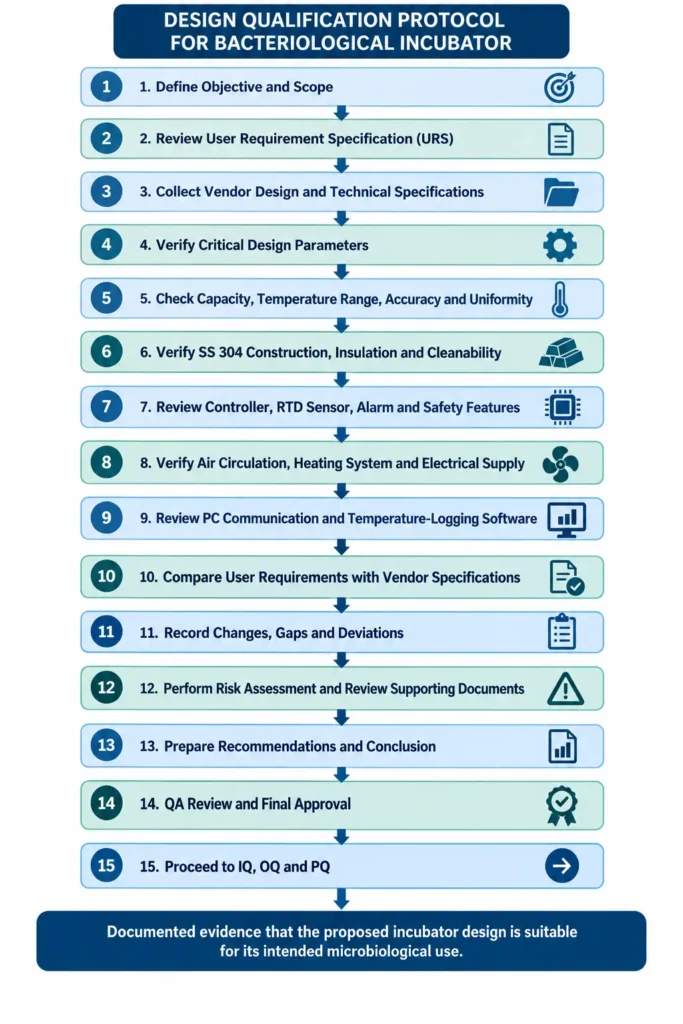
The user requirements are compared with the vendor specifications to identify any differences. All changes, gaps, and deviations must be recorded and properly justified. A risk assessment is conducted, and supporting documents such as the purchase order, comparison sheet, operating manual, and equipment specifications are reviewed. Finally, recommendations and conclusions are prepared. After QA review and approval, the equipment can proceed to Installation Qualification, Operational Qualification, and Performance Qualification. This process provides documented evidence that the incubator design is appropriate, safe, reliable, and suitable for its intended microbiological use.