







1. Introduction for Design Qualification Protocol for Garment Storage Cabinet:
The Design Qualification Protocol for Garment Storage Cabinet is prepared to confirm that the proposed equipment is suitable for storing sterilized garments in the microbiology change room. The cabinet provides a controlled, clean environment through recirculated, filtered airflow and helps protect packed garments from dust, particles, and possible contamination. This protocol compares the user requirements with the vendor’s design specifications before the cabinet is installed and used. Design Qualification Protocol for Garment Storage Cabinet reviews important features such as stainless-steel construction, HEPA and pre-filters, air velocity, differential pressure, illumination, UV light, alarms, electrical supply, shelves, dimensions, and safety controls. It also checks whether the cabinet allows easy cleaning, safe operation, proper maintenance, and sufficient working space. Any difference between the required design and the supplied design must be recorded, assessed, and justified. Successful completion of this qualification provides documented evidence that the selected cabinet design meets its intended purpose, GMP expectations, and routine operational needs.
Skip to PDF content2. Flow Diagram for Design Qualification Protocol for Garment Storage Cabinet:
The flow diagram explains the step-by-step Design Qualification process for a Garment Storage Cabinet used in the parenteral section. The process begins with preparing the User Requirement Specification (URS), which defines the required construction, capacity, airflow, filtration, safety, and control features. The vendor’s design and technical documents are then reviewed and compared with the approved URS. Critical parameters such as stainless-steel construction, HEPA filters, pre-filters, air velocity, differential pressure, electrical supply, UV light, alarms, indicators, and cabinet dimensions are verified.
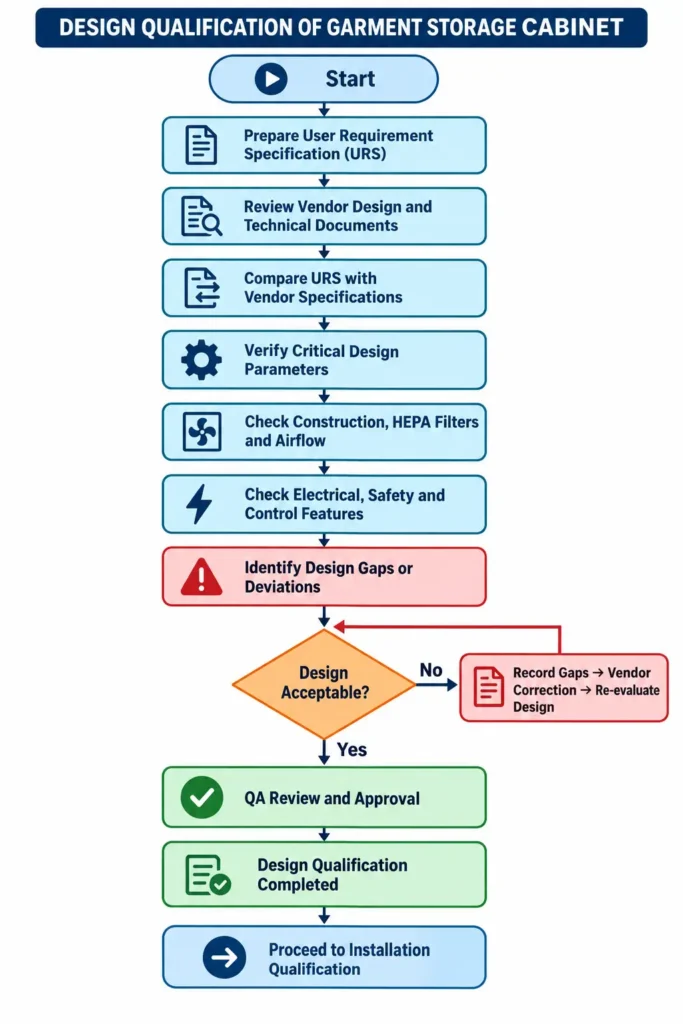
Any difference between the user requirements and vendor specifications is identified and recorded as a design gap or deviation. If the design is not acceptable, the vendor must correct the identified gaps, and the revised design is evaluated again. When all requirements are satisfactorily fulfilled, Quality Assurance reviews and approves the design. The Design Qualification is then completed, allowing the Garment Storage Cabinet to proceed to the Installation Qualification stage.
3. Brainstorming for Design Qualification Protocol for Garment Storage Cabinet not done:
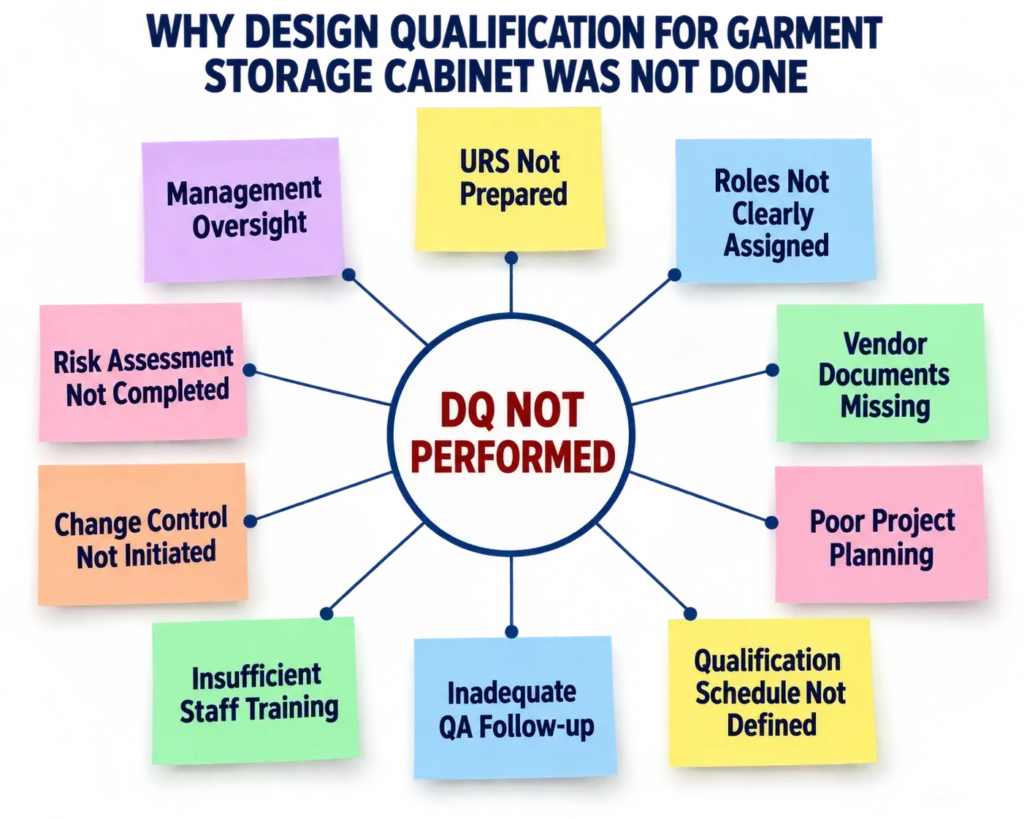
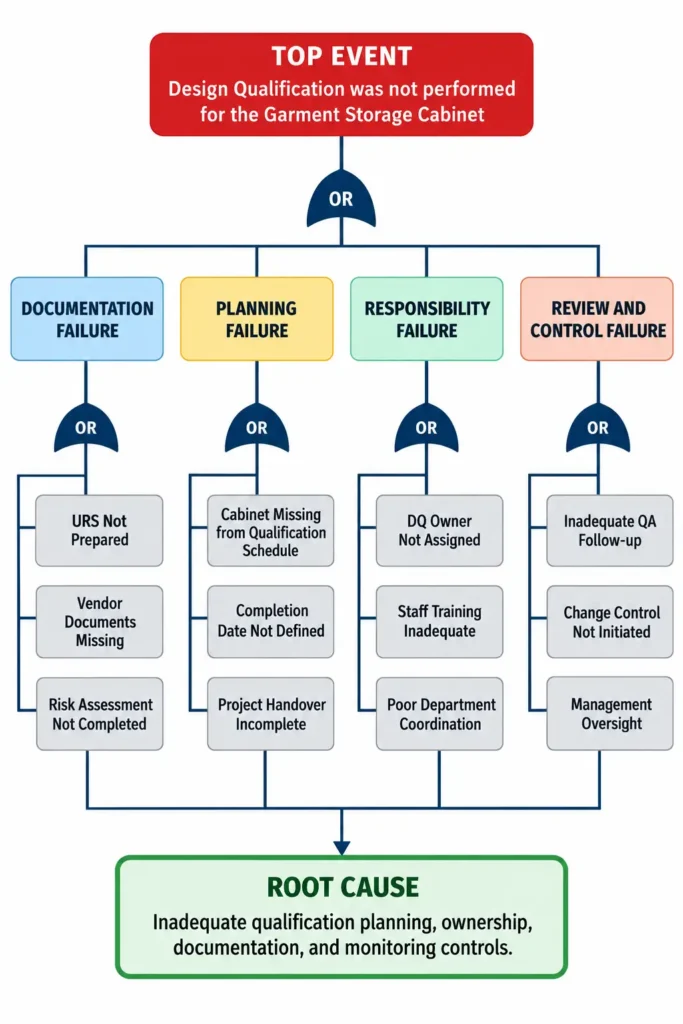
The brainstorming diagram explains the possible reasons why Design Qualification was not performed for the Garment Storage Cabinet. It shows that the problem may have started because the User Requirement Specification was not prepared or responsibilities were not clearly assigned. Documents may not have been received from the vendor, making it difficult to compare the cabinet design with requirements. Poor project planning and the absence of a qualification schedule may also have delayed the activity. Inadequate follow-up by Quality Assurance and insufficient staff training could allow the task to remain unnoticed or incomplete. The change control and risk assessment may not have been initiated before purchasing or installing the cabinet. Management oversight may have contributed to the delay. This brainstorming exercise helps the investigation team identify all possible causes without blaming individuals. Each cause should be checked using records, interviews, and evidence before selecting the root cause and implementing corrective and preventive actions (CAPA).
4. 5-Why Analysis for Design Qualification Protocol for Garment Storage Cabinet not done:
The 5-Why Analysis identifies the main reason why Design Qualification was not performed for the Garment Storage Cabinet. The first question shows that the qualification activity was not initiated. It was not initiated because no responsible person or completion date was assigned. This happened because the cabinet was not included in the equipment qualification schedule. The cabinet was excluded from the schedule because the project handover and Quality Assurance review were incomplete. Further investigation shows that the handover remained incomplete because the qualification procedure did not clearly define responsibility, documentation requirements, timelines, and follow-up controls.
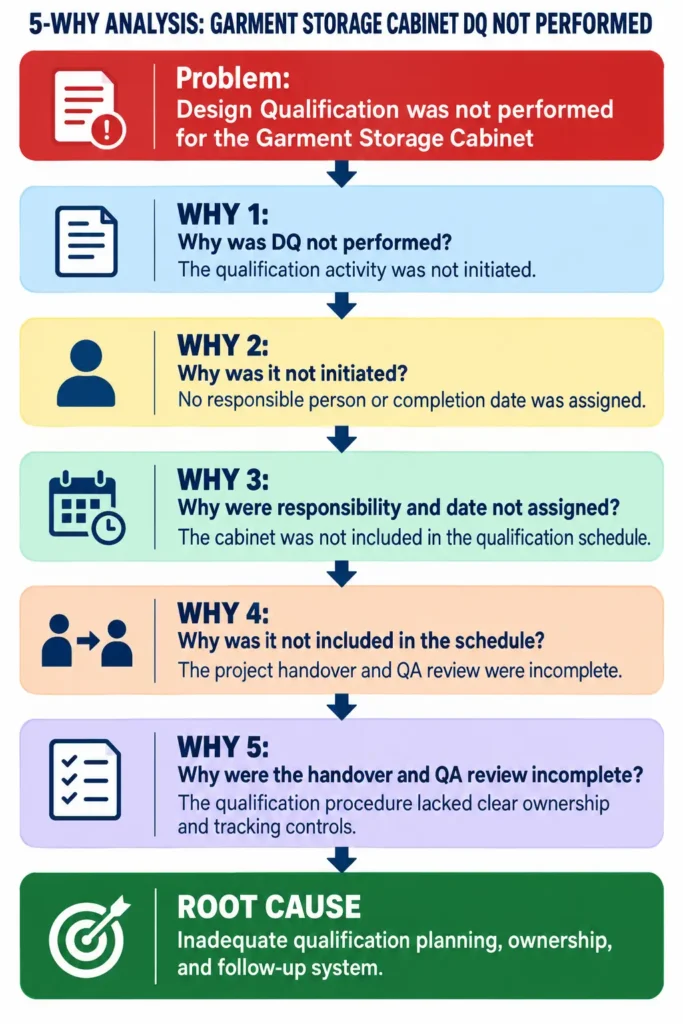
Therefore, the identified root cause is an inadequate qualification planning, ownership, and tracking system. The analysis indicates that the failure was mainly related to the management system rather than an individual employee. Corrective actions should include completing the Design Qualification and assessing equipment impact. Preventive actions should include assigning responsibilities, updating the qualification schedule, defining timelines, and periodically reviewing qualification status.
5. Heat Map Analysis for Design Qualification Protocol for Garment Storage Cabinet not done:
The Heat Map Analysis shows the risks created when Design Qualification is not performed for the Garment Storage Cabinet. Each risk is evaluated according to its likelihood of occurring and the seriousness of its impact. The major risks include unverified airflow and HEPA filter performance, contamination of stored garments, GMP non-compliance, unsuitable cabinet design, cleaning difficulties, and missing alarms or control features. The heat map uses different colours to explain the risk levels. Green represents low risk, yellow represents medium risk, orange represents high risk, and red represents critical risk. Most identified risks fall within the high-risk area because they may affect garment cleanliness, product quality, operator safety, and regulatory compliance.
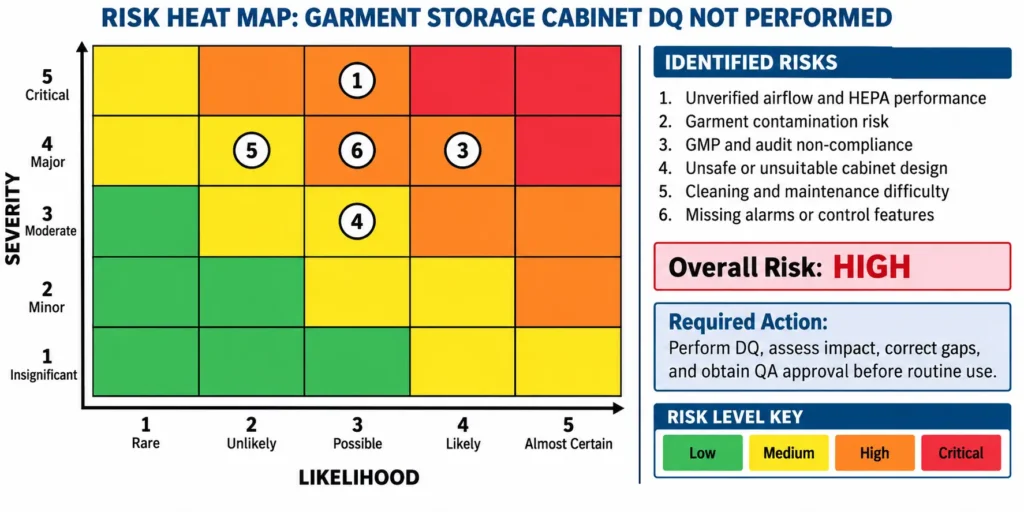
The overall risk is therefore classified as High. The cabinet should not be approved for routine use until Design Qualification is completed. The company should assess the impact, correct identified design gaps, verify vendor specifications, document deviations, and obtain Quality Assurance approval.
6. Pareto Chart Analysis for Design Qualification Protocol for Garment Storage Cabinet not done:
The Pareto Chart shows the major reasons why Design Qualification was not performed for the Garment Storage Cabinet. The causes are arranged from highest to lowest contribution. Unclear responsibility is the biggest cause at 24%, followed by poor project planning at 20%, inadequate QA follow-up at 16%, URS not prepared at 14%, and missing vendor documents at 10%. Together, these five causes contribute 84% of the total problem and are considered the “vital few.” Other causes include an undefined qualification schedule, insufficient staff training, and missing change control. These contribute less individually but still require corrective action. The orange line shows the cumulative percentage, while the 80% threshold helps identify the causes that should receive priority.
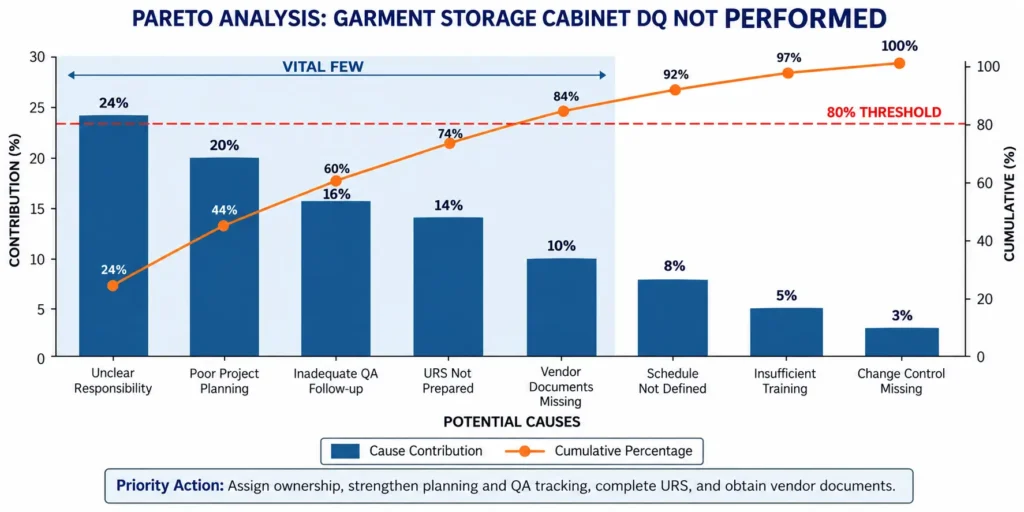
The chart indicates that management should first assign clear responsibility, improve project planning, strengthen QA tracking, complete the URS, and obtain required vendor documents. Addressing these main causes can significantly prevent similar qualification failures.
7. Pareto Chart Analysis for Design Qualification Protocol for Garment Storage Cabinet not done:
The Pareto Chart identifies and ranks the main reasons why Design Qualification was not performed for the Garment Storage Cabinet. The causes are arranged from the highest to the lowest contribution. Unclear responsibility is the leading cause at 24%, followed by poor project planning at 20%, inadequate QA follow-up at 16%, an unprepared URS at 14%, and missing vendor documents at 10%. Together, these first five causes contribute 84% of the overall problem. They are called the “vital few” because correcting them can prevent most qualification failures. The remaining causes—an undefined qualification schedule, insufficient employee training, and missing change control—contribute 16%.
The orange cumulative line shows how the percentage increases as each cause is added. The 80% line helps identify priority areas. Management should assign responsibility, prepare the URS, improve planning, obtain vendor documents, and establish regular QA tracking to ensure Design Qualification is completed before installation and routine use.
8. Questions and Answers for Design Qualification Protocol for Garment Storage Cabinet not done:
1. What is Design Qualification (DQ)?
Design Qualification is documented proof that the proposed equipment design meets user requirements, GMP requirements, and its intended purpose.
2. Why is DQ required for a Garment Storage Cabinet?
DQ confirms that the cabinet can safely store clean or sterilized garments without increasing contamination risk.
3. When should Design Qualification be performed?
It should be completed and approved before equipment purchase, fabrication, installation, or final acceptance.
4. What should be checked during DQ?
Construction material, dimensions, airflow, HEPA filters, pre-filters, differential pressure, UV lamp, alarms, controls, utilities, cleaning, and safety features should be checked.
5. What happens if DQ is not performed?
The cabinet may have unsuitable construction, insufficient airflow, ineffective filtration, missing safety features, or cleaning difficulties.
6. Can the cabinet be used without completing DQ?
Routine use should be avoided until an impact assessment is completed, the design is verified, and QA provides documented approval.
7. What is the main root cause identified by the 5-Why Analysis?
The main cause is inadequate qualification planning, unclear responsibility, and weak tracking and follow-up controls.
8. What risks were identified in the Heat Map Analysis?
Garment contamination, unverified HEPA performance, unsuitable design, GMP non-compliance, cleaning problems, and missing alarms were identified.
9. What does the Pareto Chart indicate?
It indicates that unclear responsibility, poor planning, inadequate QA follow-up, missing URS, and missing vendor documents contribute to most failures.
10. Which departments should participate in DQ?
Quality Assurance, User Department, Engineering, Validation, Purchase, and the equipment vendor should participate.
11. What documents are required for DQ?
URS, purchase order, vendor specifications, design drawings, risk assessment, technical datasheets, deviation records, and supporting certificates are required.
12. How should design differences be handled?
Each difference should be recorded, assessed for impact, justified, corrected where necessary, and approved by authorized personnel.
13. What immediate corrective action is required?
Prepare and execute the DQ protocol, compare the vendor design with the URS, identify gaps, assess impact, and obtain QA approval.
14. What preventive actions should be implemented?
Maintain a qualification schedule, assign equipment owners, define timelines, introduce tracking controls, train employees, and conduct periodic QA reviews.
15. Can IQ replace Design Qualification?
No. IQ confirms correct installation, while DQ confirms that the selected design is appropriate before installation.
16. What should happen after DQ approval?
The cabinet should proceed through Installation Qualification, Operational Qualification, and Performance Qualification before routine use.
9. Reference Guidelines for Design Qualification Protocol for Garment Storage Cabinet not done:
- EU GMP Annex 15 – Qualification and Validation
Section 3 covers Design Qualification and requires documented verification that the proposed design complies with GMP and the approved URS.
EU GMP Annex 15 - EU GMP Annex 1 – Manufacture of Sterile Medicinal Products
Relevant for sterile garment handling, contamination control, clean-air equipment, HEPA integrity, airflow, pressure, particle monitoring, cleaning, and qualification.
EU GMP Annex 1 - WHO TRS 1019, Annex 3 – Guidelines on Validation
Appendix 6 provides guidance on the qualification of systems and equipment, including URS, DQ, IQ, OQ, and PQ.
WHO Validation Guidelines - WHO TRS 1044, Annex 2 – GMP for Sterile Pharmaceutical Products
Covers sterile-area contamination control, garment practices, cleanroom requirements, HEPA filtration, and clean-air equipment qualification.
WHO Sterile Pharmaceutical GMP - ICH Q9(R1) – Quality Risk Management
Provides the framework for identifying, evaluating, controlling, communicating, and reviewing risks caused by missing DQ or design deficiencies.
ICH Q9(R1) - ICH Q10 – Pharmaceutical Quality System
Supports documented responsibilities, change management, CAPA, management oversight, and lifecycle control of qualified equipment.
ICH Q10 - ISO 14644-1 and ISO 14644-3
These standards may be applied when the cabinet is designed to provide classified clean air. They cover airborne-particle classification and clean-air test methods.