






Brief Description
This Standard Operating Procedure describes the method for destruction and disposal of excess laboratory materials generated in the Quality Control department. Its objective is to establish a defined procedure for handling excess materials such as tablets, capsules, raw materials, liquids and ointments. The SOP assigns responsibility to the Executive-QC for preparation and to the Manager-QC and Head QA/QC for effective implementation. According to the procedure, excess pharmaceutical materials are dissolved in hot water and the dissolved material is drained. The drainage line is subsequently flushed using 10% hydrochloric acid and 10% sodium hydroxide. Excess packaging materials are cut into pieces and transferred to the scrap yard, while excess bottles are crushed before being sent for scrap disposal. The SOP also specifies training for QC personnel, document distribution, abbreviations and revision-history requirements to support controlled implementation and documentation.
Skip to PDF content1. Flow Diagram:
The flow diagram illustrates the sequence for destruction of excess laboratory materials in the Quality Control department. It begins with identification of excess materials such as tablets, capsules, raw materials, liquids and ointments. These materials are then dissolved in hot water, followed by draining of the dissolved material. As specified in the SOP, the drainage line is subsequently flushed using 10% hydrochloric acid and 10% sodium hydroxide.
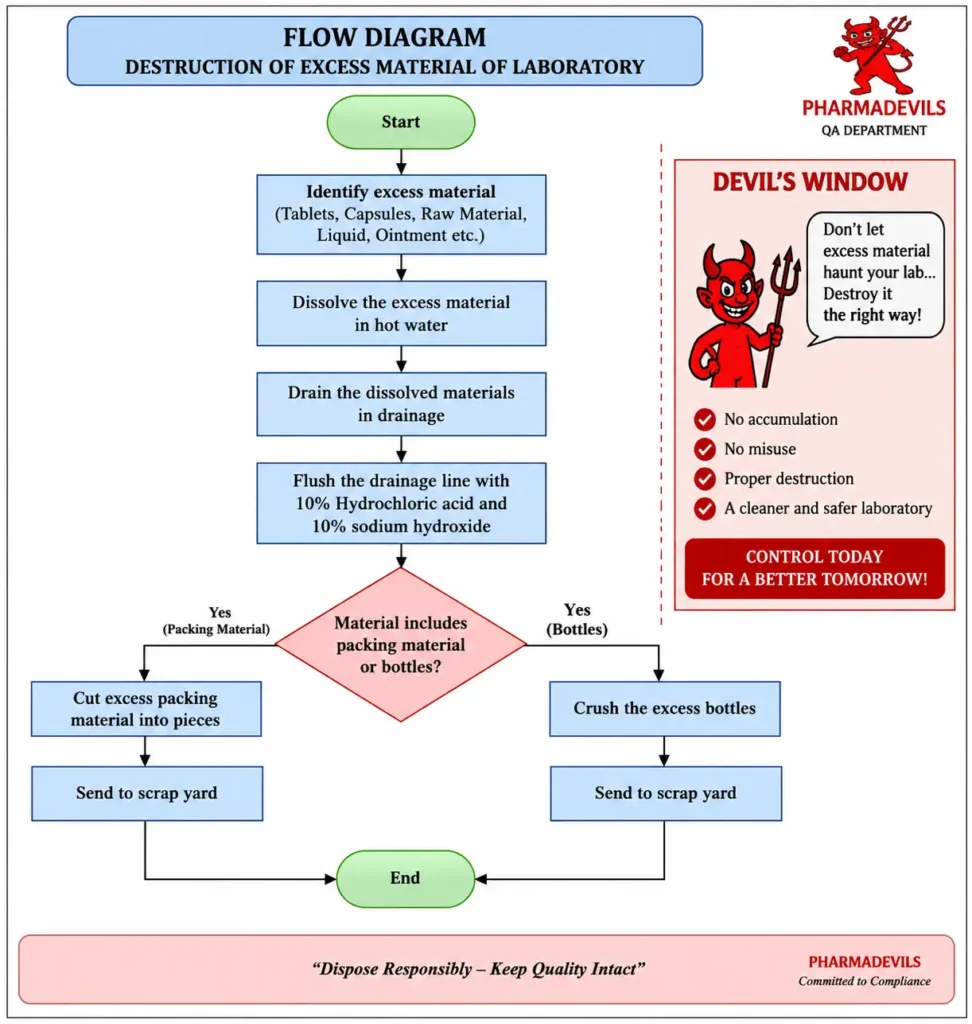
The flow then separates the handling of packaging materials and bottles. Excess packing materials are cut into pieces and transferred to the scrap yard, while excess bottles are crushed before being sent for scrap disposal.The “Devil’s Window” visually highlights key reminders such as avoiding accumulation or misuse of excess material and ensuring controlled destruction and disposal.
2. Brainstorming for SOP Failure:
The brainstorming diagram identifies possible reasons for failure to follow the SOP for Destruction of Excess Material of Laboratory. The central issue is SOP non-compliance during handling and destruction of excess laboratory materials. Potential causes highlighted through sticky notes include lack of SOP awareness, inadequate training, unclear or incomplete procedures, lack of required materials, workload and time pressure, poor supervision, inadequate disposal facilities, weak documentation, poor communication between shifts, lack of accountability, deliberate shortcuts, negligence, and absence of periodic SOP review.
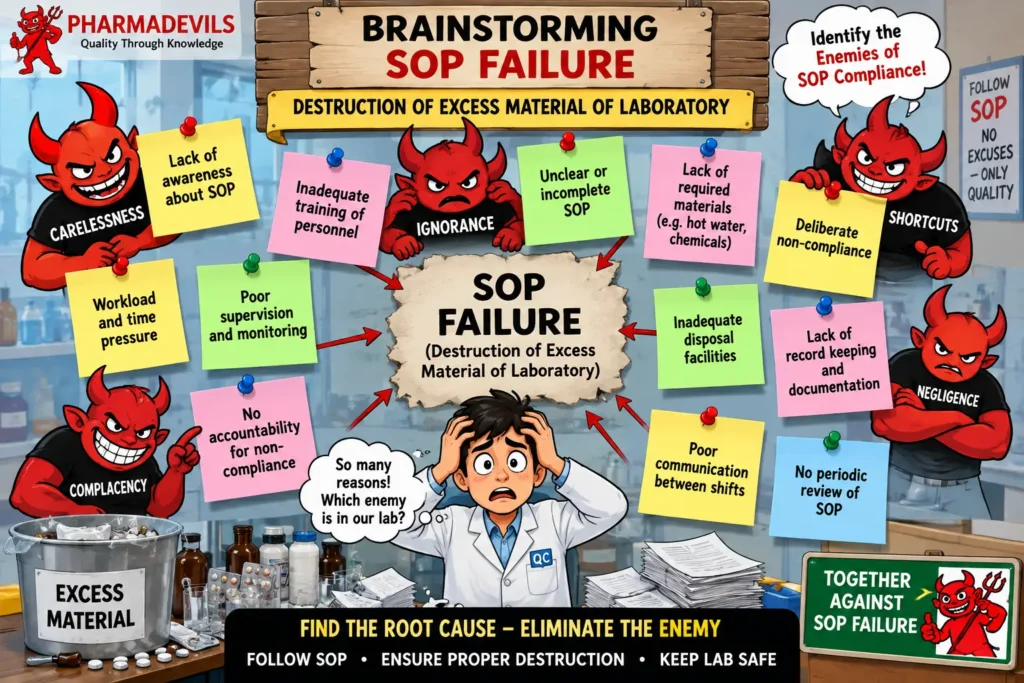
The “enemy” theme visually represents behaviors such as carelessness, ignorance, complacency, shortcuts, and negligence that can lead to SOP failure. The brainstorming exercise helps the QC and QA teams identify contributing factors systematically so that appropriate corrective and preventive actions can be established. The purpose is to strengthen SOP compliance, ensure proper destruction of excess laboratory materials, improve documentation, and maintain a safe and controlled laboratory environment.
3. 5-Why Analysis for SOP Failure:
The 5-Why Analysis diagram investigates the failure to follow the SOP for Destruction of Excess Material of Laboratory by progressively identifying the underlying causes of non-compliance. It begins with the question of why the SOP was not followed and traces the issue through lack of awareness, inadequate training and communication, insufficient monitoring and supervision, unclear accountability, and weak periodic review and enforcement.
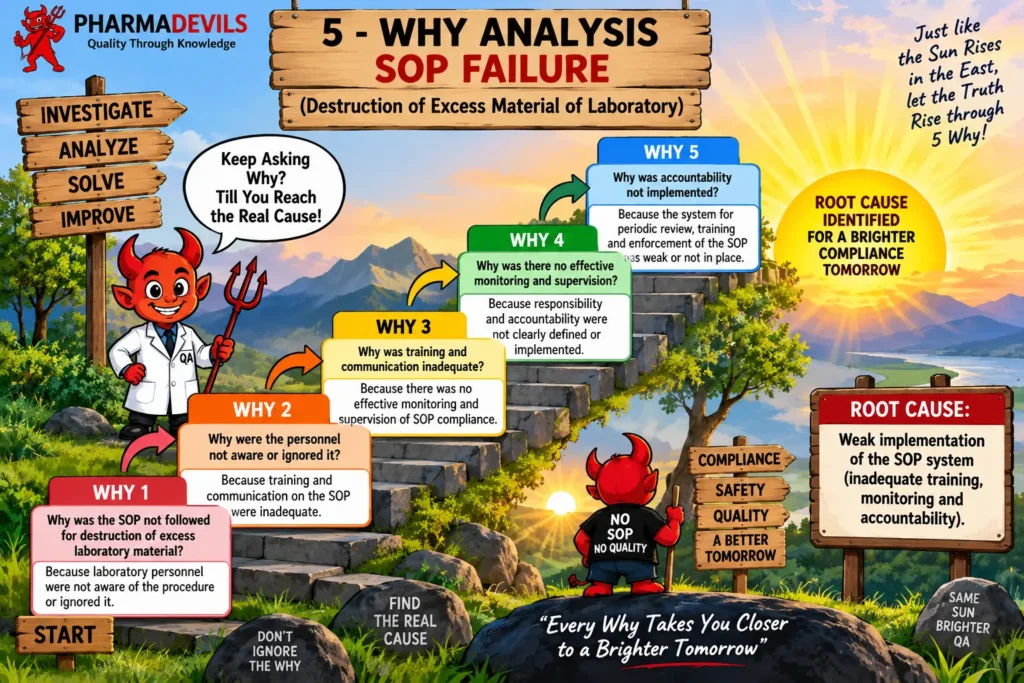
The analysis concludes that the primary root cause is weak implementation of the SOP system, particularly deficiencies in training, monitoring, responsibility, and accountability. The sunrise-in-the-east theme represents the gradual discovery of the true root cause, where each “Why” brings the investigation closer to corrective action and improved compliance.The diagram emphasizes that identifying and eliminating systemic causes can strengthen SOP adherence, improve laboratory safety, enhance quality control, and prevent recurrence of improper destruction or disposal practices.
4. Fishbone Analysis for SOP Failure:
The Fishbone Analysis identifies the major potential causes of SOP failure during destruction of excess laboratory material. The causes are grouped into six main categories: Man/Personnel, Method/Procedure, Material/Resources, Machine/Facilities, Measurement/Documentation, and Management/Environment.
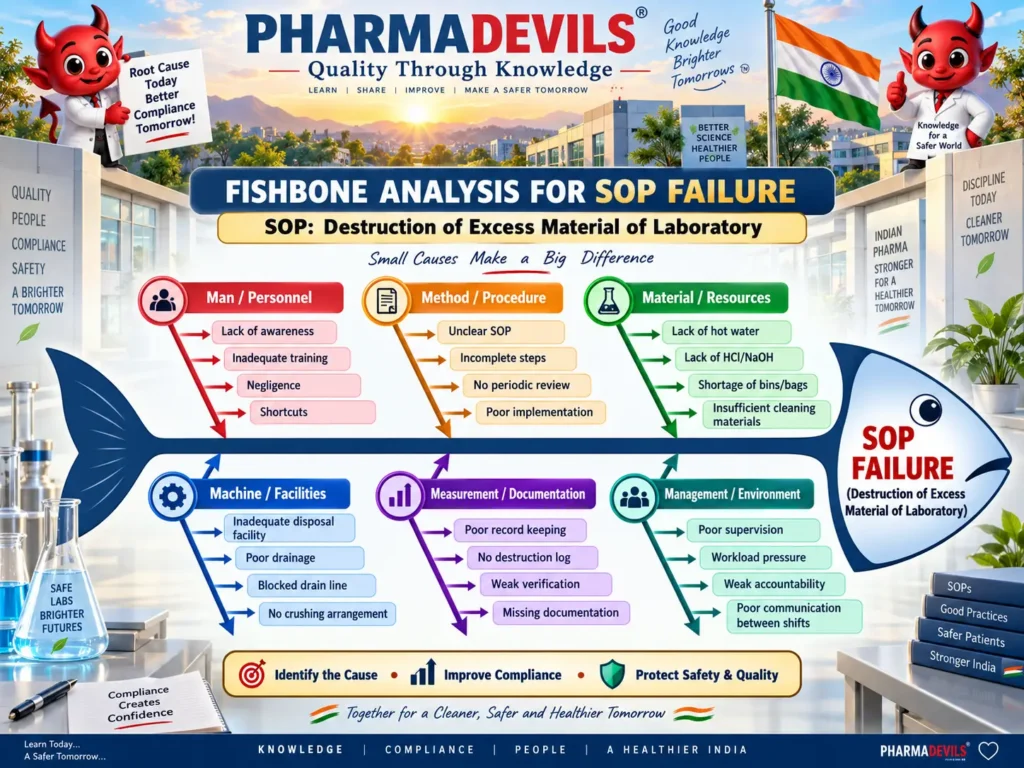
Personnel-related causes include lack of awareness, inadequate training, negligence, and shortcuts. Method-related issues include unclear or incomplete SOP steps, lack of periodic review, and poor implementation. Material and resource causes include insufficient hot water, chemicals, bins, bags, or cleaning materials. Facility-related causes include inadequate disposal arrangements, poor drainage, blocked drain lines, and absence of suitable crushing facilities. Documentation issues include poor record keeping, missing destruction logs, weak verification, and incomplete records. Management factors include poor supervision, workload pressure, weak accountability, and poor communication between shifts.The diagram helps systematically identify contributing factors so that suitable CAPA can be implemented to strengthen SOP compliance, laboratory safety, documentation, and controlled disposal practices.
5. Fault Tree Analysis:
The Fault Tree Analysis (FTA) diagram evaluates how failure of the SOP for Destruction of Excess Material of Laboratory can occur through multiple contributing events. The top event is improper destruction of excess laboratory material, which may result from material not being destroyed properly, drainage not being cleaned properly, packing material not being disposed of correctly, or bottles not being crushed and sent to scrap.
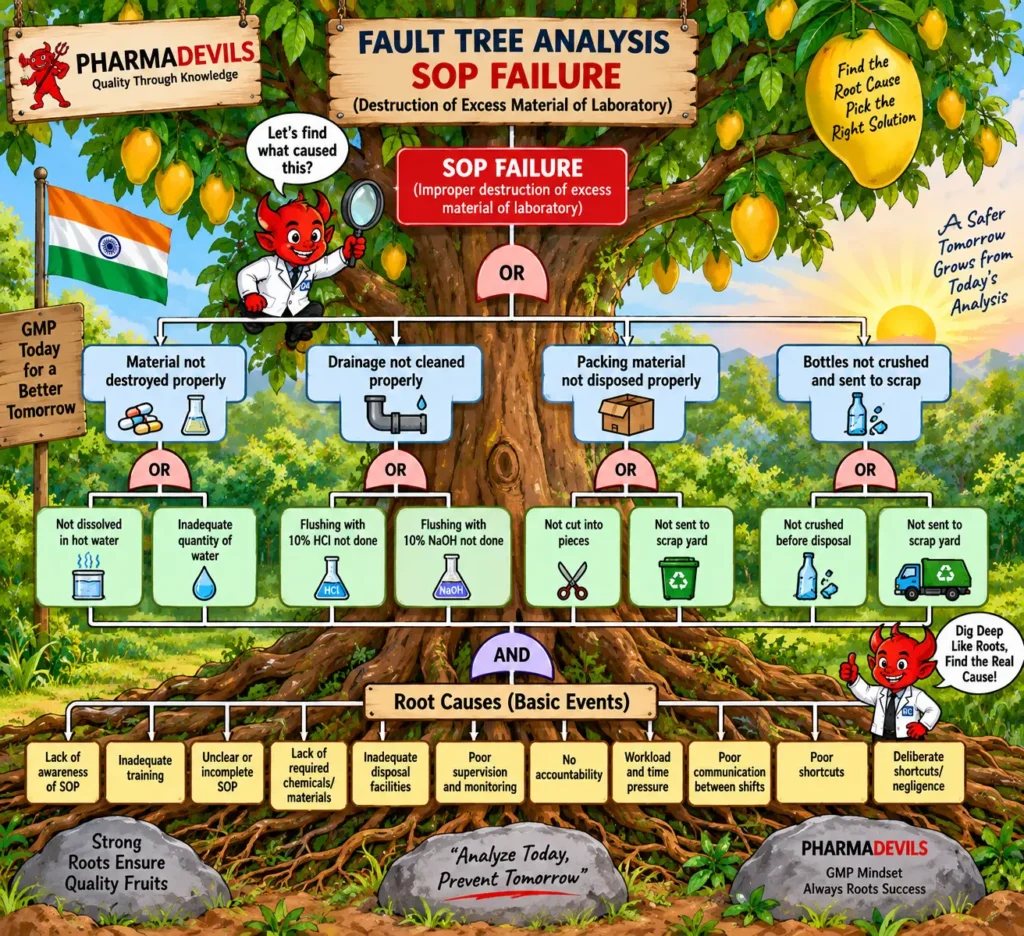
The diagram further breaks these failures into specific events such as failure to dissolve material in hot water, inadequate water quantity, omission of 10% HCl or 10% NaOH flushing, failure to cut packing material into pieces, and failure to crush bottles before disposal. These procedural steps are consistent with the SOP requirements.The mango-tree roots represent underlying basic causes such as lack of SOP awareness, inadequate training, unclear procedures, insufficient resources, poor supervision, weak accountability, workload pressure, poor communication, shortcuts, and negligence. The tree concept emphasizes that identifying the deepest root causes is essential for effective CAPA and prevention of recurrence.
Questions & Answers – SOP for Destruction of Excess Material of Laboratory
Q1. What is the objective of this SOP?
Answer: To establish a procedure for destruction of excess material generated in the laboratory.
Q2. What is the scope of this SOP?
Answer: It is applicable to the destruction of excess laboratory material.
Q3. Who is responsible for preparation of the SOP?
Answer: Executive-QC is responsible for preparation of the SOP.
Q4. Who is responsible for effective implementation of the SOP?
Answer: Manager-QC and Head QA/QC are responsible for effective implementation.
Q5. Which types of excess materials are covered?
Answer: Tablets, capsules, raw materials, liquids, ointments and similar excess laboratory materials are included.
Q6. How is excess pharmaceutical material initially destroyed according to the SOP?
Answer: The excess material is dissolved in hot water.
Q7. What is done after the material is dissolved?
Answer: The dissolved material is drained into the drainage system.
Q8. How is the drainage line flushed?
Answer: The SOP specifies flushing with 10% hydrochloric acid and 10% sodium hydroxide.
Q9. How is excess packing material handled?
Answer: It is cut into pieces and sent to the scrap yard.
Q10. How are excess bottles disposed of?
Answer: The bottles are crushed and then sent to the scrap yard.
Q11. Who provides training for this SOP?
Answer: Head QA/QC is designated as the trainer.
Q12. Who are the trainees?
Answer: Quality Control personnel.
Q13. What is the specified training duration?
Answer: Half an hour.
Q14. Who receives the controlled copy of the SOP?
Answer: Head of Department – Quality Control.
Q15. Who maintains the master copy?
Answer: Head of Department – Quality Assurance.
Q16. What reference is specified in the SOP?
Answer: The SOP lists the reference as “In House.”
Q17. Are any enclosures specified?
Answer: No. The SOP states “Enclosures: Nil.”
Q18. Why should the destruction procedure be followed exactly as written?
Answer: Following the approved procedure ensures that excess materials, packing materials and bottles are handled according to the defined SOP steps and assigned responsibilities.
Reference Guidelines:
- Revised Schedule M – Drugs Rules, 1945, G.S.R. 922(E), 28 December 2023
Good Manufacturing Practices and Requirements of Premises, Plant and Equipment for Pharmaceutical Products. It establishes the current GMP framework for pharmaceutical manufacturers and requires documented systems and procedures. (Drugs Control)
CDSCO – Revised Schedule M / Gazette Notifications - WHO TRS 1052, Annex 4 – Good Practices for Pharmaceutical Quality Control Laboratories, 2024
Relevant for QC laboratory operations, responsibilities, safety, controlled procedures and laboratory quality systems. (World Health Organization)
WHO – Good Practices for Pharmaceutical Quality Control Laboratories - Hazardous and Other Wastes (Management and Transboundary Movement) Rules, 2016, as amended
Relevant when discarded APIs, chemicals, solvents, contaminated materials or pharmaceutical residues meet hazardous-waste classifications. Waste should be handled and disposed of through authorized systems according to the applicable SPCB/PCC requirements. (MoEFCC)
MoEFCC – Hazardous Waste Rules and Amendments - Bio-Medical Waste Management Rules, 2016, as amended – where applicable
The rules provide requirements for discarded medicines, pharmaceutical waste and chemical liquid waste. They specify controlled collection/treatment routes rather than unrestricted disposal. (Central Pollution Control Board)
CPCB – Bio-Medical Waste Management Rules 2016 - CPCB – Guidelines for the Pharmaceutical Industry in India
CPCB’s pharmaceutical-industry guidance addresses hazardous waste, pharmaceutical residues, discarded medicines, storage, records and authorized disposal facilities. The currently surfaced document is a draft guideline, so it should be used as supplementary guidance rather than cited as binding law. (Central Pollution Control Board) - WHO – Safe Management of Pharmaceutical Waste, 2025
Provides current international best practices for handling unused medicines, bulk tablets/capsules and other pharmaceutical waste, including laboratory-generated waste in healthcare settings. (World Health Organization)
WHO – Safe Management of Pharmaceutical Waste