






1. Introduction – SOP for Die Blocking:
The SOP for Die Blocking describes the standardized procedure for safely blocking an unusable die cavity in a tablet compression machine when a die bore or punch bore is damaged, or when an adequate number of punches and dies are not available. The SOP applies to compression machines used in the production compression area and assigns responsibility to the compression operator, Production Chemist, AGM–Production, and Head–QA/QC for proper execution and implementation. As specified in the procedure, the affected cavity should preferably be blocked using a dummy die without a bore. When a dummy die is unavailable, solid beeswax may be placed into the die cavity, gently secured using a metal rod and hammering, and excess wax subsequently removed. The turret should then be cleaned and the feed frame adjusted before further machine operation. This controlled approach helps ensure safe compression-machine operation and prevents use of a defective die station during tablet manufacturing.
Skip to PDF content2. Flow Diagram – SOP for Die Blocking:
The SOP for Die Blocking explains the controlled method for blocking a die cavity of a compression machine when the die bore or punch bore is damaged or when there is a shortage of suitable punches and dies. The procedure first requires the affected cavity to be blocked with a dummy die without a bore, wherever available.
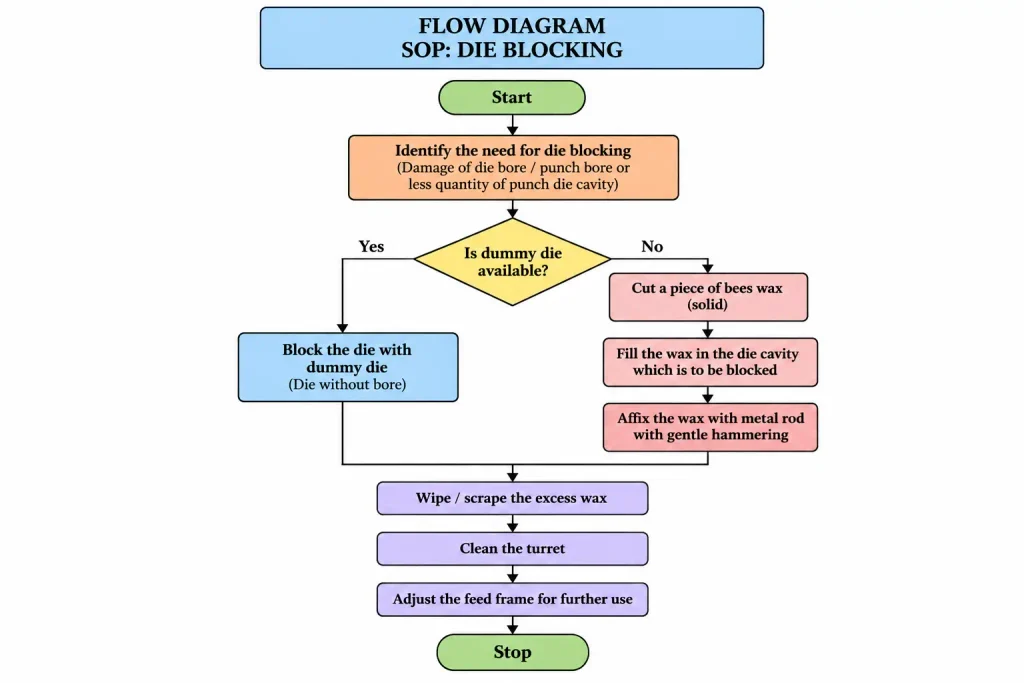
If a dummy die is not available, a piece of solid beeswax is cut and filled into the die cavity, then fixed with a metal rod using gentle hammering. Excess wax is wiped or scraped off, the turret is cleaned, and the feed frame is adjusted before further use. This procedure helps ensure safe machine operation and prevents use of a defective die station during compression activities.
3. Benefits of Following SOP for Die Blocking:
Following the SOP for Die Blocking ensures that a damaged or unavailable die station is controlled properly before continuing tablet compression activities. The procedure requires use of a dummy die without a bore for blocking the affected cavity. When a dummy die is not available, solid beeswax may be placed in the die cavity, fixed gently with a metal rod, and excess wax removed before cleaning the turret and adjusting the feed frame.
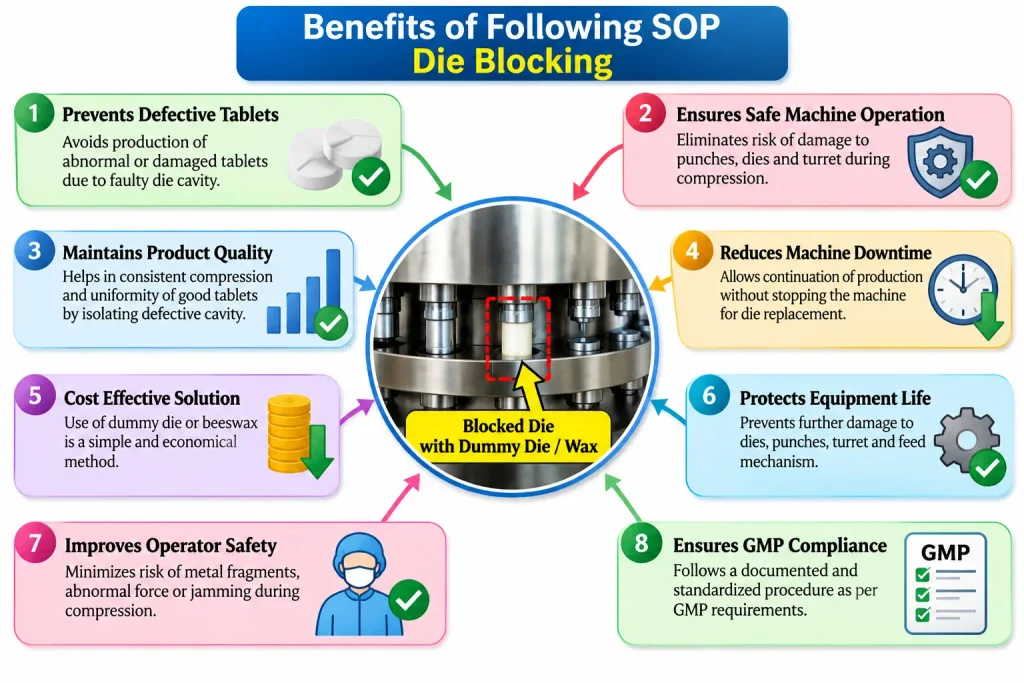
Proper implementation of this SOP helps prevent the use of a defective die cavity during compression, supports safer machine operation, and reduces the possibility of further damage to punches, dies, turret components, or the feed system. It also promotes consistent production practices, better equipment control, and orderly continuation of compression activities. By following a documented method, operators and production personnel can maintain GMP discipline, improve operational reliability, and ensure that die blocking is carried out in a controlled and repeatable manner.
4. Brainstorming for SOP Failure – Die Blocking:
The Brainstorming for SOP Failure – Die Blocking identifies potential causes and consequences that may lead to ineffective implementation of the die-blocking procedure during tablet compression. The approved SOP requires a damaged or unavailable die cavity to be blocked using a dummy die, or by using solid beeswax when a dummy die is not available, followed by removal of excess wax, cleaning of the turret, and adjustment of the feed frame.
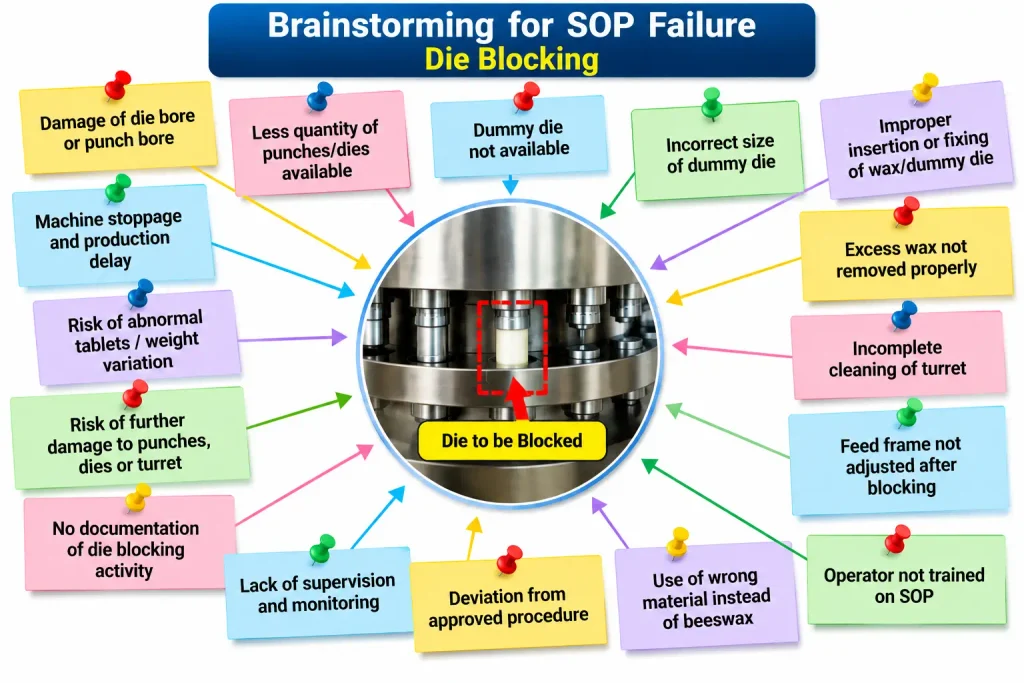
Possible failure factors include damaged die or punch bores, shortage of punches and dies, unavailability or incorrect selection of a dummy die, improper fixation of beeswax, incomplete cleaning, inadequate feed-frame adjustment, operator error, insufficient supervision, and deviation from the approved procedure. Such failures may contribute to production delays, abnormal tablets, equipment damage, and poor process control. Brainstorming helps the production and quality teams identify these risks early and establish suitable controls, training, monitoring, and procedural compliance.
5. 5-Why Analysis for SOP Failure – Die Blocking:
The 5-Why Analysis for SOP Failure – Die Blocking is used to identify the underlying reason for failure to follow the approved die-blocking procedure during tablet compression. The SOP specifies that when a die bore or punch bore is damaged, or when punches and dies are insufficient, the affected cavity should be blocked using a dummy die without a bore. If a dummy die is unavailable, solid beeswax may be used, followed by removal of excess wax, turret cleaning, and feed-frame adjustment.
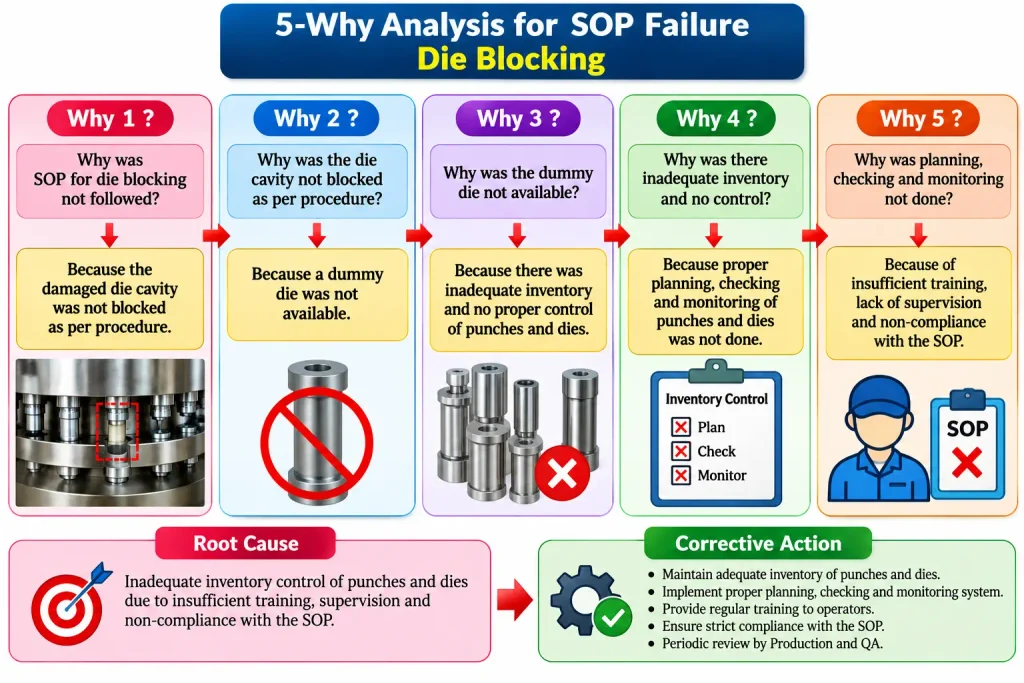
The analysis may trace the failure from improper die blocking to unavailability of a dummy die, inadequate punch-and-die inventory, poor planning and monitoring, and finally insufficient operator training or supervision. Identifying the true root cause helps Production and QA implement suitable corrective actions such as maintaining adequate tooling inventory, improving checks, strengthening supervision, providing refresher training, and ensuring strict compliance with the approved SOP.
6. Fishbone Analysis for SOP Failure – Die Blocking:
The Fishbone Analysis for SOP Failure – Die Blocking is used to systematically identify potential causes that may lead to improper execution of the die-blocking procedure during tablet compression. The SOP requires the affected die cavity to be blocked with a dummy die without a bore when a die bore or punch bore is damaged or when the required punch-die quantity is insufficient. If a dummy die is unavailable, solid beeswax is used, followed by removal of excess wax, turret cleaning, and feed-frame adjustment.
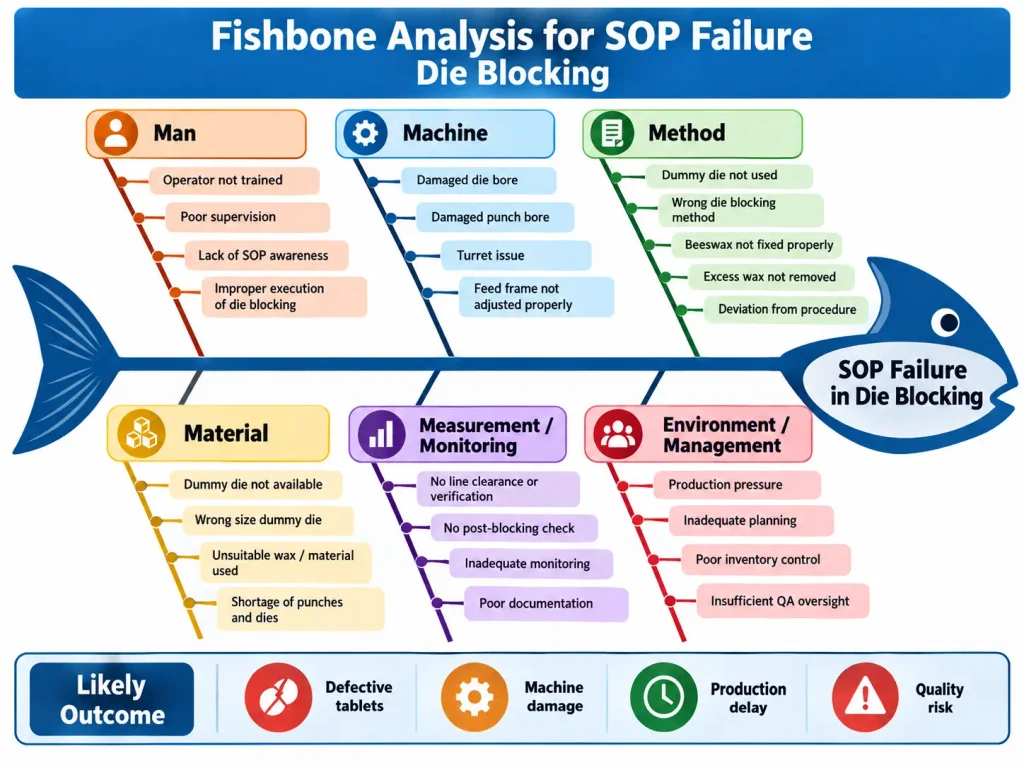
The fishbone analysis groups possible causes under Man, Machine, Method, Material, Measurement/Monitoring, and Environment/Management. Typical causes include inadequate operator training, damaged tooling, incorrect blocking method, unavailable dummy dies, poor monitoring, insufficient documentation, weak inventory control, and inadequate supervision. Identifying these causes helps Production and QA determine appropriate corrective and preventive actions, improve SOP compliance, reduce equipment damage, prevent defective tablets, and minimize production delays.
7. Fault Tree Analysis for SOP Failure – Die Blocking:
The Fault Tree Analysis for SOP Failure – Die Blocking illustrates how different failures can combine to result in improper execution of the die-blocking procedure during tablet compression. The SOP requires that when a die bore or punch bore is damaged, or when the required punch-die quantity is insufficient, the affected cavity should be blocked using a dummy die without a bore. If a dummy die is unavailable, solid beeswax may be used, followed by removal of excess wax, cleaning of the turret, and adjustment of the feed frame.
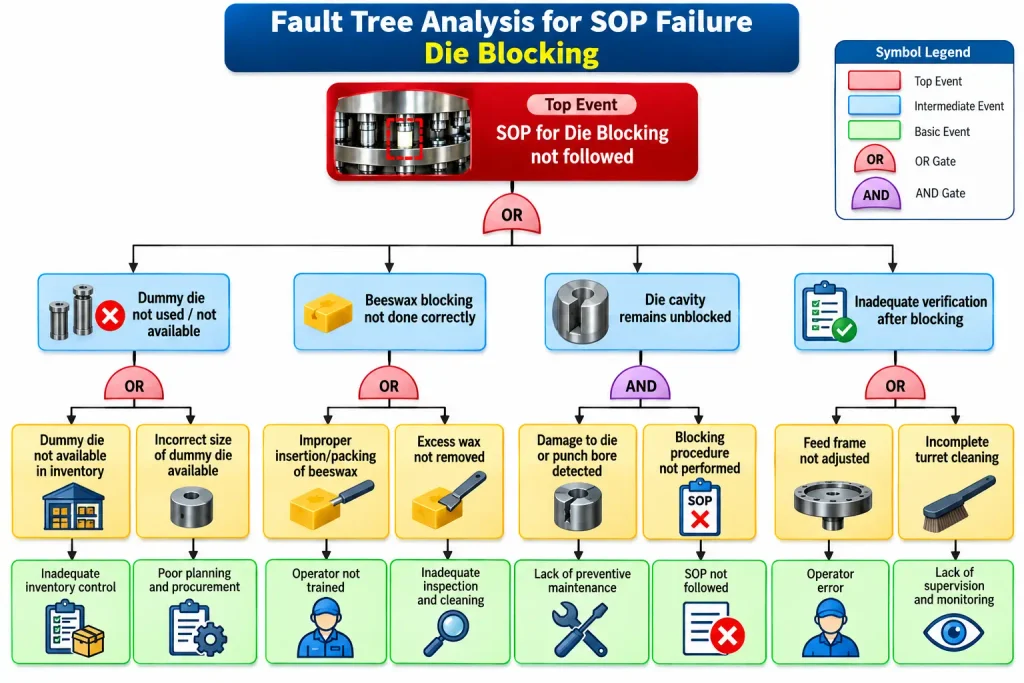
The fault tree identifies major failure paths such as non-availability or incorrect selection of a dummy die, improper beeswax application, failure to block the affected cavity, incomplete cleaning, and inadequate post-blocking checks. Underlying causes may include poor inventory control, operator error, inadequate training, weak supervision, and insufficient monitoring. This analysis supports effective root-cause identification and helps Production and QA establish suitable preventive controls.
8. Impact Assessment for SOP Failure – Die Blocking:
The Impact Assessment for SOP Failure – Die Blocking evaluates the possible consequences of not following the approved die-blocking procedure during tablet compression. The SOP requires blocking of the affected die cavity when there is damage to the die bore or punch bore, preferably by using a dummy die without a bore. If a dummy die is unavailable, solid beeswax may be used, followed by removal of excess wax, cleaning of the turret, and adjustment of the feed frame.
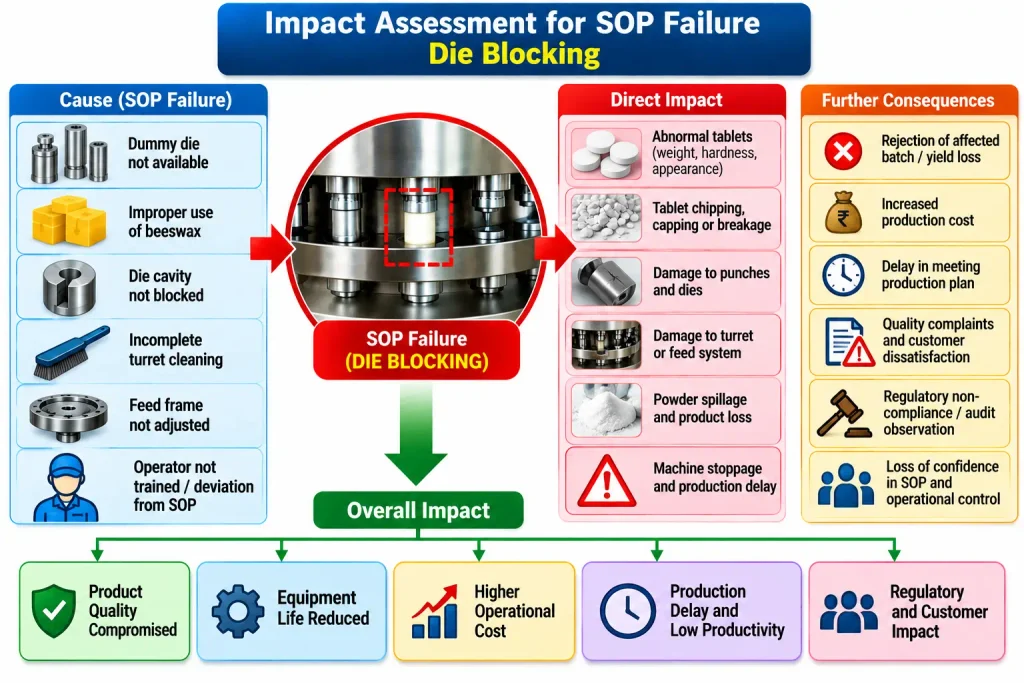
Failure to follow these steps may lead to abnormal tablets, tablet breakage, equipment damage, powder loss, machine stoppage, and production delays. Further consequences can include batch rejection, increased production cost, reduced equipment life, quality complaints, and possible audit observations. The impact assessment therefore helps Production and QA understand the severity of SOP non-compliance and supports timely corrective actions, stronger monitoring, operator training, and improved process control.
9. CAPA for SOP Failure – Die Blocking:
The CAPA for SOP Failure – Die Blocking is intended to correct identified deficiencies in the die-blocking process and prevent their recurrence during tablet compression. The SOP requires the affected die cavity to be blocked using a dummy die without a bore when the die bore or punch bore is damaged or when the required punch-die quantity is insufficient. If a dummy die is unavailable, solid beeswax may be used, followed by removal of excess wax, cleaning of the turret, and adjustment of the feed frame.
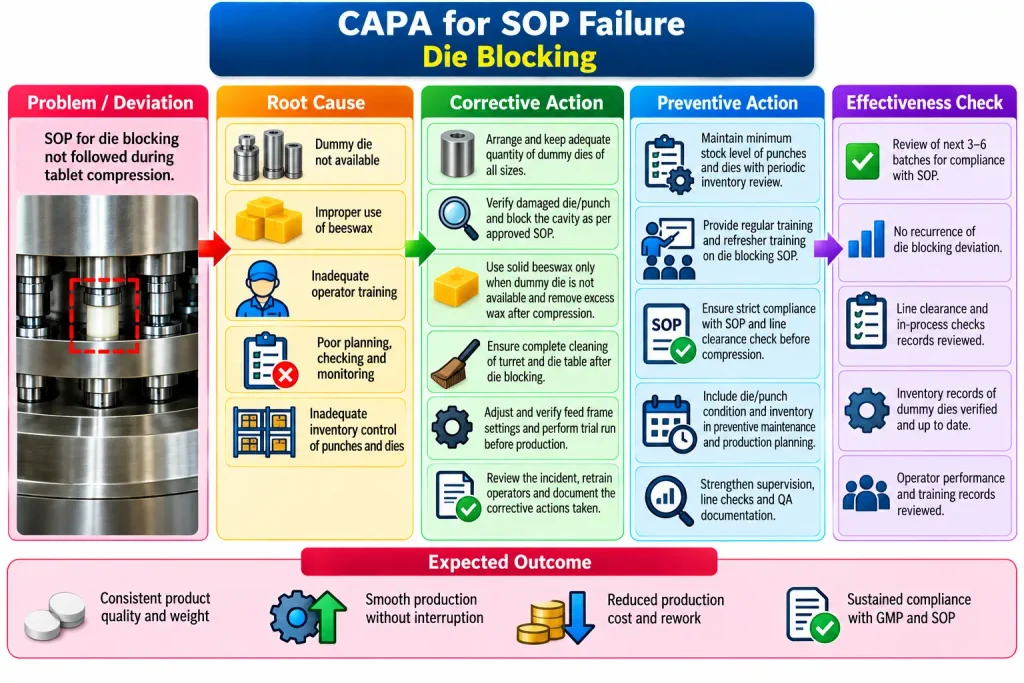
Corrective actions may include arranging suitable dummy dies, retraining operators, ensuring proper beeswax application, cleaning the turret, and verifying feed-frame settings. Preventive actions include maintaining adequate punch-and-die inventory, periodic training, improved supervision, routine checks, and stronger SOP compliance. Effectiveness should be confirmed through review of subsequent batches, documentation, operator performance, and absence of repeat die-blocking deviations.
Questions & Answers – SOP for Die Blocking:
- What is the objective of the SOP for Die Blocking?
The objective is to lay down a defined procedure for die blocking. - Where is this SOP applicable?
It is applicable to die blocking of compression machines in the compression area of the Production Department. - Who is responsible for working as per this SOP?
The compression operator is responsible for working according to the SOP. - Who is responsible for execution of the SOP?
The Production Chemist is responsible for execution of the SOP. - Who is responsible for effective implementation of the SOP?
AGM-Production and Head-QA/QC are responsible for effective implementation. - When should a die cavity be blocked?
A die cavity should be blocked when there is damage to the die bore or punch bore, or when the quantity of punches and dies is insufficient. - What is the preferred method for die blocking?
The preferred method is to use a dummy die without a bore. - What should be done if a dummy die is not available?
Solid beeswax should be cut and filled into the die cavity that needs to be blocked. - How should the beeswax be fixed in the die cavity?
It should be affixed using a metal rod with gentle hammering. - What should be done after fixing the beeswax?
Excess wax should be wiped or scraped off, the turret should be cleaned, and the feed frame should be adjusted for further use. - What is the reference mentioned in the SOP?
The SOP states the reference as “As per GMP.” - Are any annexures included in this SOP?
No. The annexure section is stated as Nil.
Reference Guideline – SOP for Die Blocking:
- Schedule M, Drugs and Cosmetics Rules, India – GMP requirements for pharmaceutical manufacturing facilities, equipment, production operations, documentation, and controls.
- WHO Good Manufacturing Practices for Pharmaceutical Products – requirements for controlled manufacturing operations, equipment suitability, prevention of errors, and documented procedures.
- EU Guidelines for Good Manufacturing Practice, Part I – Chapter 3: Premises and Equipment – requirements for suitable equipment design, maintenance, and prevention of contamination or manufacturing errors.
- EU GMP Part I – Chapter 5: Production – requirements for controlled production operations and adherence to approved written procedures.
- EU GMP Part I – Chapter 4: Documentation – requirements for approved SOPs, records, and traceable documentation.
- PIC/S Guide to GMP for Medicinal Products, PE 009 – guidance on production controls, equipment management, documentation, and operator responsibilities.
- US FDA 21 CFR Part 211.67 – Equipment Cleaning and Maintenance – requirements for appropriate maintenance and cleaning of pharmaceutical manufacturing equipment.
- US FDA 21 CFR Part 211.100 – Written Procedures; Deviations – requires written production and process-control procedures to be established and followed.