




Brief Description
This Standard Operating Procedure describes the safe and systematic method for discarding used microbiological media in the Quality Control laboratory. Its purpose is to prevent contamination and ensure proper handling of plates, tubes, and other media after completion of microbiological testing. The procedure requires personnel to wear appropriate protective items such as gloves, mask, and cap before handling discarded media. Used plates and tubes are removed from the incubator, covered with aluminium foil, placed in an autoclave, and autoclaved according to the applicable SOP.After autoclaving, the materials are carefully removed and treated with 70% v/v IPA. After 30 minutes, the media is transferred into a hazardous waste polybag, sealed, labelled “DO NOT OPEN,” and disposed of at the designated location. Glassware is subsequently washed with running water, 0.1% Teepol solution, and purified water. All media-discarding activities are documented in the prescribed logbook.
Skip to PDF content1. Flow Diagram:
The flow diagram explains the step-by-step process for safe discarding of microbiological media in a pharmaceutical company. The process begins with wearing appropriate PPE such as gloves, mask, and cap. Used plates and tubes are removed from the incubator, covered with aluminium foil, placed in the autoclave, and autoclaved according to the applicable SOP. After autoclaving, PPE is worn again and the materials are removed carefully.
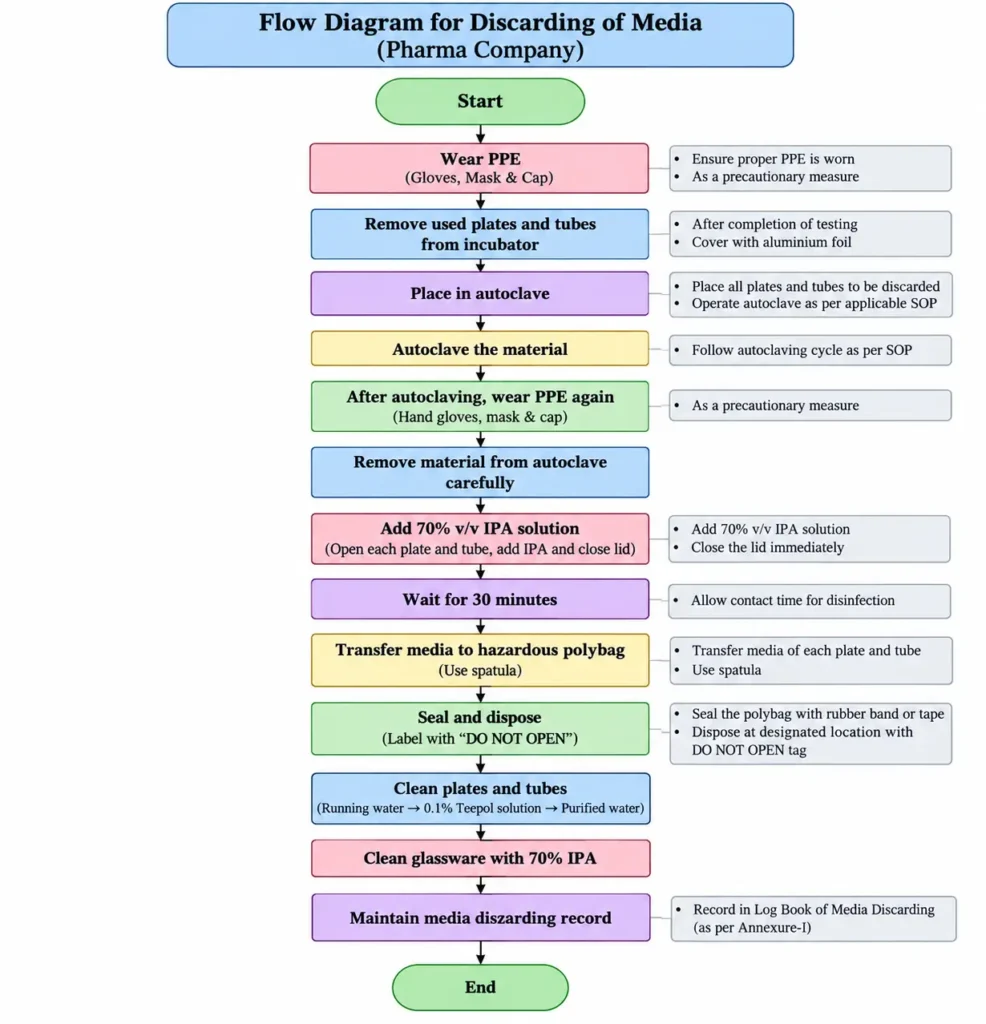
Each plate and tube is then treated with 70% v/v IPA solution and kept for 30 minutes. The media is transferred into a hazardous polybag using a spatula, sealed properly, labelled “DO NOT OPEN,” and disposed of at the designated place. The plates and tubes are cleaned with running water, 0.1% Teepol solution, purified water, and 70% IPA. Finally, the media-discarding activity is documented in the prescribed logbook to ensure traceability and GMP compliance.
2. Brainstorming for SOP Failure:
The brainstorming diagram identifies possible reasons for failure of the SOP for Discarding of Media in a pharmaceutical microbiology laboratory. The activity focuses on collecting potential causes from personnel, process, equipment, materials, documentation, and management. Important causes include inadequate training, failure to wear required PPE, improper handling of used plates and tubes, incorrect autoclave operation, insufficient contact time with 70% IPA, improper segregation of discarded media, and incomplete documentation. These points directly relate to critical requirements described in the SOP for autoclaving, IPA treatment, hazardous-waste disposal, cleaning, and record maintenance.
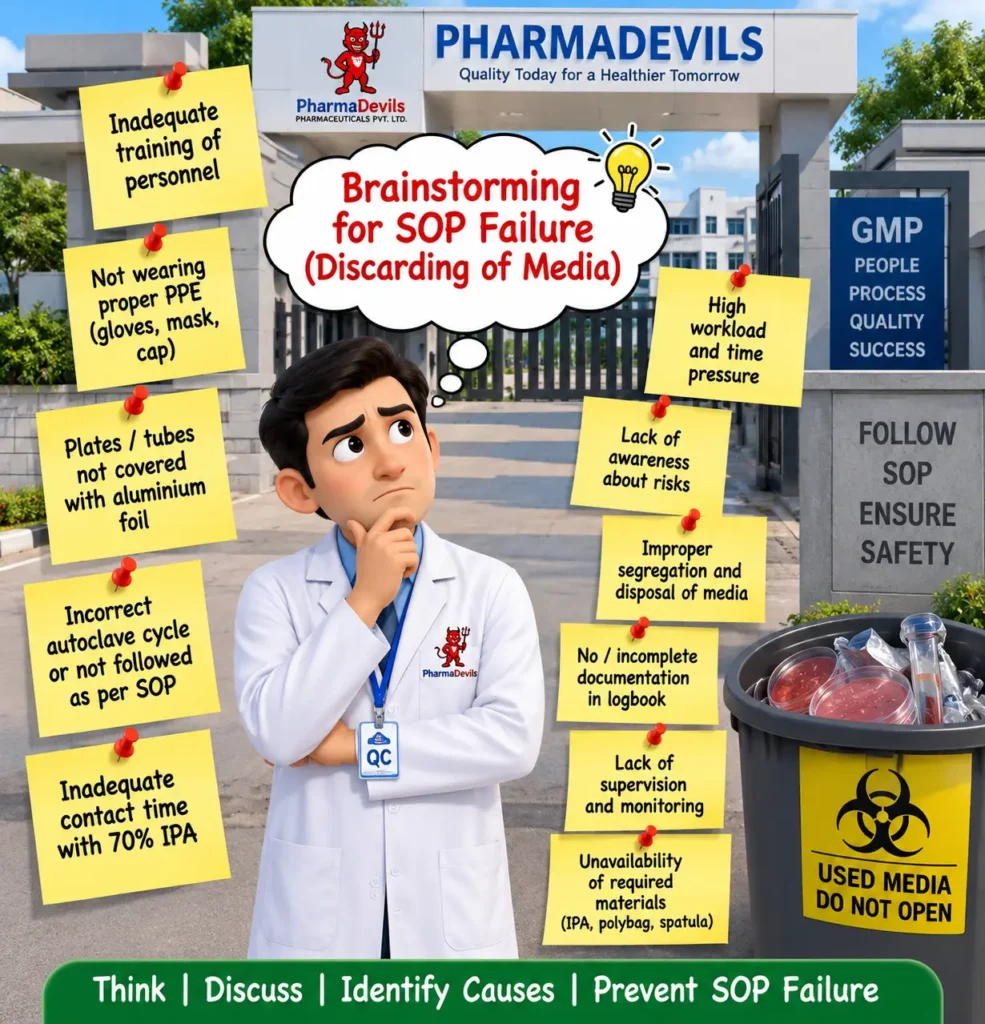
Other contributing factors may include high workload, poor supervision, lack of awareness of biohazard risks, and non-availability of required materials. Brainstorming helps the team identify all possible causes before performing detailed root-cause analysis, enabling appropriate corrective and preventive actions to improve GMP compliance, safety, and reliable media disposal practices.
3. 5-Why Analysis for SOP Failure:
The 5-Why diagram explains the root-cause investigation for failure of the SOP for Discarding of Media. The analysis starts with the problem that used microbiological media was not discarded according to the defined procedure. It then examines why critical activities such as autoclaving, treatment with 70% v/v IPA, maintaining the required 30-minute contact time, hazardous-bag disposal, cleaning, and documentation may have been missed or performed incorrectly. These are key steps described in the SOP.
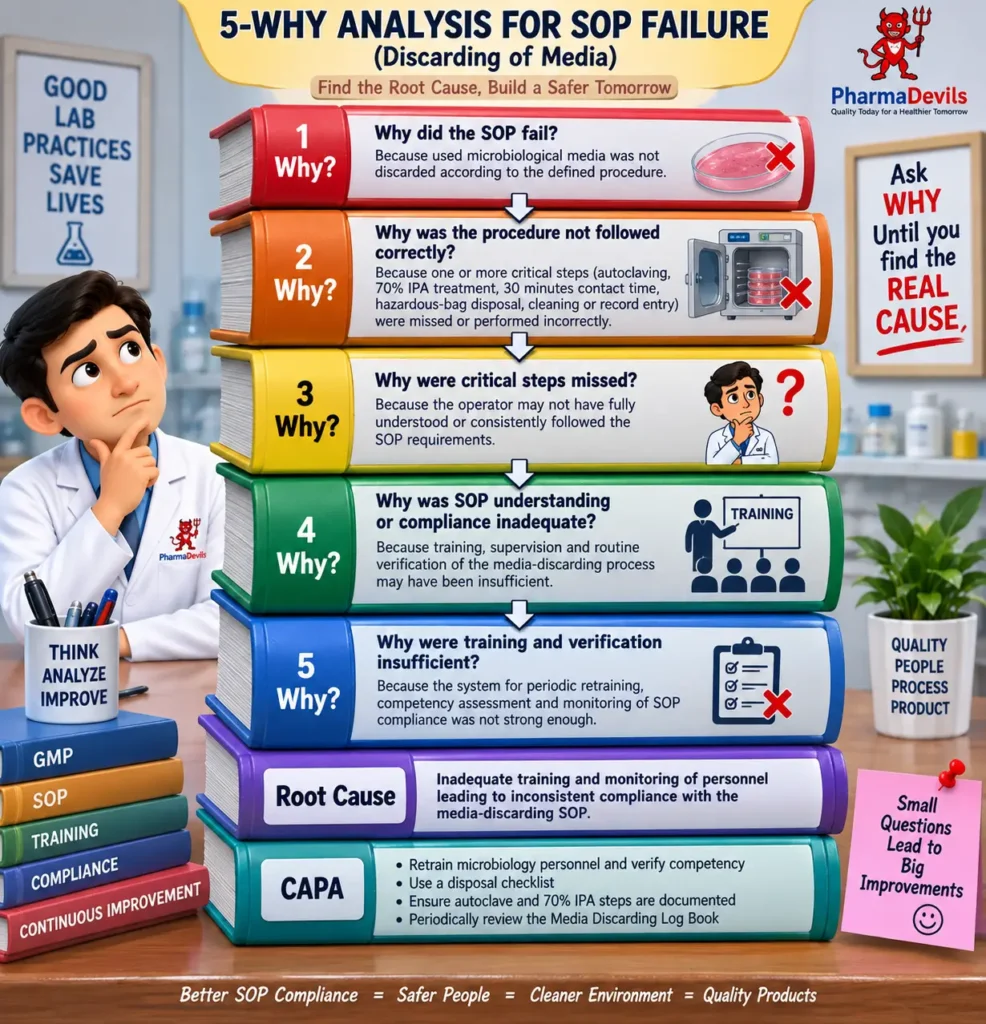
The deeper analysis indicates that the operator may not have fully understood or consistently followed the procedure due to inadequate training, supervision, competency verification, or routine monitoring. The probable root cause is therefore insufficient training and monitoring of personnel, resulting in inconsistent SOP compliance. Corrective and preventive actions include retraining microbiology personnel, verifying competency, using a disposal checklist, documenting autoclave and IPA steps, and periodically reviewing the Media Discarding Log Book.
4. Fishbone Analysis – SOP Failure:
The Fishbone Analysis diagram presents possible causes of failure of the SOP for Discarding of Media in a pharmaceutical microbiology laboratory. The causes are systematically grouped under Man, Method, Machine, Material, Measurement, Environment, and Management to help identify where process weaknesses may originate. Key concerns include inadequate training, failure to wear PPE, incorrect autoclave operation, insufficient 70% IPA contact time, poor waste segregation, unavailable materials, incomplete monitoring, workload pressure, and weak supervision.
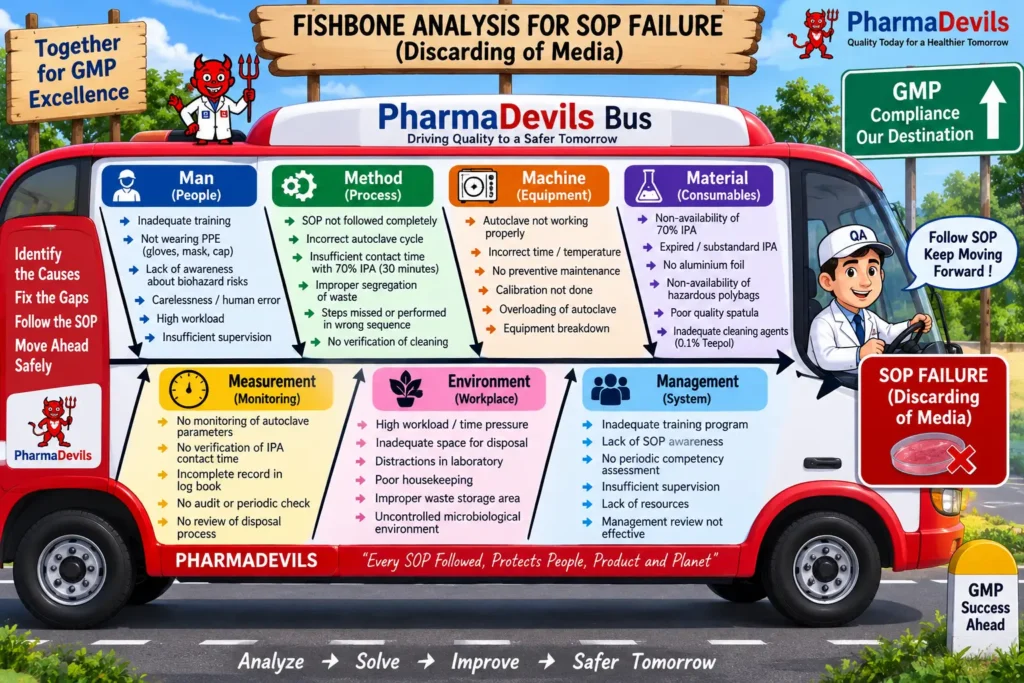
These potential causes are linked to critical SOP activities such as wearing protective equipment, autoclaving used plates and tubes, applying 70% IPA, maintaining the required 30-minute contact period, transferring discarded media into a hazardous polybag, cleaning glassware, and maintaining disposal records.The fishbone approach helps the QA/QC team investigate contributing factors systematically and supports effective root-cause identification, CAPA development, GMP compliance, and prevention of recurring SOP failures.
5. Fault Tree Analysis for SOP Failure:
The Fault Tree Analysis diagram shows a structured investigation of possible causes leading to failure of the SOP for Discarding of Media. The top event is “SOP Failure,” which is divided into major contributing areas such as improper sterilization of media, incorrect handling and disposal, and inadequate cleaning or documentation. These branches are further broken down into potential causes including incorrect autoclave cycle, inadequate contact time with 70% v/v IPA, improper segregation of waste, failure to clean plates and tubes correctly, and incomplete record keeping.
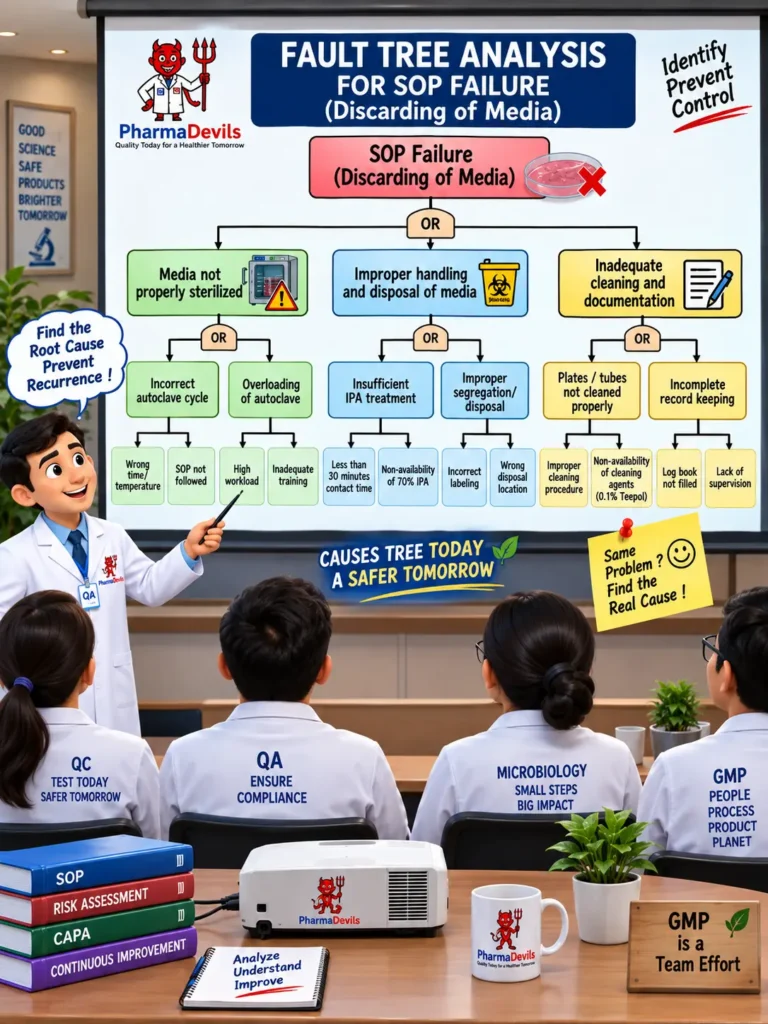
These causes are linked to the critical steps defined in the SOP, including autoclaving used plates and tubes, applying 70% IPA, maintaining 30 minutes of contact time, transferring discarded media into a hazardous polybag, cleaning glassware, and maintaining the media-discarding record.The analysis helps QA/QC teams identify failure paths, determine root causes, and establish suitable CAPA to prevent recurrence.
Questions & Answers – SOP for Discarding of Media
1. What is the objective of the SOP for Discarding of Media?
The objective is to lay down a defined procedure for the safe discarding of microbiological media.
2. Where is this SOP applicable?
This SOP is applicable to the discarding of media in the Quality Control department.
3. Who is responsible for carrying out this SOP?
The responsibility is assigned to the Microbiologist and Sr. Manager QA/QC.
4. What PPE should be worn before handling media for disposal?
Personnel should wear gloves, mask, and cap as a precautionary measure.
5. What should be done with used plates and tubes after completion of testing?
They should be removed from the incubator, covered with aluminium foil, and placed in the autoclave for discarding.
6. How should the autoclave be operated?
The autoclave should be operated according to the applicable autoclave SOP.
7. What treatment is given to plates and tubes after autoclaving?
After autoclaving, the material is carefully removed, and 70% v/v IPA solution is added to each Petri plate and tube before immediately closing the lid.
8. What contact time is required after adding 70% IPA?
The SOP specifies a contact time of 30 minutes before transferring the media.
9. How is the discarded media transferred for disposal?
The media from each Petri plate and tube is transferred into a hazardous polybag using a spatula.
10. How should the hazardous polybag be handled?
The polybag should be sealed using a rubber band or tape and disposed of at the designated place with a “DO NOT OPEN” tag.
11. How should plates and tubes be cleaned after media disposal?
They should be washed with running water, followed by 0.1% Teepol solution, and finally rinsed with purified water.
12. What record should be maintained after discarding media?
The Media Discarding Record / Log Book of Media Discarding should be maintained.
13. Who provides training for this SOP?
The trainer is the Sr. Manager – QC/QA, and the trainee is the Microbiologist.
14. What does the Media Discarding Log Book record?
The log book includes details such as date, required temperature/time for discarding, name of media discarded, name of sample tested, performed by, checked by, and remarks.
15. What are the abbreviations used in this SOP?
QC means Quality Control, QA means Quality Assurance, and SOP means Standard Operating Procedure.