







1. Introduction to Dispersible Paracetamol Tablets IP 100 mg – Batch Manufacturing Record (BMR):
Dispersible Paracetamol Tablets IP 100 mg are an oral pharmaceutical formulation containing Paracetamol IP 100 mg as the active pharmaceutical ingredient (API). Paracetamol is widely used as an analgesic and antipyretic agent for the symptomatic relief of mild to moderate pain and fever. The dispersible dosage form is designed to disintegrate rapidly in water before administration, making it particularly convenient for pediatric patients and individuals experiencing difficulty swallowing conventional tablets. The Batch Manufacturing Record (BMR) provides comprehensive documentation of manufacturing activities, ensuring product quality, consistency, traceability, and compliance with Good Manufacturing Practices (GMP). The manufacturing process involves raw material dispensing, binder preparation, wet granulation, drying, sizing, blending, lubrication, tablet compression, and subsequent quality control testing. Critical manufacturing parameters include granule moisture content, blending time, tablet weight, thickness, hardness, friability, and disintegration time. According to the BMR, the standard tablet weight is 285 mg, with a disintegration time of not more than two minutes. The BMR also incorporates equipment clearance, in-process quality checks, batch yield reconciliation, material accountability, and production documentation. Proper implementation ensures consistent manufacturing performance, regulatory compliance, and production of safe, effective, and quality-assured dispersible tablets.
Skip to PDF content2. Manufacturing Process Flow Diagram of Dispersible Paracetamol Tablets IP 100 mg (BMR):
The manufacturing process flow diagram of Dispersible Paracetamol Tablets IP 100 mg illustrates the systematic sequence of pharmaceutical manufacturing operations performed in accordance with Good Manufacturing Practices (GMP) and the approved Batch Manufacturing Record (BMR). The process begins with raw material dispensing and sieving, ensuring accurate weighing and uniform particle size of Paracetamol IP and other approved excipients. Binder preparation involves preparing starch paste, followed by wet granulation in a Rapid Mixer Granulator (RMG) to achieve suitable granule characteristics. The wet granules undergo drying in a Fluid Bed Dryer (FBD), followed by milling and sizing to obtain the required particle size distribution. Subsequently, the dried granules are blended with extragranular excipients, including disintegrants, and lubricated with magnesium stearate to improve processing characteristics.
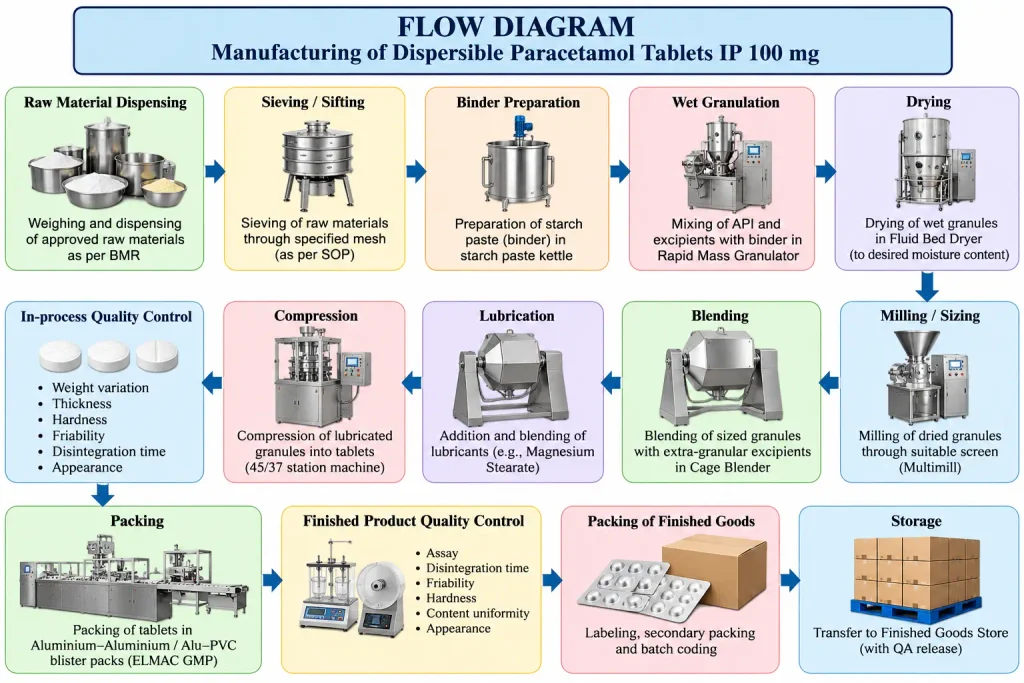
The lubricated granules are compressed into tablets using a rotary compression machine. During compression, critical quality parameters such as tablet weight, thickness, hardness, friability, appearance, and disintegration time are monitored through in-process quality control checks. Following satisfactory quality evaluation, the tablets proceed to blister packaging, finished product testing, labeling, and secondary packaging. The manufacturing process concludes with batch reconciliation, quality assurance review, and release of approved finished products. This flow diagram provides a clear visual representation of manufacturing stages, equipment utilization, process controls, and quality checkpoints, supporting product consistency, traceability, regulatory compliance, and pharmaceutical quality assurance.
2. Critical Process Parameters (CPP) and Critical Quality Attributes (CQA) of Dispersible Paracetamol Tablets IP 100 mg:
The Critical Process Parameters (CPP) and Critical Quality Attributes (CQA) of Dispersible Paracetamol Tablets IP 100 mg play an essential role in ensuring consistent manufacturing performance, product quality, safety, and efficacy in accordance with Good Manufacturing Practices (GMP).

Critical Process Parameters (CPP) are manufacturing variables that require monitoring and control to maintain the desired product quality. Important parameters include raw material dispensing accuracy, sieve mesh size, binder preparation temperature, granulation time, impeller speed, drying temperature, granule moisture content, blending duration, lubrication time, and compression force. During granulation and drying, maintaining appropriate moisture content and particle size distribution is essential for achieving uniform granule flow and compression characteristics. Compression parameters influence tablet weight, hardness, thickness, friability, and disintegration performance.
Critical Quality Attributes (CQA) represent measurable physical, chemical, biological, and microbiological characteristics necessary to ensure the finished product meets established specifications. Important attributes include appearance, identification, average weight, weight variation, thickness, hardness, friability, disintegration time, assay, content uniformity where applicable, and packaging integrity. According to the provided Batch Manufacturing Record (BMR), the standard tablet weight is 285 mg, thickness is 3.50–4.10 mm, hardness is not less than 2 kg/cm², friability is not more than 1.0%, and disintegration time is not more than 2 minutes. Effective monitoring of CPPs and verification of CQAs help minimize manufacturing deviations, improve batch consistency, and ensure reliable pharmaceutical product quality. Final acceptance criteria must follow the approved product specifications and applicable Indian Pharmacopoeia requirements.