







1. Introduction – SOP for Division of Unit Dose for Packing into Different Pack Sizes:
The SOP for Division of Unit Dose for Packing into Different Pack Sizes describes the controlled procedure for dividing a released batch of tablets or capsules into different quantities according to specific market requirements or pack sizes. The procedure ensures that only batches released by the Quality Assurance Department are considered for division and that the required quantity is calculated based on the planned number of units and the average unit weight. The divided quantity is transferred into a properly pre-labeled HDPE container and documented in the prescribed Batch Division Form, which is subsequently attached to the Batch Packing Record.The SOP also requires verification by the Production Manager, proper recording of multiple withdrawals for different markets or pack configurations, retention of the original container label in the batch documentation, and investigation of any observed discrepancy or abnormality before final dispatch. This system helps maintain traceability, reconciliation, accountability, batch integrity, and GMP compliance during packing operations.
Skip to PDF content2. Flow Diagram – Division of Unit Dose for Packing into Different Pack Sizes:
The Flow Diagram for Division of Unit Dose for Packing into Different Pack Sizes illustrates the controlled sequence followed when a single released batch is divided for packing into different market requirements or pack configurations. The process begins with confirmation of Quality Assurance release of the batch, followed by weighing the required quantity of tablets or capsules based on the planned number of units and average weight. The weighed quantity is transferred into a pre-labeled HDPE container and recorded in the prescribed Batch Division Form, which is attached to the Batch Packing Record. The entries are then verified by the Production Manager.
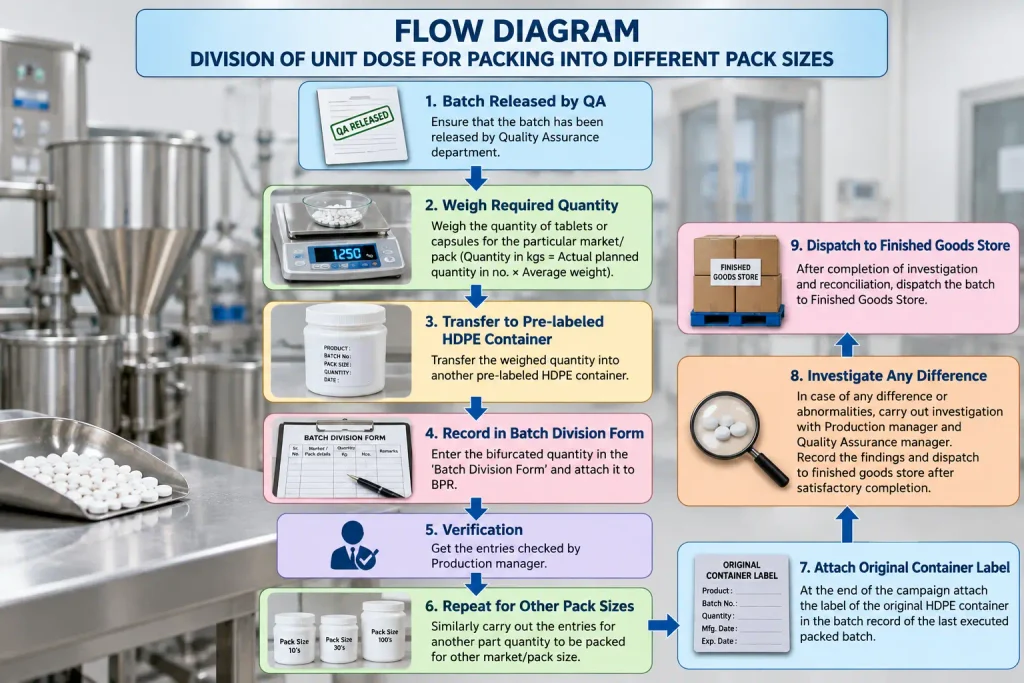
Where additional pack sizes or markets are required, the same controlled procedure is repeated. At the end of the campaign, the original container label is attached to the relevant batch record. Any discrepancy or abnormality is investigated with Production and QA before satisfactory completion and dispatch to the Finished Goods Store.
3. Benefits of Following SOP – Division of Unit Dose for Packing into Different Pack Sizes:
Following the SOP for Division of Unit Dose for Packing into Different Pack Sizes ensures that a released batch is divided into the required quantities in a controlled and traceable manner. The procedure supports accurate calculation and weighing of tablets or capsules for different market requirements and pack sizes. Use of properly pre-labeled HDPE containers helps prevent mix-ups and maintains clear product identification.
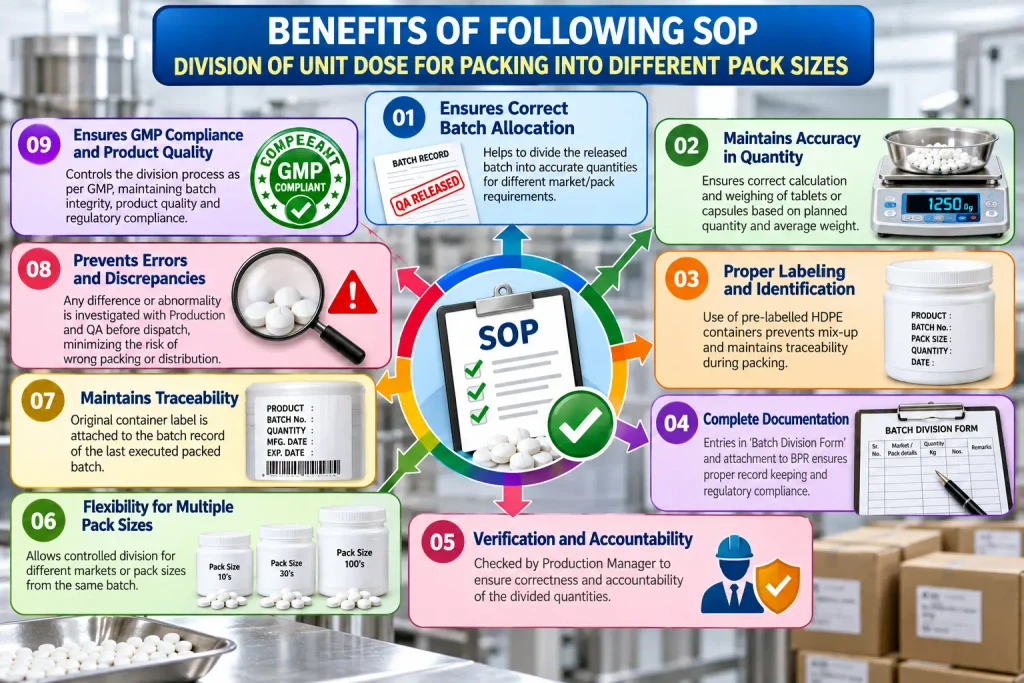
Recording each divided quantity in the Batch Division Form and attaching it to the Batch Packing Record strengthens documentation and traceability. Verification by the Production Manager improves accountability and reduces the chance of quantity or documentation errors. The SOP also allows the same batch to be systematically divided for multiple markets or pack configurations while maintaining batch integrity. Any difference or abnormality is investigated in consultation with Production and Quality Assurance before dispatch, helping to prevent incorrect packing and ensuring proper GMP control.
4. Brainstorming for SOP Failure – Division of Unit Dose for Packing into Different Pack Sizes:
The Brainstorming for SOP Failure – Division of Unit Dose for Packing into Different Pack Sizes identifies possible causes that may lead to errors during division and packing of a released batch. Potential failures include use of an incorrect batch release status, wrong calculation of required quantity, use of an incorrect average weight, weighing errors, improper labeling of HDPE containers, and mix-up of market or pack-size details. Other possible causes include incomplete entries in the Batch Division Form,
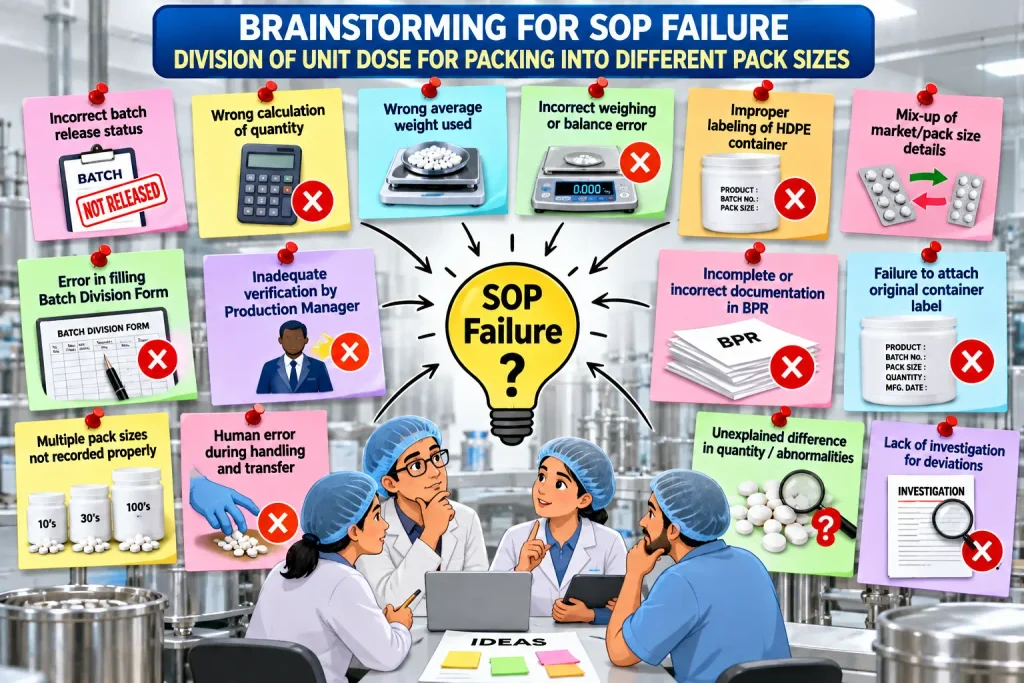
inadequate verification by the Production Manager, incomplete documentation in the BPR, failure to attach the original container label, and improper recording of multiple pack-size withdrawals. Human errors during handling and transfer may also create discrepancies. Any difference or abnormality observed during the process should be investigated with Production and Quality Assurance before the batch is dispatched. Brainstorming helps identify these risks early and supports stronger controls, documentation, traceability, and compliance with the SOP requirements.
5. 5-Why Analysis for SOP Failure – Division of Unit Dose for Packing into Different Pack Sizes:
The 5-Why Analysis for SOP Failure – Division of Unit Dose for Packing into Different Pack Sizes is used to identify the underlying causes of errors occurring during batch division and packing activities. The analysis begins with the problem of an incorrectly divided, recorded, or handled quantity. The first causes may include errors in weighing, calculation, or pack-size selection.
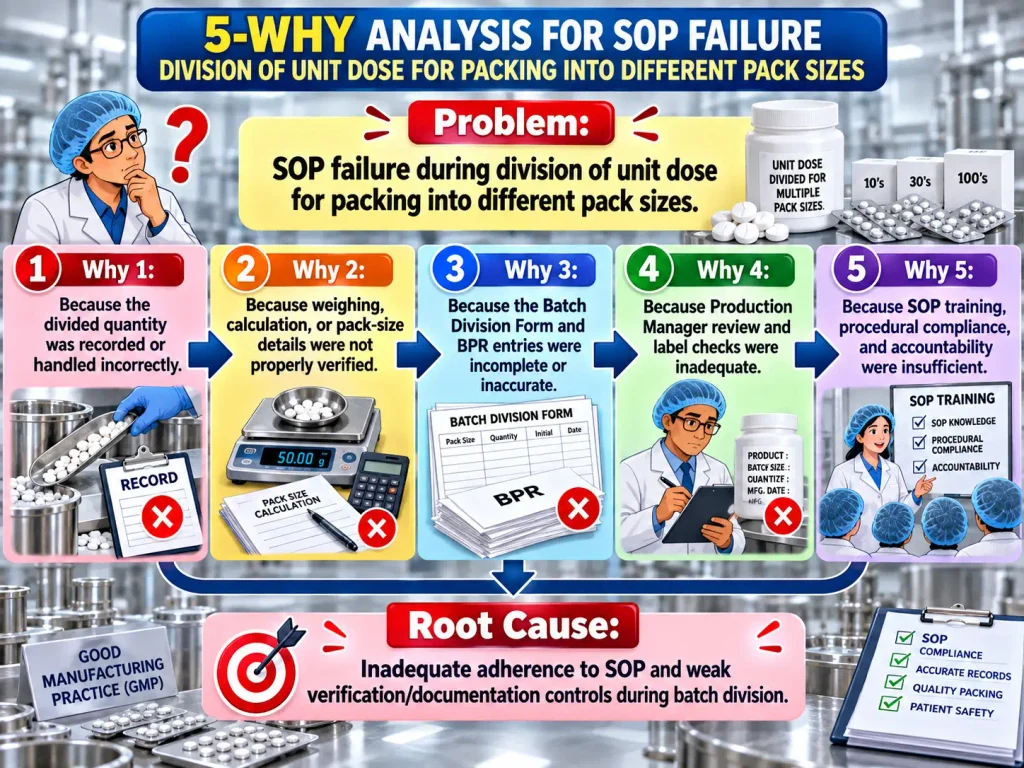
Further investigation can reveal incomplete or inaccurate entries in the Batch Division Form and Batch Packing Record, inadequate verification by the Production Manager, and insufficient checking of container labels and pack details. At a deeper level, inadequate SOP training, weak procedural compliance, and poor accountability may contribute to repeated failures. The probable root cause is therefore inadequate adherence to the approved SOP along with weak verification and documentation controls. Strengthening training, independent verification, accurate recording, and supervisory review can help prevent recurrence and maintain batch traceability and GMP compliance.
6. Fishbone Analysis for SOP Failure – Division of Unit Dose for Packing into Different Pack Sizes:
The Fishbone Analysis for SOP Failure – Division of Unit Dose for Packing into Different Pack Sizes identifies the major factors that may contribute to incorrect batch division or packing into different pack sizes. The analysis groups potential causes under Man, Machine, Material, Method, Environment, Measurement, and Management. Personnel-related causes may include inadequate training, calculation errors, poor SOP compliance, and insufficient verification. Equipment-related causes can include uncalibrated balances or malfunctioning weighing devices. Material causes may involve wrong batch selection, incorrect labels, unsuitable HDPE containers, or pack-size mix-ups.
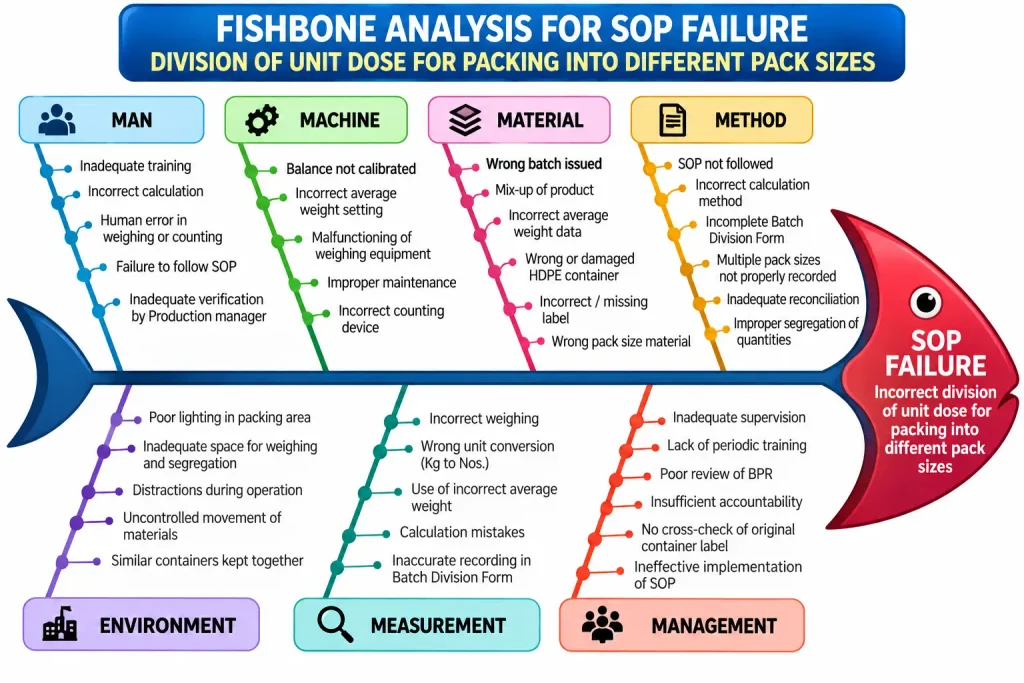
Method and measurement failures may include incorrect calculations, incomplete Batch Division Form entries, poor reconciliation, and use of incorrect average weight. Environmental and management factors such as poor workspace organization, inadequate supervision, weak BPR review, and insufficient accountability can also contribute. This analysis helps systematically identify probable causes so that suitable corrective and preventive actions can be established.
7. Fault Tree Analysis for SOP Failure – Division of Unit Dose for Packing into Different Pack Sizes:
The Fault Tree Analysis for SOP Failure – Division of Unit Dose for Packing into Different Pack Sizes evaluates the possible pathways that can lead to incorrect division of a batch for different packing configurations. The top event may result from one or more intermediate failures such as incorrect quantity weighing, wrong product or pack-size selection, inadequate documentation, and insufficient verification or supervision.
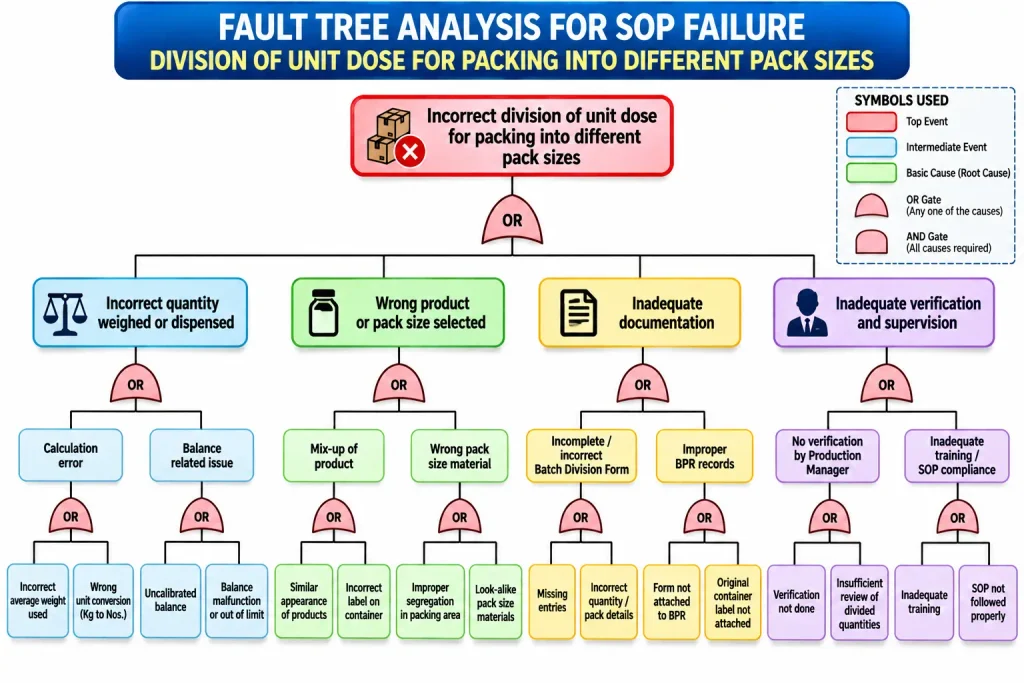
Potential basic causes include use of an incorrect average weight, wrong unit conversion, uncalibrated or malfunctioning balance, product or label mix-up, improper segregation of pack-size materials, incomplete Batch Division Form entries, incorrect BPR documentation, failure to attach the original container label, inadequate Production Manager review, insufficient training, or poor SOP compliance. The analysis helps identify how individual failures can combine to produce the final SOP failure. It supports systematic root-cause identification and helps establish appropriate controls to improve accuracy, documentation, traceability, verification, and GMP compliance during batch division and packing operations.
8. Impact Assessment (Positive Manner) – Division of Unit Dose for Packing into Different Pack Sizes:
The Impact Assessment (Positive Manner) – Division of Unit Dose for Packing into Different Pack Sizes highlights the benefits achieved when the SOP is followed effectively. Proper batch division helps ensure that the correct quantity is allocated and packed for each required market or pack size while maintaining batch integrity and product quality. Accurate weighing, labeling, documentation in the Batch Division Form, attachment to the BPR, and verification by the Production Manager improve traceability and accountability.
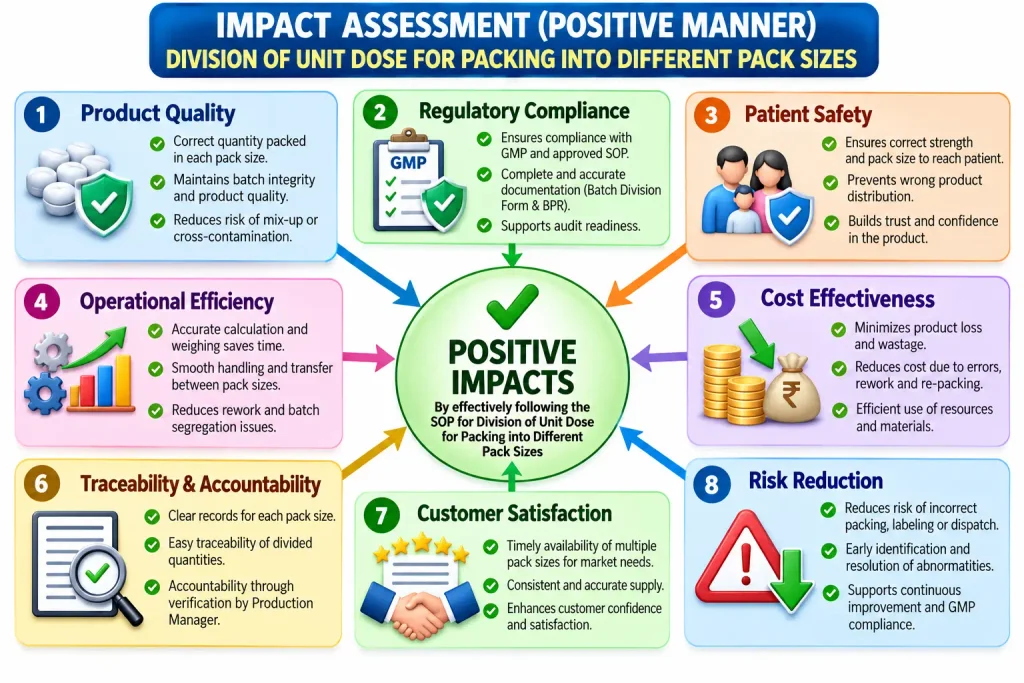
Effective implementation of the SOP also supports GMP compliance, operational efficiency, reduction of mix-ups, improved reconciliation, reduced rework, and better control over packing activities. Proper investigation of any difference or abnormality before dispatch further strengthens quality assurance and risk control. Overall, consistent compliance with the SOP contributes to reliable packing operations, accurate records, better product control, improved audit readiness, and greater confidence that different pack sizes are prepared and dispatched in a controlled and documented manner.
9. CAPA for SOP Failure – Division of Unit Dose for Packing into Different Pack Sizes:
The CAPA for SOP Failure – Division of Unit Dose for Packing into Different Pack Sizes is intended to correct identified deficiencies and prevent recurrence of errors during batch division and packing. Corrective actions should include investigation of the discrepancy, review of weighing records, labels, the Batch Division Form, and the BPR, followed by correction or reallocation of the affected quantity where required. Documentation should be corrected and the original container label attached to the appropriate batch record. Verification and approval by Production and Quality Assurance should be completed before dispatch. These actions are consistent with the SOP requirement to investigate differences or abnormalities before release to the finished goods store.
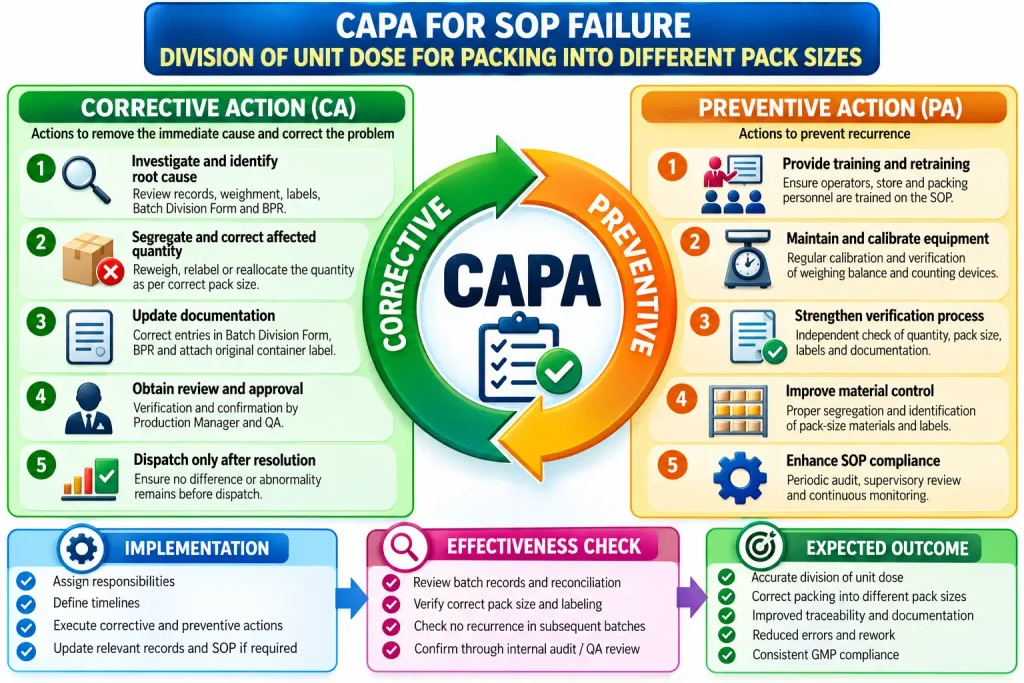
Preventive actions may include retraining personnel on the approved SOP, periodic calibration and verification of weighing equipment, stronger independent checks of quantity and pack-size details, improved segregation and identification of pack-size materials, and periodic supervisory review. Effectiveness can be confirmed through review of subsequent batch records, reconciliation, label verification, and confirmation that similar discrepancies do not recur.
Questions and Answers – Division of Unit Dose for Packing into Different Pack Sizes:
Q1. What is the objective of this SOP?
The objective is to describe the procedure for dividing a batch into different quantities required for packing into different pack sizes.
Q2. What is the scope of this SOP?
The SOP covers division of a batch into different quantities that need to be packed for different pack sizes.
Q3. Who is responsible for execution of the SOP?
The concerned Production Chemist and Production Manager are responsible for execution of the SOP.
Q4. Who is responsible for effective implementation of the SOP?
The Senior Production Manager and Head-QA/QC are responsible for effective implementation.
Q5. What should be checked before division of the batch?
It should be ensured that the batch has been released by the Quality Assurance Department.
Q6. How is the required quantity for a particular market or pack calculated?
The quantity in kilograms is calculated as: Actual planned quantity in numbers × Average weight.
Q7. Where should the divided quantity be transferred?
The required quantity of tablets or capsules should be transferred into another pre-labeled HDPE container.
Q8. Where should the divided quantity be recorded?
The bifurcated quantity should be entered in the Batch Division Form and the form should be attached to the BPR.
Q9. Who should check the Batch Division Form entries?
The entries should be checked by the Production Manager.
Q10. What should be done if another part of the same batch is required for a different market or pack size?
The same procedure and entries should be carried out for the additional quantity required for the other market or pack size.
Q11. What should be done with the original HDPE container label at the end of the campaign?
The original HDPE container label should be attached to the batch record of the last executed packed batch.
Q12. What action should be taken if any difference or abnormality is observed?
An investigation should be carried out in consultation with the Production Manager and Quality Assurance Manager, and the findings should be recorded.
Q13. When can the batch be dispatched to the Finished Goods Store?
The batch can be dispatched after satisfactory completion of the investigation.
Q14. What is the annexure attached to this SOP?
The annexure is the Batch Division Form.
Q15. What does BPR stand for?
BPR stands for Batch Packing Record.
Q16. What does HDPE stand for?
HDPE stands for High Density Poly Ethylene.
Reference Guidelines – Division of Unit Dose for Packing into Different Pack Sizes:
- WHO Good Manufacturing Practices (GMP) for Pharmaceutical Products
- Schedule M of the Drugs Rules, 1945 – Good Manufacturing Practices and Requirements of Premises, Plant and Equipment for Pharmaceutical Products
- EU Guidelines for Good Manufacturing Practice – EudraLex Volume 4, Part I
- Chapter 4 – Documentation
- Chapter 5 – Production
- PIC/S Guide to Good Manufacturing Practice for Medicinal Products, PE 009
- US FDA 21 CFR Part 211 – Current Good Manufacturing Practice for Finished Pharmaceuticals
- §211.100 – Written procedures and deviations
- §211.122 – Materials examination and usage criteria
- §211.125 – Labeling issuance
- §211.130 – Packaging and labeling operations
- §211.188 – Batch production and control records
- ICH Q9 – Quality Risk Management
- ICH Q10 – Pharmaceutical Quality System