







Brief Description
This SOP describes the controlled procedure for electronic data backup of analytical instruments, particularly HPLC and FTIR systems used in the Quality Control Laboratory. Its purpose is to preserve critical analytical data for future reference and maintain data authenticity, confidentiality, integrity, and availability. Analytical data generated on instrument computers is stored locally and backed up through a domain server. The SOP requires daily electronic data backup at a predefined time, with missed backups completed on the following day. Backup data is additionally maintained on an external hard disk or other controlled media using a defined folder structure. Access to the domain server and backup media is restricted to authorized personnel. The SOP also defines responsibilities for IT, QC and QA, controlled data retrieval for audit or review purposes, quarterly backup-data challenge/review, and investigation of electronic-data abnormalities through the CAPA system.
Skip to PDF content1. Flow Diagram:
The flow diagram illustrates the systematic process for electronic data backup of analytical instruments such as HPLC and FTIR used in the Quality Control Laboratory. Analytical data is first generated and stored on the respective instrument computer, which is connected to the domain server. The SOP requires daily backup at the predefined time of 10:00 AM using the specified backup software. If the backup cannot be completed because of an unplanned event, it is taken on the next day.
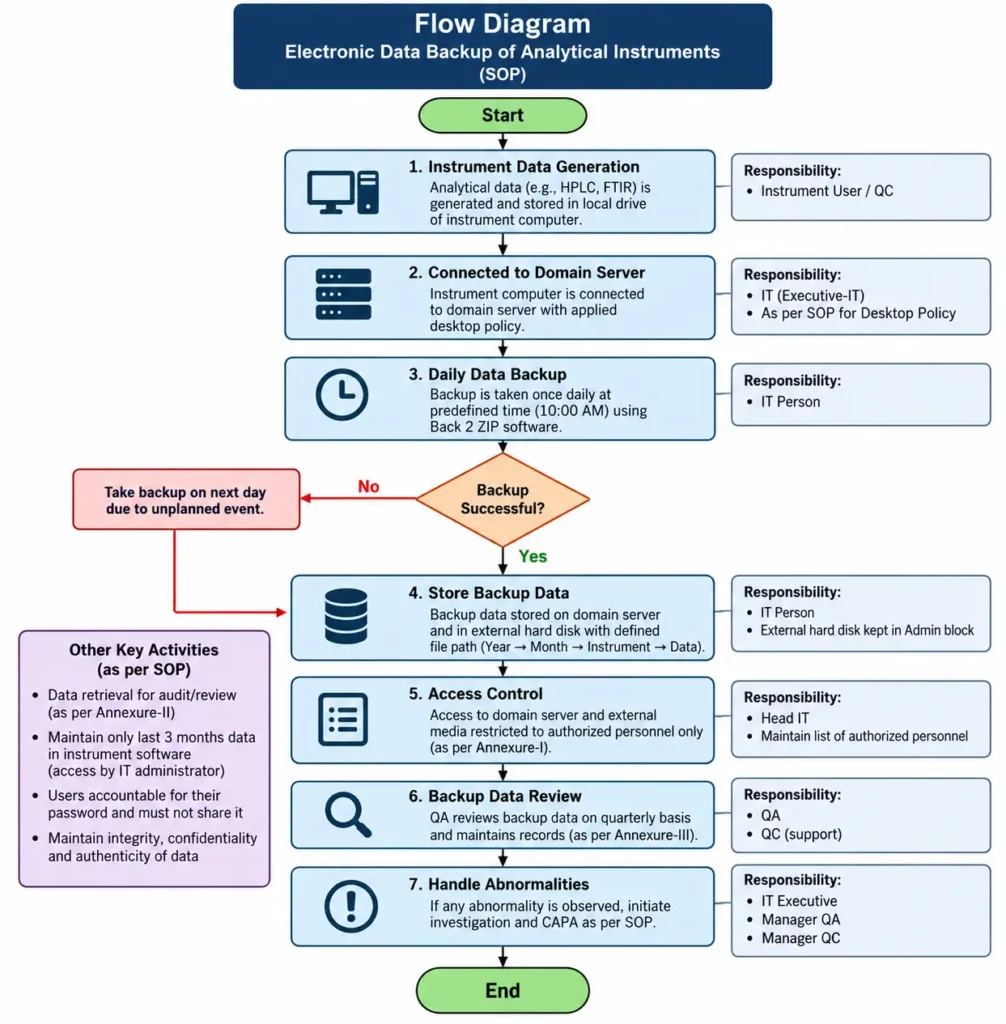
Successfully backed-up data is stored on the domain server and external hard disk using a defined folder structure. Access is restricted to authorized personnel. QA performs periodic backup-data review, while any abnormality identified in electronic data is investigated and appropriate CAPA is initiated. The overall process helps maintain data availability, confidentiality, authenticity, integrity, traceability, and controlled retrieval for audit and review purposes.
2. Brainstorming for SOP Failure:
The brainstorming diagram presents the major potential causes of SOP failure in a pharmaceutical manufacturing area. It uses sticky notes around the central issue, “SOP Failure in MFG Area,” to highlight factors that can lead to poor procedural compliance. Key causes include inadequate training, lack of awareness of current SOP revisions, complex or user-unfriendly SOPs, time pressure, poor supervision, inadequate monitoring, human error, language barriers, insufficient resources, high manpower turnover, and unfavorable workplace conditions.
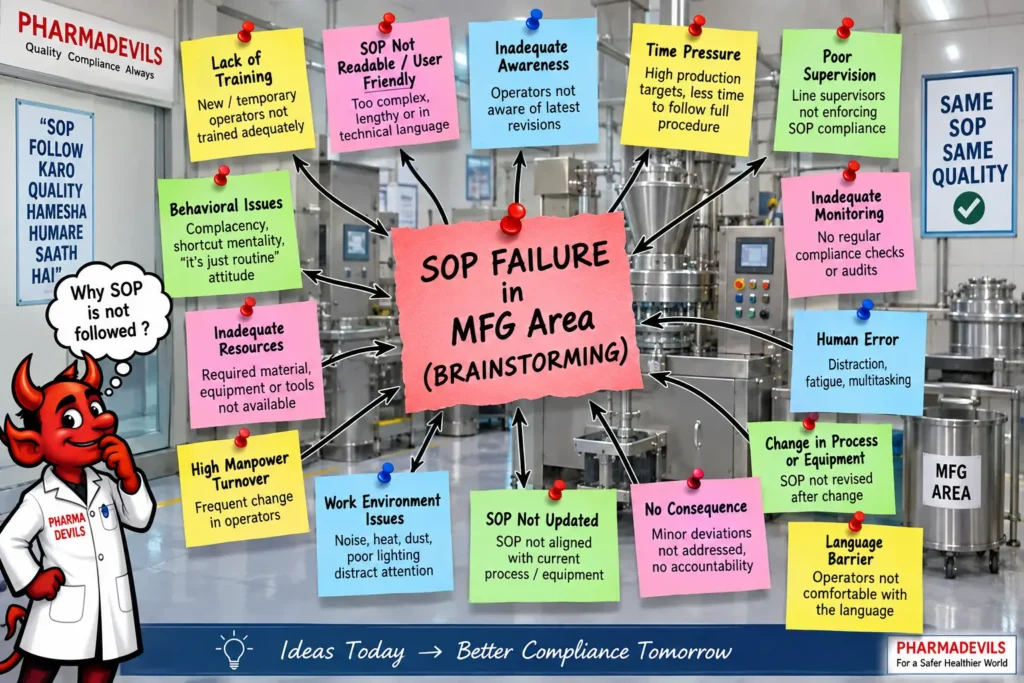
The diagram also highlights behavioral issues such as complacency and shortcut practices, as well as failure to update SOPs after changes in equipment or manufacturing processes. Lack of accountability for minor deviations can further weaken compliance. This brainstorming approach helps QA and Production teams identify probable causes systematically and provides a foundation for root cause analysis, CAPA development, retraining, SOP revision, improved supervision, and stronger GMP compliance.
3. 5-Why Analysis for SOP Failure:
The 5-Why Analysis identifies the underlying reasons for SOP failure in the pharmaceutical manufacturing area. The analysis begins with the problem that operators are not following the required SOP during manufacturing activities. It progressively identifies contributing causes such as lack of awareness, poor understanding of the procedure, complex or technical SOP language, inadequate training, absence of refresher training, and weak verification of training effectiveness.
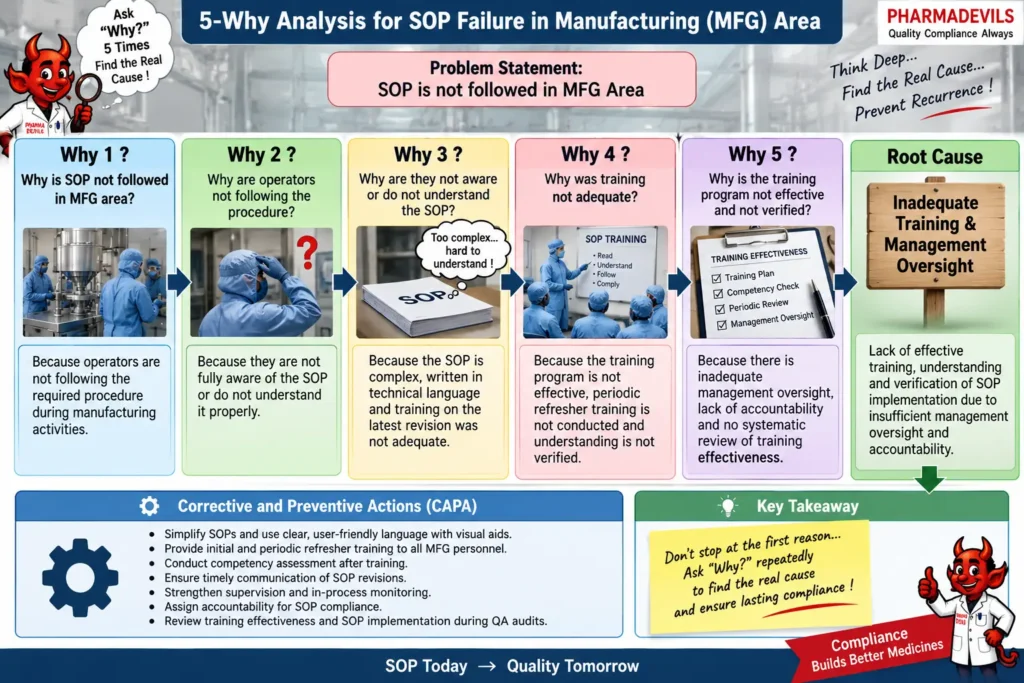
The final root cause is linked to inadequate training and insufficient management oversight, including poor accountability and lack of systematic monitoring of SOP implementation. The analysis also highlights suitable CAPA measures such as simplifying SOPs, providing periodic training, conducting competency assessments, communicating SOP revisions promptly, strengthening supervision, and routinely reviewing training effectiveness. This approach helps identify the real cause of SOP non-compliance and supports sustainable GMP improvement.
4. Fishbone Analysis for SOP Failure:
The Fishbone Analysis identifies the possible causes of SOP failure in a pharmaceutical manufacturing area by grouping them into major categories. The diagram evaluates Man (People), Method (Procedure), Machine (Equipment), Material, Management, Measurement/Monitoring, Environment, and Manpower/Workload as potential contributors to non-compliance.
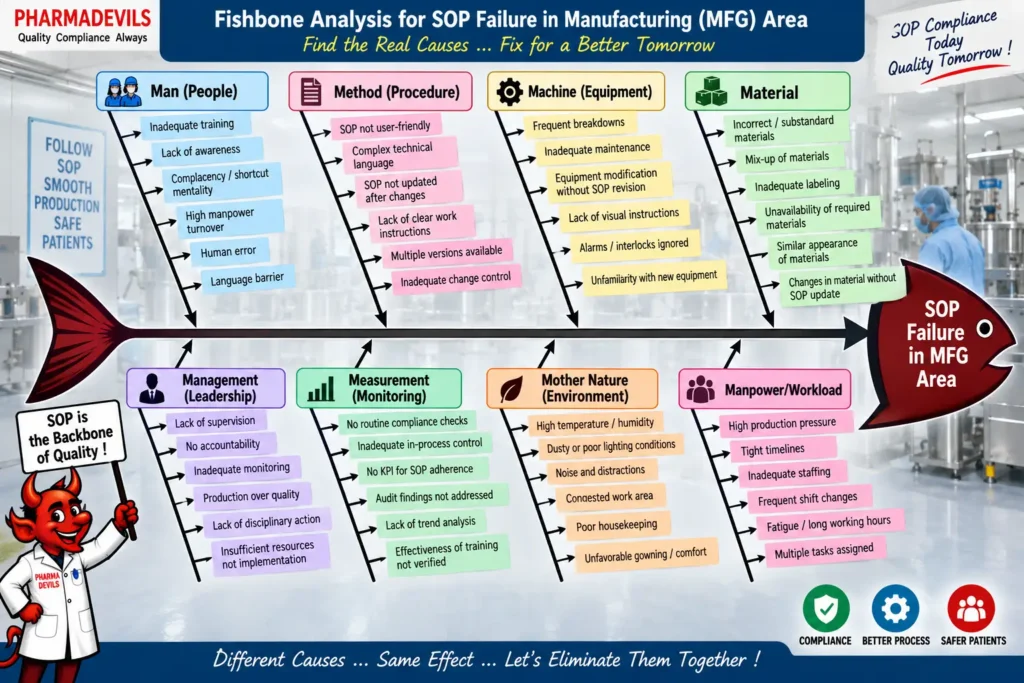
Key causes include inadequate training, lack of awareness, human error, complex or outdated SOPs, equipment breakdowns, insufficient maintenance, material mix-ups, weak supervision, poor monitoring, production pressure, inadequate staffing, and unfavorable environmental conditions. The analysis helps QA and Production teams systematically explore the root causes behind SOP non-adherence rather than focusing only on operator error.The fishbone approach supports development of effective CAPA such as training improvement, SOP revision, stronger supervision, better monitoring, adequate resources, improved maintenance, and workload control, thereby strengthening GMP compliance and reducing recurrence of SOP failures.
5. Fault Tree Analysis for SOP Failure:
The Fault Tree Analysis (FTA) diagram illustrates the potential causes leading to SOP failure in the pharmaceutical manufacturing area, where operators do not follow the approved procedure. The top event is divided into major cause categories such as people-related failures, SOP-related failures, management and supervision weaknesses, resource or infrastructure deficiencies, and environmental or production-pressure factors.
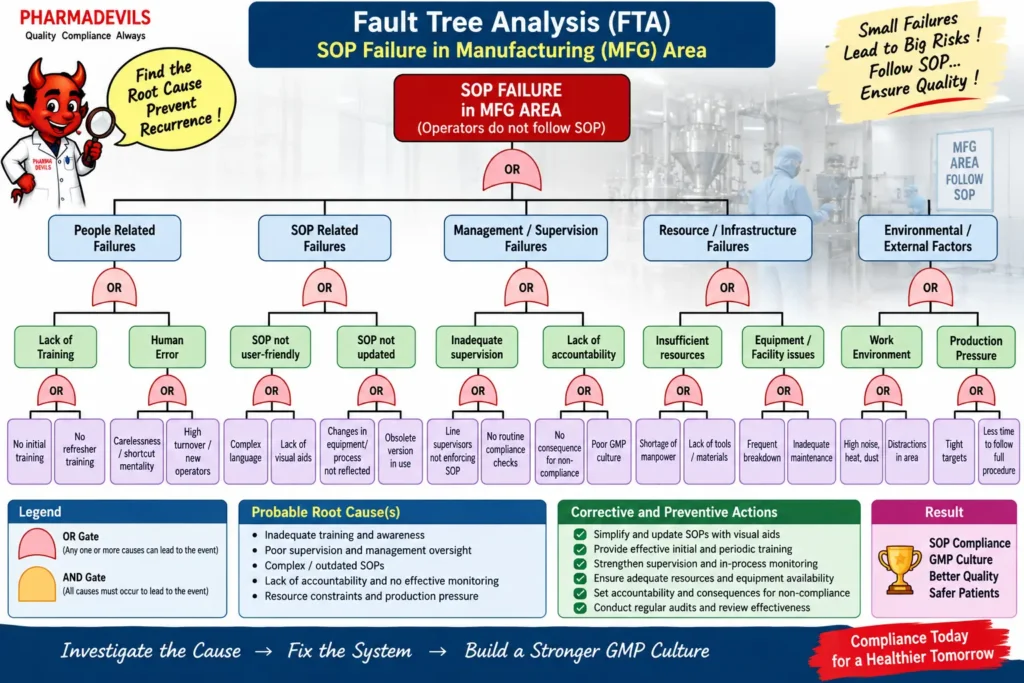
Each branch further identifies contributing causes, including inadequate training, human error, complex or outdated SOPs, weak supervision, lack of accountability, insufficient manpower or tools, equipment problems, workplace distractions, and tight production targets. The diagram uses logical OR gates to show how individual failures may independently contribute to SOP non-compliance. The analysis helps identify probable root causes and supports CAPA such as improved training, SOP simplification and revision, stronger supervision, adequate resource availability, periodic audits, and enhanced accountability to strengthen GMP compliance and prevent recurrence.
Questions & Answers – SOP for Electronic Data Backup of Analytical Instruments
- Q: What is the objective of this SOP?
A: The objective is to define the procedure for electronic data backup of analytical instruments so that critical analytical data is preserved for future reference. - Q: Which analytical instruments are covered under this SOP?
A: The SOP applies to electronic data backup of analytical instruments such as HPLC and FTIR used in the Quality Control Laboratory. - Q: Who is responsible for execution of the SOP?
A: The Executive-IT is responsible for execution of the SOP. - Q: Who is responsible for effective implementation of the SOP?
A: The Manager-QC and Head QC/QA are responsible for effective implementation. - Q: Who is accountable for the electronic data backup system?
A: The IT Head is accountable. - Q: Where is electronic analytical data initially stored?
A: Electronic data is stored in the local drive of the respective analytical-instrument computer connected to the domain server. - Q: What is the frequency of electronic data backup?
A: Electronic data backup is required once daily at the predefined time of 10:00 AM. - Q: What should be done if a scheduled backup is missed due to an unplanned event?
A: The data backup should be taken on the next day. - Q: Which software is specified for performing the backup?
A: The SOP specifies Back 2 ZIP software for data backup. - Q: How is the domain server protected?
A: The domain server is required to be password protected by the administrator. - Q: Where else is the electronic data stored besides the domain server?
A: Electronic data is also stored in an external hard disk using a defined file path based on current year, instrument name, month and data. - Q: Who can access the computerized domain server and external backup media?
A: Access is restricted to authorized personnel only, and the authorized-person list is maintained as per Annexure-I. - Q: What responsibility does each user have regarding passwords?
A: Each user is accountable for activities performed under their password and must not disclose the password to another user, in order to maintain authenticity, confidentiality and integrity of data. - Q: How much electronic data is displayed in the respective instrument software?
A: The SOP states that three months of electronic data shall be available in the respective instrument software and accessible only by the IT administrator, while users shall access only the current month of the year. - Q: How can electronic data be retrieved for audit or review purposes?
A: The section head must complete the Requisition of Electronic Data Retrieve with proper justification and obtain approval from Head QA. - Q: Within what period should IT retrieve the requested electronic data?
A: The IT person should retrieve the electronic data within two working days. - Q: How frequently is backup data reviewed or challenged?
A: QA selects data for backup challenges on a quarterly basis, and the review is documented using the electronic data review checklist. - Q: What should be done if an abnormality is observed in electronic data?
A: The abnormality should be reported to the IT Executive and Manager QA, followed by investigation, impact evaluation and suitable action through the applicable CAPA procedure. - Q: What annexures are included in the SOP?
A: The SOP includes Annexure-I for the authorized-person list, Annexure-II for electronic-data retrieval requisition, and Annexure-III for the electronic-data review checklist. - Q: What is the purpose of this SOP from a compliance perspective?
A: Based on the SOP, its purpose is to ensure that analytical electronic data is backed up, protected from unauthorized access, retrievable when required, periodically reviewed, and investigated if abnormalities occur, thereby supporting controlled and reliable electronic data management.
Reference Guidelines:
- Revised Schedule M, Drugs Rules, 1945 – India (G.S.R. 922(E), 28 December 2023): Applicable to pharmaceutical GMP, computerized systems, documentation, access control, data integrity, data retention and backup requirements. (CDSCO) CDSCO Revised Schedule M
- EU GMP Annex 11 – Computerised Systems: Covers validated computerized systems, security, data storage, backup, restoration, access control, audit trails and periodic evaluation. (Public Health)
- US FDA 21 CFR Part 11 – Electronic Records; Electronic Signatures: Provides requirements for trustworthy and reliable electronic records, system controls, electronic data retention and protection. (U.S. Food and Drug Administration)
- US FDA – Data Integrity and Compliance with Drug CGMP: Questions and Answers, 2018: Provides expectations for complete, consistent and accurate electronic laboratory data and appropriate controls over computerized records. (U.S. Food and Drug Administration)
- PIC/S PI 041-1 – Good Practices for Data Management and Integrity in Regulated GMP/GDP Environments: Covers data lifecycle management, electronic data, backup, access privileges, review, security and data-integrity controls. (PIC/S)
- WHO Technical Report Series No. 996, Annex 5 – Guidance on Good Data and Record Management Practices: Addresses good data governance, electronic records, data lifecycle, security, storage, backup, archival and retrieval. (WHO Extranet)
- MHRA – GxP Data Integrity Guidance and Definitions: Provides expectations for data governance, electronic records, access control, backup, archival, audit trail review and maintaining data throughout its lifecycle. (GOV.UK)