







1. Introduction – SOP for Elevated Temperature Test:
The SOP for Elevated Temperature Test describes the standardized procedure used to verify the sealing integrity of filled bottles under elevated-temperature conditions. The purpose of the test is to ensure that bottles sealed from each sealing head remain leak-proof and maintain acceptable closure integrity when exposed to 50°C for 24 hours. As specified in the SOP, two consecutive bottles are collected from each sealing head, visually inspected for proper threading and finishing, wrapped with tissue paper, numbered according to the respective sealing head, and placed in a hot air oven in the supine position. After completion of the exposure period, each bottle is examined for evidence of leakage. Any leaking bottle requires further checks such as cap opening torque, threading, wad presence and impression, and the bottle lip condition. Successful completion of this test provides assurance regarding proper bottle sealing performance and helps prevent leakage-related product quality issues.
Skip to PDF content1. Flow Diagram – SOP for Elevated Temperature Test:
The SOP for Elevated Temperature Test provides a systematic procedure to evaluate the sealing integrity of bottles by exposing sealed containers to elevated temperature conditions. As per the SOP, two consecutive bottles from each sealing head are collected, numbered, and visually inspected for proper threading and finishing. If the sealing quality is unsatisfactory, the sealing head is readjusted and acceptable bottles are selected for testing. The bottles are placed in a labeled tray, wrapped individually with tissue paper, and kept in a hot air oven at 50°C for 24 hours in the supine position.
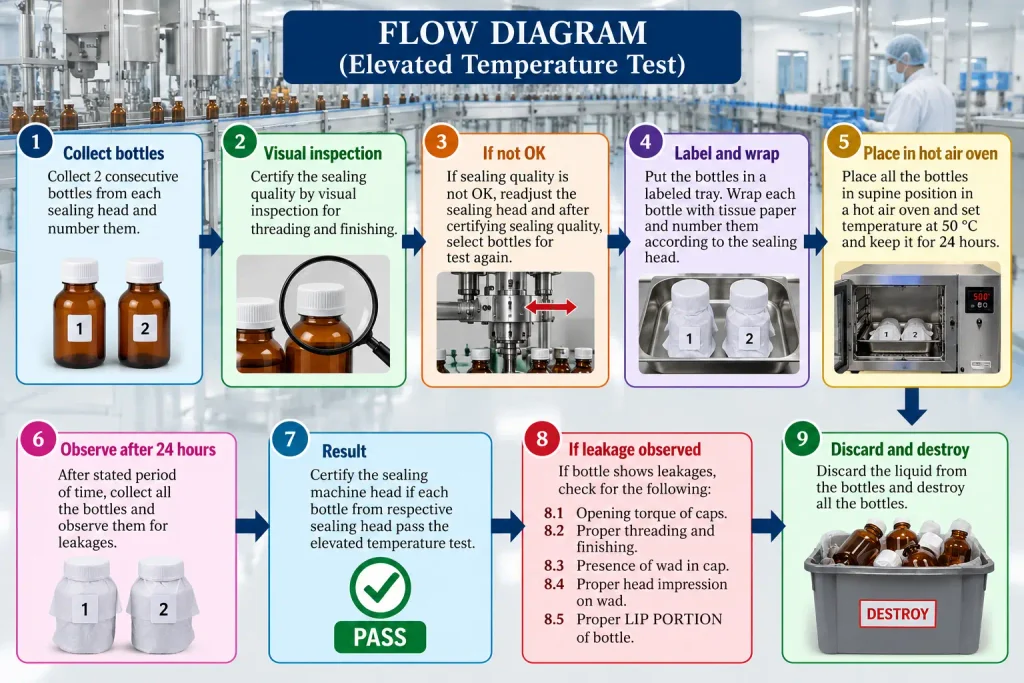
After completion of the test period, the bottles are examined for leakage. If leakage is observed, checks are performed for cap opening torque, threading, wad presence, wad impression, and bottle lip condition. Bottles passing the test confirm satisfactory sealing performance of the respective sealing head.
2. Benefits of Following SOP for Elevated Temperature Test:
Following the SOP for Elevated Temperature Test helps ensure consistent verification of bottle sealing integrity under defined elevated-temperature conditions. The procedure confirms whether bottles sealed from each sealing head can withstand exposure at 50°C for 24 hours without leakage. Proper implementation helps identify sealing defects related to inadequate threading, poor finishing, incorrect cap torque, missing or improperly seated wad, inadequate head impression, or defects in the bottle lip portion.
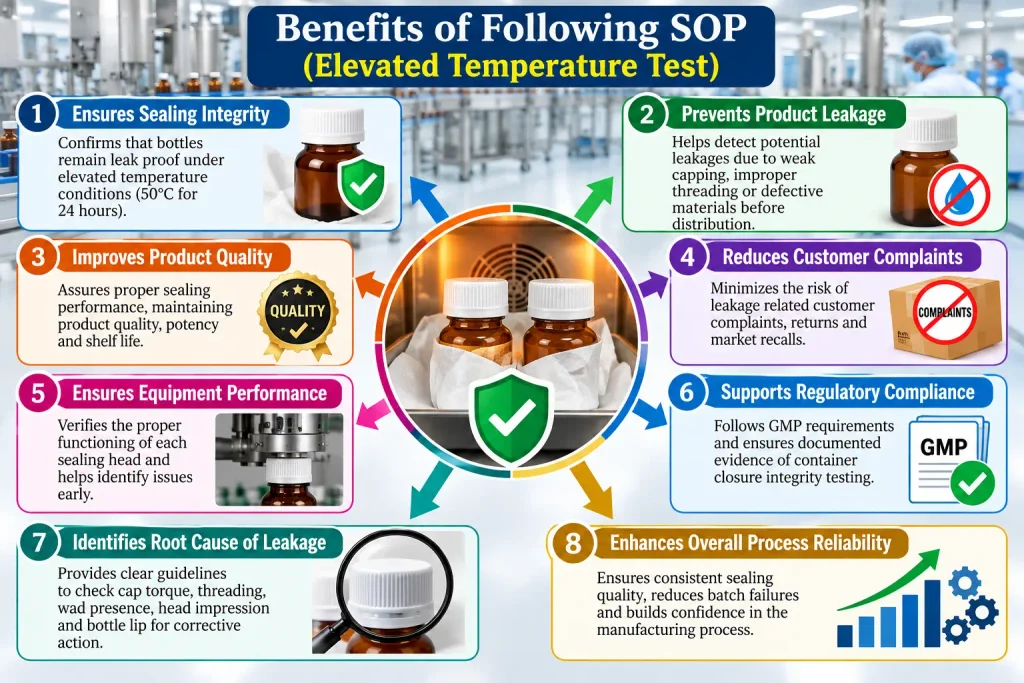
Compliance with this SOP also supports reliable sealing-machine performance, reduces the possibility of leakage-related product loss, and provides a structured method for identifying sealing problems before they affect product quality. Because the test is linked to bottle supplier changes, it also provides an additional verification step when packaging components may change.
3. Brainstorming for SOP Failure – Elevated Temperature Test:
The Brainstorming for SOP Failure – Elevated Temperature Test identifies potential causes that may lead to failure or unreliable results during execution of the procedure. Based on the SOP, important areas requiring attention include correct collection of two consecutive bottles from each sealing head, proper visual inspection of threading and finishing, correct adjustment of the sealing head, appropriate labeling and tissue wrapping, correct positioning of bottles in the hot air oven, and maintaining the specified 50°C exposure for 24 hours.
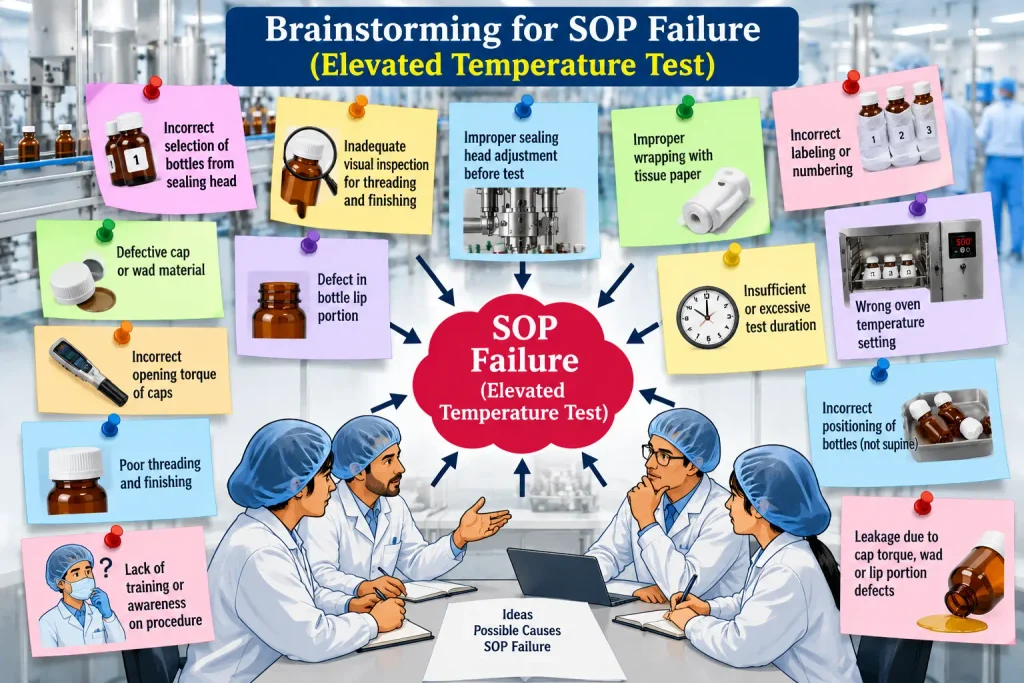
Other possible causes of failure include incorrect cap opening torque, defective threading, absence or improper seating of the wad, inadequate head impression on the wad, and defects in the bottle lip portion. Brainstorming these possible causes helps the production and quality teams identify weaknesses in equipment, materials, operating practices, and personnel execution, so that appropriate corrective and preventive actions can be planned.
5. 5-Why Analysis for SOP Failure – Elevated Temperature Test:
The 5-Why Analysis for SOP Failure – Elevated Temperature Test is used to identify the underlying reason for bottle leakage or failure observed after exposure at 50°C for 24 hours. The analysis begins with the problem of leakage and progressively evaluates possible causes such as improper bottle sealing, incorrect adjustment of the sealing head, inadequate visual inspection of threading and finishing, and incomplete execution of the prescribed procedure. These areas are directly linked to the SOP requirements for sealing quality verification before testing and detailed checks when leakage is observed.
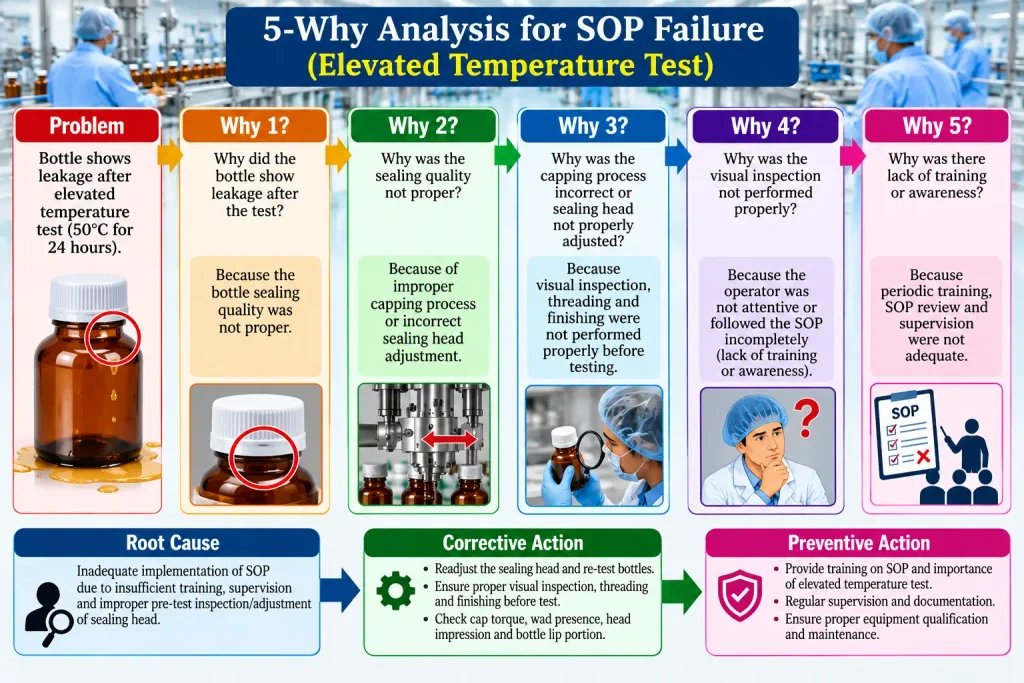
The analysis helps move beyond the immediate defect to determine whether the failure originated from the sealing process, inspection activity, or procedural execution. Identifying the root cause supports focused corrective actions such as sealing-head readjustment, improved inspection, verification of cap torque and wad condition, and better adherence to the approved SOP.
6. Fishbone Analysis for SOP Failure – Elevated Temperature Test:
The Fishbone Analysis for SOP Failure – Elevated Temperature Test systematically identifies possible causes of test failure or bottle leakage by grouping them into major categories such as Man, Machine, Method, Material, Measurement/Inspection, and Environment/Handling. Potential causes include inadequate operator training, incomplete SOP execution, improper sealing-head adjustment, hot-air oven temperature variation, incorrect bottle selection, inadequate visual inspection, improper wrapping or labeling, and failure to maintain the specified 50°C for 24 hours.
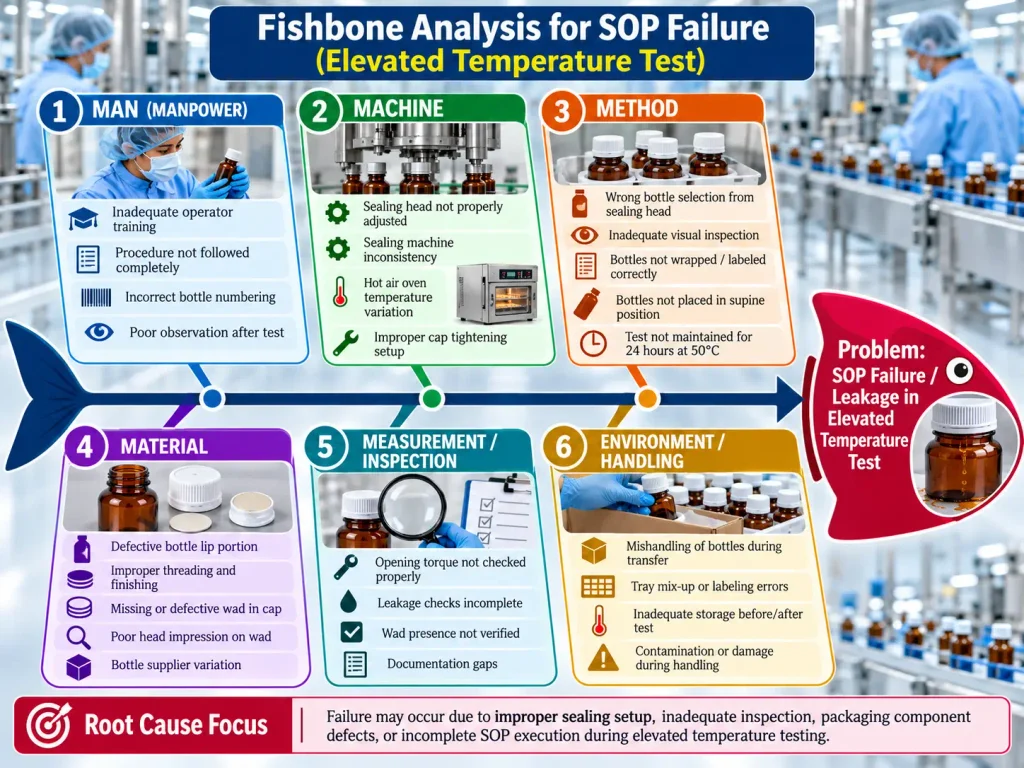
Material-related causes may include defective bottle lip portions, improper threading and finishing, missing or defective wad, or poor wad impression. Measurement and inspection failures may involve inadequate checking of cap opening torque or incomplete leakage investigation. The analysis helps the manufacturing and quality teams visually organize these possible causes so that the most probable contributors can be investigated and appropriate corrective actions can be implemented.
7. Fault Tree Analysis for SOP Failure – Elevated Temperature Test:
The Fault Tree Analysis for SOP Failure – Elevated Temperature Test evaluates the possible causes that can lead to the top event of bottle leakage after exposure at 50°C for 24 hours. The analysis breaks the failure into major contributing branches such as inadequate bottle sealing, improper execution of the test procedure, and test conditions not maintained as per the SOP. These branches further include sealing-head adjustment problems, incorrect cap torque, defective or missing wad, poor wad impression, improper threading and finishing, defective bottle lip, incorrect bottle selection, inadequate visual inspection, and improper labeling or wrapping.
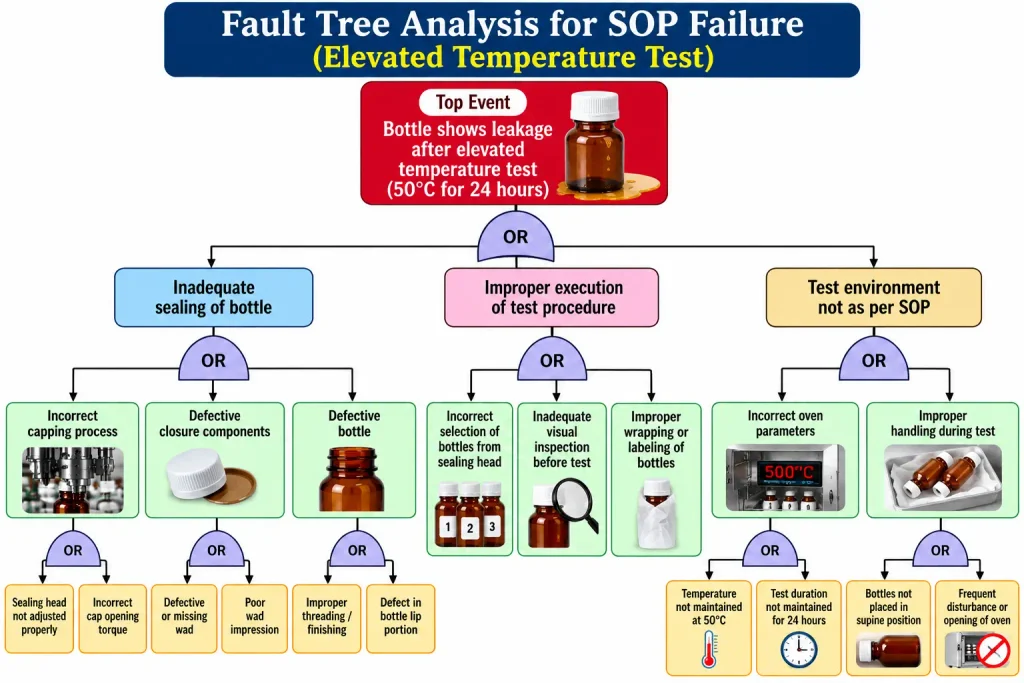
The fault tree also highlights test-condition failures, including incorrect oven temperature, insufficient test duration, and improper bottle positioning. By tracing the top event down to basic causes, the analysis supports systematic investigation and helps the production and quality teams identify the most likely failure points requiring corrective action.
8. Impact Assessment for SOP Failure – Elevated Temperature Test:
The Impact Assessment for SOP Failure – Elevated Temperature Test evaluates the possible consequences of improper execution of the procedure and the benefits achieved when the SOP is followed correctly. Failure to properly verify bottle sealing can result in leakage, product loss, rejection, investigation, and possible quality concerns. The SOP specifically requires checking the sealing quality, maintaining bottles at 50°C for 24 hours, and examining any leaking bottle for cap opening torque, threading, wad presence, wad impression, and bottle lip condition.
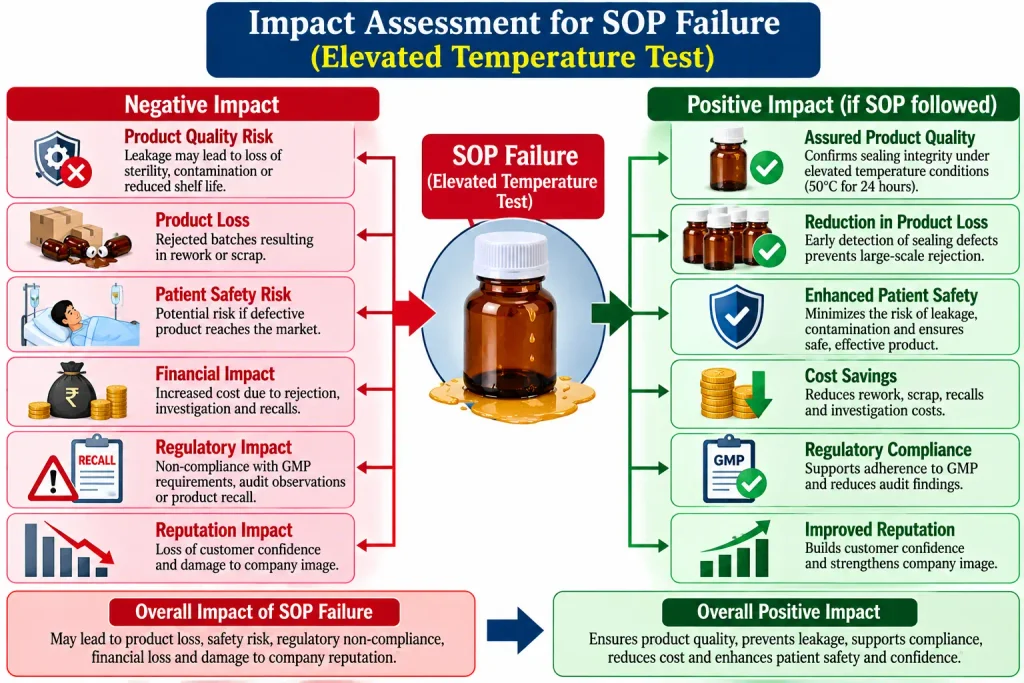
When the SOP is properly followed, sealing defects can be identified before acceptance of the sealing head. This supports consistent packaging performance and helps reduce leakage-related failures. The test also provides additional assurance when there is a change of bottle supplier, as specified in the SOP frequency requirement.
9. CAPA for SOP Failure – Elevated Temperature Test:
The CAPA for SOP Failure – Elevated Temperature Test is intended to correct the immediate cause of bottle leakage and prevent recurrence of similar failures. When leakage is observed after the elevated temperature test, the SOP requires evaluation of cap opening torque, threading and finishing, presence of wad, proper head impression on the wad, and the bottle lip portion.
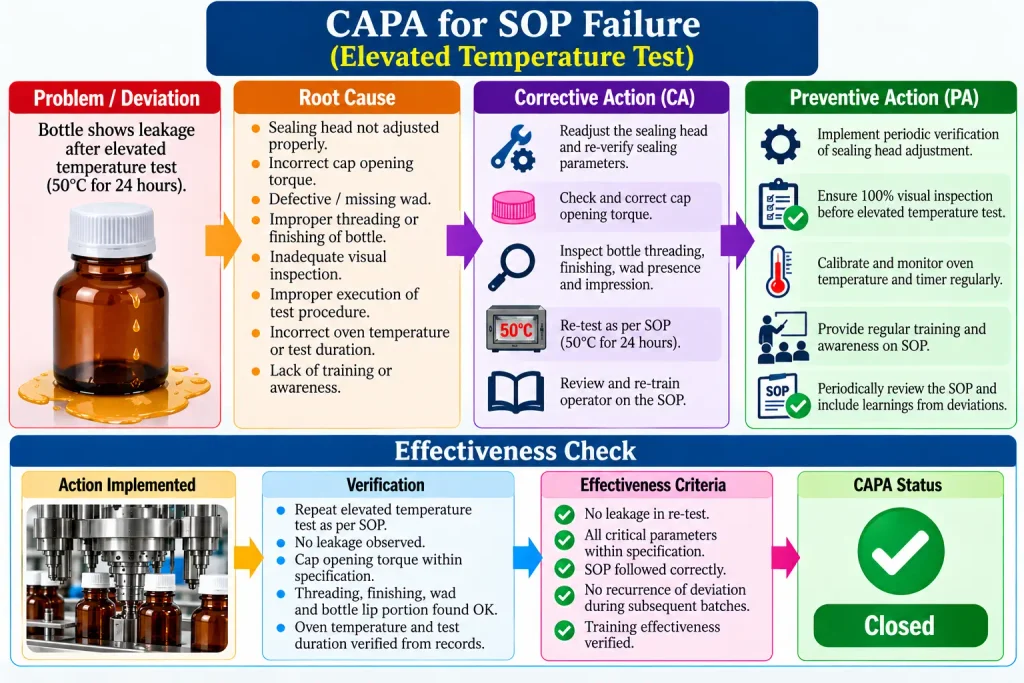
Corrective actions may include readjustment of the sealing head, correction of cap torque, replacement of defective bottles or closures, reinspection of threading and finishing, and repeat testing at the specified 50°C for 24 hours. Preventive actions should focus on periodic sealing-head verification, proper visual inspection before testing, regular training of operators, and consistent monitoring of oven temperature and test duration. Effectiveness should be confirmed through successful repeat testing, absence of leakage, acceptable sealing parameters, and no recurrence of the same failure in subsequent testing.
Questions & Answers – SOP for Elevated Temperature Test:
Q1. What is the objective of the Elevated Temperature Test SOP?
Answer: The objective is to lay down a standardized procedure for performing the elevated temperature test.
Q2. Who is responsible for execution of this SOP?
Answer: Concerned production personnel, the Production Chemist, and the Production Manager are responsible for execution of the SOP.
Q3. How many bottles are collected from each sealing head?
Answer: Two consecutive bottles are collected from each sealing head and numbered accordingly.
Q4. What should be checked before the elevated temperature test?
Answer: The sealing quality should be visually inspected for proper threading and finishing.
Q5. What action is required if sealing quality is not satisfactory?
Answer: The sealing head should be readjusted, sealing quality should be reverified, and bottles should then be selected for leak testing.
Q6. How should the bottles be prepared before placing them in the hot air oven?
Answer: The bottles should be placed in a labeled tray, individually wrapped with tissue paper, and numbered according to the sealing head from which they were taken.
Q7. What are the temperature and duration of the test?
Answer: The bottles are kept in a hot air oven at 50°C for 24 hours.
Q8. In which position should the bottles be kept during the test?
Answer: The bottles should be placed in the supine position inside the hot air oven.
Q9. What is checked after completion of the 24-hour test period?
Answer: All bottles are collected and observed for leakage or other signs of sealing failure.
Q10. When can a sealing machine head be considered satisfactory?
Answer: A sealing machine head can be certified when each bottle taken from that sealing head passes the elevated temperature test.
Q11. What checks are required if leakage is observed?
Answer: The SOP requires checking the cap opening torque, threading and finishing, presence of wad in the cap, proper head impression on the wad, and the bottle lip portion.
Q12. What should be done with the tested bottles after completion of the test?
Answer: The liquid should be discarded and all tested bottles should be destroyed.
Q13. What is the specified frequency of this test?
Answer: The SOP states that the test must be performed when there is a change of bottle supplier.
Q14. What reference is mentioned in the SOP?
Answer: The SOP mentions “As per GMP” as the reference.
Q15. Is any annexure provided with this SOP?
Answer: No. The SOP specifies Annexure: Nil.
Reference Guideline – SOP for Elevated Temperature Test:
- Good Manufacturing Practices (GMP) – for ensuring proper control, execution, documentation, and verification of the elevated temperature test.