






Brief Description
This Standard Operating Procedure defines the controlled entry and exit requirements for personnel working in the Raw Material Sampling Room. Its purpose is to ensure that personnel follow appropriate gowning, hygiene, and contamination-control practices before entering the sampling area. QC chemists are responsible for executing the procedure, while QC supervisory personnel and QA/QC management are responsible for verification, review, and effective implementation. During entry, personnel proceed through the designated personnel entrance, wear fresh shoe covers, clean apron and cap, gloves, and mask, and disinfect their hands using 70% IPA. Gloves are again disinfected before carrying out raw-material sampling. After completion of sampling, personnel enter the airlock, remove the apron, shoe covers, mask, and gloves, dispose of them in the designated waste bins, and exit the sampling area. The SOP also specifies training responsibilities for QC personnel and controlled-copy distribution.
Skip to PDF content1. Flow Diagram:
The flow diagram illustrates the controlled entry and exit procedure for personnel entering the Raw Material Sampling Room. The entry sequence begins with access through the designated personnel entry door, confirmation of clean protective garments, wearing fresh shoe covers, hand disinfection with 70% IPA, and donning a clean apron, cap, gloves, and mask. Personnel then enter the sampling room, disinfect gloves again with 70% IPA, and perform the sampling activity.
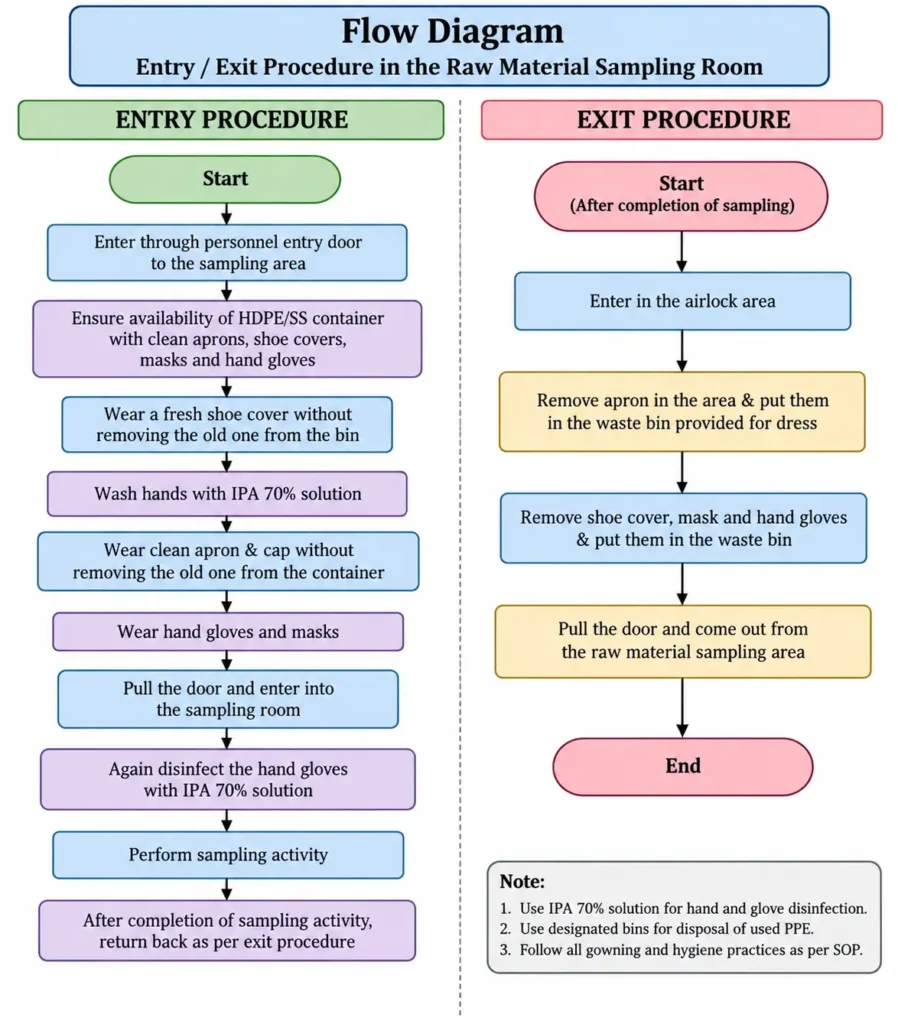
After completion of sampling, the exit sequence starts by entering the airlock area. Personnel remove the apron, shoe covers, mask, and gloves and discard them in the designated waste bins before leaving the raw material sampling area. The flow emphasizes proper gowning, hygiene, disinfection, and orderly movement to minimize contamination risk and maintain controlled sampling-room practices.
2. Brainstorming for SOP Failure:
The brainstorming diagram highlights the possible causes of SOP failure in the pharmaceutical manufacturing area by grouping them into major categories such as People, Methods, Materials, Machine/Equipment, Environment, and Management. It helps the investigation team systematically identify weaknesses that may lead to non-compliance with approved procedures.
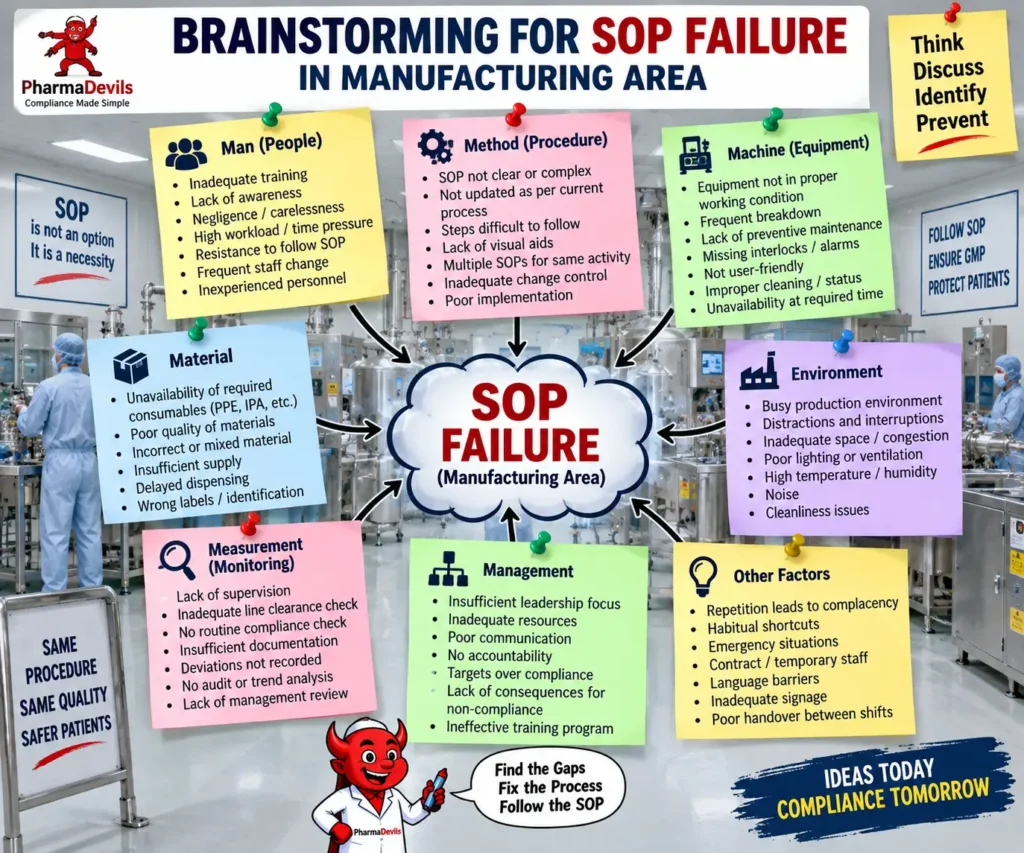
Key concerns include inadequate training, poor SOP awareness, negligence, unclear or outdated procedures, non-availability of PPE and 70% IPA, equipment or airlock problems, poor housekeeping, uncontrolled personnel movement, insufficient supervision, and production pressure. For the raw material sampling process, these factors are particularly important because the SOP requires defined gowning, hand and glove disinfection, controlled entry through the sampling area, and proper removal and disposal of PPE during exit.The brainstorming exercise supports root-cause identification, risk assessment, CAPA development, improved training, and stronger GMP compliance to prevent recurrence of SOP failures.
3. 5-Why Analysis for SOP Failure:
The 5-Why Analysis diagram evaluates the root cause of SOP failure in the pharmaceutical manufacturing area by repeatedly asking why the approved procedure was not followed. The analysis starts with operator non-adherence and progressively identifies deeper causes such as inadequate awareness, insufficient or ineffective training, weak supervision, lack of training-effectiveness assessment, production pressure, and poor accountability.
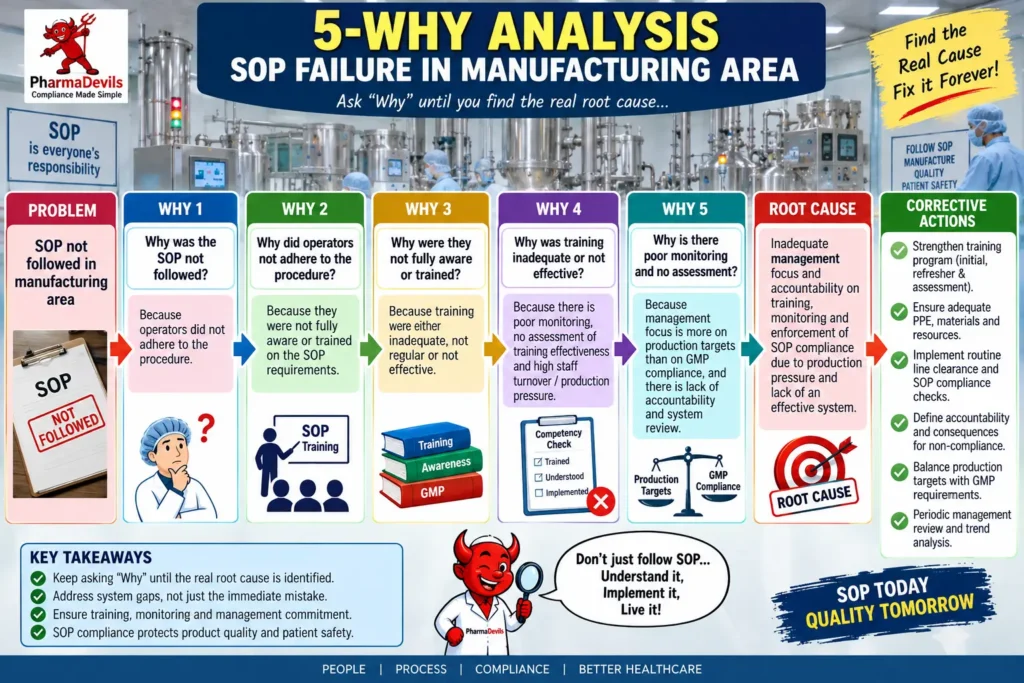
The final root cause is linked to inadequate management focus on GMP compliance, monitoring, training effectiveness, and enforcement of SOP requirements. Corrective actions include strengthening initial and refresher training, ensuring adequate resources and PPE, performing routine SOP compliance checks, defining responsibilities and accountability, balancing production targets with GMP requirements, and conducting periodic management review and trend analysis. The diagram emphasizes that the purpose of 5-Why analysis is to correct system weaknesses rather than only the immediate human error, thereby reducing recurrence and protecting product quality and patient safety.
4. Fishbone Analysis for SOP Failure:
The Fishbone Analysis diagram identifies the potential causes of SOP failure in the pharmaceutical manufacturing area by organizing contributing factors into major categories such as People, Methods, Machines/Equipment, Materials, Environment, and Management. It helps investigation teams systematically evaluate why an approved SOP may not be followed as intended.
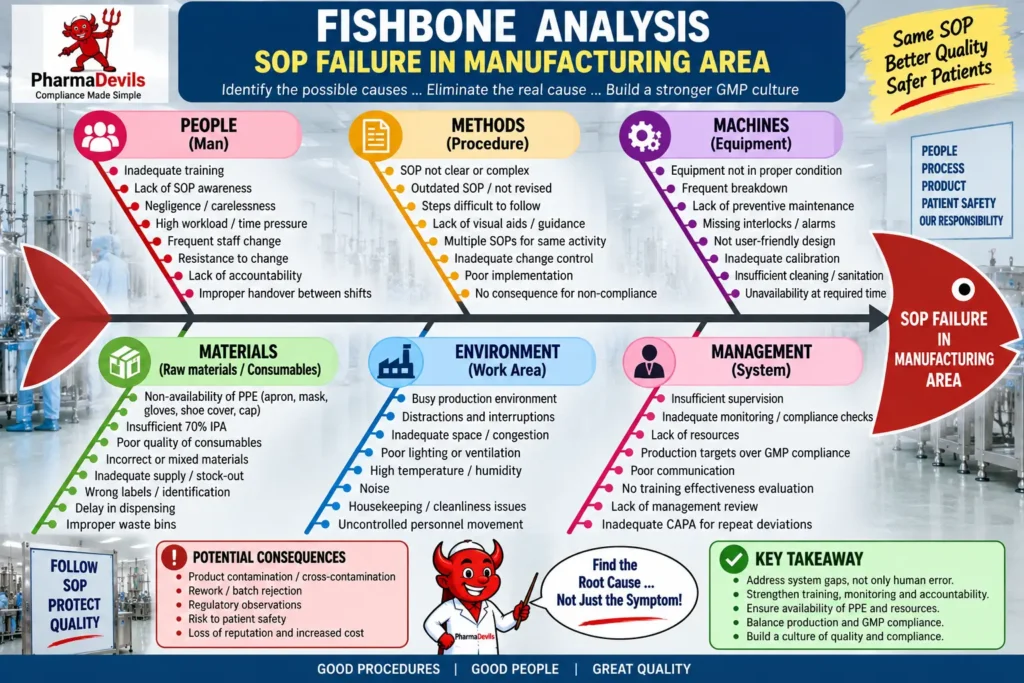
Possible causes include inadequate training, poor SOP awareness, unclear or outdated procedures, equipment malfunction, insufficient PPE or 70% IPA, poor housekeeping, uncontrolled personnel movement, weak supervision, production pressure, and ineffective management review. For the raw material sampling-room procedure, compliance depends on correct gowning, use of shoe covers, apron, cap, gloves and mask, hand and glove disinfection with 70% IPA, and proper entry and exit through the designated areas.The Fishbone approach supports root-cause investigation, CAPA development, improved training, stronger supervision, and prevention of repeated SOP deviations, helping maintain GMP compliance and product quality.
5. Fault Tree Analysis for SOP Failure:
The Fault Tree Analysis diagram presents a top-down evaluation of SOP failure in the pharmaceutical manufacturing area. The top event, “SOP Failure in Manufacturing Area,” is broken down into major contributing branches such as Personnel-related failure, Procedural failure, Resource/Equipment-related failure, and Environmental/Organizational failure.
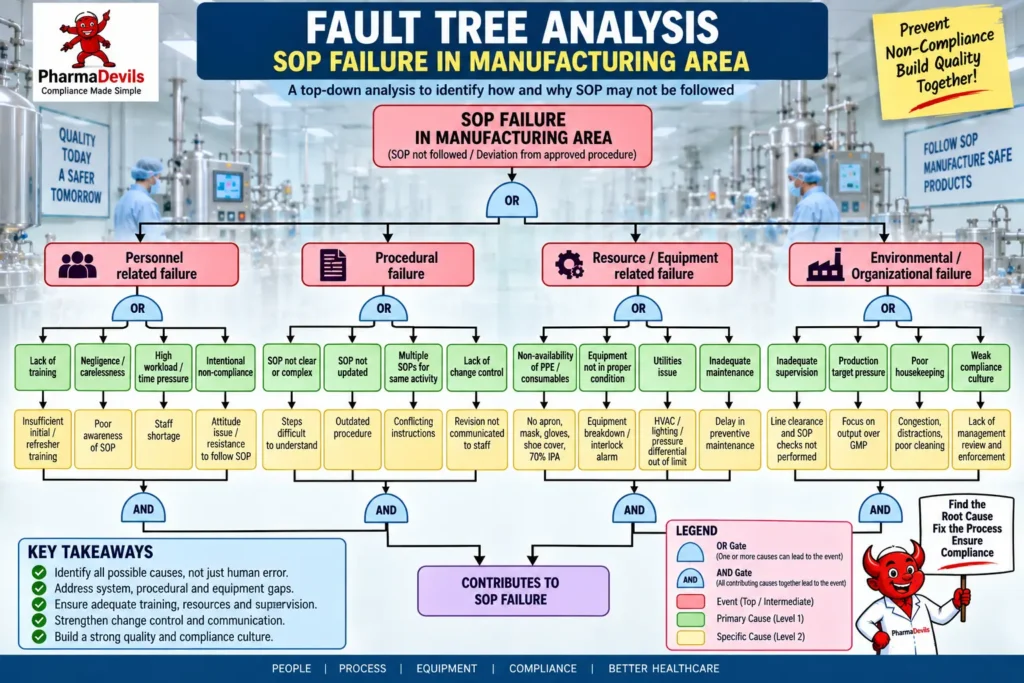
Potential causes include inadequate training, negligence, excessive workload, unclear or outdated SOPs, poor change control, non-availability of PPE and consumables, equipment breakdown, utility problems, inadequate maintenance, weak supervision, production pressure, poor housekeeping, and an ineffective compliance culture. OR and AND logic gates illustrate how individual or combined failures can contribute to the overall event. The analysis supports systematic root-cause identification, CAPA development, improved training, stronger supervision, adequate resource availability, effective change control, and better GMP compliance, helping prevent repeated SOP deviations and protect product quality and patient safety.
Questions & Answers – Entry / Exit Procedure in the Raw Material Sampling Room
- Q: What is the objective of this SOP?
A: To clearly define the procedure for entry and exit of personnel in the Raw Material Sampling Room. - Q: Where is this SOP applicable?
A: It is applicable to personnel entering and exiting the raw material sampling area of the RM store. - Q: Who is responsible for execution of the SOP?
A: The QC Chemist is responsible for executing the SOP. - Q: Who is responsible for review and effective implementation?
A: Manager-QC / Head QA/QC is responsible for review and effective implementation of the SOP. - Q: What PPE should be available before entering the sampling room?
A: Clean aprons, shoe covers, masks, hand gloves, and caps should be available in the designated HDPE/SS container. - Q: What disinfectant is used for hand disinfection?
A: 70% IPA solution is used for hand disinfection. - Q: What should personnel do before starting the sampling activity?
A: After entering the sampling room, personnel should again disinfect their hand gloves with 70% IPA solution before performing sampling. - Q: What is the first step of the exit procedure?
A: Personnel should enter the airlock area after completion of the sampling activity. - Q: How should used PPE be handled during exit?
A: The apron, shoe covers, mask, and hand gloves should be removed and placed in the designated waste bins. - Q: Who provides training for this SOP?
A: Manager-QC is the trainer, and all QC Chemists are trainees. - Q: What is the training duration specified in the SOP?
A: The training duration is half an hour. - Q: To whom are controlled copies of the SOP distributed?
A: Controlled copies are distributed to the Head of Quality Control, Store In-Charge, and Work Area, while the master copy is maintained by the Head of Quality Assurance. - Q: What references are specified in this SOP?
A: The SOP lists Reference: Nil. - Q: What does SOP stand for?
A: SOP stands for Standard Operating Procedure. - Q: Why is proper entry and exit important according to the procedure?
A: The SOP requires defined gowning, hand and glove disinfection, controlled personnel movement, and proper PPE disposal during entry and exit.
Reference Guidelines:
- Revised Schedule M, Drugs Rules, 1945 – G.S.R. 922(E), 28 December 2023, Government of India
Applicable to GMP requirements for pharmaceutical premises, personnel practices, material handling and contamination/cross-contamination control. Revised Schedule M is the current Indian GMP framework. (Drugs Control)
Revised Schedule M – G.S.R. 922(E) - WHO Technical Report Series No. 929, Annex 4 – Guidelines for Sampling of Pharmaceutical Products and Related Materials
Particularly relevant because it recommends dedicated or suitably controlled sampling facilities designed to prevent contamination of opened containers, cross-contamination and exposure of the sampler. (World Health Organization)
WHO Guidelines for Sampling of Pharmaceutical Products - WHO – Quality Assurance of Pharmaceuticals: Good Manufacturing Practices and Inspection, Volume 2
Covers GMP principles relating to personnel hygiene, protective clothing, premises, contamination prevention and pharmaceutical sampling practices. (World Health Organization)
WHO GMP Compendium - PIC/S Guide to GMP – PE 009, Annex 8: Sampling of Starting and Packaging Materials
Requires personnel performing sampling to receive initial and ongoing training covering sampling procedures, sampling equipment, cross-contamination risks and precautions during sampling. (PIC/S)
PIC/S GMP Annexes - EU Guidelines for GMP – EudraLex Volume 4, Part I and Annex 8: Sampling of Starting and Packaging Materials
Relevant sections include Chapter 2 – Personnel, Chapter 3 – Premises and Equipment, Chapter 6 – Quality Control, and Annex 8 – Sampling of Starting and Packaging Materials. (Public Health)
EudraLex Volume 4 – EU GMP - US FDA 21 CFR Part 211 – Current Good Manufacturing Practice for Finished Pharmaceuticals
§211.28 – Personnel Responsibilities requires appropriate clean clothing, protective apparel and good sanitation practices; §211.84 – Testing and Approval or Rejection of Components requires sampling to be performed so as to prevent contamination of the material and other components. (GovInfo)