






Brief Description
This SOP describes the procedure for environmental monitoring of non-sterile manufacturing areas and the microbiology section to maintain controlled cleanroom conditions and assess microbiological quality. It is applicable to Production and Microbiology departments, with execution performed by the Microbiologist and implementation overseen by the Lab QA Manager and Head QA/QC. Monitoring is performed primarily by the passive air sampling/settle plate method using Soyabean Casein Digest Agar. Media plates are pre-incubated for 48 hours, checked for contamination and integrity, properly labelled, and handled using masks and gloves. Plates are exposed at predetermined locations for not less than 2 hours, transferred to the microbiology laboratory, incubated, and examined for colony growth. Results are recorded and compared with specified alert, action, and acceptance limits. Monitoring is conducted twice monthly for the liquid section and monthly for other sections, with layouts and monitoring locations defined in the annexures.
Skip to PDF content1. Flow Diagram:
The flow diagram presents a clear, step-by-step overview of environmental monitoring in non-sterile pharmaceutical areas using the settle plate method. The process begins with preparation of Soyabean Casein Digest Agar plates, followed by 48-hour pre-incubation, inspection for contamination and media integrity, and verification of area conditions such as cleaning status, temperature, humidity, and differential pressure.
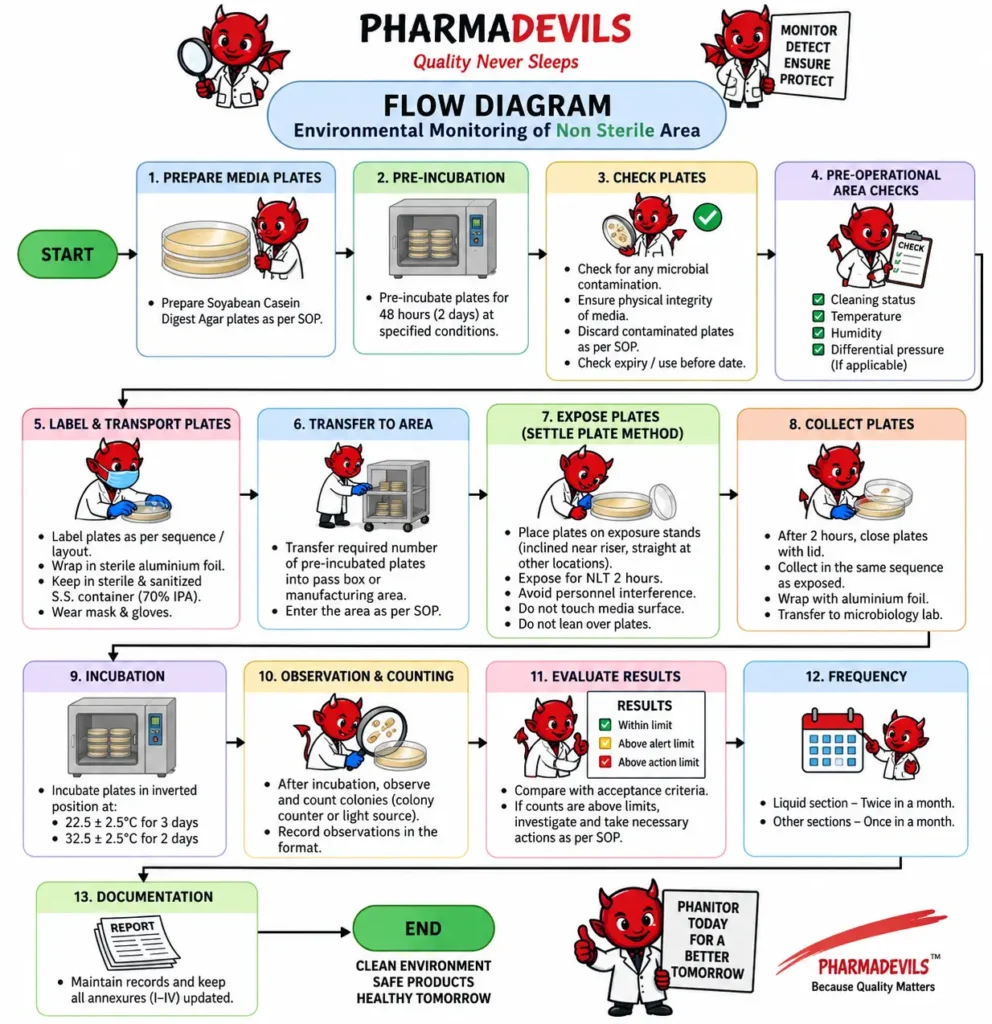
The plates are then labelled, wrapped, transferred to the designated monitoring locations, and exposed for not less than 2 hours while avoiding personnel interference and direct contact with the media surface. After exposure, plates are collected, transported to the microbiology laboratory, and incubated under specified temperature conditions. Colonies are subsequently counted and results are compared against established alert and action limits.The diagram also highlights monitoring frequency, documentation, investigation of excursions, and maintenance of annexure records, reinforcing consistent environmental control and GMP compliance.
2. Brainstorming for SOP Failure:
The brainstorming diagram presents potential causes of failure in the Environmental Monitoring of Non-Sterile Area SOP using a colorful sticky-note concept. Possible causes are grouped under six major categories—Man, Method, Material, Machine, Measurement, and Environment—to support systematic root-cause identification.
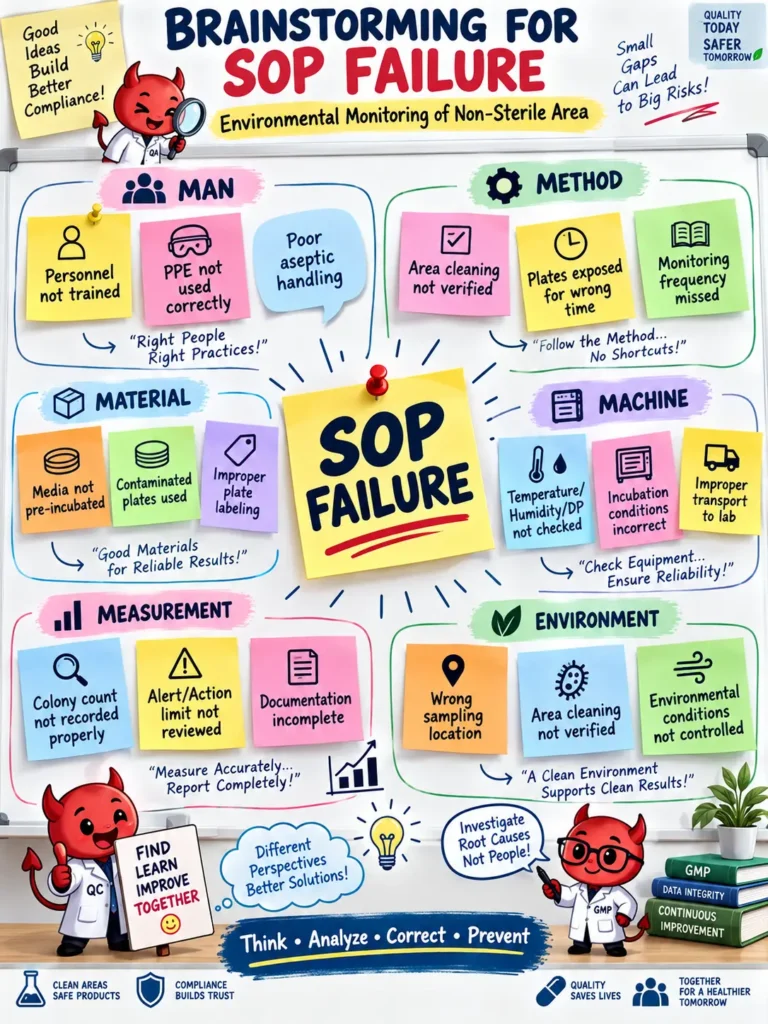
Personnel-related failures include inadequate training, incorrect PPE use, and poor aseptic handling. Method-related issues include failure to verify area cleaning, incorrect plate exposure time, and missed monitoring frequency. Material causes cover use of contaminated or improperly pre-incubated plates and incorrect labeling. Equipment and process-control concerns include improper incubation conditions and failure to verify temperature, humidity, or differential pressure. Measurement-related failures include inaccurate colony counting, incomplete documentation, and inadequate review of alert/action limits. Environmental causes include unsuitable sampling locations and uncontrolled area conditions. These factors reflect critical controls described in the SOP for plate preparation, exposure, incubation, observation, and result evaluation.The diagram encourages teams to identify, analyze, correct, and prevent potential SOP failures through collaborative brainstorming.
3. 5-Why Analysis for SOP Failure:
The 5-Why Analysis diagram evaluates a potential failure of the Environmental Monitoring of Non-Sterile Area SOP by progressively tracing an above-action-limit result to its underlying cause. The analysis begins with excessive microbial colonies on settle plates and examines possible contributing factors such as incorrect exposure duration, contaminated monitoring conditions, failure to verify area cleaning, uncontrolled personnel movement, and inadequate adherence to the approved procedure. The SOP requires plates to be exposed for not less than 2 hours, handled carefully to avoid personnel interference, and evaluated against defined alert and action limits.
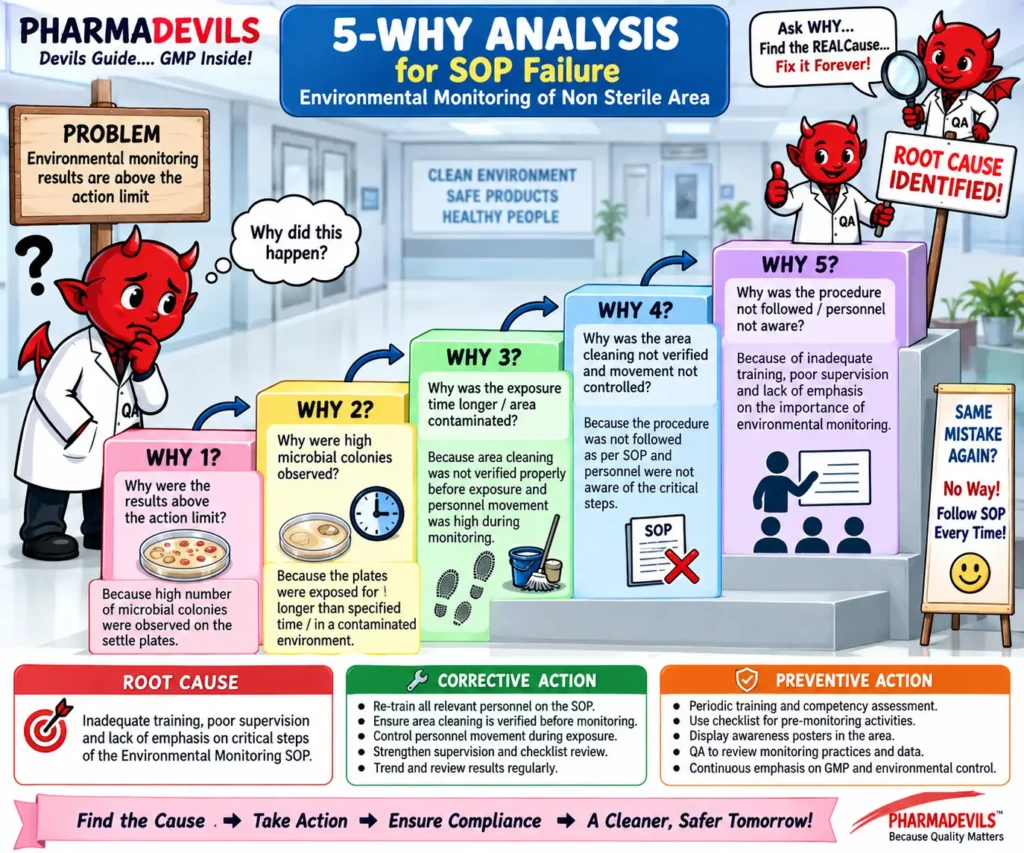
The illustrated analysis identifies inadequate training, insufficient supervision, and poor awareness of critical environmental-monitoring steps as the proposed root cause. Corrective and preventive actions include personnel retraining, verification of cleaning before monitoring, controlled movement during plate exposure, strengthened supervision, checklist implementation, competency assessment, routine trend review, and continued GMP awareness. The diagram demonstrates how repeated questioning helps move from the visible failure to the probable systemic cause and appropriate CAPA.
4. Fishbone Analysis for SOP Failure:
The Fishbone Analysis diagram identifies potential causes of failure in the Environmental Monitoring of Non-Sterile Area SOP by organizing them into six major categories: Man, Method, Material, Machine, Measurement, and Environment. The central effect is an environmental monitoring result that exceeds the specified limit.
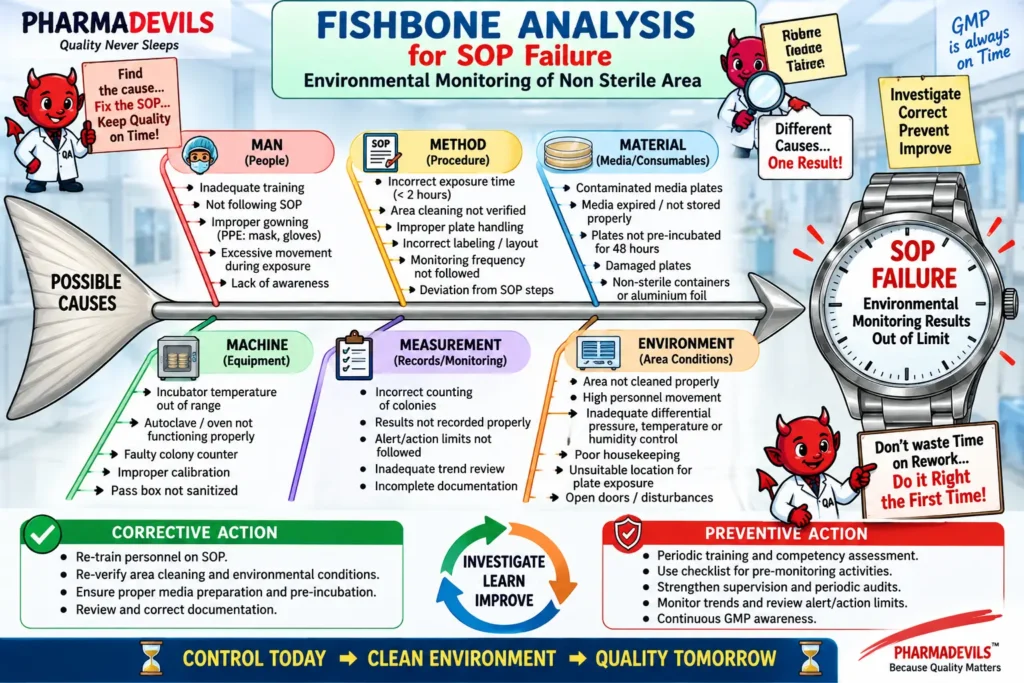
Personnel-related causes include inadequate training, failure to follow the SOP, improper gowning, and excessive movement during monitoring. Method-related causes include incorrect plate exposure time, failure to verify area cleaning, improper plate handling, incorrect labeling, and missed monitoring frequency. Material issues include contaminated, expired, damaged, or improperly pre-incubated media plates. Equipment-related causes include unsuitable incubator conditions, faulty colony counting equipment, and inadequate sanitization. Measurement causes include incorrect colony counting, incomplete documentation, and poor review of alert/action limits. Environmental factors include poor housekeeping, uncontrolled temperature, humidity or differential pressure, and unsuitable sampling locations. These potential causes directly relate to the SOP requirements for plate preparation, handling, exposure, incubation, monitoring conditions, and result evaluation.The watch-themed design emphasizes that timely investigation, corrective action, and preventive action are essential to maintain reliable environmental monitoring and GMP compliance.
5. Fault Tree Analysis for SOP Failure:
The Fault Tree Analysis (FTA) diagram explains how failure of the Environmental Monitoring of Non-Sterile Area SOP can lead to unreliable or out-of-limit monitoring results. The top event is divided into major failure branches such as Media/Plate Failure, Area Check Failure, Exposure Failure, Incubation/Observation Failure, and People/System Failure.
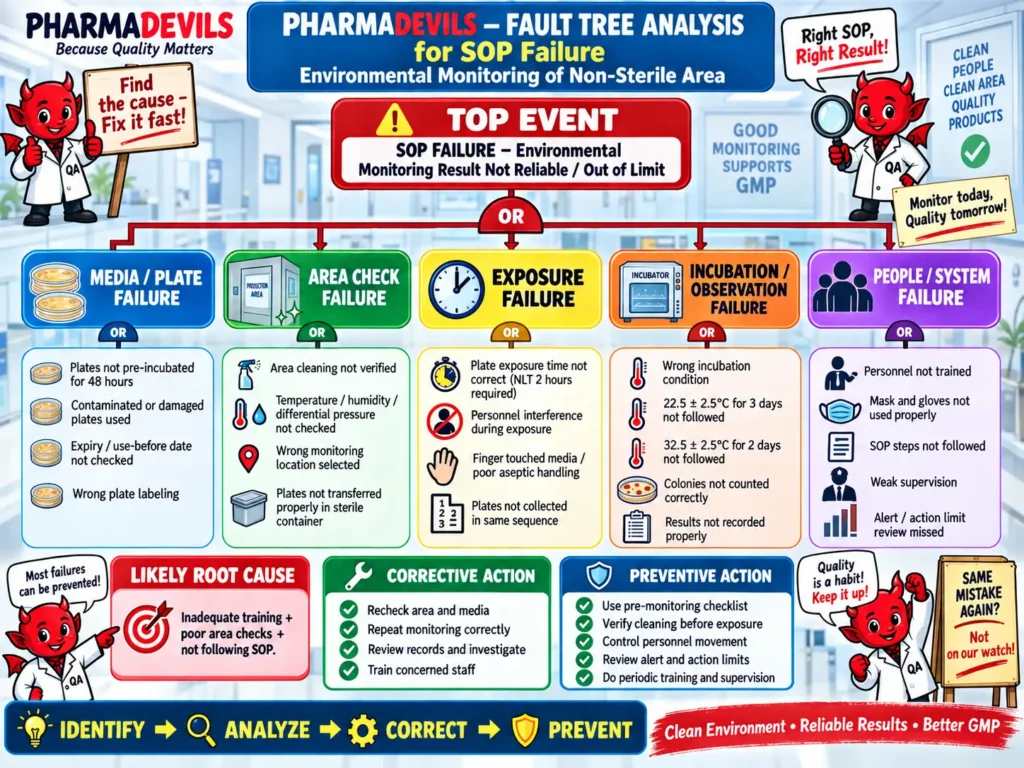
Potential causes include contaminated or damaged plates, failure to complete the required 48-hour pre-incubation, incorrect labeling, unverified area cleaning, unsuitable environmental conditions, improper plate exposure, personnel interference, incorrect incubation, inaccurate colony counting, incomplete records, insufficient training, and failure to follow SOP requirements. The SOP specifically requires pre-incubated plates, verification of cleaning and environmental conditions, careful plate handling, controlled exposure, specified incubation conditions, colony counting, and investigation when limits are exceeded.The diagram also highlights root cause identification, corrective action, preventive action, training, supervision, and checklist-based controls to reduce recurrence and strengthen GMP compliance.
Questions & Answers – Environmental Monitoring of Non-Sterile Area
- Q: What is the objective of this SOP?
A: To describe the environmental monitoring system for maintaining cleanroom conditions and controlled environmental areas used for non-sterile product manufacturing and the microbiology section. - Q: Where is this SOP applicable?
A: It is applicable to the Production and Microbiology departments. - Q: Who is responsible for execution of the SOP?
A: The Microbiologist is responsible for execution of the SOP. - Q: Who is responsible for effective implementation of the SOP?
A: The Lab QA Manager and Head-QA/QC are responsible for effective implementation. - Q: Which microbiological medium is used for environmental monitoring?
A: Soyabean Casein Digest Agar is used. - Q: How long should plates be pre-incubated before use?
A: The plates should be pre-incubated for 48 hours (2 days) before use. - Q: What should be checked after pre-incubation?
A: Plates should be checked for microbial contamination and physical integrity of the solid media. - Q: What area conditions should be checked before monitoring?
A: Cleaning status, temperature, humidity, and differential pressure should be verified, where applicable. - Q: What PPE is required while handling monitoring plates?
A: The operator should wear a mask and gloves before handling the plates. - Q: What precautions should be followed during plate exposure?
A: Personnel interference should be avoided, fingers must not touch the media surface, and personnel should not lean over the plates during exposure or collection. - Q: Which method is used for passive air monitoring?
A: The settle plate method is used for passive air sampling. - Q: For how long should settle plates be exposed?
A: Plates should be exposed at the specified locations for NLT 2 hours. - Q: How should exposed plates be collected?
A: Plates should be closed after exposure, collected in the same sequence in which they were exposed, wrapped in aluminium foil, and transferred to the microbiology laboratory. - Q: What are the incubation conditions for exposed plates?
A: Plates are incubated in inverted position at 22.5 ± 2.5°C for 3 days and 32.5 ± 2.5°C for 2 days. - Q: How are colonies evaluated after incubation?
A: Colonies are observed and counted using a colony counter or light source with the help of a marker, and the observations are recorded in the specified format. - Q: What action is required when microbial counts exceed specified limits?
A: The results should be investigated and necessary action taken as per SOP. - Q: What is the monitoring frequency for the liquid section?
A: Environmental monitoring is performed twice in a month for the liquid section. - Q: What is the monitoring frequency for other sections?
A: Environmental monitoring is performed once in a month for other sections. - Q: What are the alert and action limits for Class C (ISO 07)?
A: The alert limit is 11 CFU/2 hours, the action limit is 22 CFU/2 hours, and the stated limit is 25 CFU/2 hours. - Q: What annexures are included in the SOP?
A: The SOP contains Annexure-I for environmental monitoring by plate count, Annexure-II for monitoring areas, Annexure-III for plate exposure locations, and Annexure-IV for environmental monitoring layouts.