







Brief Description
This SOP describes the procedure for carrying out fumigation in different areas of the pharmaceutical plant to maintain proper environmental cleanliness. The procedure is the responsibility of the Microbiologist, Assistant Manager–QC, and Head QA/QC. Before fumigation, activities are stopped and systems such as LAF, AHU, and lights are switched off. Personnel must wear suitable safety goggles and gloves while preparing the fumigation solution. Fumigation is started from the aseptic area and completed toward the airlock, while ensuring all connecting and external doors remain tightly closed. The SOP covers manufacturing, dispensing, sampling, storage, packing, quarantine, and microbiology laboratory areas. After fumigation, the area is kept closed overnight and cleaned before activities restart. The AHU is switched on one hour before operation. Fumigation is scheduled once every seven days ± three days, and all activities are documented in the fumigation record. The SOP also includes a record for preparation of 20% v/v Silvicide solution and a fumigation record format.
Skip to PDF content1. Flow Diagram:
The flow diagram presents the complete fumigation process in a simple step-by-step sequence. It begins with planning fumigation according to the defined schedule, followed by stopping all activities and switching off the LAF, AHU system, and lights. Personnel then prepare the required fumigation solution while wearing appropriate safety goggles and gloves. All connecting and outer doors are closed properly before starting the process. Fumigation is carried out from the aseptic area toward the airlock as specified in the SOP.
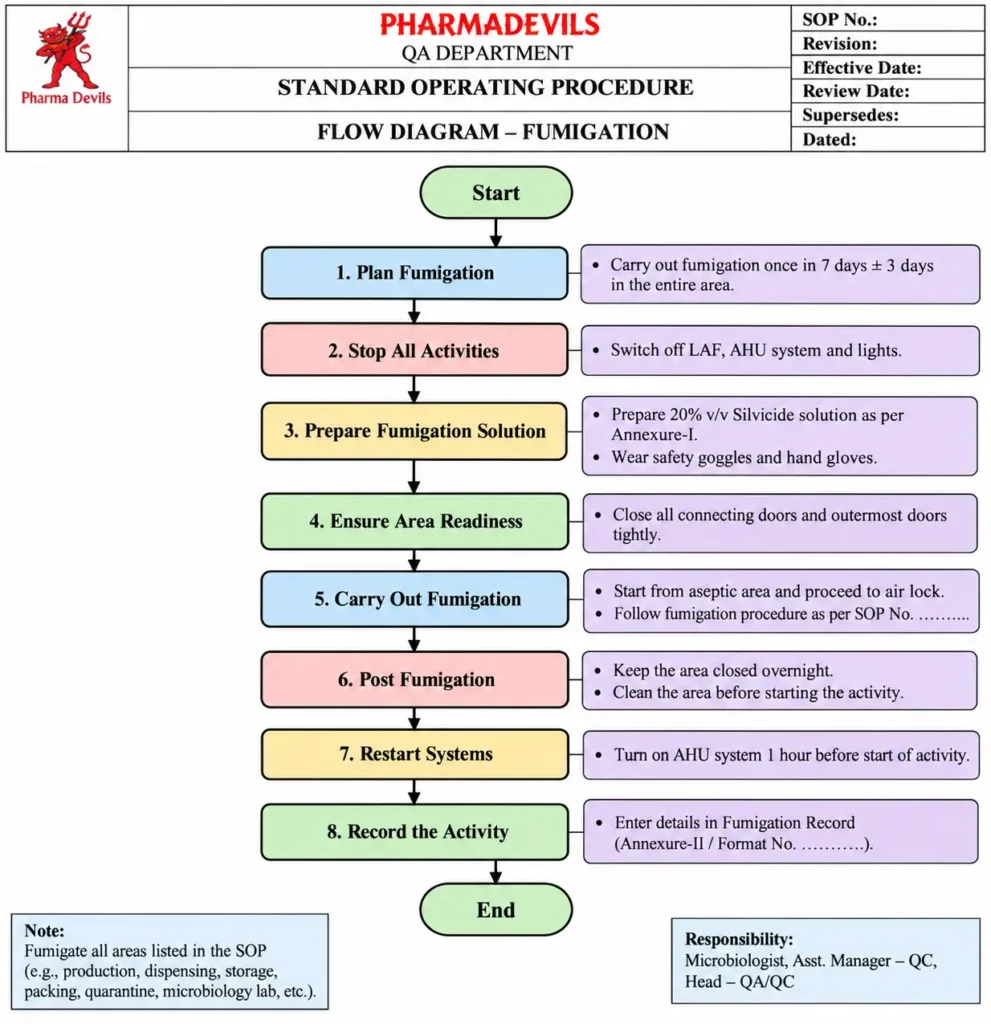
After fumigation, the area is kept closed overnight and cleaned before routine work is resumed. The AHU system is switched on one hour before starting activities. Finally, all fumigation details are documented in the prescribed fumigation record. The flow diagram also highlights the responsibility of the Microbiologist, Assistant Manager–QC, and Head QA/QC for proper execution and control of the process.
2. Brainstorming for SOP Failure:
The brainstorming diagram visually presents the possible causes of fumigation SOP failure at a PharmaDevils pharmaceutical facility. A PharmaDevils gate and devil mascot are used as the central theme, while colored sticky notes highlight potential compliance gaps. Key failure causes include inadequate personnel training, failure to switch off the LAF, AHU and lights, improper preparation of fumigation solution, incorrect solution concentration, non-use of safety goggles and gloves, doors not being properly closed, and following the wrong fumigation sequence. These points directly relate to the SOP requirements for preparation, safety and area control.
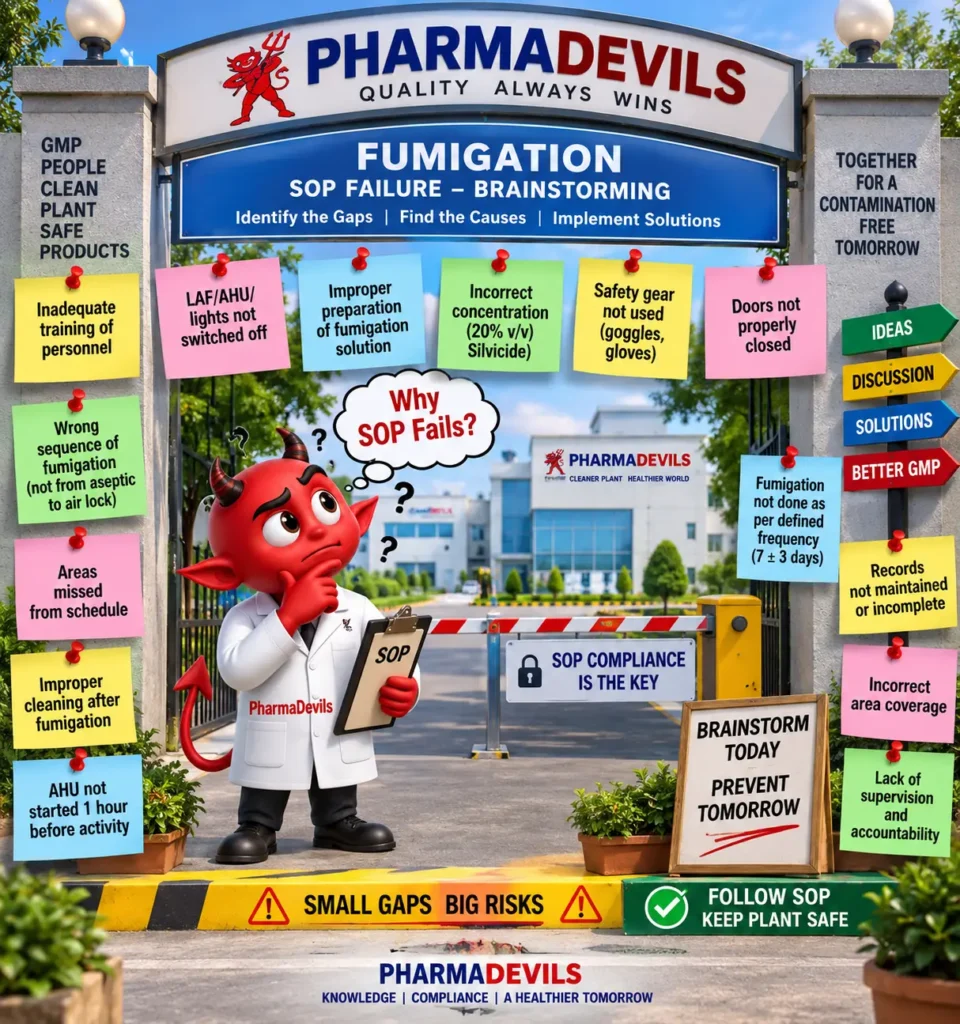
The diagram also highlights missed areas, improper post-fumigation cleaning, failure to restart the AHU one hour before activity, incorrect fumigation frequency, incomplete records, inadequate area coverage and poor supervision. The brainstorming concept helps teams identify weaknesses, discuss root causes and develop corrective actions to improve SOP compliance and contamination control.
3. 5-Why for SOP Failure:
The 5-Why diagram explains the root cause of fumigation SOP failure in a simple step-by-step manner using a College of Pharmacy and PharmaDevils theme. It begins with the main problem: fumigation failure, which may increase contamination risk or result in incomplete area fumigation. The analysis then asks why the failure occurred and traces the causes through improper execution of the defined fumigation procedure, failure to switch off the AHU/LAF/lights, improperly closed doors, and lack of awareness about the correct fumigation sequence. These requirements are stated in the SOP procedure.
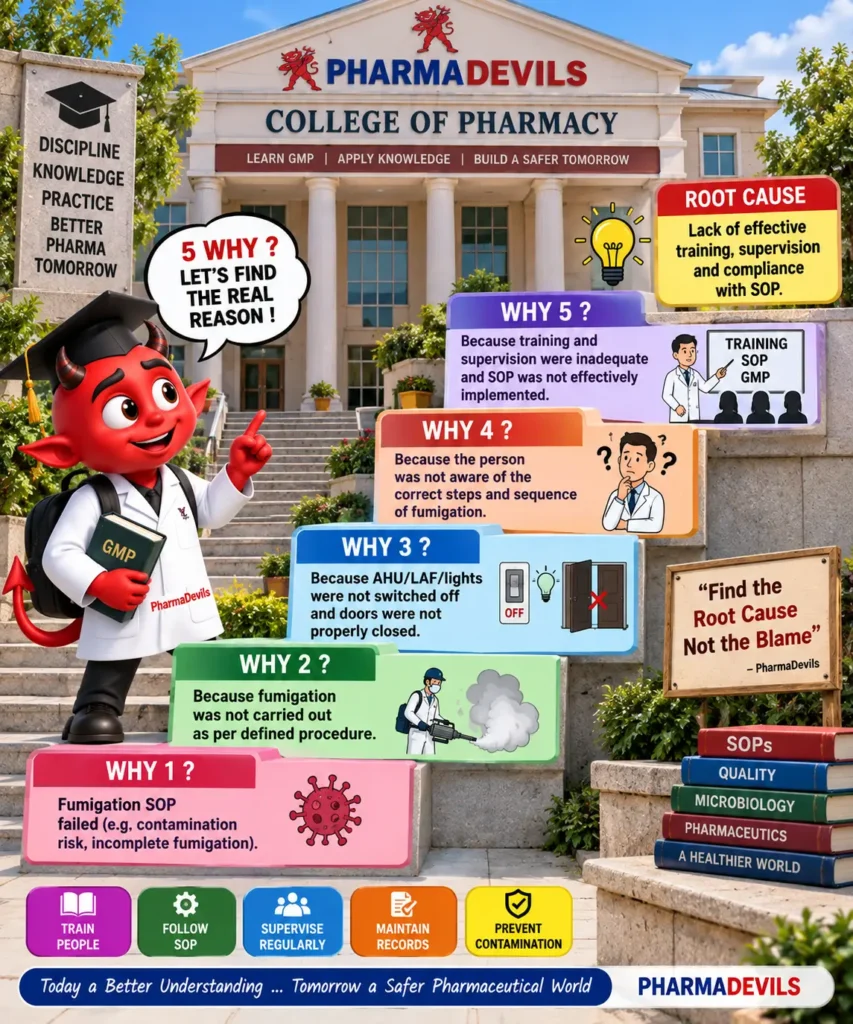
The final level identifies inadequate training, supervision, and SOP implementation as the root cause. The diagram also highlights corrective actions such as proper training, strict SOP compliance, regular supervision, complete record maintenance, and contamination prevention. This approach helps personnel understand that the purpose of 5-Why analysis is to identify the true root cause rather than assign blame.
4. Fishbone Analysis for SOP Failure:
The Fishbone Diagram presents a structured root-cause analysis of fumigation SOP failure using a PharmaDevils chemist/pharmacy theme. Potential causes are organized under major categories such as Man (People), Machine (Equipment), Method (Procedure), Material (Chemicals), Measurement (Monitoring), Environment, and Management. Examples highlighted include inadequate training, failure to follow the SOP, incorrect fumigation sequence, non-use of safety goggles and gloves, LAF/AHU not being switched off, improper Silvicide solution preparation, incomplete records, poor supervision, and inadequate verification of fumigation activities.
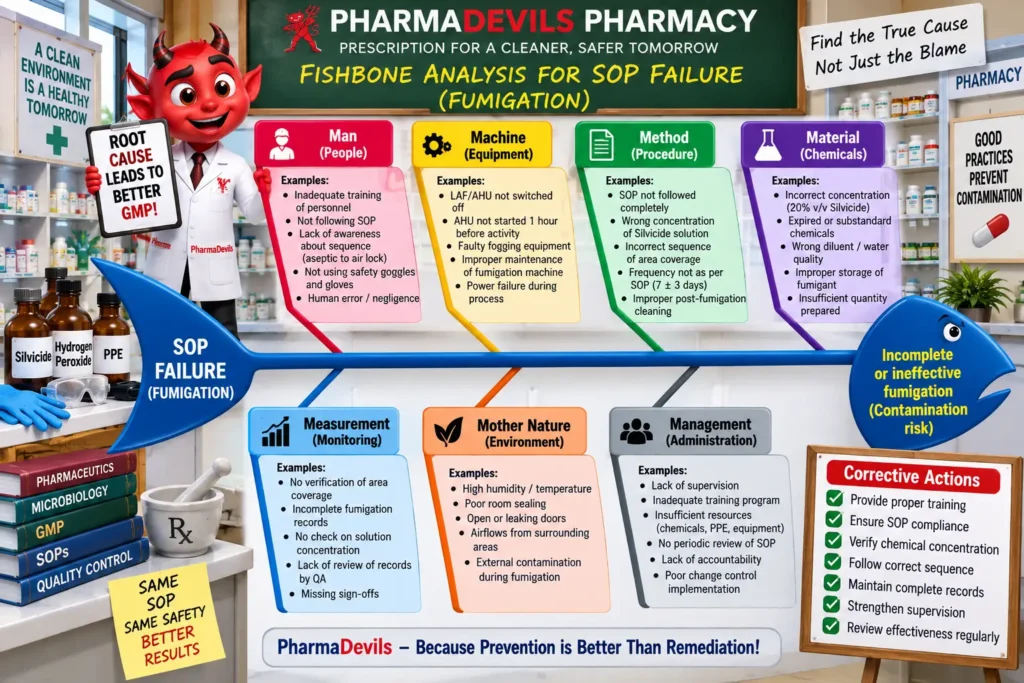
These causes relate directly to key SOP requirements such as switching off LAF/AHU and lights, using appropriate PPE, keeping doors tightly closed, and carrying out fumigation from the aseptic area toward the airlock.The diagram helps teams systematically identify contributing factors, determine the most probable root causes, and establish corrective actions such as improved training, stronger supervision, correct solution preparation, complete documentation, and strict SOP compliance.
5. Fault Tree Analysis for SOP Failure:
The Fault Tree Analysis diagram illustrates how different failures can lead to the top event: Fumigation SOP Failure, creating a risk of ineffective fumigation and possible contamination. The analysis groups the causes into major branches such as Personnel Failure, Procedure Failure, Chemical/Solution Failure, System/Equipment Failure, Documentation/Monitoring Failure, and Management/Supervision Failure.
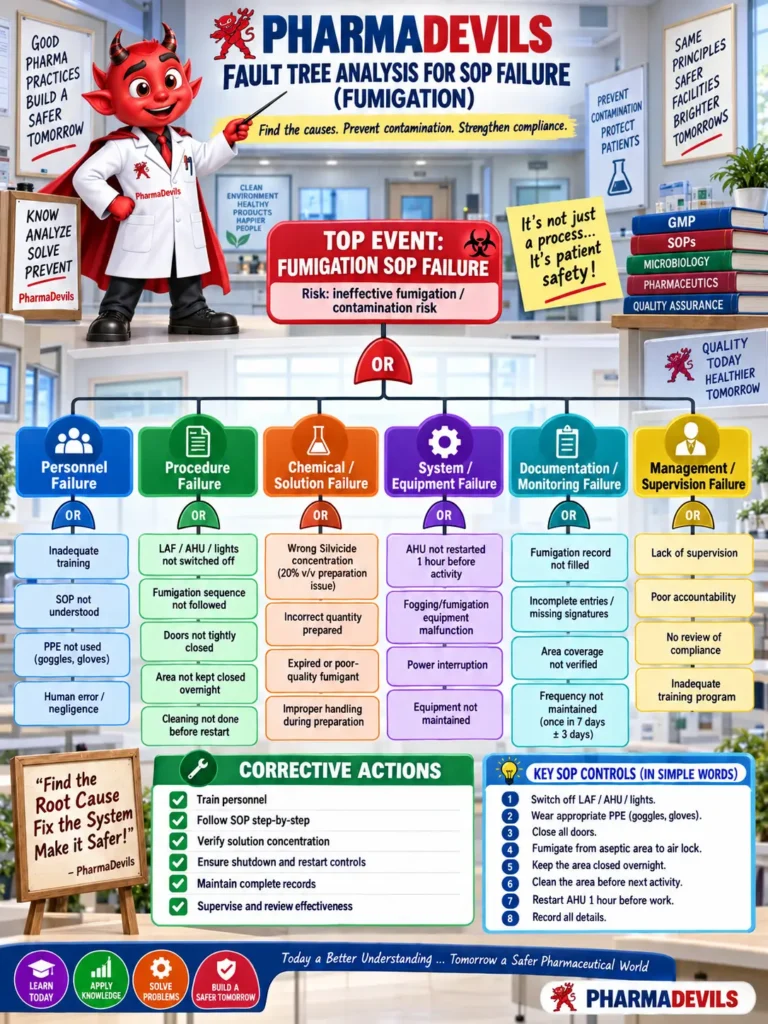
Examples include inadequate training, failure to understand the SOP, non-use of PPE, incorrect fumigation sequence, LAF/AHU/lights not being switched off, doors not being tightly closed, improper Silvicide concentration, equipment malfunction, incomplete fumigation records, and lack of supervision. These points are consistent with the SOP requirements for shutdown, PPE use, proper sequence, door closure, post-fumigation cleaning, AHU restart, and recordkeeping.The diagram helps identify both immediate and underlying causes so that corrective actions can be focused on training, supervision, equipment control, proper solution preparation, documentation, and strict SOP compliance.
Question & Answer – SOP for Fumigation
Q1. What is the objective of the fumigation SOP?
Answer: To define the procedure for carrying out fumigation in the pharmaceutical plant.
Q2. Who is responsible for fumigation activities?
Answer: Microbiologist, Assistant Manager–QC, and Head QA/QC.
Q3. What should be switched off before fumigation?
Answer: LAF, AHU system, and lights should be switched off.
Q4. From where should fumigation start?
Answer: Fumigation should start from the aseptic area and proceed toward the airlock.
Q5. What PPE should be worn during solution preparation?
Answer: Proper safety goggles and hand gloves should be worn.
Q6. What should be ensured regarding doors?
Answer: Connecting doors and the outermost door should be tightly closed.
Q7. What should be done after fumigation?
Answer: The area should be kept closed overnight and cleaned before starting activity.
Q8. When should the AHU be restarted?
Answer: The AHU should be switched on one hour before starting activity.
Q9. How frequently should fumigation be performed?
Answer: Once every 7 days ± 3 days in the entire area.
Q10. Where should fumigation details be recorded?
Answer: Details should be entered in the prescribed fumigation record format.
Q11. Who provides training for this SOP?
Answer: Head QA/QC provides training to personnel of the concerned department.
Q12. What is the training duration?
Answer: One hour.
Q13. What is Annexure-I?
Answer: Annexure-I is the record for preparation of 20% v/v Silvicide solution.
Q14. What is Annexure-II?
Answer: Annexure-II is the Fumigation Record used to document fumigation and post-fumigation activities.
Q15. What fumigant is mentioned in the record?
Answer: Silvicide containing 0.01% w/v Silver Nitrate and 10% w/v Hydrogen Peroxide is mentioned.