





Brief Description
This Standard Operating Procedure describes the method for Growth Promotion Testing (GPT) of culture media used in the microbiology laboratory. Its purpose is to verify that prepared or newly received media can support the growth of specified microorganisms and, where applicable, demonstrate proper inhibitory and indicative properties.The SOP covers inoculum preparation, including preparation of stock microbial suspensions, serial dilution, colony counting, and selection of an appropriate dilution containing approximately the required CFU. New media packs are tested for growth-promotion, inhibition, and indicative characteristics as applicable, while prepared media lots are routinely qualified using suitable microbial cultures.Testing procedures are defined for liquid broth and solid agar media, including inoculation, negative controls, incubation, observation, colony counting, percentage recovery, and acceptance criteria. Media is released only after satisfactory GPT results. The SOP also specifies precautions for aseptic handling, media storage, temperature control, spill management, documentation, and recording of GPT results through dedicated annexures.
Skip to PDF content1. Flow Diagram:
The flow diagram for Growth Promotion Testing (GPT) of Culture Media presents the systematic sequence used to confirm that microbiological media are suitable for routine laboratory testing. The process starts with preparation of the microbial inoculum from maintained cultures, followed by serial dilution to obtain an appropriate challenge concentration, generally not more than 100 CFU for growth-promotion testing.
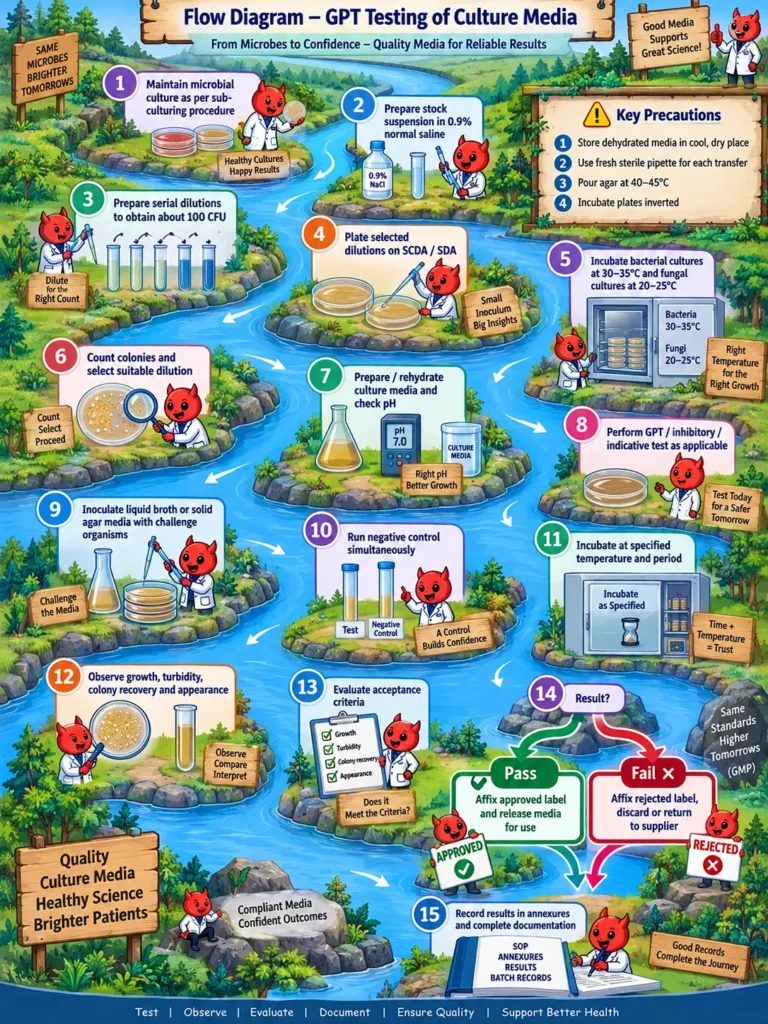
The prepared culture media are then subjected to applicable growth-promoting, growth-inhibitory and indicative property tests. Liquid or solid media are inoculated with the specified challenge organisms, while a negative control is tested simultaneously to verify test conditions. After incubation at the specified temperature and period, growth, turbidity, colony count, recovery, or inhibition is evaluated against the defined acceptance criteria.If the media meet the acceptance criteria, an approved label is affixed and the media are released for analysis. Failed media are labeled rejected and discarded or returned to the supplier. Test results are documented in the prescribed GPT record.
2. Brainstorming for SOP Failure:
The Brainstorming for SOP Failure diagram identifies major factors that can cause failure in following or implementing a Standard Operating Procedure. The central “SOP Failure Devil” represents the overall risk, while the surrounding sections highlight different potential causes. Documentation-related issues include use of outdated SOPs, incomplete records, missing signatures and poor review. People-related causes include inadequate training, lack of understanding, carelessness, time pressure and complacency. Equipment factors include malfunction, improper maintenance, calibration failure and incorrect settings.
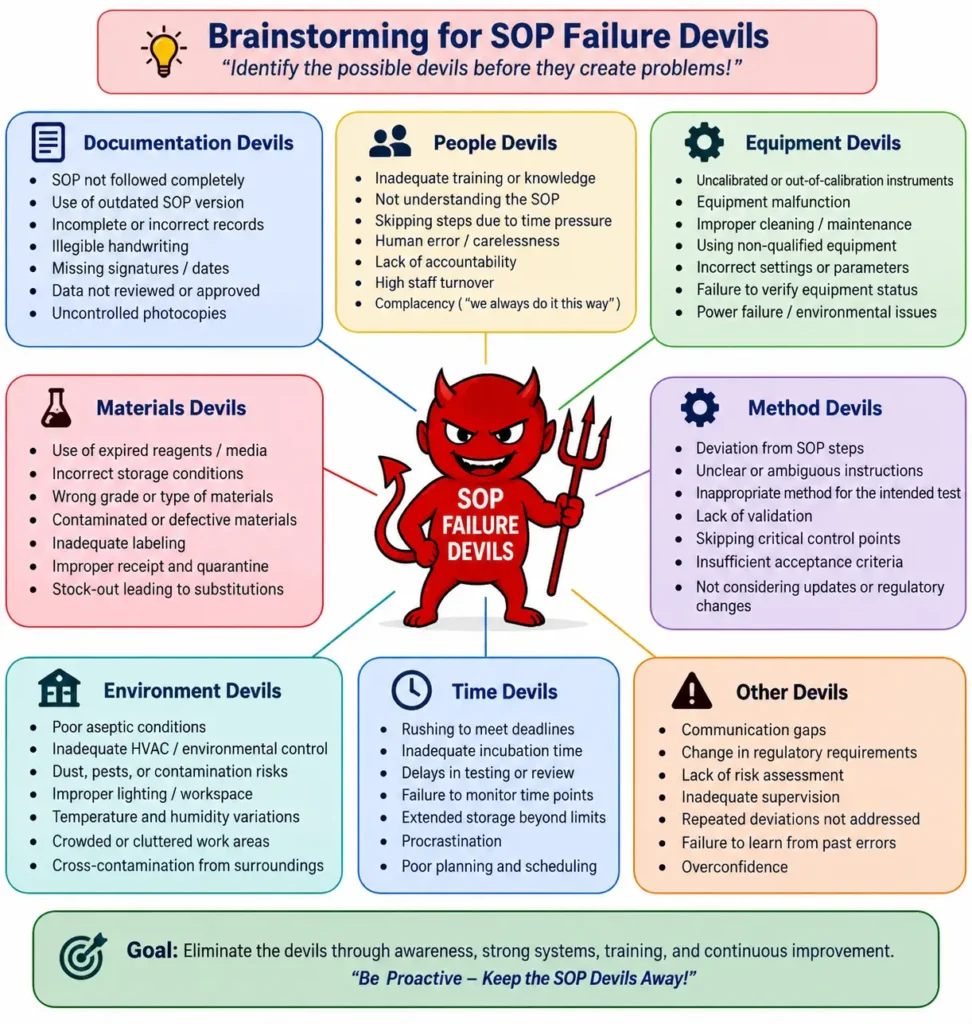
Material-related issues may involve expired reagents, wrong materials, contamination or improper storage. Method failures include unclear instructions, deviation from approved steps and insufficient controls. Environmental conditions such as poor HVAC, contamination and unsuitable working conditions can also contribute. Time pressure, communication gaps, weak supervision and inadequate risk assessment further increase the possibility of SOP failure. The brainstorming exercise helps identify these risks early so that suitable training, controls, monitoring and corrective actions can be implemented.
3. 5-Why Analysis for SOP Failure:
The 5-Why Analysis for SOP Failure diagram uses a sun-and-devils theme to trace the problem from the visible symptom to its underlying root cause. The analysis starts with the observation that the SOP was not followed correctly, leading to process or test failure. It then asks why the procedure was not performed properly, identifying skipped or incorrectly executed critical steps. The next level points to inadequate understanding or training of the operator. Further questioning shows that training effectiveness and practical competency were not properly evaluated before independent work. The final “Why” identifies weakness in the SOP implementation system, particularly insufficient controls for training effectiveness, supervision, competency verification, and periodic compliance monitoring.
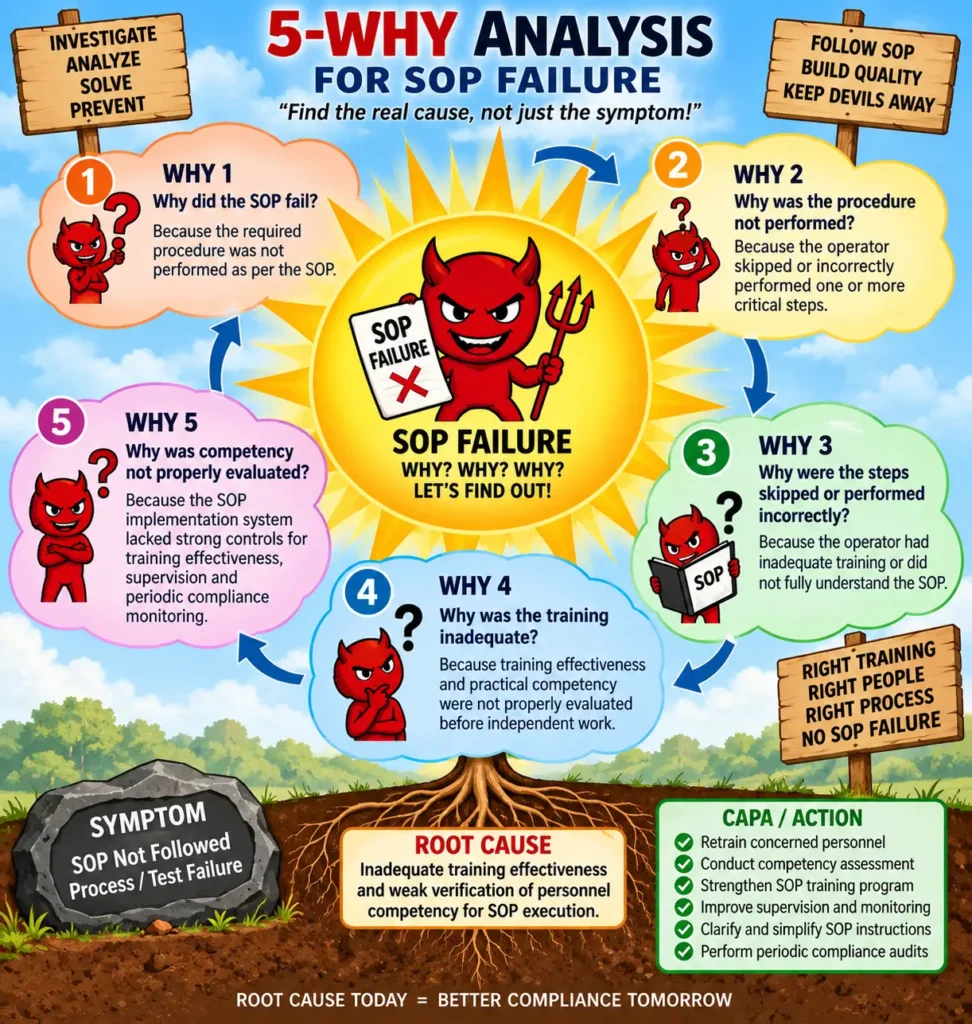
The diagram concludes that the probable root cause is inadequate training effectiveness and weak verification of personnel competency. Recommended CAPA includes retraining, competency assessment, stronger supervision, clearer SOP instructions, improved training controls, and periodic compliance audits.
4. Fishbone Analysis for SOP Failure:
The Fishbone Analysis for SOP Failure diagram presents the possible root causes of SOP failure in a clear cause-and-effect format, designed with a tree-shaped fishbone structure and devils theme. The head of the fish represents the main problem, “SOP Failure,” while the branches identify the major contributing categories. These include People, Method, Machine/Equipment, Materials, Environment, and Documentation/Measurement.
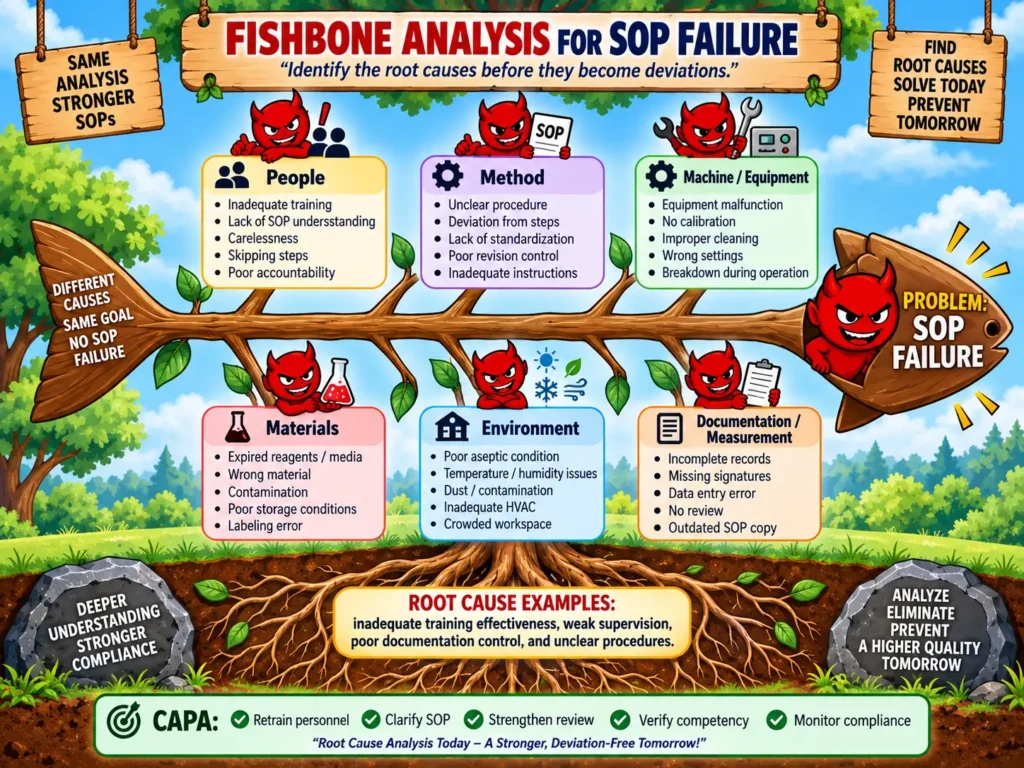
Each branch lists common causes that can lead to SOP non-compliance or process deviation. For example, people-related issues include inadequate training, carelessness, and poor accountability. Method-related causes include unclear procedures, deviation from steps, and lack of standardization. Equipment issues include malfunction, lack of calibration, and wrong settings. Material factors include expired media or reagents, contamination, and poor storage conditions. Environmental causes involve poor aseptic conditions, inadequate HVAC, and dust or contamination risks. Documentation/measurement issues include incomplete records, missing signatures, data entry errors, and outdated SOP copies.The root section highlights that the main underlying causes often include poor training effectiveness, weak supervision, poor documentation control, and unclear procedures. The diagram also suggests CAPA actions such as retraining personnel, clarifying SOPs, strengthening review, verifying competency, and monitoring compliance.
5. Fault Tree Analysis for SOP Failure:
The Fault Tree Analysis (FTA) for SOP Failure diagram shows how different failures in a pharmaceutical manufacturing area can combine and lead to the top event, “SOP Failure.” The analysis divides the possible causes into major branches such as Personnel, SOP/Method, Equipment, Material, Environment, and Management/System failures.
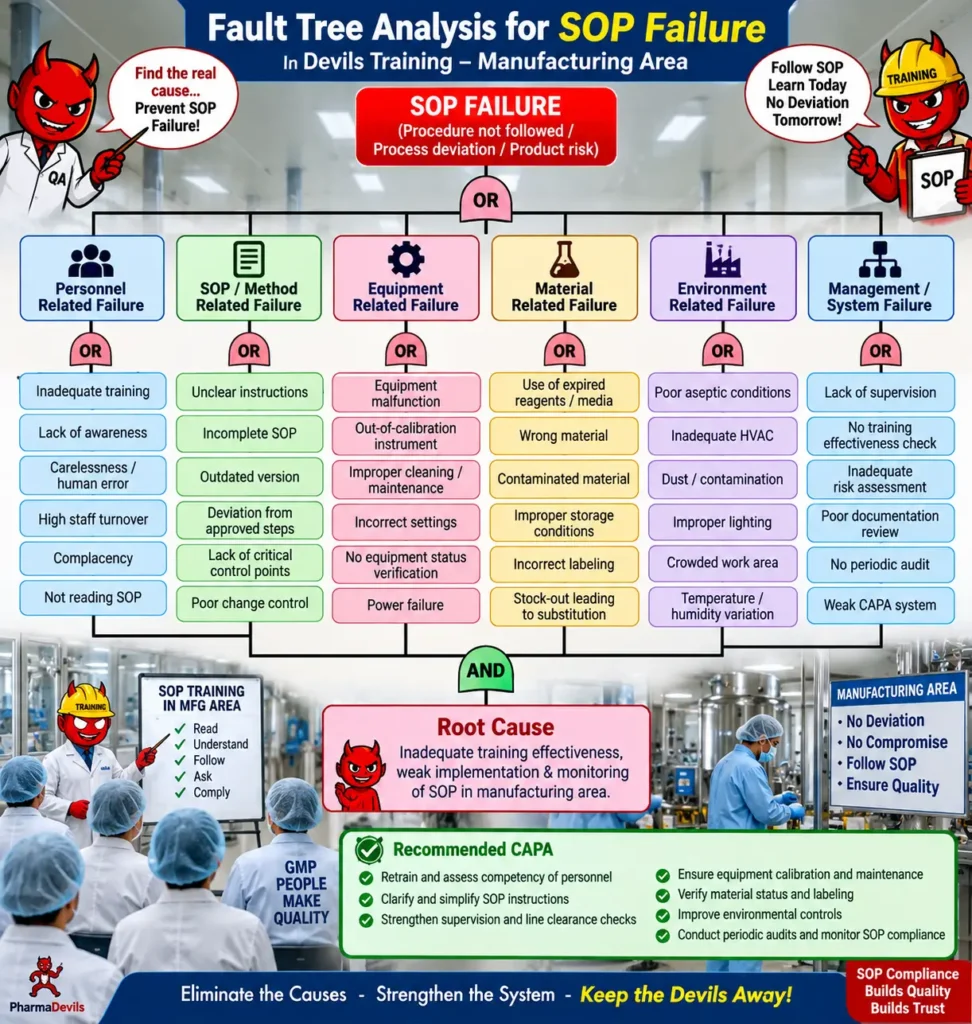
Personnel-related causes include inadequate training, lack of awareness, human error, complacency, and failure to read or understand the SOP. Method-related causes include unclear instructions, outdated SOP versions, incomplete procedures, deviation from approved steps, and poor change control. Equipment failures may involve malfunction, calibration issues, incorrect settings, poor cleaning, or inadequate status verification. Material-related causes include expired or contaminated materials, improper storage, wrong labeling, and substitution risks. Environmental causes include poor aseptic conditions, inadequate HVAC, dust, temperature or humidity variation, and crowded work areas. Management/system causes include weak supervision, poor training-effectiveness checks, inadequate risk assessment, weak CAPA, and lack of periodic audits.The diagram identifies the main root cause as inadequate training effectiveness together with weak SOP implementation and monitoring. Recommended CAPA focuses on retraining and competency assessment, clearer SOP instructions, stronger supervision, equipment and material controls, environmental improvements, and regular compliance audits.
Questions & Answers – GPT Testing of Culture Media
- Q: What is the objective of the SOP for GPT testing of culture media?
A: To lay down a procedure for Growth Promotion Testing (GPT) of culture media. - Q: Who is responsible for performing GPT testing?
A: The Microbiologist is responsible for execution of the SOP, while the Sr. Executive QC/Manager QC is responsible for review and effective implementation. - Q: How is the stock microbial suspension prepared?
A: A loopful of culture from the slant is transferred into 9 mL of 0.9% normal saline solution to prepare the stock suspension. - Q: What may be added while preparing an Aspergillus niger spore suspension?
A: The SOP states that 0.05% Polysorbate 80 may be added to normal saline to help suspend the spores. - Q: What microbial concentration is selected for routine GPT use?
A: The dilution containing NMT 100 CFU/mL, or as required for routine use, is selected. - Q: What are the incubation conditions during inoculum preparation?
A: Bacterial cultures are incubated at 30–35°C for NLT 48 hours, while fungal cultures are incubated at 20–25°C for NLT 72 hours. - Q: When should a new pack of microbiological media be tested?
A: Every new pack of media should be tested for applicable growth promotion, inhibition, and indicative properties using the specified challenge organisms. - Q: When can microbiological media be released for use?
A: Media can be released only after obtaining satisfactory GPT results. - Q: How many CFU are used for growth-promotion testing?
A: For both solid and liquid media, the SOP specifies inoculation with not more than 100 CFU of the appropriate microorganism. - Q: What inoculum level is specified for growth-inhibitory testing?
A: The medium is inoculated with at least 100 CFU of the appropriate microorganism. - Q: Where should inoculation work be performed?
A: The SOP requires the LAF to be started as per procedure, and further work should be performed under Laminar Air Flow. - Q: Why is a negative control run during GPT?
A: A negative control is run to verify the testing conditions by using diluent instead of the test organism. - Q: What is the acceptance criterion for GPT of liquid broth media?
A: Satisfactory growth should be observed within the predefined incubation period. - Q: What is the acceptance criterion for the growth-inhibitory test?
A: There should be no growth in the growth-inhibitory test and the negative control. - Q: What action is taken when media passes GPT?
A: An approved label is affixed to the media container, and the media may then be used for analysis. - Q: What action is taken when media fails GPT?
A: A rejected label is affixed, and the media is rejected and either discarded or returned to the supplier. - Q: At what temperature should agar media be poured into Petri plates?
A: The cooled media should be poured at 40–45°C. - Q: How is microbial recovery calculated?
A:
% Recovery = (Mean CFU observed ÷ Inoculated CFU/mL) × 100. - Q: What is the acceptance criterion for recovery of challenge organisms?
A: Recovery of the challenge organism should be within a factor of 2 of the challenge CFU. - Q: What is the acceptance criterion for growth-indicative properties?
A: Colonies on the test media should be similar in appearance to those on previously approved media or as defined in Annexure II. - Q: How should GPT plates be incubated?
A: Plates should be incubated in an inverted position to prevent condensation from collecting on the agar surface. - Q: What should be done if culture is spilled?
A: The SOP specifies that culture spillage should be immediately cleaned with 70% IPA solution. - Q: What should be done if the medium does not support microbial growth?
A: The test should be repeated along with a passed lot of the same medium. If it fails again, the manufacturer should be informed and the medium returned. - Q: Where are GPT results recorded?
A: The results are recorded in Annexure I – Growth Promotion Test Record of Media. - Q: What is the main purpose of GPT testing?
A: GPT confirms that microbiological culture media have the required ability to promote, inhibit, or indicate microbial growth as applicable before the media are released for laboratory use.