







1. Brief Description:
This guideline provides a structured approach for validating analytical procedures used in the Quality Control Department. It defines key validation characteristics such as specificity, detection limit, quantitation limit, linearity, precision, accuracy, and robustness, and explains how each parameter should be evaluated. The document covers validation requirements for assay, preservative content, content uniformity, blend uniformity, related substances, and dissolution testing of drug products. It also describes studies for solution stability, filter compatibility, filter saturation, system suitability, repeatability, intermediate precision, recovery, forced degradation, and relative response factor where applicable. Separate expectations are provided for in-house and pharmacopoeial methods, including defined test conditions and acceptance criteria. Overall, the guideline ensures that analytical methods are scientifically evaluated for reliability, reproducibility, sensitivity, selectivity, and suitability for routine laboratory use, thereby supporting consistent and dependable quality-control results throughout pharmaceutical testing and product evaluation activities. It assigns responsibilities to validation analysts and the Head of Quality Control.
Skip to PDF content2. Flow Diagram for Analytical Method Validation:
The flow diagram presents a systematic sequence for performing Analytical Method Validation to demonstrate that an analytical procedure is suitable for its intended use. The process begins by defining the objective and scope, followed by selecting appropriate validation parameters and establishing predefined acceptance criteria. The guideline evaluates characteristics such as specificity, linearity, precision, accuracy, robustness, and other applicable parameters.
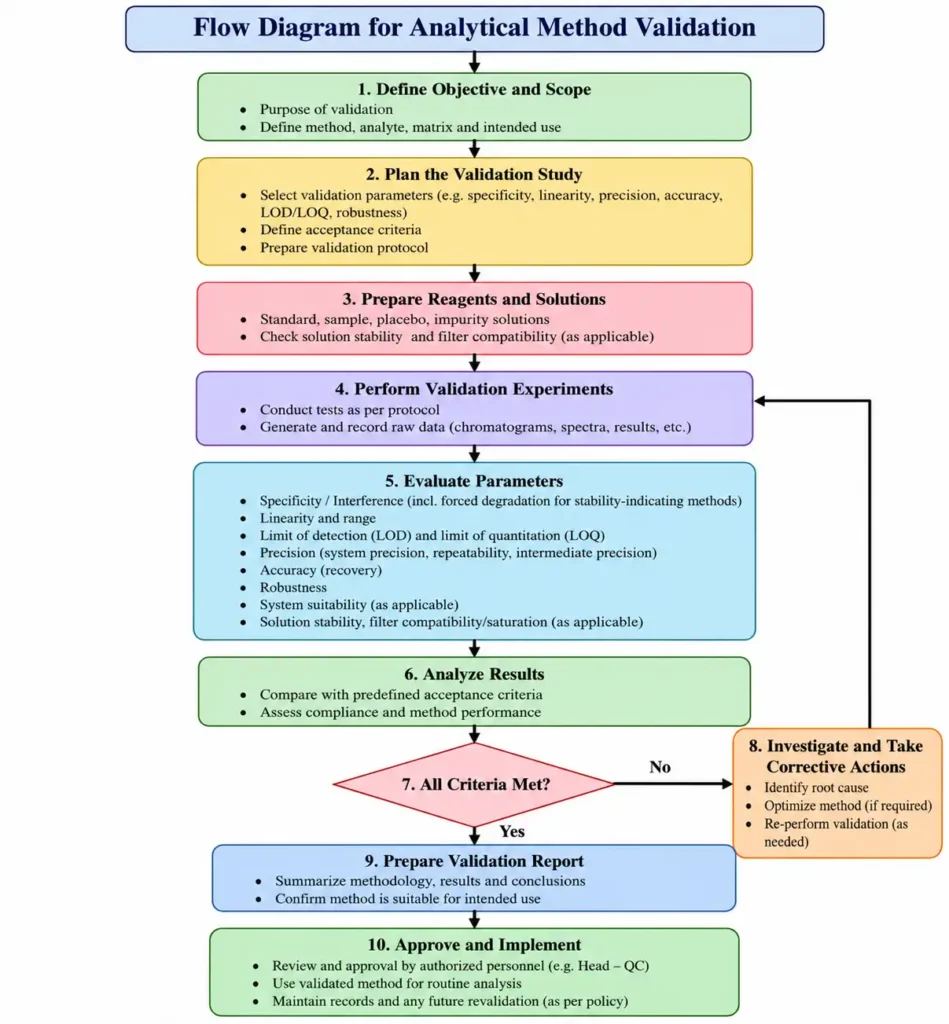
Standards, samples, placebo, impurity solutions, reagents, and other required preparations are then prepared before conducting validation experiments. Results are generated, documented, calculated, and compared against established acceptance criteria. System suitability is verified before applicable validation parameters to confirm proper analytical system performance. If any criterion fails, the cause is investigated, corrective actions are implemented, and the affected study may be repeated. When all requirements are satisfactorily met, results are compiled in the validation report, reviewed, approved, and the validated analytical method is released for routine Quality Control use.
3. Brainstorming for Analytical Method Validation Failure:
The brainstorming diagram is used to identify and organize possible causes responsible for the failure of Analytical Method Validation in the Quality Control laboratory. The validation guideline considers key characteristics such as specificity, detection and quantitation limits, linearity, precision, accuracy, and robustness while evaluating analytical procedures. The brainstorming exercise expands these technical parameters into practical failure causes such as poor specificity, low accuracy, poor precision, linearity failure, robustness problems, solution instability, filter compatibility and saturation issues, system suitability failure, instrument calibration errors, analyst mistakes, and incorrect sample preparation.
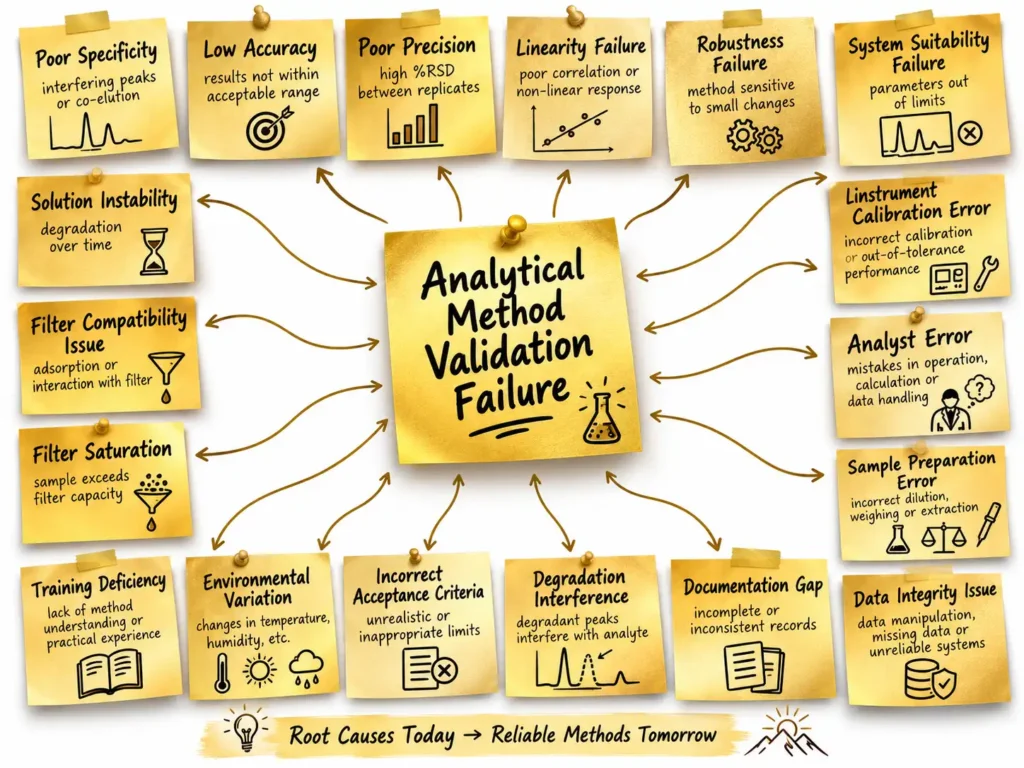
It also considers supporting causes including inadequate training, unsuitable acceptance criteria, environmental variation, degradation interference, documentation gaps, and data integrity problems. By collecting these ideas on sticky notes, the team can visually compare potential causes, discuss their significance, and prioritize areas for further investigation. This supports systematic root-cause analysis, corrective actions, and improvement of analytical method reliability.
4. 5 Why Analysis for Analytical Method Validation Failure:
The 5 Why analysis helps identify the underlying root cause of an Analytical Method Validation failure by repeatedly asking why the validation did not meet predefined requirements. The investigation begins when one or more validation parameters, such as specificity, linearity, precision, accuracy, robustness, or system suitability, fail to comply with acceptance criteria. These characteristics are key elements of analytical method validation.
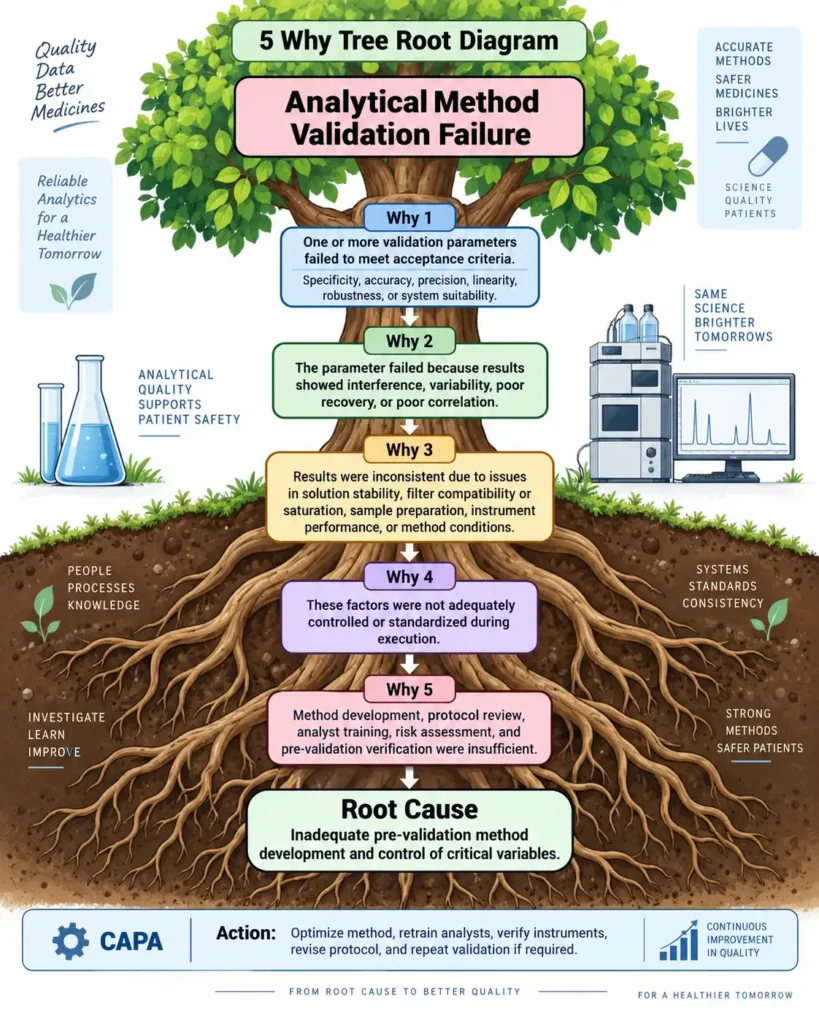
The analysis then explores possible reasons such as interference, poor recovery, excessive variability, weak correlation, solution instability, filter compatibility or saturation problems, sample-preparation errors, instrument performance issues, or unsuitable analytical conditions. Further questioning may identify inadequate standardization, insufficient analyst training, incomplete method development, weak protocol review, or inadequate pre-validation verification. System suitability is also expected to comply with the analytical methodology before applicable validation parameters are performed. The final root cause guides suitable CAPA, including method optimization, analyst retraining, instrument verification, protocol improvement, and repetition of affected validation studies.
5. Heat Map for Analytical Method Validation Failure:
The Heat Map for Analytical Method Validation Failure is a risk-assessment tool used to identify, classify, and prioritize potential causes that may affect the reliability of an analytical method. It evaluates each failure based on likelihood of occurrence and severity of impact, placing the risk within low, moderate, high, or critical zones. The validation guideline considers important characteristics such as specificity, detection and quantitation limits, linearity, precision, accuracy, and robustness.
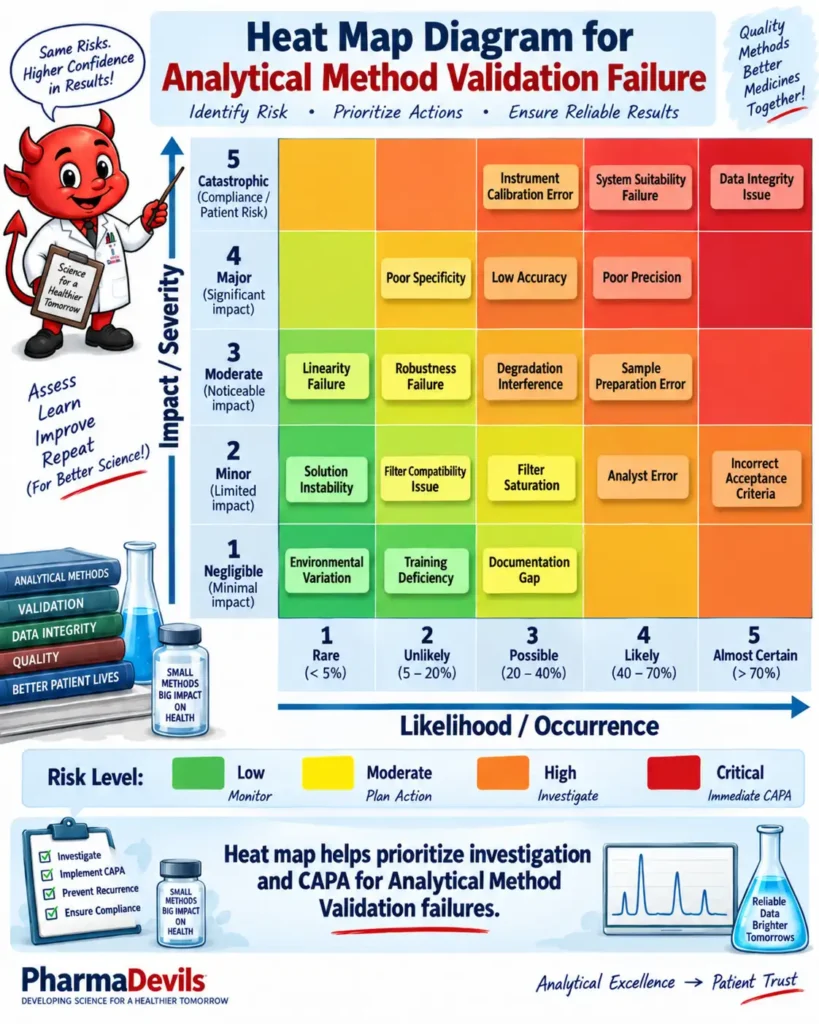
Potential failures shown in the heat map include poor specificity, low accuracy, poor precision, linearity and robustness failures, solution instability, filter problems, sample-preparation errors, instrument calibration issues, system-suitability failure, documentation gaps, and data-integrity concerns. Critical and high-risk items require priority investigation and appropriate CAPA, while moderate and low risks may be controlled through monitoring and preventive measures.
Questions & Answers – Analytical Method Validation
- Q: What is the objective of Analytical Method Validation?
A: The objective is to establish the characteristics required for validation of an analytical procedure, define how they are determined, and specify applicable acceptance criteria. - Q: What is the scope of this guideline?
A: It applies to all analytical method validations carried out in the Quality Control Department. - Q: Who is responsible for Analytical Method Validation?
A: Analysts of the validation group and the Head of Quality Control are responsible. - Q: What is specificity?
A: Specificity is the ability of an analytical method to assess the analyte unequivocally in the presence of other components expected in the sample. - Q: What is the Limit of Detection (LOD)?
A: LOD is the lowest amount of analyte that can be detected, although it may not necessarily be quantitatively determined. - Q: What is the Limit of Quantitation (LOQ)?
A: LOQ is the lowest amount of analyte that can be quantitatively determined with suitable precision and accuracy. - Q: What is linearity?
A: Linearity is the ability of an analytical procedure to produce results that are directly proportional to analyte concentration within a specified range. - Q: What is precision?
A: Precision expresses the closeness of agreement among a series of measurements obtained from multiple samplings of the same homogeneous sample. - Q: What is repeatability?
A: Repeatability is precision evaluated under the same operating conditions over a short interval of time and is also known as intra-assay precision. - Q: What is intermediate precision?
A: Intermediate precision evaluates variation within a laboratory, such as different days, analysts, and equipment. - Q: What is accuracy?
A: Accuracy is the closeness of agreement between the measured value and an accepted true or reference value. - Q: What is robustness?
A: Robustness is the ability of an analytical procedure to remain unaffected by small deliberate variations in method parameters during normal use. - Q: Which parameters are considered for an in-house assay method?
A: The guideline includes specificity, solution stability, filter compatibility, filter saturation, linearity and range, precision, accuracy, robustness, and system suitability. - Q: What is the acceptance criterion for assay linearity?
A: The correlation coefficient should be not less than 0.999. - Q: What is the acceptance criterion for system precision in assay validation?
A: Relative standard deviation should not be more than 2.0%, or as specified in the analytical method. - Q: How is repeatability evaluated for assay?
A: Six different sample solutions are prepared from the same homogeneous sample and analyzed by the same analyst, on the same equipment, and on the same day. - Q: What is the acceptance criterion for assay repeatability?
A: The RSD of assay or preservative-content results from six preparations should not be more than 2.0%. - Q: At what levels is assay accuracy evaluated?
A: Recovery solutions are prepared at 50%, 100%, and 150% of the target concentration. - Q: What is the acceptance criterion for assay recovery?
A: Individual recoveries should be 97.0%–103.0%, and mean recovery should be 98.0%–102.0%. - Q: What deliberate variations may be studied during robustness testing?
A: Applicable variations include changes in mobile-phase or buffer pH, mobile-phase composition, column-oven temperature, and flow rate. - Q: When should system suitability be performed?
A: System suitability should be performed before carrying out any applicable validation parameter and should comply with the methodology. - Q: What signal-to-noise ratios are specified for LOD and LOQ?
A: The guideline specifies approximately 3:1 for LOD and 10:1 for LOQ. - Q: What is the acceptance criterion for LOQ precision in related-substances validation?
A: The RSD of peak areas from six replicate injections at the LOQ level should not be more than 10.0%. - Q: What is the acceptance criterion for related-substances recovery?
A: Recovery should be between 80% and 120%. - Q: Why is Analytical Method Validation important?
A: It demonstrates that an analytical procedure performs reliably for its intended purpose by evaluating defined validation characteristics and acceptance criteria.