







1. Introduction – SOP for Handling and Control of Dies and Punches:
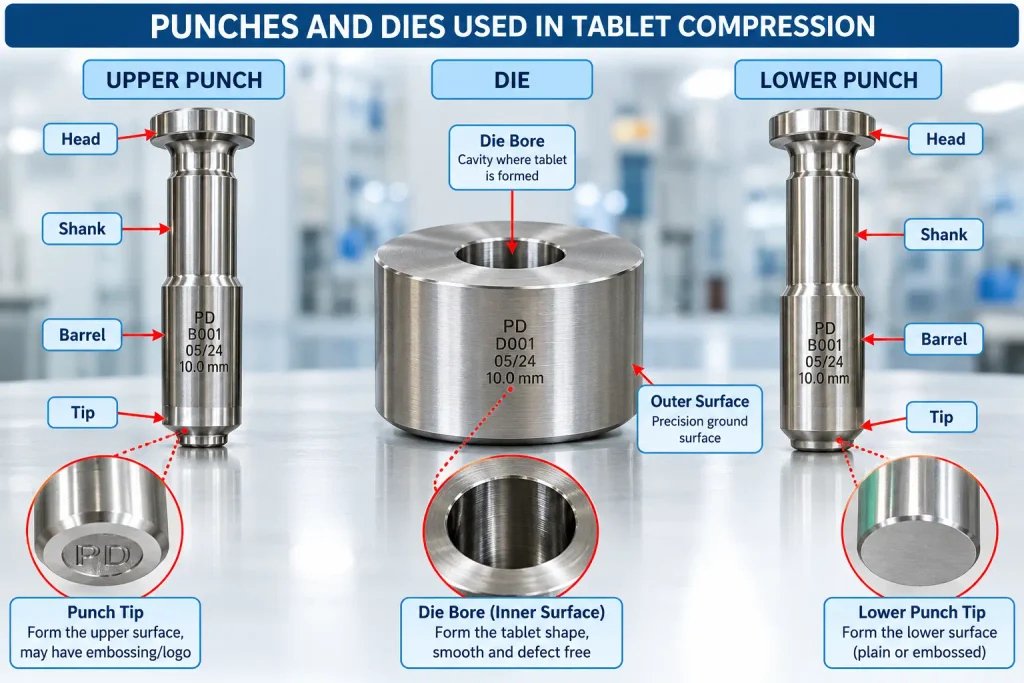
The SOP for Handling and Control of Dies and Punches establishes a systematic procedure for the proper receipt, identification, cleaning, inspection, issuance, retrieval, maintenance, polishing, storage, and disposal of punches and dies used in pharmaceutical tablet manufacturing. The procedure is intended to maintain tooling in suitable condition and support consistent tablet quality during compression operations. Proper control of punches and dies is important because damaged, worn, corroded, improperly cleaned, or incorrectly issued tooling can contribute to tablet defects and compression problems. The SOP defines requirements for inspection of punch dimensions, surface condition, concentricity, embossing, die condition, and overall tooling suitability. It also includes requirements for cleaning, lubrication, storage, usage recording, polishing, and controlled destruction of defective or expired tooling. Following this SOP helps ensure tooling integrity, traceability, controlled usage, proper maintenance, prevention of mix-ups, and reliable tablet compression performance throughout the lifecycle of dies and punches.
Skip to PDF content2. SOP for Handling and Control of Dies and Punches:
The SOP for Handling and Control of Dies and Punches describes a controlled system for managing punches and dies throughout their complete lifecycle in pharmaceutical tablet manufacturing. The procedure covers procurement, receipt, identification, cleaning, inspection, polishing, issuance, retrieval, maintenance, storage, and disposal of tooling. New punches and dies are checked against approved specifications, dimensions, appearance, damage, and identification details before use. Used tooling is cleaned before and after machine use, inspected for cracks, chipping, surface defects, wear, and dimensional conformity, and lubricated with food-grade oil before storage.
The flow also includes periodic inspection of punch tip diameter, concentricity, overall length, embossing, die dimensions, surface condition, and suitability for continued use. Polishing is carried out whenever burrs, roughness, blackening, sticking, corrosion, or wear are observed. Proper issuance, retrieval, usage recording, lubrication, storage, and controlled destruction of defective or life-expired tooling help maintain traceability, prevent mix-ups, minimize tablet defects, and ensure reliable compression performance.
3. Benefits of Following SOP for Handling and Control of Dies and Punches:
The SOP for Handling and Control of Dies and Punches provides important benefits for maintaining tooling integrity, product quality, traceability, and reliable tablet compression operations. Proper implementation ensures that punches and dies are systematically cleaned, inspected, lubricated, polished, issued, retrieved, maintained, stored, and disposed of according to defined requirements. The SOP requires inspection of punches and dies for dimensional accuracy, surface condition, cracks, chipping, wear, concentricity, embossing, and other defects before continued use.
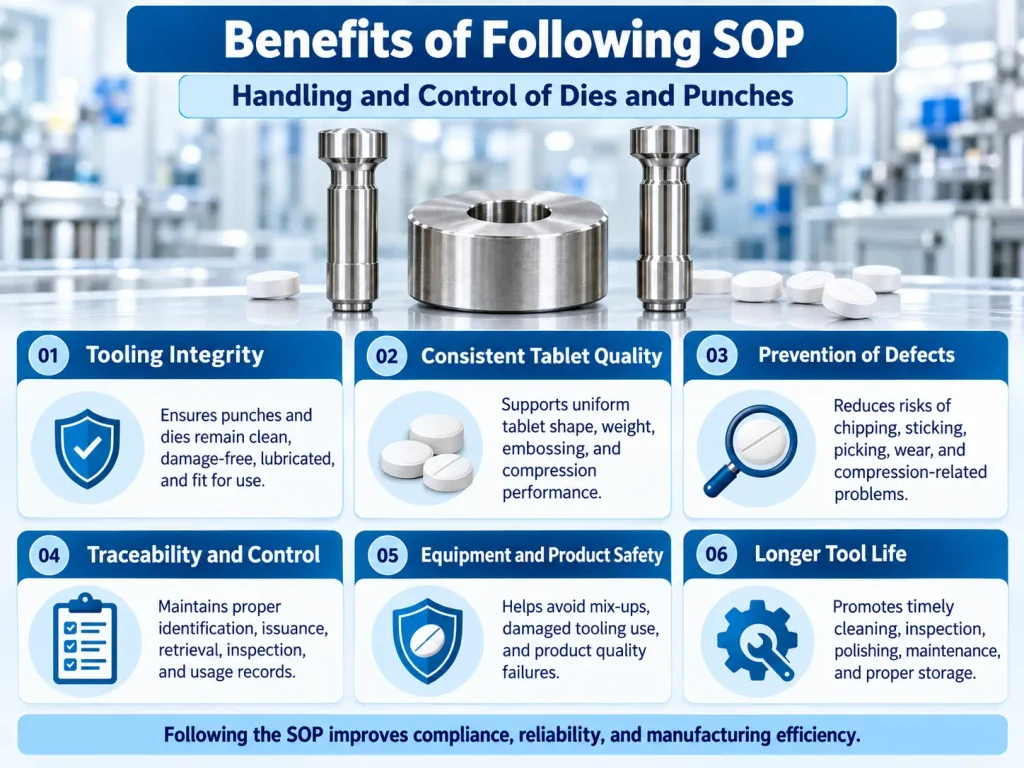
Following this procedure helps reduce compression-related problems such as sticking, picking, rough surfaces, corrosion, excessive wear, and defects caused by damaged tooling. It also improves traceability through controlled identification, issuance, retrieval, usage records, and tooling destruction documentation. Proper lubrication and dedicated storage help protect punches and dies from corrosion and accidental damage. Overall, compliance with this SOP supports consistent tablet quality, longer tooling life, prevention of mix-ups, improved equipment reliability, controlled maintenance, GMP compliance, and efficient pharmaceutical manufacturing operations.
4. SOP for Handling and Control of Dies and Punches – CPP and CQA:
The SOP for Handling and Control of Dies and Punches ensures that tooling-related Critical Process Parameters (CPPs) are properly controlled to support the required Critical Quality Attributes (CQAs) of compressed tablets. Important CPPs include selection of the correct tooling type, punch and die dimensions, surface condition, embossing, concentricity, overall punch length, cleaning, lubrication, polishing, inspection, storage, and controlled issuance of tooling. The SOP specifically requires dimensional checks, visual inspection, concentricity verification, tip examination, embossing checks, and die surface assessment before continued use.
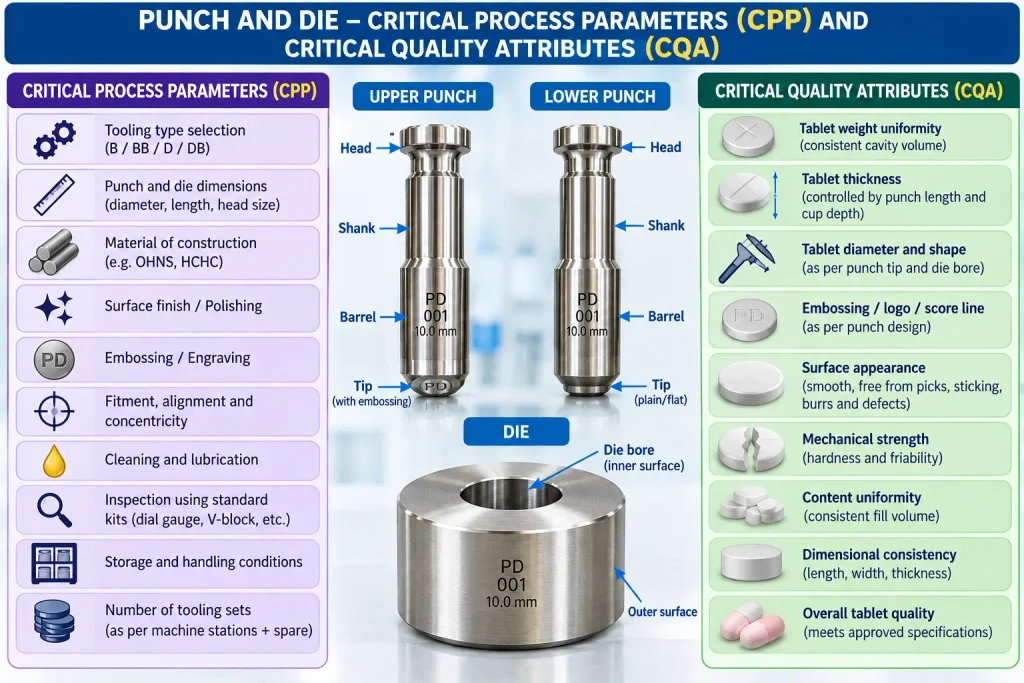
Proper control of these parameters helps maintain tablet CQAs such as uniform shape, diameter, thickness, appearance, embossing quality, mechanical strength, and consistency during compression. The SOP also requires polishing when burrs, roughness, blackening, sticking, picking, corrosion, or wear are observed, thereby supporting acceptable tablet surface quality and compression performance.Overall, effective punch and die control minimizes tooling-related defects, improves repeatability, supports GMP compliance, and contributes to consistent finished-tablet quality.
5. SOP for Handling and Control of Dies and Punches – Punch and Die Selection:
The SOP for Handling and Control of Dies and Punches defines a controlled approach for selecting suitable punches and dies for tablet compression based on product requirements and compression-machine compatibility. Selection begins with evaluation of the required tooling type, punch and die dimensions, quantity, material of construction, embossing requirements, and approved dimensional drawing. The SOP specifies that tooling details such as B, BB, D or DB type, dimensions, quantity, construction material, and engraving requirements should be defined during procurement. After receipt, the punch set is identified, inspected, and verified for appearance, damage, dimensional conformity, tip condition, concentricity, surface quality, embossing, and die condition before use.
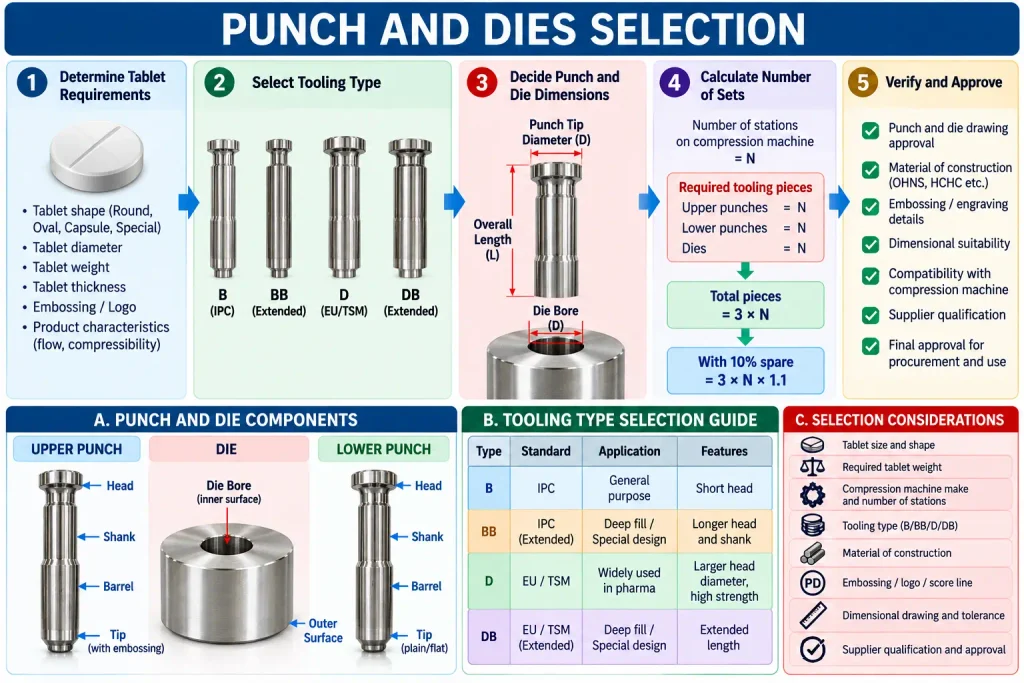
The correct punch set is then selected according to the product and the compression machine, and issued in a controlled manner. Proper punch and die selection helps ensure compatibility with the machine, correct tablet size and shape, reliable embossing, uniform compression performance, reduced tooling damage, improved traceability, and consistent finished-product quality.
6. SOP for Handling and Control of Dies and Punches – FMEA:
The SOP for Handling and Control of Dies and Punches uses a risk-based approach to identify and control potential failures associated with tooling throughout its lifecycle. The FMEA evaluates important activities such as punch and die selection, receipt and identification, cleaning, inspection, polishing, lubrication, storage, issuance, retrieval, use during compression, and disposal. Each potential failure mode is assessed for its possible cause, impact on the product or process, and relative risk using Severity, Occurrence, and Detection ratings, with the Risk Priority Number calculated as RPN = S × O × D.
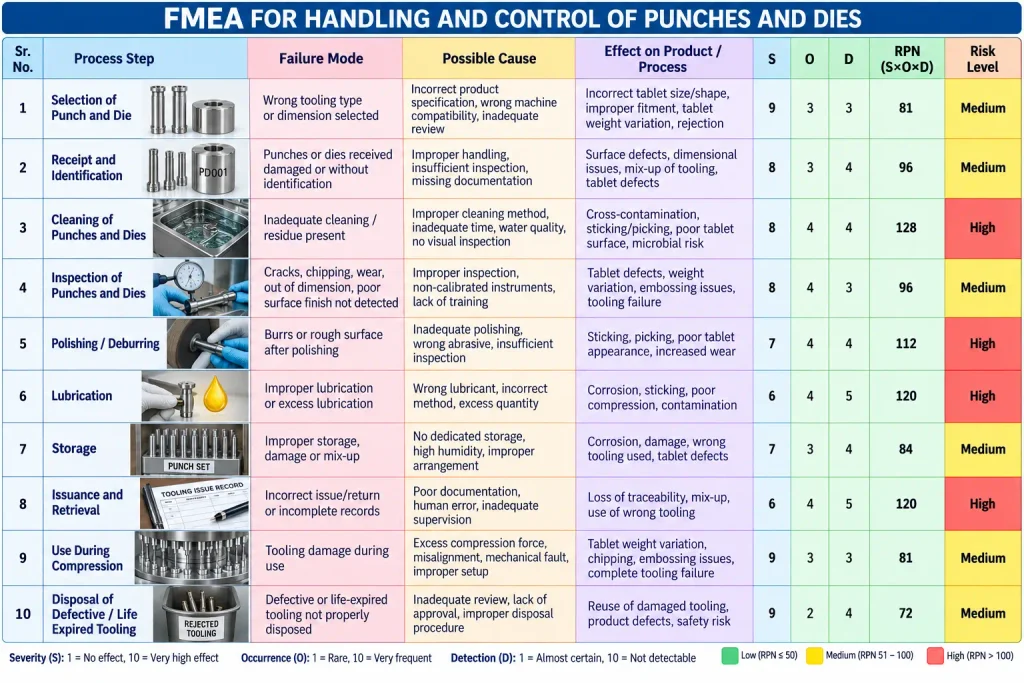
The SOP itself requires systematic inspection of punches and dies for dimensions, concentricity, surface defects, cracks, chipping, embossing condition, and die integrity before continued use. It also defines cleaning, polishing, lubrication, controlled storage, issuance, retrieval, maintenance, and disposal requirements to reduce tooling-related failures.Effective FMEA helps prioritize higher-risk activities, establish appropriate controls, prevent mix-ups and damage, reduce tablet defects, improve tooling reliability, maintain traceability, and support consistent GMP-compliant tablet manufacturing.
7. SOP for Handling and Control of Dies and Punches – CAPA:
The SOP for Handling and Control of Dies and Punches supports an effective Corrective and Preventive Action (CAPA) system for controlling tooling-related deviations during tablet manufacturing. Typical issues may include selection of an incorrect punch or die set, damage during handling or compression, burrs or rough surfaces, corrosion, tooling mix-up, incomplete records, or use of defective tooling. The SOP requires controlled cleaning, inspection, polishing, lubrication, issuance, retrieval, storage, maintenance, and disposal of punches and dies to prevent recurrence of such problems.
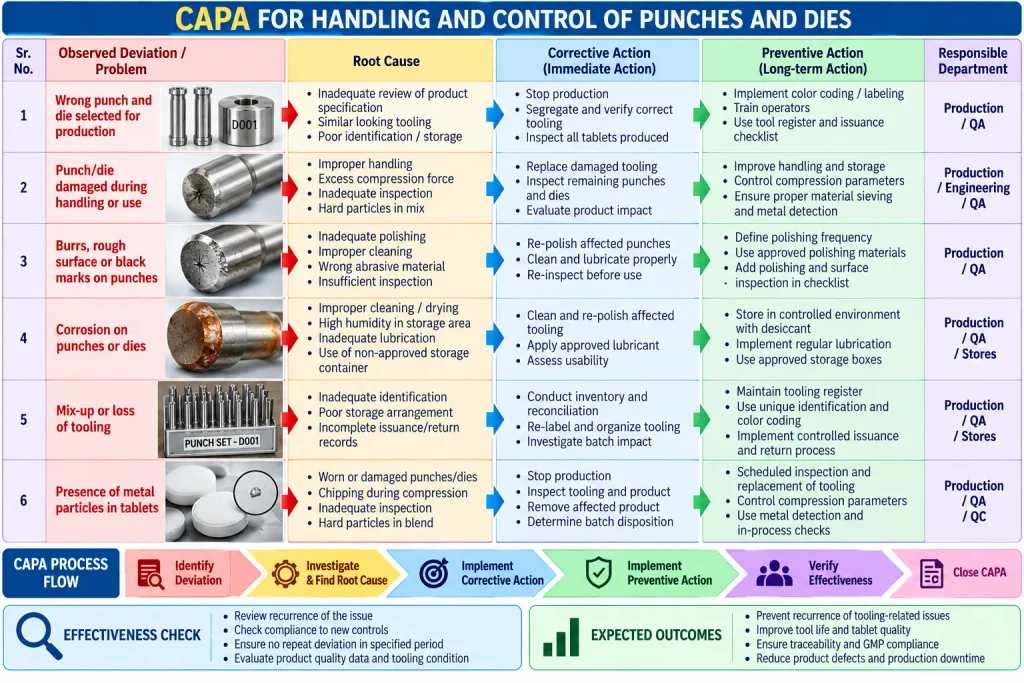
Corrective actions may involve stopping use of affected tooling, segregation, cleaning, re-polishing, inspection, replacement, and assessment of product impact. Preventive actions include improved identification, dedicated storage, proper lubrication, routine inspection, controlled issuance and return, operator training, and maintenance of usage records. The SOP also requires defective or life-expired tooling to be formally destroyed and documented. Effective CAPA implementation helps prevent recurrence, improve tooling life, maintain traceability, reduce tablet defects, and strengthen GMP compliance and manufacturing reliability.
9. Impact on Compression Machine – SOP for Handling and Control of Dies and Punches:
Improper handling, selection, inspection, or maintenance of punches and dies can directly affect the performance of the tablet compression machine. Damaged, worn, misaligned, corroded, or dimensionally incorrect tooling may cause abnormal compression load, excessive vibration, sticking, picking, tablet weight variation, poor embossing, and inconsistent tablet thickness. The SOP requires inspection of punch tip diameter, concentricity, overall length, surface condition, embossing, die dimensions, and die bore condition before continued use.
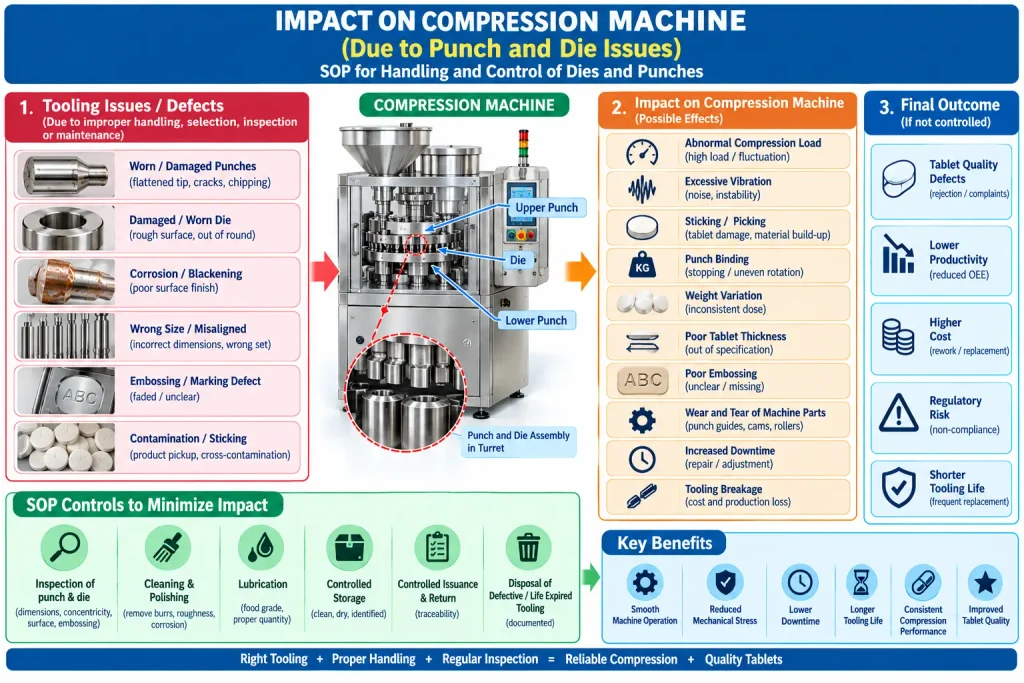
Defective tooling can also contribute to punch binding, abnormal turret load, premature wear of punch guides, cams and rollers, increased machine downtime, and possible tooling breakage. Proper cleaning, lubrication, polishing, and controlled storage help maintain smooth punch movement and minimize friction during compression. The SOP specifically requires food-grade lubrication and proper storage after use. Effective control of punches and dies therefore supports smooth machine operation, reduced mechanical stress, lower downtime, longer tooling life, consistent compression performance, and improved tablet quality.
Questions and Answers – SOP for Handling and Control of Dies and Punches:
Q1. What is the objective of the SOP for Handling and Control of Dies and Punches?
The objective is to define the procedure for proper handling and control of punches and dies used in tablet manufacturing.
Q2. What activities are covered under this SOP?
The SOP covers receipt, cleaning, issuance, retrieval, maintenance, disposal, and use of punch inspection and polishing kits.
Q3. Who is responsible for execution of this SOP?
Concerned Production personnel and Officer/Chemist–Production are responsible for execution, while AGM–Production and Head–QA/QC are responsible for effective implementation.
Q4. What details should be considered during procurement of punches and dies?
Tooling type, dimensions, quantity, material of construction, embossing, serial number, supplier identification, manufacturing date, and punch/die dimensions should be defined.
Q5. How are new punches and dies cleaned?
They are cleaned with a clean dry cloth to remove oil and grease, and die bores are cleaned using a lint-free wipe. Cleanliness is visually verified before further use.
Q6. How are used punches and dies cleaned after removal from the machine?
They are cleaned with lint-free wipes and 100% IPA, visually inspected for damage, lubricated with a thin layer of food-grade oil, and stored in the designated cabinet.
Q7. What are the important inspection parameters for punches?
Important checks include tip diameter, concentricity, tip surface condition, chamfer, embossing, central break line, and overall punch length.
Q8. What are the important inspection parameters for dies?
Dies are checked for outer diameter, inner surface condition, body surface, height, chamfer, and free movement of the upper and lower punches inside the die.
Q9. When should punches be polished?
Punches should be polished when burrs, blackening, roughness, sticking/picking, or dull tablet appearance is observed.
Q10. When should dies be polished?
Dies should be polished when ring formation, blackening, corrosion, wear, or drag is observed inside the die bore.
Q11. How is the correct punch set issued for production?
The punch set is selected according to the product and compression machine, cleaned, issued as per serial numbers, and recorded in the dies and punches usage record.
Q12. What is done after completion of tablet compression?
The punch set is retrieved from the machine, cleaned, individually inspected, lubricated with food-grade oil, stored in the designated cabinet, and recorded in the usage record.
Q13. When should a punch set be disposed of?
A punch set is disposed of when it becomes incomplete, individual components become unusable due to damage or corrosion, or the defined tooling life is completed.
Q14. How should defective punch sets be destroyed?
Defective tooling should be collected, punch tips preferably defaced using a grinder, documented in the tooling destruction note, approved by the department head, and transferred to the scrap yard.
Q15. Why is proper control of punches and dies important?
Proper control helps maintain tooling condition, traceability, correct issuance, consistent compression performance, and prevention of tablet defects caused by damaged, worn, corroded, or incorrect tooling.
Reference Guidelines – Handling and Control of Dies and Punches:
- WHO Good Manufacturing Practices (GMP) for Pharmaceutical Products – requirements for equipment handling, cleaning, maintenance, documentation, and prevention of contamination.
- EU Guidelines for Good Manufacturing Practice, EudraLex Volume 4 – particularly requirements related to production equipment, maintenance, cleaning, and documentation.
- PIC/S Guide to Good Manufacturing Practice for Medicinal Products (PE 009) – guidance on equipment control, maintenance, cleaning, and production operations.
- US FDA – 21 CFR Part 211, Current Good Manufacturing Practice for Finished Pharmaceuticals – especially:
- 21 CFR 211.63 – Equipment design, size, and location
- 21 CFR 211.67 – Equipment cleaning and maintenance
- 21 CFR 211.68 – Automatic, mechanical, and electronic equipment
- ISPE Good Practice Guides – useful for equipment lifecycle, maintenance, risk management, and pharmaceutical manufacturing practices.
- IPEC / Tablet Tooling Manufacturer Recommendations – for punch and die dimensional inspection, tooling maintenance, polishing, storage, lubrication, and tooling-life management.
- ISO 18084 – Press Tools for Tablets – useful for standard terminology and dimensional requirements related to tablet compression tooling.
- Approved Manufacturer’s Manual / Tooling Drawing – for specific punch type, die dimensions, tolerances, material of construction, embossing, and machine compatibility.