






Brief Description
The SOP for Handling, Cleaning & Storage of Cuvettes of Spectrophotometer provides standardized instructions for proper use and maintenance of spectrophotometer cuvettes in the Quality Control Department. Its objective is to prevent breakage, scratches, contamination, and improper positioning that may affect spectrophotometric measurements. Cuvettes must be handled by their opaque sides without touching the transparent optical surfaces and should be carefully placed in the holder with the clear sides aligned in the optical path.The SOP also defines cleaning procedures for both aqueous and non-aqueous solutions, including washing with appropriate blank solution, purified water or compatible solvent, followed by blotting and air drying when required. Dry cuvettes are stored in cushioned cases or boxes. New cuvettes are initially qualified by checking path length using a calibrated Vernier caliper and comparing their transmittance at 200 nm. Training is provided to QC chemists by the Manager–Quality Control.
Skip to PDF content1. Flow Diagram:
The flow diagram presents the complete process for Handling, Cleaning & Storage of Cuvettes of Spectrophotometer in an easy-to-understand training format, supported by PharmaDevils characters acting as trainers. It starts with the purpose of ensuring proper cuvette handling for accurate spectrophotometric measurements. The diagram explains safe handling practices such as avoiding scratches, touching only opaque sides, blotting before use, preventing spillage, and correctly positioning transparent sides in the optical path.
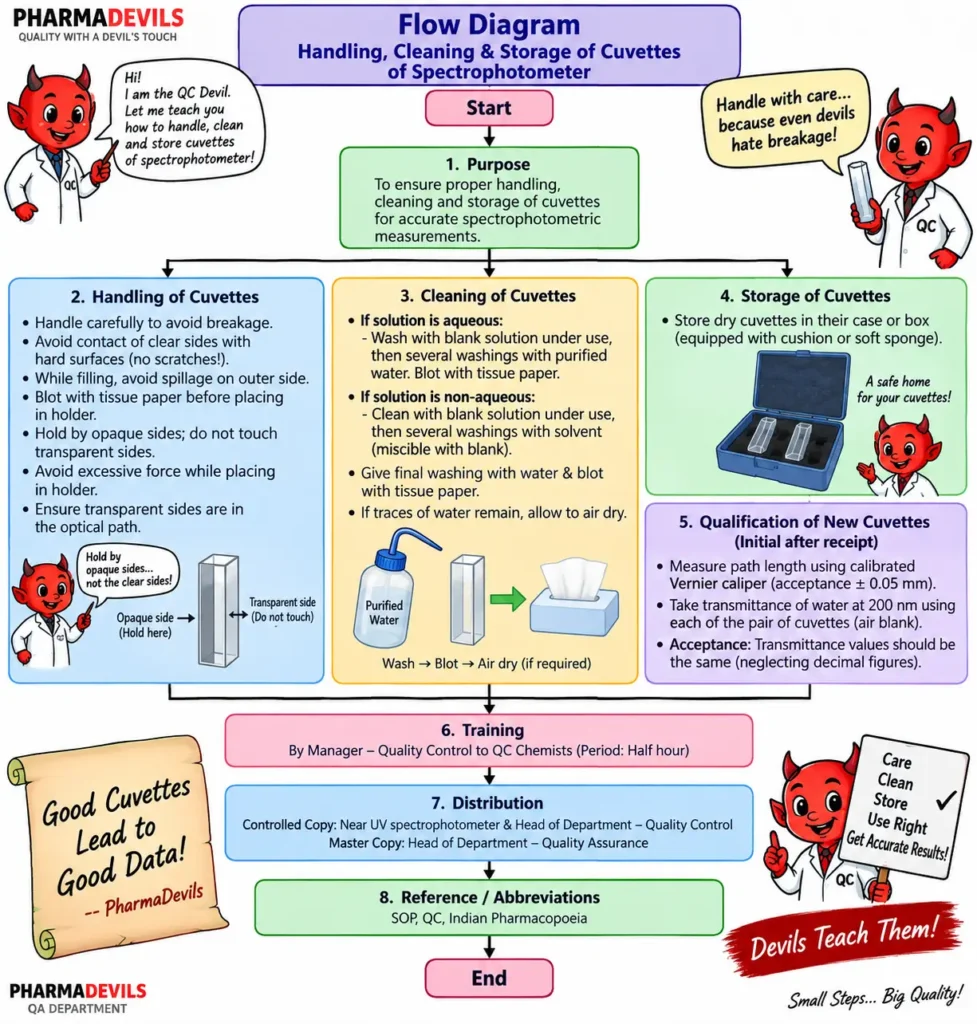
It further illustrates separate cleaning steps for aqueous and non-aqueous solutions, followed by final rinsing, blotting, and air drying when required. Proper storage in a cushioned case or box is highlighted to prevent damage. The qualification section covers path-length verification with a calibrated Vernier caliper and transmittance comparison at 200 nm for newly received cuvettes. The diagram also includes training, document distribution, references, and abbreviations, reinforcing the message: “Care, Clean, Store, Use Right—Get Accurate Results.”
2. Brainstorming for SOP Failure:
The brainstorming diagram presents the major possible causes of failure in the SOP for Handling, Cleaning & Storage of Cuvettes of Spectrophotometer in a simple and engaging PharmaDevils format. The central question, “Why did the SOP fail?”, is connected to key failure areas such as improper handling, touching transparent sides, scratches or breakage, incorrect cleaning method, poor drying, improper storage, incomplete qualification, and inadequate training or documentation. These causes directly relate to the SOP requirements for careful handling, correct cleaning, air drying, cushioned storage, and initial qualification of cuvettes.
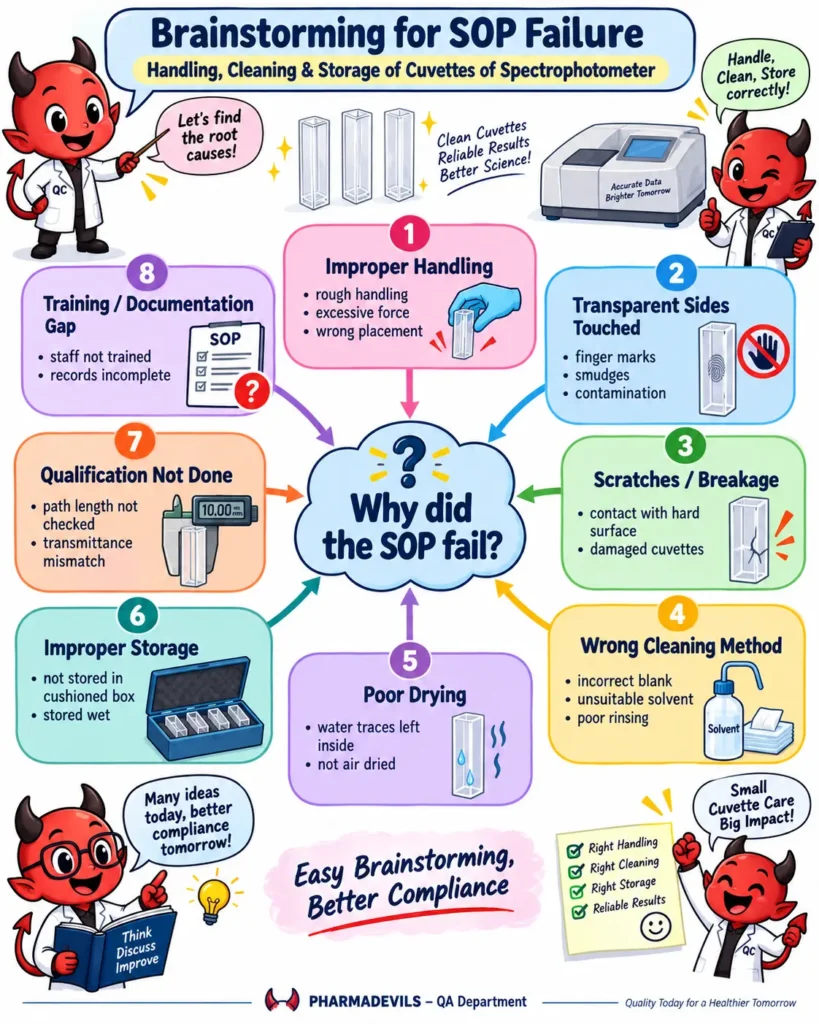
The devil characters act as visual trainers and make the brainstorming process easier to understand. The diagram helps QC personnel identify potential root causes, discuss corrective actions, strengthen compliance, and reduce the risk of inaccurate spectrophotometric results. Its key message is “Easy Brainstorming, Better Compliance.”
3. 5-Why Analysis for SOP Failure:
The 5-Why analysis diagram explains the likely root cause of failure in the SOP for Handling, Cleaning & Storage of Cuvettes of Spectrophotometer in a simple comic-style format. It begins with the problem of improper handling, cleaning, and storage of cuvettes, then asks a sequence of “Why?” questions to trace the issue step by step. The analysis highlights failures such as improper handling, touching transparent sides, scratches, poor drying, wrong cleaning practices, improper storage, missed qualification checks, and lack of understanding of SOP requirements. These points are directly linked to the SOP instructions for careful handling, cleaning with suitable blank or solvent, drying, storage in cushioned boxes, and qualification of new cuvettes.
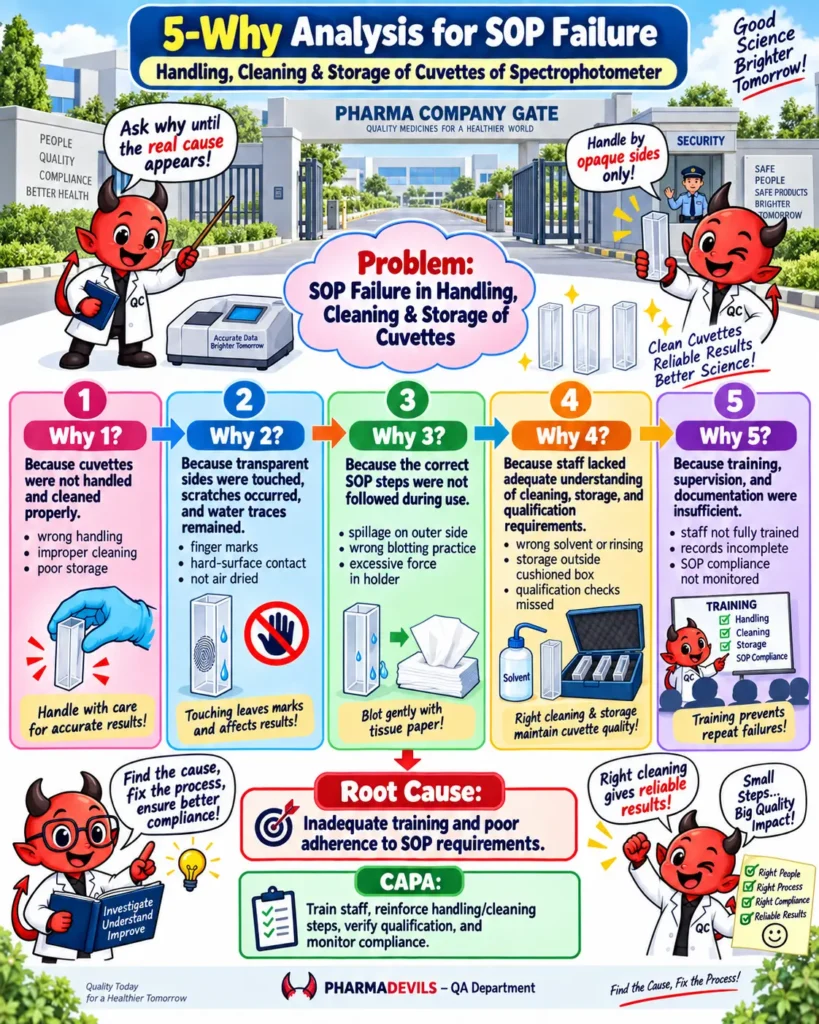
The diagram concludes that the root cause is inadequate training and poor adherence to SOP requirements. It also presents a simple CAPA message: train staff, reinforce correct handling and cleaning practices, verify qualification activities, and monitor compliance. Since the SOP assigns training responsibility to the Manager–Quality Control for QC chemists, the diagram effectively emphasizes that proper training and supervision are essential to prevent repeat failures and ensure reliable spectrophotometric results.
4. Fishbone Analysis for SOP Failure:
The Fishbone Analysis diagram visually identifies the possible causes of SOP failure in the handling, cleaning, and storage of spectrophotometer cuvettes. The causes are grouped into major categories such as Man, Method, Machine, Material, Measurement, Environment, and Management, making the investigation easy to understand in a comic-style format. Key issues include inadequate training, not following the SOP, touching transparent sides, incorrect cleaning sequence, damaged holders, unsuitable solvents, unverified path length, poor storage conditions, and lack of supervision. These factors can lead to improper cuvette condition and inaccurate spectrophotometric results. The SOP specifically requires careful handling, correct cleaning, proper drying, cushioned storage, and qualification of new cuvettes.
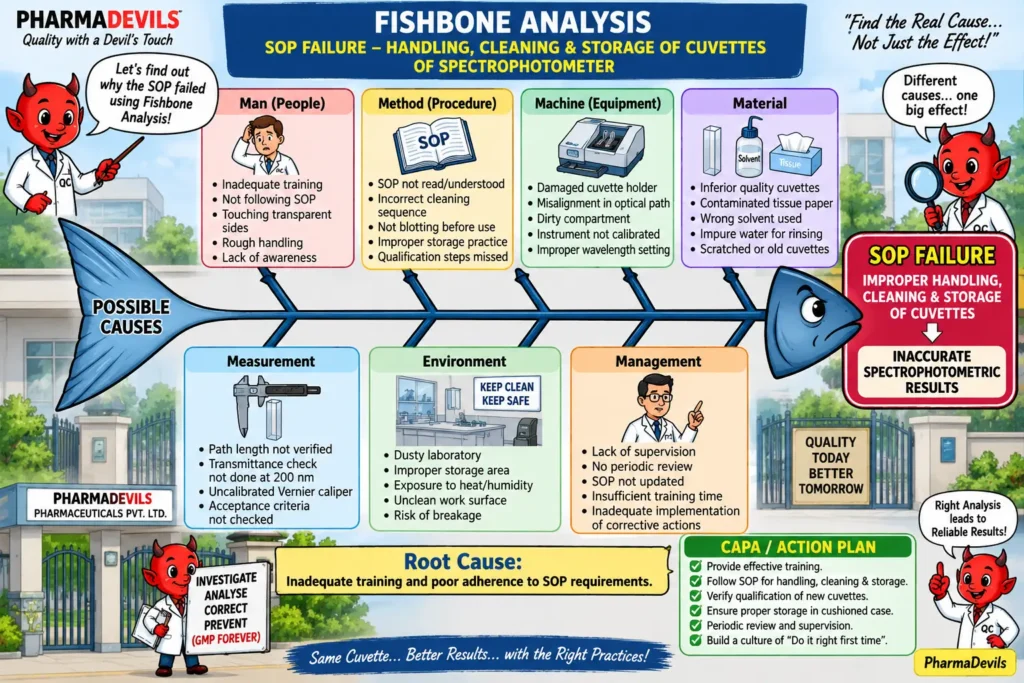
The diagram highlights inadequate training and poor adherence to SOP requirements as the likely root cause and proposes CAPA actions such as effective training, qualification verification, proper storage, periodic supervision, and strict SOP compliance.
5. Fault Tree Analysis for SOP Failure:
The Fault Tree Analysis diagram systematically evaluates SOP failure in the handling, cleaning, and storage of spectrophotometer cuvettes by starting with the top event, “SOP Failure,” and tracing it downward to its potential causes. The main failure branches include incorrect handling, inadequate cleaning, improper storage, inadequate qualification of new cuvettes, and lack of training or non-adherence to the SOP. These branches are further broken into specific causes such as touching transparent sides, excessive insertion force, spillage, incomplete rinsing, poor drying, wet storage, lack of cushioned storage, unverified path length, missed transmittance checks, and inadequate training. These failure modes reflect the critical controls defined in the SOP for handling, cleaning, storage, and qualification of cuvettes.
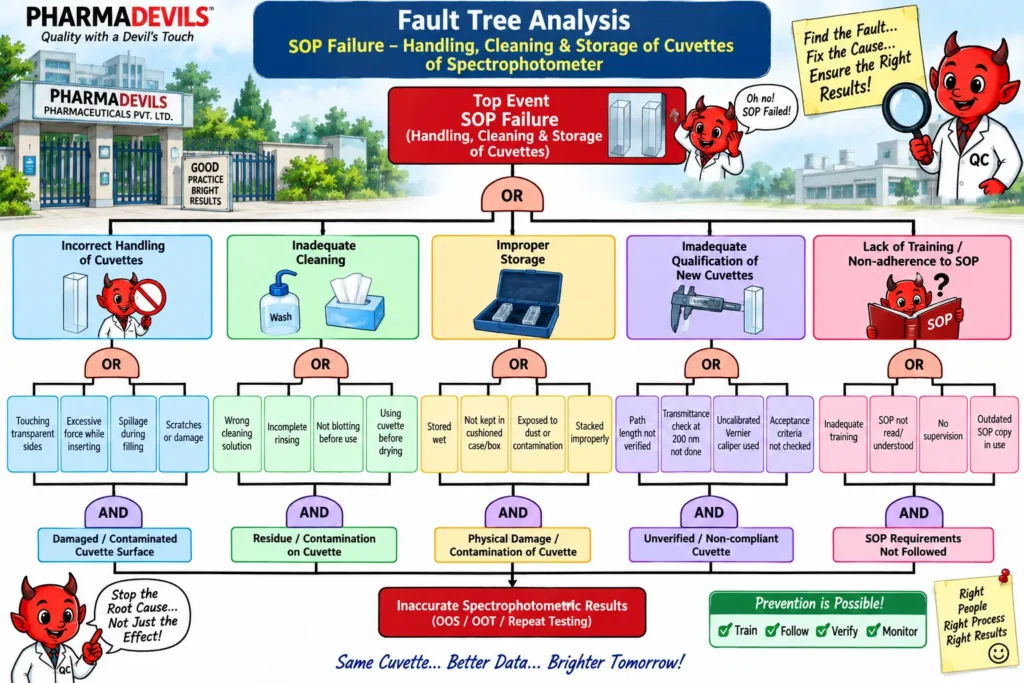
The diagram uses OR and AND logic gates to show how individual faults can combine and ultimately lead to damaged, contaminated, or non-compliant cuvettes, resulting in inaccurate spectrophotometric results, OOS/OOT findings, or repeat testing.
Questions & Answers – Handling, Cleaning & Storage of Cuvettes of Spectrophotometer
Q1. What is the objective of this SOP?
Answer: To provide guidelines for the proper handling, cleaning, and storage of spectrophotometer cuvettes.
Q2. Who is responsible for following this SOP?
Answer: Chemist Q.C., Sr. Executive QC, Assistant Manager Q.C., and Manager-QC.
Q3. How should cuvettes be handled to avoid damage?
Answer: Cuvettes should be handled carefully to avoid breakage and the clear sides should not contact hard surfaces to prevent scratches.
Q4. Which sides of the cuvette should be held with fingers?
Answer: The opaque sides should be held between two fingers, while the transparent sides should not be touched.
Q5. What should be done before placing a cuvette in the holder?
Answer: The cuvette should be blotted from all sides with tissue paper and excessive force should be avoided during placement.
Q6. How should the transparent sides of the cuvette be positioned?
Answer: The transparent sides should be positioned in the optical path of the spectrophotometer.
Q7. How should a cuvette used for an aqueous solution be cleaned?
Answer: It should be washed with the blank solution under use, followed by several washings with purified water, and then blotted with tissue paper.
Q8. How should a cuvette used for a non-aqueous solution be cleaned?
Answer: It should be cleaned with the blank solution under use, followed by several washings with a solvent that is miscible with the blank.
Q9. What should be done if traces of water remain inside the cuvette after blotting?
Answer: The cuvette should be allowed to air dry.
Q10. How should dry cuvettes be stored?
Answer: Dry cuvettes should be stored in their case or box equipped with a cushion or soft sponge.
Q11. When is qualification of cuvettes required?
Answer: Qualification is to be performed initially after receipt of new cuvettes.
Q12. How is the path length of a cuvette checked?
Answer: The distance between the two clear sides is measured from inside using a calibrated Vernier caliper.
Q13. What is the acceptance criterion for cuvette path length?
Answer: The acceptance criterion is ± 0.05 mm of the theoretical value.
Q14. At what wavelength is transmittance checked during qualification?
Answer: The transmittance of water is checked at 200 nm using an air blank.
Q15. What is the acceptance criterion for transmittance between a pair of cuvettes?
Answer: The transmittance values obtained using the two cuvettes should be the same, neglecting figures after the decimal point.
Q16. Who provides training for this SOP?
Answer: The Manager – Quality Control acts as the trainer.
Q17. Who are the trainees and what is the training period?
Answer: The trainees are Quality Control Chemists, and the training period is half an hour.
Q18. Where are controlled copies of the SOP distributed?
Answer: Controlled copies are kept near the UV spectrophotometer and with the Head of Department – Quality Control, while the master copy is maintained by the Head of Department – Quality Assurance.