







1. Introduction – SOP for Handling & Distribution of Sugar Syrup Manufacturing:
The SOP for Handling & Distribution of Sugar Syrup Manufacturing defines a controlled procedure for the preparation, handling, testing, allocation, and distribution of sugar syrup used during pharmaceutical manufacturing. Its purpose is to ensure that sugar syrup is consistently prepared according to defined processing requirements and is correctly assigned to the intended product batch. HANDLING & DISTRIBUTION OF SUGA… The procedure includes collection of the required quantity of purified water in a clean stainless-steel jacketed vessel, addition and dissolution of pharmaceutical-grade sucrose, heating of the syrup, cooling, volume adjustment, and filtration through a 150# stainless-steel sieve. The clarified syrup is sampled for QC testing of parameters such as pH and optical rotation before further cooling and distribution. HANDLING & DISTRIBUTION OF SUGA… The SOP also establishes Production and Quality Assurance verification during syrup allocation and distribution to prevent mix-ups or incorrect use between product batches. Any change in planned distribution requires prior Quality Assurance approval and appropriate deviation handling. HANDLING & DISTRIBUTION OF SUGA…
Skip to PDF content2. SOP for Handling & Distribution of Sugar Syrup Manufacturing – Flow Diagram:
The flow diagram for Handling & Distribution of Sugar Syrup Manufacturing presents the sequential activities required for controlled preparation and distribution of sugar syrup. The process begins with collection of the required quantity of purified water in a clean stainless-steel jacketed vessel, followed by stirring and dissolution of pharmaceutical-grade sucrose. The syrup is then heated to 102°C for two minutes, cooled below 80°C, checked for volume, and strained through a 150# stainless-steel sieve. HANDLING & DISTRIBUTION OF SUGA…
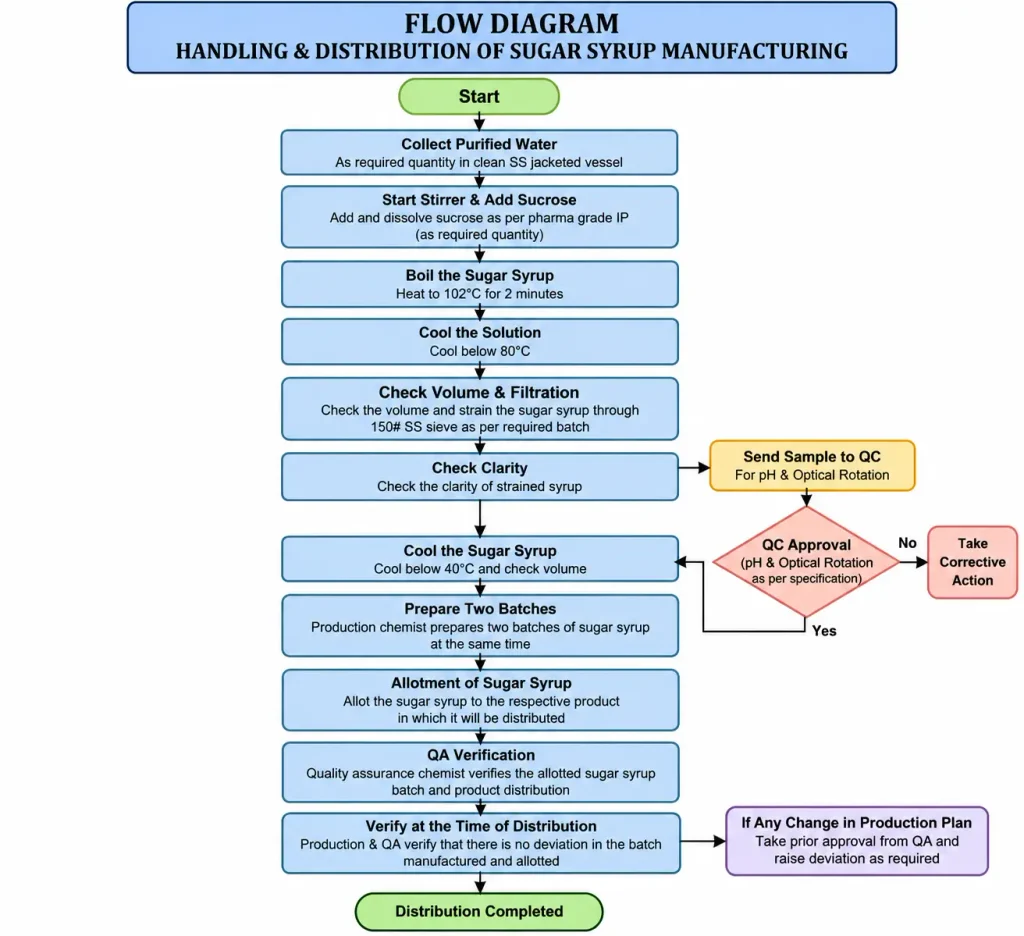
After filtration, the syrup is checked for clarity and a sample is sent to Quality Control for pH and optical rotation testing. The syrup is subsequently cooled below 40°C and its volume is verified. Production then prepares and allots the sugar syrup to the intended product batch, while Quality Assurance verifies the allocation before distribution. HANDLING & DISTRIBUTION OF SUGA… At the time of distribution, Production and Quality Assurance jointly verify that the correct syrup batch is issued to the designated product. Any change in production planning requires prior QA approval and appropriate deviation handling, helping prevent mix-ups and maintain batch traceability and GMP control. HANDLING & DISTRIBUTION OF SUGAR.
3. SOP for Handling & Distribution of Sugar Syrup Manufacturing – Benefits of Following SOP:
Following the SOP for Handling & Distribution of Sugar Syrup Manufacturing helps ensure that sugar syrup is prepared, handled, tested, allotted, and distributed in a controlled and consistent manner. The defined steps for purified water collection, sucrose dissolution, heating, cooling, filtration, clarity checking, and QC testing help maintain uniform syrup quality from batch to batch. HANDLING & DISTRIBUTION OF SUGA…
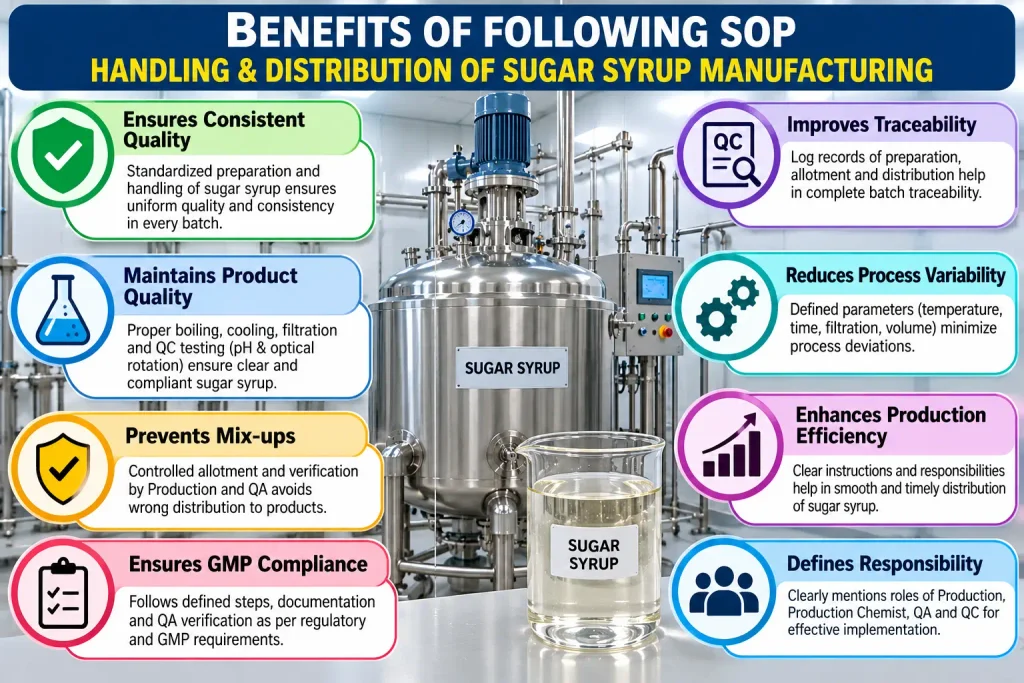
The SOP also helps prevent mix-ups and incorrect batch allocation by requiring Production and Quality Assurance to verify the syrup batch and the product to which it is distributed. This improves traceability, accountability, and control during manufacturing operations. HANDLING & DISTRIBUTION OF SUGA… Clear assignment of responsibilities supports effective SOP implementation, while prior QA approval for any production-planning change helps ensure that deviations are formally controlled. Overall, adherence to the SOP supports consistent product quality, better documentation, reduced process variability, and effective coordination between Production, QA, and QC. HANDLING & DISTRIBUTION OF SUGA… HANDLING & DISTRIBUTION OF SUGA…
4. SOP for Handling & Distribution of Sugar Syrup Manufacturing – CPP & CQA:
The CPP & CQA diagram for Handling & Distribution of Sugar Syrup Manufacturing highlights the important process controls and quality checks required to obtain consistent sugar syrup during manufacturing. Key Critical Process Parameters (CPPs) shown include the required quantity of purified water, addition and dissolution of pharmaceutical-grade sucrose, heating of the syrup to 102°C for two minutes, cooling below 80°C, filtration through a 150# stainless-steel sieve, and final cooling below 40°C with volume verification. HANDLING & DISTRIBUTION OF SUGA…
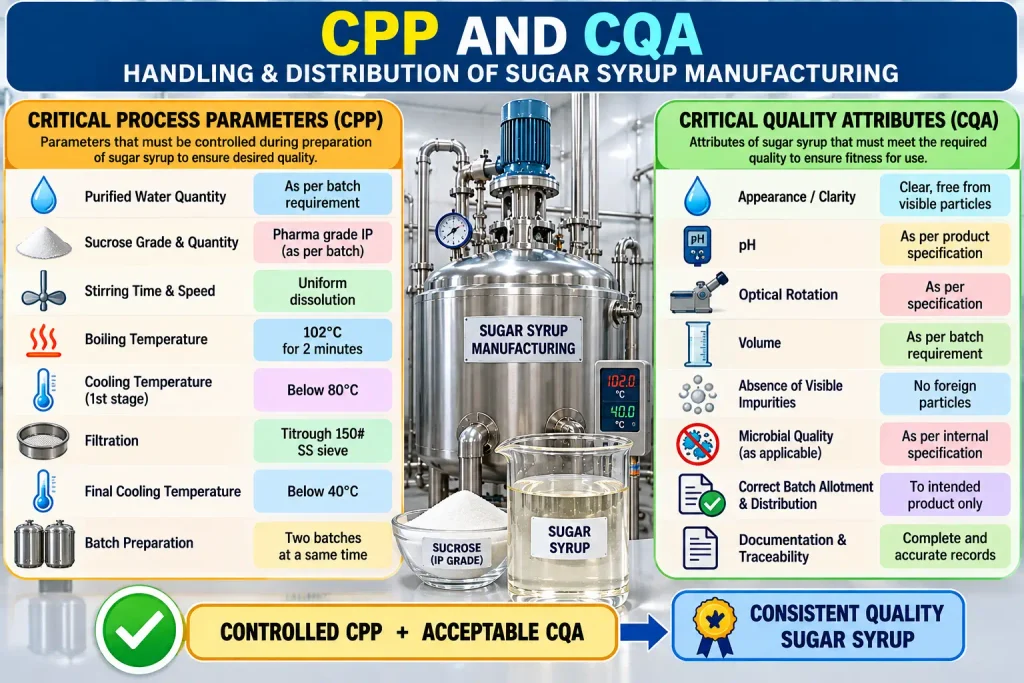
The important quality attributes represented in the diagram include clarity, pH, optical rotation, and correct volume, which are checked before the syrup is released for further use. The SOP specifically requires clarity checking and submission of the syrup sample to Quality Control for pH and optical rotation testing. HANDLING & DISTRIBUTION OF SUGA… The diagram also emphasizes correct batch allotment and verification by Production and Quality Assurance before distribution. Proper control of these process parameters and quality checks supports consistent syrup preparation, correct product allocation, traceability, and prevention of distribution mix-ups. HANDLING & DISTRIBUTION OF SUGA…
5. SOP for Handling & Distribution of Sugar Syrup Manufacturing – Brainstorming for SOP Failure:
The Brainstorming for SOP Failure in Handling & Distribution of Sugar Syrup Manufacturing identifies possible failure points that may occur during preparation, testing, allotment, and distribution of sugar syrup. The analysis focuses on issues such as use of incorrect purified water quantity, improper sucrose addition, inadequate stirring or dissolution, failure to maintain the specified boiling condition, incorrect cooling, filtration problems, poor clarity, incorrect volume, and delays or errors in QC testing. These areas directly relate to the manufacturing steps defined in the SOP. HANDLING & DISTRIBUTION OF SUGA…
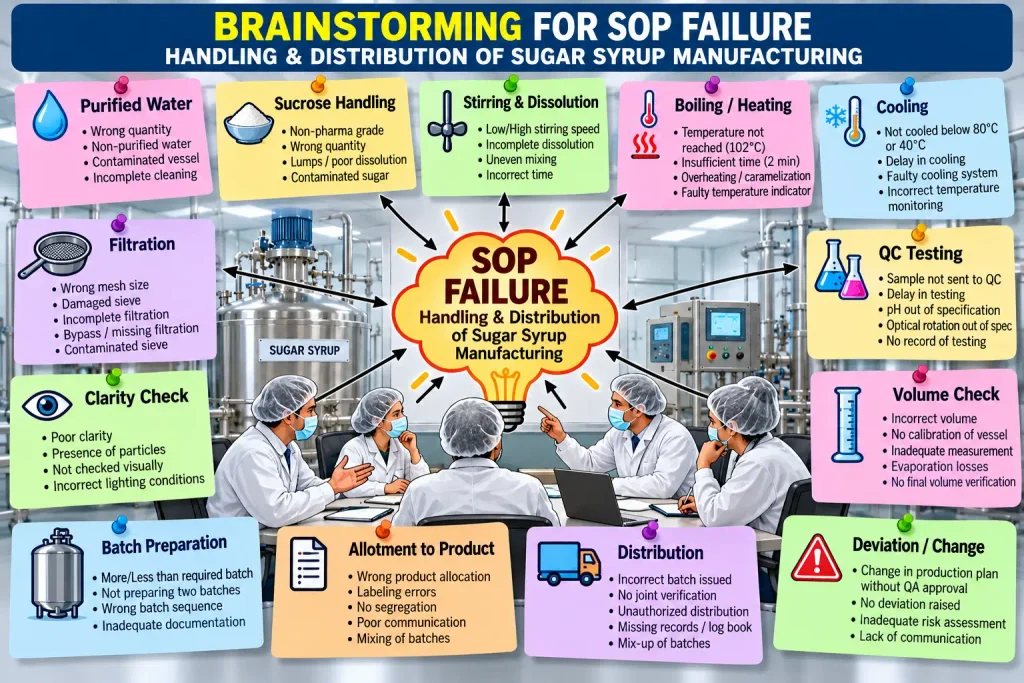
The brainstorming also highlights potential failures during batch preparation, syrup allotment, QA verification, and final distribution, including wrong product allocation, missing verification, incomplete records, batch mix-ups, and unauthorized distribution. The SOP specifically requires Production and Quality Assurance to verify the allotted sugar syrup and ensure that no deviation occurs during distribution. HANDLING & DISTRIBUTION OF SUGA… Any change in production planning without prior QA approval can further increase the risk of SOP failure. Therefore, brainstorming these possible causes helps identify weaknesses in advance, strengthen controls, improve communication, and reduce the likelihood of deviations or incorrect syrup distribution. HANDLING & DISTRIBUTION OF SUGA…
6. SOP for Handling & Distribution of Sugar Syrup Manufacturing – 5-Why Analysis for SOP Failure:
The 5-Why Analysis for SOP Failure in Handling & Distribution of Sugar Syrup Manufacturing is used to identify the underlying causes of failures that may occur during syrup preparation, testing, allotment, and distribution. The analysis starts with observable problems such as unclear syrup, incorrect pH, failure to achieve the required boiling temperature, incorrect final volume, wrong product allotment, delayed QC testing, or distribution without proper QA approval.
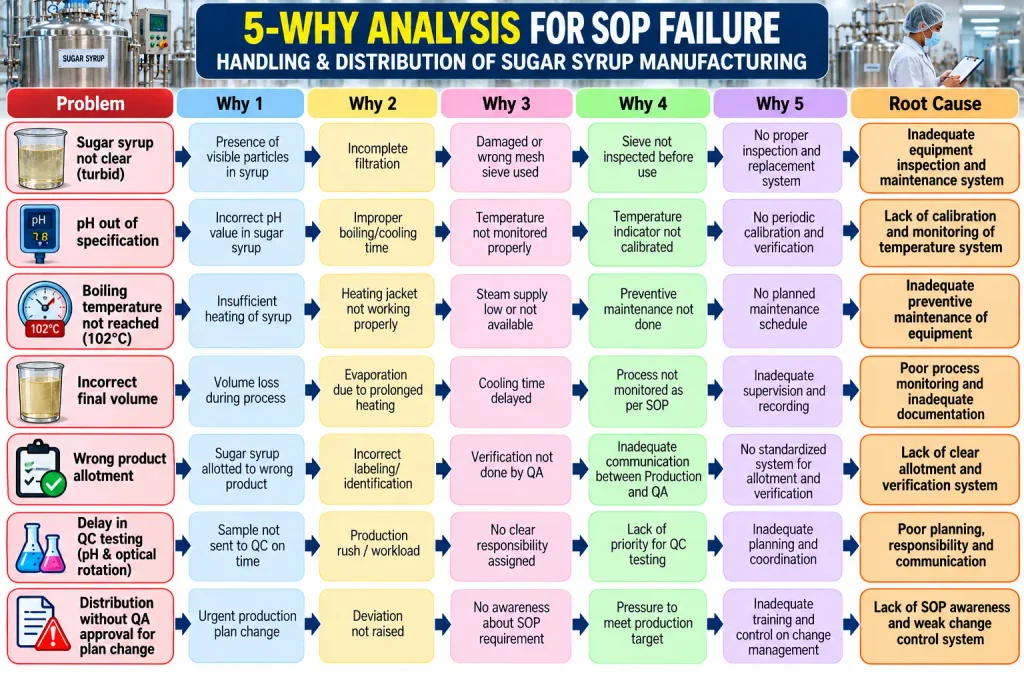
By repeatedly asking “Why?”, the analysis traces these failures to deeper causes such as inadequate filtration control, improper temperature monitoring, insufficient equipment maintenance, weak process supervision, incomplete documentation, poor communication between Production and QA, and inadequate SOP training. These risks are relevant because the SOP requires defined controls for boiling, cooling, filtration, clarity checking, QC testing, product allotment, and QA verification. HANDLING & DISTRIBUTION OF SUGA… The analysis also highlights the importance of deviation and change-control practices. The SOP requires prior Quality Assurance approval when urgent production-planning changes affect syrup distribution. Therefore, 5-Why analysis helps identify the true root cause of SOP failure and supports suitable CAPA to prevent recurrence. HANDLING & DISTRIBUTION OF SUGA…
7. SOP for Handling & Distribution of Sugar Syrup Manufacturing – Fishbone Analysis for SOP Failure:
The Fishbone Analysis for SOP Failure in Handling & Distribution of Sugar Syrup Manufacturing identifies the major categories of potential causes that can lead to failure during syrup preparation, testing, allotment, and distribution. The analysis groups possible causes under Man, Machine, Material, Method, Measurement, Environment, and Management to support systematic root-cause identification. Personnel-related causes may include inadequate SOP training, failure to follow defined steps, incorrect measurement, poor attention during boiling, cooling, or filtration, and weak coordination between Production, QA, and QC. Equipment-related causes can include problems with the temperature indicator, heating jacket, cooling system, stirrer, sieve, valves, pipelines, or inadequate maintenance. These areas are directly related to the SOP steps for stirring, heating, cooling, filtration, clarity checking, and QC testing. HANDLING & DISTRIBUTION OF SUGA…
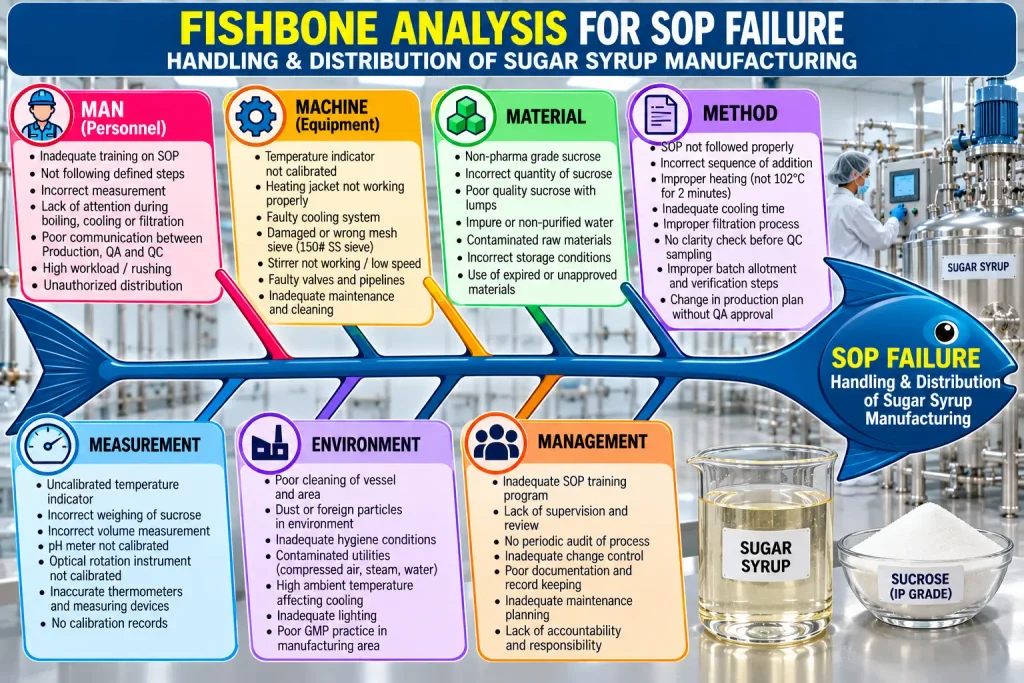
Material- and method-related causes may include incorrect sucrose quantity, unsuitable raw materials, wrong sequence of operations, improper heating or filtration, and incorrect batch allotment. Measurement failures may involve incorrect volume checks or unreliable test results, while management-related causes can include poor supervision, weak documentation, and inadequate change control. The SOP requires Production and QA verification before distribution and prior QA approval for production-plan changes, making these controls essential for preventing mix-ups and deviations. HANDLING & DISTRIBUTION OF SUGA…
8. SOP for Handling & Distribution of Sugar Syrup Manufacturing – Fault Tree Analysis for SOP Failure:
The Fault Tree Analysis for SOP Failure in Handling & Distribution of Sugar Syrup Manufacturing evaluates how different individual failures can combine to cause improper preparation, handling, or distribution of sugar syrup. The top event is SOP failure, which may result from incorrect syrup preparation, poor syrup quality, wrong batch allotment, improper distribution, or changes in the production plan without prior QA approval. The analysis traces these events to causes such as incorrect quantities of purified water or sucrose, improper boiling, inadequate cooling, defective or incorrect filtration, poor clarity, out-of-specification pH or optical rotation, incorrect product allotment, inadequate Production and QA verification, and incomplete distribution records. These potential failures correspond to the SOP requirements for preparation, filtration, QC testing, cooling, batch allotment, and verification before distribution. HANDLING & DISTRIBUTION OF SUGA…
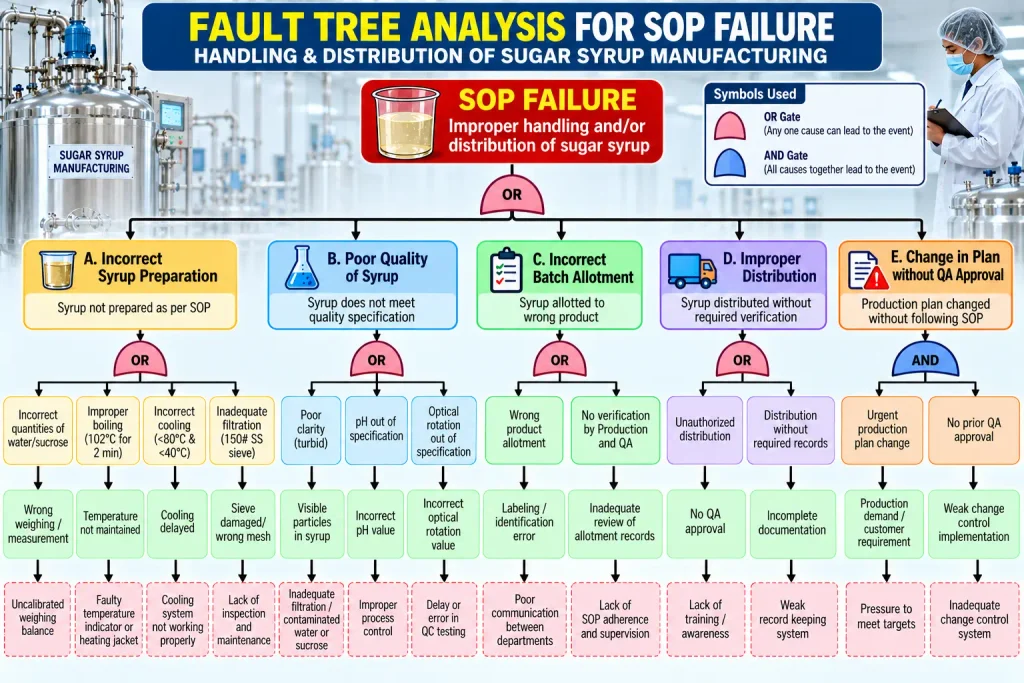
The fault tree also highlights failures associated with unauthorized production-plan changes. The SOP requires prior Quality Assurance approval when urgent planning changes affect syrup distribution. By identifying the initiating events and their underlying causes, Fault Tree Analysis helps support root-cause investigation, risk reduction, stronger process controls, and appropriate CAPA implementation. HANDLING & DISTRIBUTION OF SUGA…
9. SOP for Handling & Distribution of Sugar Syrup Manufacturing – Impact Assessment of SOP Failure:
The Impact Assessment for SOP Failure in Handling & Distribution of Sugar Syrup Manufacturing evaluates the possible consequences that may arise when the defined manufacturing and distribution controls are not followed. The SOP requires controlled preparation of sugar syrup, including use of purified water, sucrose dissolution, heating, cooling, filtration, clarity checking, QC testing, final cooling, batch allotment, and QA verification before distribution. HANDLING & DISTRIBUTION OF SUGA…
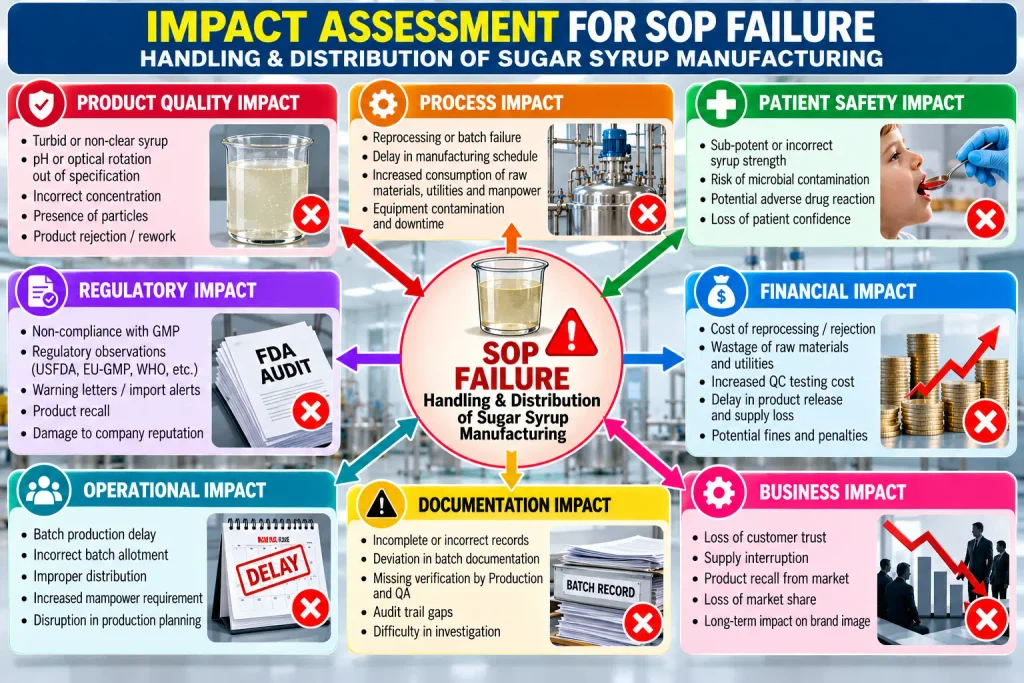
Failure to follow these steps may directly affect product quality, for example through poor clarity, incorrect pH, abnormal optical rotation, incorrect volume, or wrong allocation of syrup to a product batch. It may also create process and operational impacts, such as rework, production delays, additional testing, increased manpower involvement, and disruption of manufacturing schedules. From a compliance perspective, inadequate verification or uncontrolled distribution can result in incomplete records, deviation concerns, weak traceability, and potential GMP observations. The SOP specifically requires Production and Quality Assurance to verify the syrup allocation and distribution, while any urgent production-plan change requires prior QA approval and deviation handling. HANDLING & DISTRIBUTION OF SUGA… Overall, SOP failure can affect product quality, documentation, operations, compliance, cost, and business continuity. A structured impact assessment helps determine the seriousness of the failure and supports appropriate investigation, CAPA, and preventive controls.
10. SOP for Handling & Distribution of Sugar Syrup Manufacturing – CAPA:
The Corrective and Preventive Action (CAPA) for SOP Failure in Handling & Distribution of Sugar Syrup Manufacturing focuses on eliminating identified causes of failure and preventing their recurrence during sugar syrup preparation, testing, allotment, and distribution. The SOP requires controlled activities such as sucrose dissolution, boiling, cooling, filtration through a 150# stainless-steel sieve, clarity checking, QC testing for pH and optical rotation, final cooling, batch allotment, and QA verification. HANDLING & DISTRIBUTION OF SUGA… Corrective actions may include re-filtration of unclear syrup, inspection or replacement of damaged sieves, calibration of temperature-monitoring devices, verification of heating and cooling systems, correction of batch-allotment errors, review of records, and retraining of concerned personnel. Preventive actions include periodic equipment inspection, calibration, preventive maintenance, strengthened SOP training, improved labeling and identification controls, and Production–QA double verification before distribution.
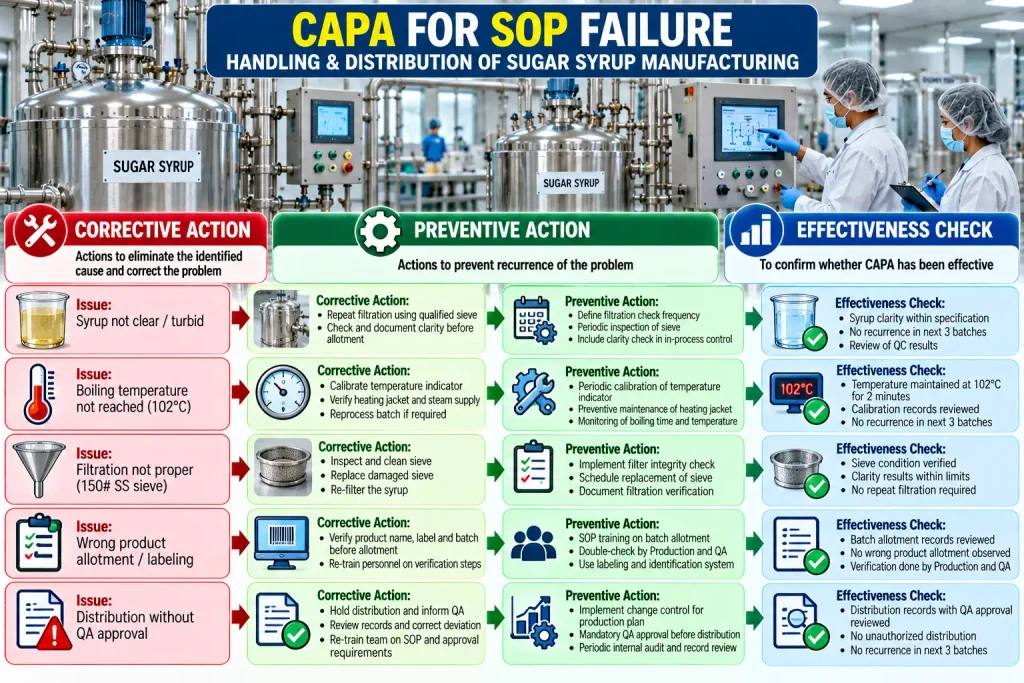
The SOP also requires prior QA approval when an urgent production-planning change affects syrup distribution. Therefore, CAPA should include stronger deviation and change-control practices to prevent unauthorized distribution. HANDLING & DISTRIBUTION OF SUGA… CAPA effectiveness can be confirmed through review of subsequent batch records, QC results, calibration and maintenance records, allotment verification, and evidence that similar deviations do not recur in succeeding batches.
Questions & Answers – SOP for Handling & Distribution of Sugar Syrup Manufacturing:
- What is the objective of this SOP?
The objective is to define the procedure for handling and distribution of sugar syrup during manufacturing. HANDLING & DISTRIBUTION OF SUGA… - Who is responsible for execution of this SOP?
Concerned Production personnel and the Officer/Chemist–Production are responsible for execution of the SOP. HANDLING & DISTRIBUTION OF SUGA… - Who is responsible for effective implementation of the SOP?
The Sr. Manager–Production and Head–QA/QC are responsible for effective implementation. HANDLING & DISTRIBUTION OF SUGA… - Which water is used for preparation of sugar syrup?
Purified water is collected in the required quantity in a clean stainless-steel jacketed vessel. HANDLING & DISTRIBUTION OF SUGA… - Which grade of sucrose should be used?
Sucrose of pharmaceutical grade IP is used as per the required quantity. HANDLING & DISTRIBUTION OF SUGA… - What is the specified boiling condition for sugar syrup?
The SOP specifies boiling the sugar syrup at 102°C for two minutes. HANDLING & DISTRIBUTION OF SUGA… - At what temperature should the syrup be cooled after boiling?
The SOP states that the solution should be cooled below 80°C after boiling. HANDLING & DISTRIBUTION OF SUGA… - Which sieve is used for straining the sugar syrup?
The syrup is strained through a 150# stainless-steel sieve according to the required batch. HANDLING & DISTRIBUTION OF SUGA… - Which quality checks are performed before further use?
The syrup is checked for clarity, and a sample is sent to QC for pH and optical rotation testing. HANDLING & DISTRIBUTION OF SUGA… - What is the final cooling requirement?
The sugar syrup should be cooled below 40°C, with volume verification. HANDLING & DISTRIBUTION OF SUGA… - How many batches of sugar syrup may be prepared at the same time?
The SOP states that the Production Chemist prepares two batches of sugar syrup at the same time. HANDLING & DISTRIBUTION OF SUGA… - Why is sugar syrup allotment required?
Sugar syrup is allotted to identify the specific product in which it will be distributed. HANDLING & DISTRIBUTION OF SUGA… - Who verifies the allotted sugar syrup batch?
A Quality Assurance Chemist verifies the allotted sugar syrup batch and its intended product distribution. HANDLING & DISTRIBUTION OF SUGA… - What should be verified during syrup distribution?
Production and Quality Assurance should verify that there is no deviation between the manufactured sugar syrup batch and the batch/product for which it has been allotted. HANDLING & DISTRIBUTION OF SUGA… - What should be done if the production plan changes urgently?
Prior approval from Quality Assurance should be taken, and deviation handling should be initiated as required. HANDLING & DISTRIBUTION OF SUGA… - Which record is maintained for this activity?
The SOP includes Annexure-I: Handling & Distribution Sugar Syrup Log for recording the activity. HANDLING & DISTRIBUTION OF SUGA… - Why is QA verification important in sugar syrup distribution?
QA verification helps ensure that the correct syrup batch is distributed to the intended product and supports prevention of batch mix-ups. This is consistent with the verification requirements stated in the SOP. HANDLING & DISTRIBUTION OF SUGA… - What is the main purpose of maintaining the sugar syrup distribution log?
The log provides documented evidence of syrup batch preparation, allotment, checking, and distribution details for traceability. The annexure on page 3 contains fields for syrup batch number, batch size, allotted product, batch number, personnel checks, and remarks. HANDLING & DISTRIBUTION OF SUGA…
Reference Guidelines – SOP for Handling & Distribution of Sugar Syrup Manufacturing:
- Schedule M, Drugs Rules, India – Good Manufacturing Practices and requirements for pharmaceutical manufacturing operations.
- WHO Good Manufacturing Practices for Pharmaceutical Products – guidance on production controls, prevention of mix-ups, documentation, sanitation, and quality assurance.
- EU GMP, Part I – Chapter 5: Production – requirements for controlled manufacturing operations, prevention of contamination and mix-ups, in-process controls, and documented production procedures.
- EU GMP, Part I – Chapter 4: Documentation – requirements for SOPs, manufacturing records, traceability, and controlled documentation.
- ICH Q9 – Quality Risk Management – applicable for assessment and control of risks associated with syrup preparation, filtration, testing, batch allotment, and distribution.
- ICH Q10 – Pharmaceutical Quality System – applicable to deviation management, CAPA, change control, process monitoring, and continual improvement.
- Current applicable pharmacopoeia, e.g., Indian Pharmacopoeia (IP) – for specifications and quality requirements of pharmaceutical-grade sucrose, purified water, and relevant analytical tests.