





Brief Description
The SOP for Handling of Acids provides a controlled procedure for the safe handling, opening, transferring, and storage of acids in the Quality Control laboratory. Its objective is to minimize exposure to acid fumes, spills, and unsafe laboratory practices. The SOP requires personnel to wear gloves and a nose mask while opening acid bottles and to keep the face away from the bottle to avoid direct exposure to fumes. The chemical laboratory exhaust system must be switched on before opening or transferring acids.During transfer of acids from the original market pack to working bottles, any acid contamination on the outside of the bottle should be washed with water. After completion of work, the working area must be cleaned and acid bottles returned properly to their designated storage location. The SOP assigns responsibility to Executive QC and Manager QC and specifies training for Quality Control personnel.
Skip to PDF content1. Flow Diagram:
The flow diagram presents the safe handling of acids in the Quality Control laboratory in a simple step-by-step sequence. The process begins with wearing appropriate PPE, including gloves and a nose mask, followed by switching on the chemical laboratory exhaust system.
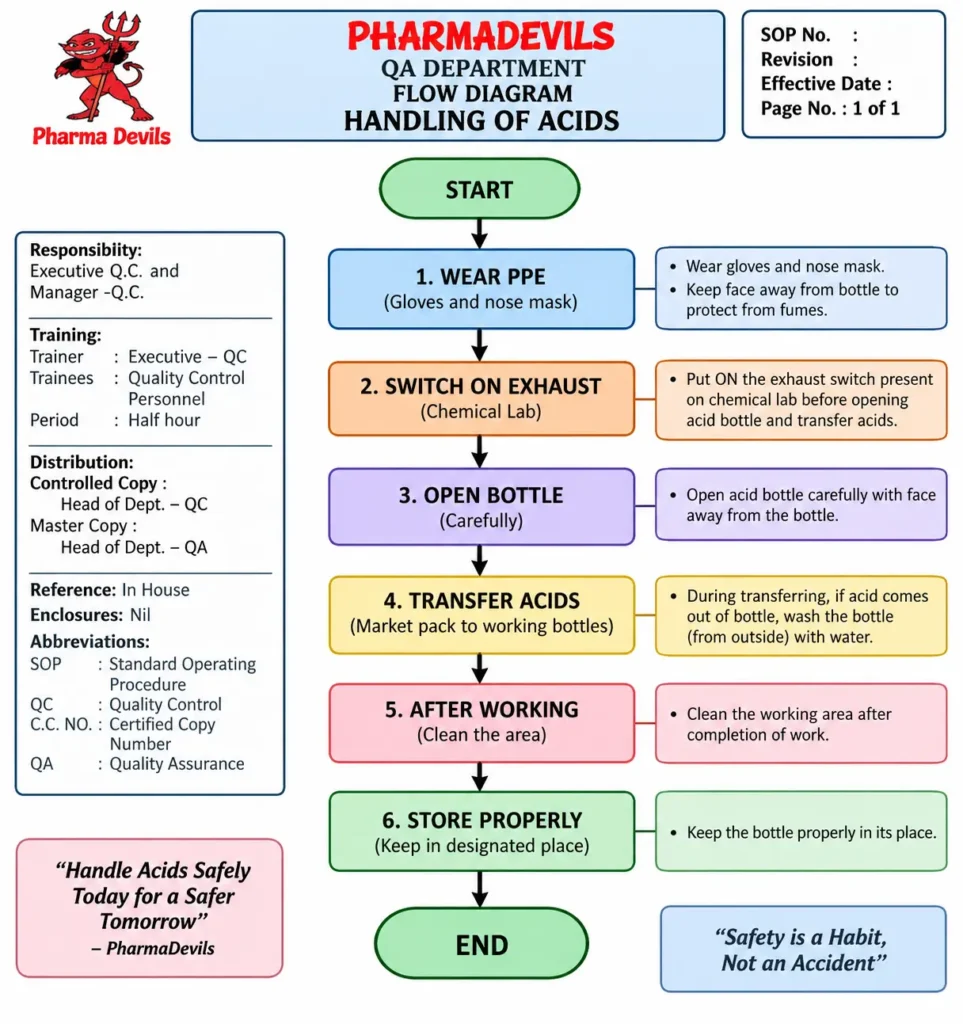
The acid bottle is then opened carefully while keeping the face away from the bottle to avoid exposure to fumes. Acids are transferred from the original market pack into working bottles, and any acid present on the outside of the bottle is washed off with water. After completion of the activity, the working area is cleaned and the acid bottle is returned to its designated storage location. The diagram emphasizes personnel safety, proper ventilation, careful handling, cleanliness, and correct storage practices during acid handling activities.
2. Brainstorming for SOP Failure:
The brainstorming diagram highlights the main possible causes of failure to follow the SOP for Handling of Acids. It presents the central problem in a sticky-note format and connects it with key contributing factors such as PPE not being worn, exhaust system not switched on, unsafe bottle opening, face positioned too close to acid fumes, acid spillage during transfer, bottle outer surface not washed, working area not cleaned, improper bottle storage, inadequate training, lack of supervision, SOP unavailability, and human error or negligence.
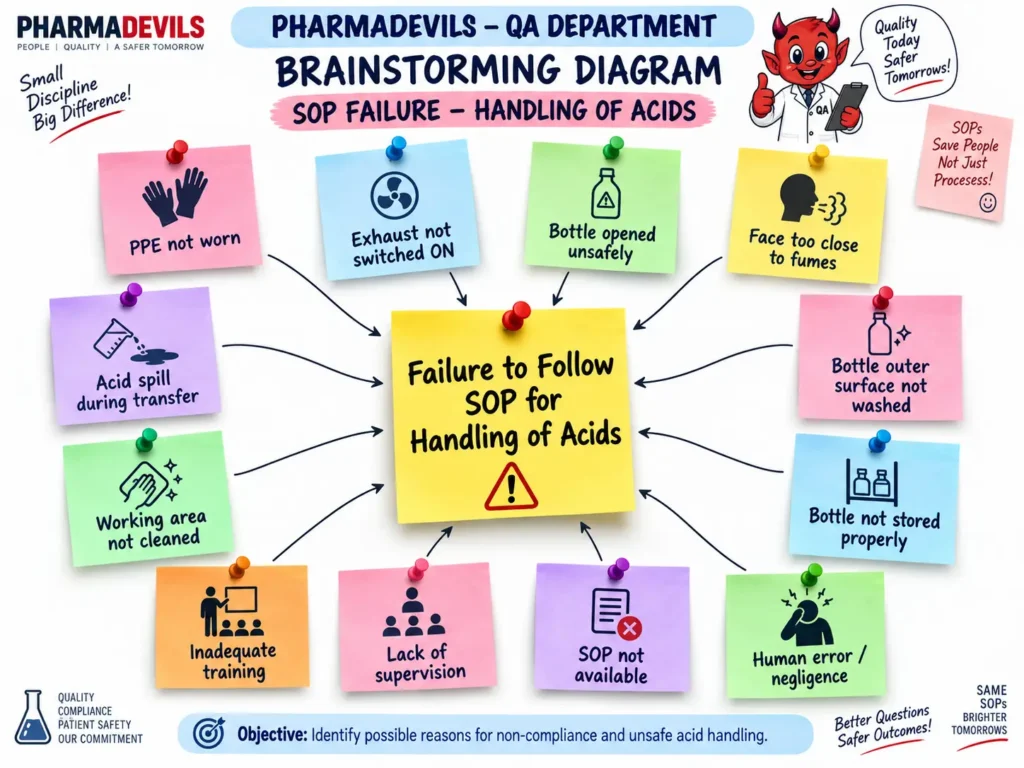
The diagram helps personnel quickly understand where non-compliance may occur during acid handling activities. These identified causes are consistent with the SOP requirements for PPE, exhaust operation, careful transfer, cleaning, proper storage, and training.It can be used as a practical starting point for further root cause analysis, 5-Why analysis, CAPA development, and training improvement.
3. 5-Why Analysis for SOP Failure:
The 5-Why analysis examines the possible reasons behind failure to follow the SOP for Handling of Acids. It starts with the immediate failure: the operator did not wear the required PPE and opened the acid bottle without switching on the laboratory exhaust system. These are key safety requirements stated in the SOP.
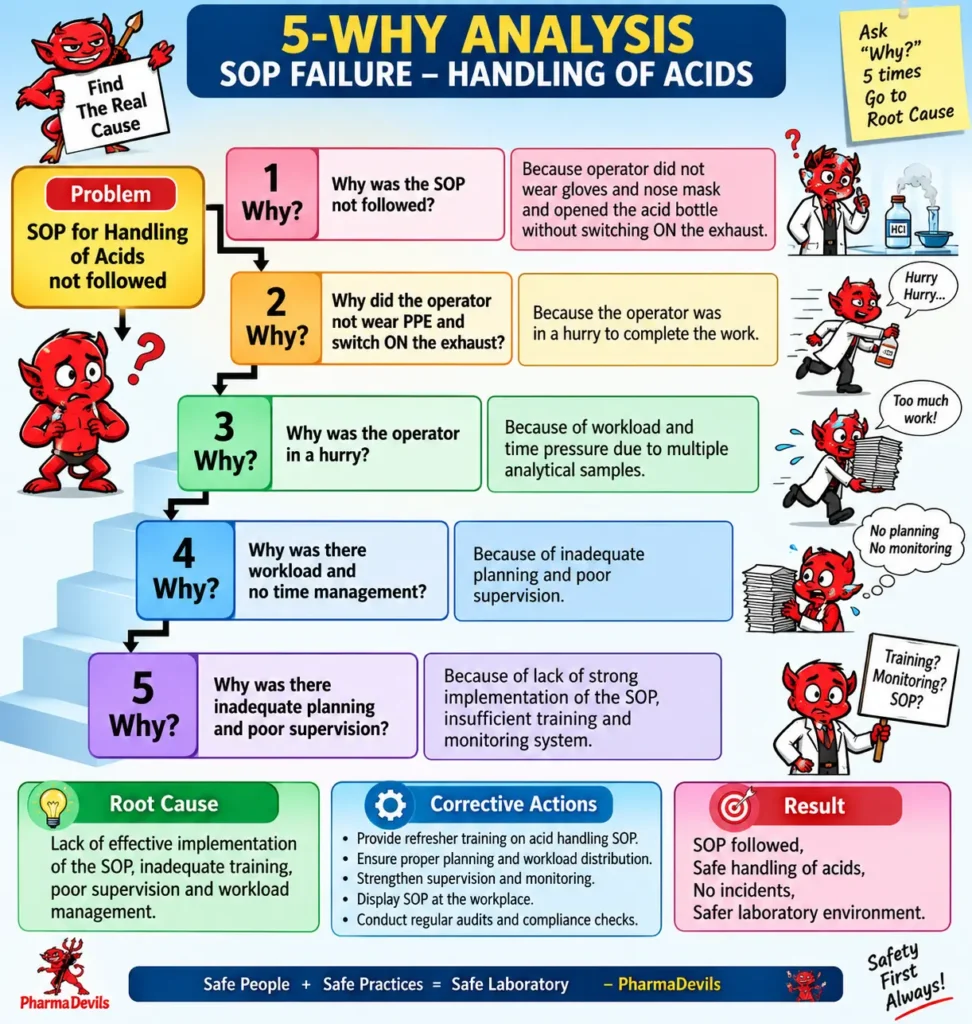
The analysis then traces the failure through possible contributing factors such as working in a hurry, workload and time pressure, inadequate planning, poor supervision, insufficient training, and weak SOP implementation. The diagram identifies the probable root cause as ineffective implementation of the SOP combined with inadequate training, supervision, and workload management.Corrective actions include refresher training, better workload planning, stronger supervision, easy availability of the SOP, and regular compliance checks. The objective is to ensure consistent SOP compliance and safer acid handling in the QC laboratory.
4. Fishbone Analysis for SOP Failure:
The Fishbone Analysis diagram identifies potential causes for failure to follow the SOP for Handling of Acids using six major categories: Man, Machine, Method, Material, Measurement, and Environment. The central problem is non-compliance with the acid-handling SOP.
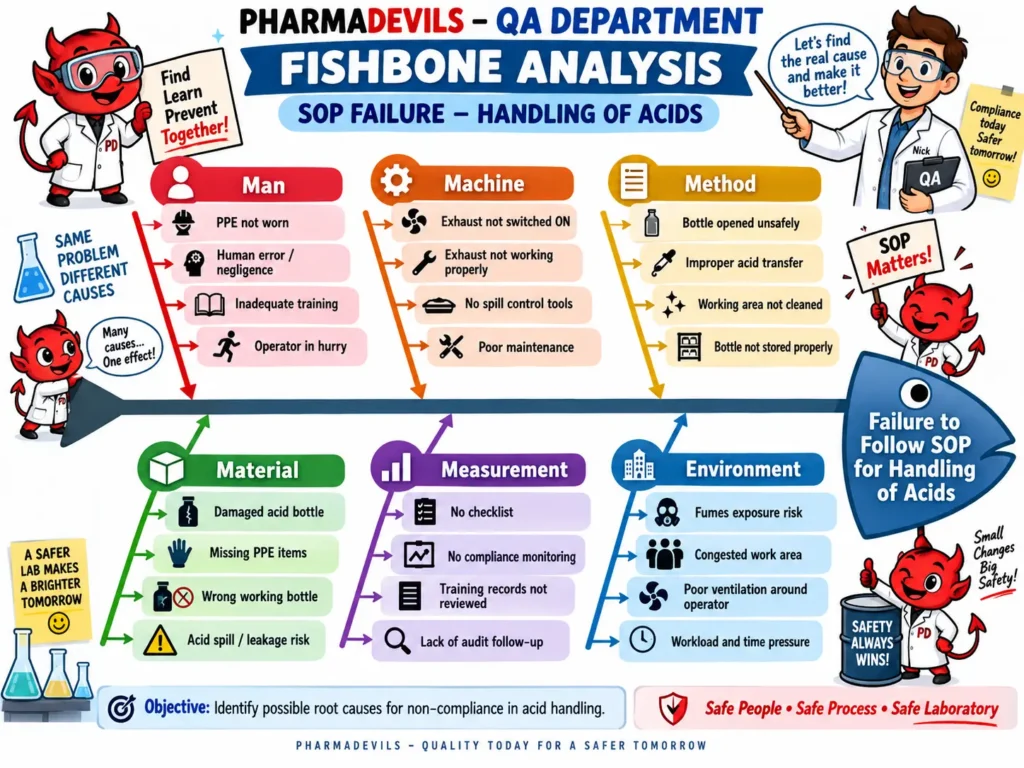
Possible causes include PPE not being worn, human error, inadequate training, and operators working in a hurry under the Man category. Machine-related factors include the exhaust not being switched on or not functioning properly. Method-related causes include unsafe bottle opening, improper acid transfer, poor cleaning, and incorrect storage. Material issues may involve damaged acid bottles, missing PPE items, or leakage risks. Measurement causes include lack of checklists, weak compliance monitoring, and poor review of training records, while environmental factors include fume exposure, poor ventilation, congested work areas, and time pressure.The diagram helps organize potential causes systematically and supports further root cause investigation and CAPA planning. The SOP itself requires PPE, exhaust use, careful transfer, cleaning, and proper storage of acid bottles.
5. Fault Tree Analysis for SOP Failure:
The Fault Tree Analysis diagram systematically evaluates the possible causes leading to the top event: “SOP for Handling of Acids Not Followed.” The failure is divided into major intermediate events such as PPE not used, exhaust system not switched ON, and unsafe handling of the acid bottle. These events are further linked to contributing causes including gloves or mask not worn, PPE unavailability, operator forgetfulness, exhaust malfunction, inadequate supervision, unsafe bottle opening, acid spillage, and failure to clean the bottle exterior.
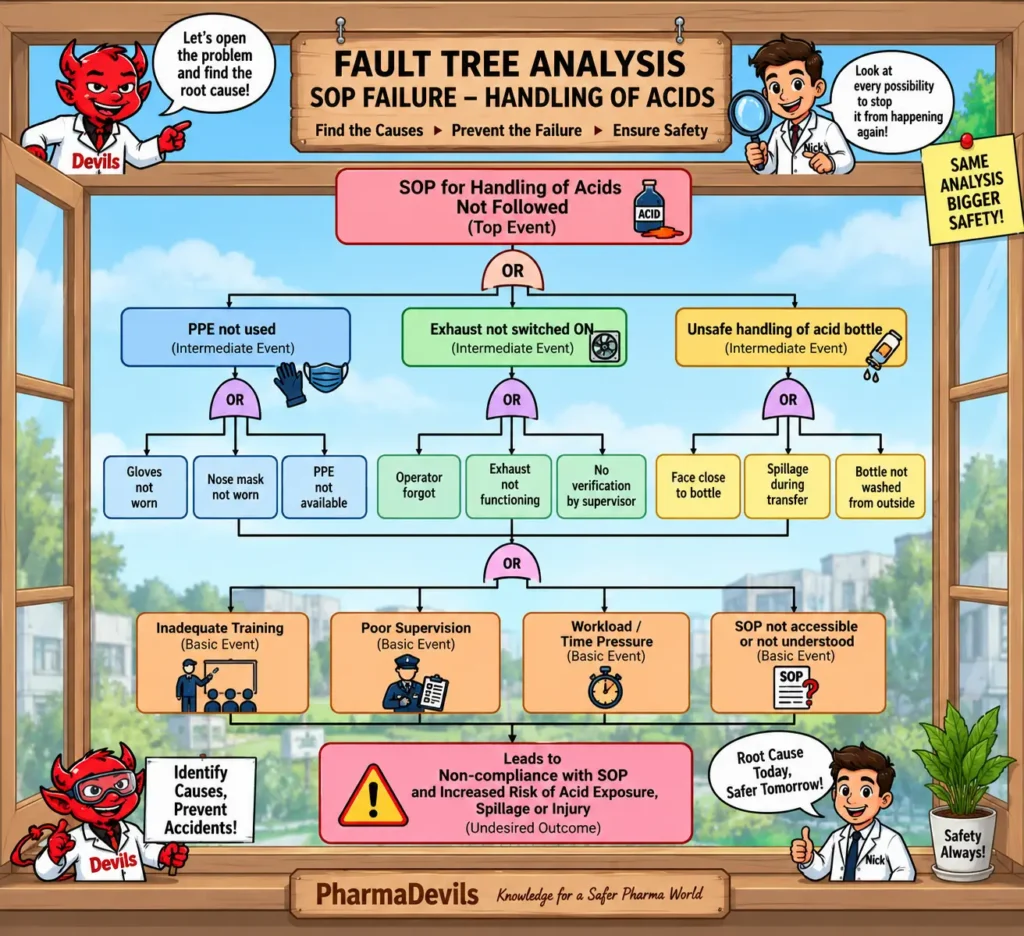
The diagram further identifies broader basic causes such as inadequate training, poor supervision, workload or time pressure, and poor SOP accessibility or understanding. These failures may result in acid exposure, spillage, injury, and overall SOP non-compliance. The original SOP specifically requires PPE, exhaust operation, careful transfer, cleaning, and proper storage of acids.
Questions & Answers – SOP for Handling of Acids
Q1. What is the objective of the SOP for Handling of Acids?
Answer: The objective is to lay down a procedure for safe handling of acids in the laboratory.
Q2. What is the scope of this SOP?
Answer: The SOP is applicable to acid handling activities.
Q3. Who is responsible for implementation of this SOP?
Answer: Executive QC and Manager QC are responsible.
Q4. What PPE should be worn while opening an acid bottle?
Answer: Gloves and a nose mask should be worn.
Q5. Why should the face be kept away from the acid bottle while opening it?
Answer: To protect the operator from fumes coming out of the bottle.
Q6. What should be done before opening or transferring acids?
Answer: The exhaust switch in the chemical laboratory should be switched ON.
Q7. What should be done if acid spills on the outside of the bottle during transfer?
Answer: The outside of the bottle should be washed with water.
Q8. What should be done after completion of acid handling work?
Answer: The working area should be cleaned.
Q9. Where should the acid bottle be kept after use?
Answer: It should be kept properly in its designated place.
Q10. Who provides training on this SOP?
Answer: Executive – Quality Control.
Q11. Who are the trainees for this SOP?
Answer: Quality Control personnel.
Q12. What is the training duration?
Answer: Half an hour.
Q13. Who receives the controlled copy of this SOP?
Answer: Head of Department – Quality Control.
Q14. Who retains the master copy?
Answer: Head of Department – Quality Assurance.
Q15. What reference is mentioned in the SOP?
Answer: The reference is stated as In House.
Reference Guidelines:
The uploaded SOP itself lists its reference as “In House.” For strengthening or updating the SOP, the following external guidelines can be used as supporting references:
- Schedule L-I, Drugs Rules, 1945 – Good Laboratory Practices and Requirements of Premises and Equipment
Relevant for pharmaceutical QC laboratory practices, documented systems, laboratory management, safety, and GLP compliance. (CDSCO)
CDSCO – Drugs Rules, 1945 - Revised Schedule M – Good Manufacturing Practices and Requirements of Premises, Plant and Equipment for Pharmaceutical Products
Supports documented procedures, personnel responsibilities, training, pharmaceutical quality systems, and safe laboratory practices. (CDSCO)
CDSCO – Revised Schedule M Notification - WHO TRS 1052, Annex 4 – Good Practices for Pharmaceutical Quality Control Laboratories, 2024
Provides current WHO guidance for pharmaceutical QC laboratory organization, personnel, safety, equipment, documentation, and laboratory operations. (World Health Organization)
WHO Good Practices for Pharmaceutical Quality Control Laboratories - OSHA 29 CFR 1910.1450 – Occupational Exposure to Hazardous Chemicals in Laboratories
Relevant to laboratory use of hazardous chemicals, exposure controls, protective measures, training, and chemical hygiene practices. (OSHA)
OSHA Laboratory Chemical Safety Standard - OSHA 29 CFR 1910.1200 – Hazard Communication Standard
Relevant to chemical hazard classification, labels, Safety Data Sheets (SDS), employee information, training, and protective measures for acids and other hazardous chemicals. (OSHA)
OSHA Hazard Communication Standard
For this particular SOP, the most directly relevant references are Schedule L-I, WHO TRS 1052 Annex 4, OSHA 1910.1450, and the SDS of each individual acid being handled.