







1. Introduction – Handling of Defective Blisters, Strips or Containers from Secondary Packing:
The SOP for Handling of Defective Blisters, Strips or Containers from Secondary Packing defines a systematic procedure for identifying, segregating, handling, recovering, reconciling, and disposing of defective packaging generated during secondary packing operations. The procedure covers defective blisters and strips caused by issues such as improper sealing, powder shedding, defective tablets or capsules, overprinting defects, and incorrect pack size. Such rejected packs are collected in designated containers, transferred in properly labeled polybags, and subjected to de-foiling as per the applicable procedure. Empty blister, strip, foil, and PVC waste is weighed, reconciled, documented, and sent to the scrap yard. For defective containers, the SOP requires proper segregation and labeling, transfer to the respective cubicle, removal and inspection of tablets or capsules, and refilling only when the recovered product complies with specifications. The rejected containers and closures are de-shaped, labels are removed or defaced, and the materials are sent for disposal. This SOP helps maintain product quality, traceability, reconciliation, GMP compliance, and controlled disposal of rejected packaging materials.
Skip to PDF content2. Flow Diagram – Handling of Defective Blisters, Strips or Containers from Secondary Packing:
The SOP for Handling of Defective Blisters, Strips or Containers from Secondary Packing describes the controlled procedure for managing rejected or defective packaging components generated during secondary packing operations. Defective blisters or strips may include packs with improper sealing, powder shedding, damaged tablets or capsules, overprinting defects, or incorrect pack size. These defective packs are removed from the packing line, collected in designated crates, transferred into pre-labeled double polybags, and sent to the primary packing cubicle for de-foiling. The empty blister or strip waste is then weighed, labeled, reconciled, documented, and transferred to the scrap yard.
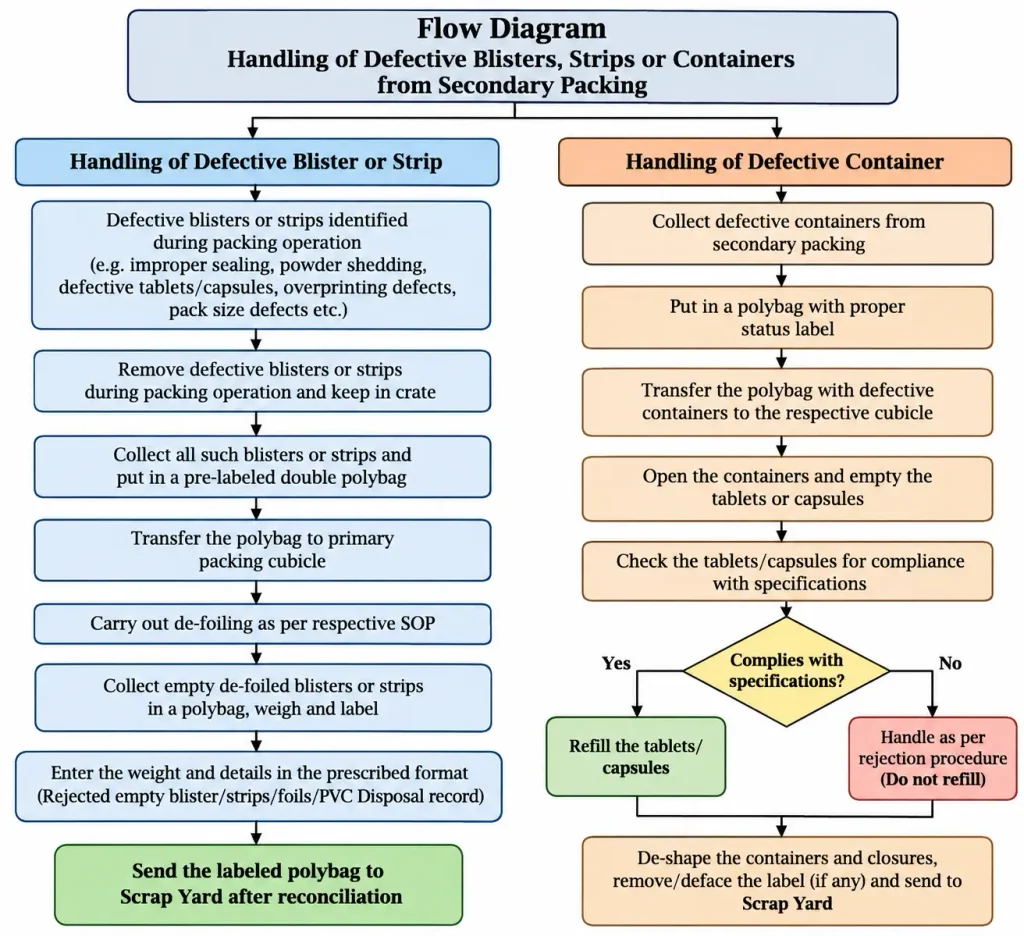
For defective containers, the procedure requires proper collection, status labeling, transfer to the respective cubicle, opening of containers, and checking of recovered tablets or capsules. Materials meeting specifications may be refilled, while the rejected containers and closures are de-shaped, labels are removed or defaced, and the waste is sent to the scrap yard. This SOP supports effective reconciliation, traceability, segregation, and GMP-compliant disposal of defective packaging materials.
2. Handling of Defective Blisters, Strips or Containers from Secondary Packing:
The SOP for Handling of Defective Blisters, Strips or Containers from Secondary Packing provides a controlled system for the identification, segregation, handling, reconciliation, and disposal of defective packaging materials generated during packing activities. Defective blisters or strips may include improper sealing, powder shedding, damaged tablets or capsules, overprinting defects, or incorrect pack size. These are removed from the packing operation, collected in crates, transferred into pre-labeled double polybags, and taken to the primary packing cubicle for de-foiling. The empty packaging material is then weighed, labeled, reconciled, documented, and sent to the scrap yard.
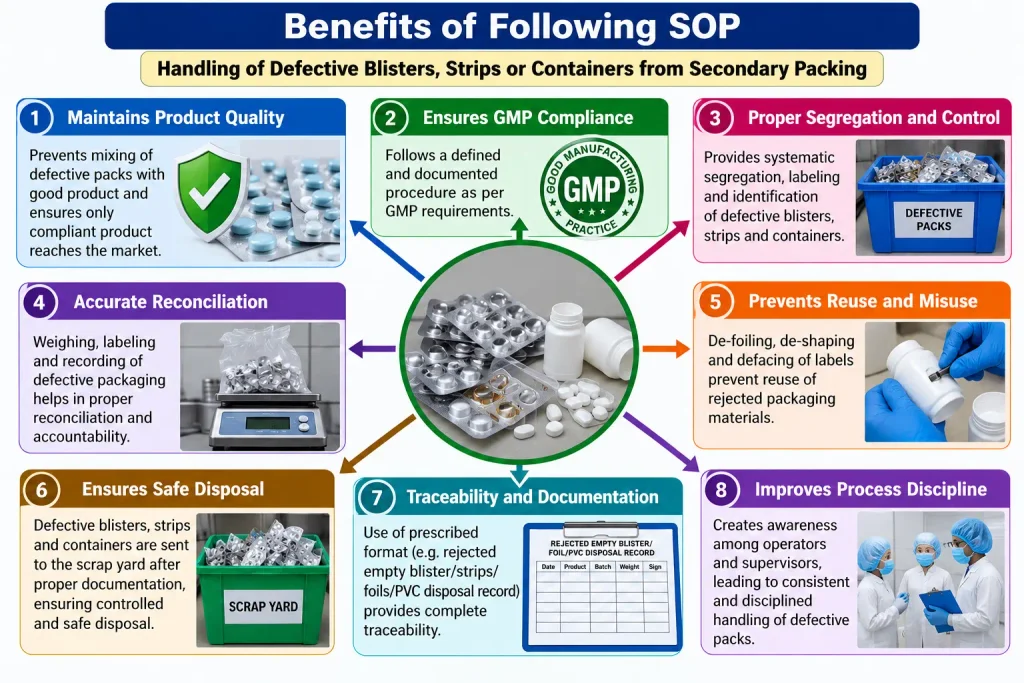
For defective containers, the SOP requires proper collection, status labeling, transfer to the appropriate cubicle, opening of the container, and inspection of the recovered tablets or capsules. Material complying with specifications may be refilled, while the rejected container and closure are de-shaped, labels are removed or defaced, and the waste is sent to the scrap yard. Following this SOP helps ensure GMP compliance, product quality, proper segregation, accurate reconciliation, traceability, controlled disposal, and prevention of misuse or unintended reuse of rejected packaging materials.
3. Handling of Defective Blisters, Strips or Containers from Secondary Packing:
The SOP for Handling of Defective Blisters, Strips or Containers from Secondary Packing establishes a controlled method for identification, segregation, handling, reconciliation, recovery, and disposal of defective packs generated during packing operations. The SOP identifies defects such as improper sealing, powder shedding, damaged tablets or capsules, overprinting defects, and incorrect pack size. Defective blisters or strips are removed from the packing line, collected in designated crates, placed in pre-labeled double polybags, transferred to the primary packing cubicle, and de-foiled as per the applicable procedure. The resulting empty packaging material is weighed, labeled, documented, reconciled, and sent to the scrap yard.
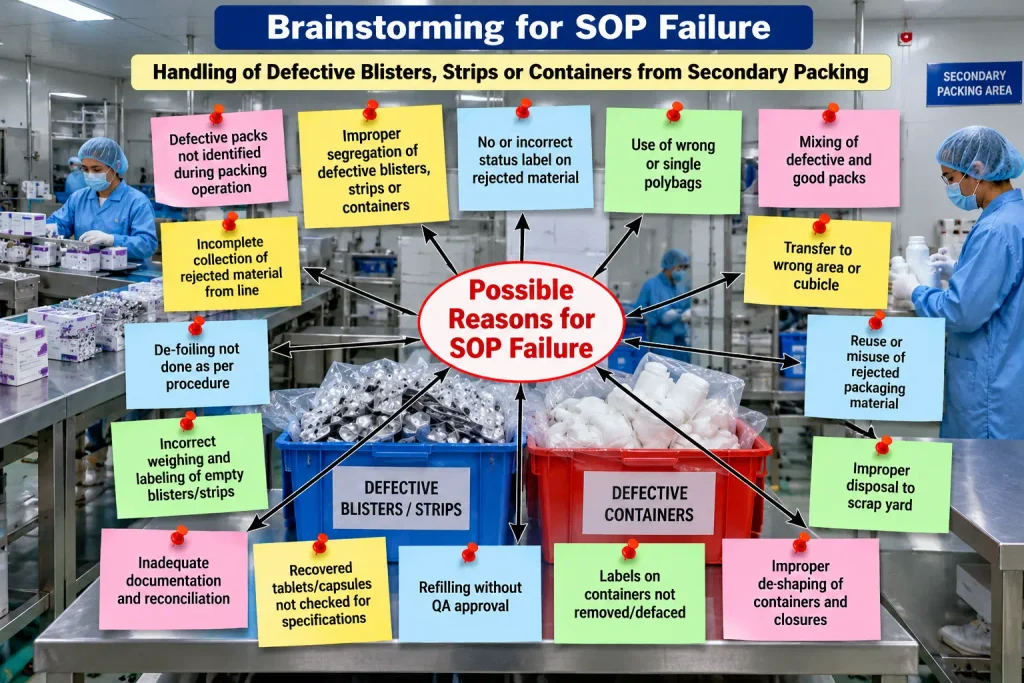
For defective containers, the SOP requires collection in properly labeled polybags, transfer to the respective cubicle, opening of containers, and checking of recovered tablets or capsules against specifications. Complying material may be refilled, while containers and closures are de-shaped, labels are removed or defaced, and the rejected packaging is sent to the scrap yard. Failure to follow this SOP can result in poor segregation, incorrect labeling, inadequate reconciliation, improper disposal, mixing of defective and acceptable packs, and loss of traceability. Proper implementation therefore supports GMP compliance, product quality, accountability, and controlled disposal of rejected packaging materials.
4. Handling of Defective Blisters, Strips or Containers from Secondary Packing:
The SOP for Handling of Defective Blisters, Strips or Containers from Secondary Packing defines the controlled method for managing rejected packaging generated during packing operations. It requires defective blisters or strips to be identified, removed from the packing line, collected in crates, placed in pre-labeled double polybags, transferred to the primary packing cubicle, and de-foiled as per the applicable procedure. The resulting empty blister or strip material is then weighed, labeled, reconciled, documented, and sent to the scrap yard.
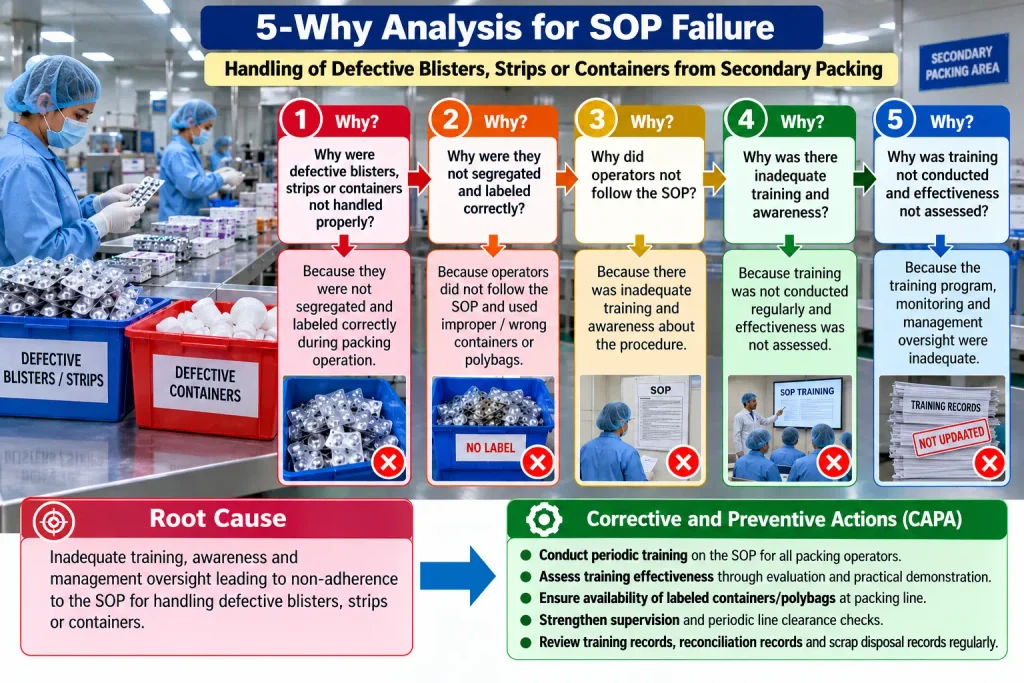
For defective containers, the SOP requires collection in properly labeled polybags, transfer to the respective cubicle, opening of the containers, and inspection of recovered tablets or capsules. If the recovered dosage units comply with specifications, they may be refilled. The rejected containers and closures are de-shaped, labels are removed or defaced, and the materials are sent to the scrap yard. Failure to follow these requirements can lead to improper segregation, incorrect labeling, poor reconciliation, unintended reuse of rejected material, and loss of traceability. Effective training, supervision, correct status labeling, complete documentation, and routine review of disposal records are therefore important for maintaining GMP compliance, product quality, accountability, and controlled handling of defective packaging materials.
5. Handling of Defective Blisters, Strips or Containers from Secondary Packing:
The SOP for Handling of Defective Blisters, Strips or Containers from Secondary Packing provides a defined system for the controlled handling of defective packaging generated during packing operations. It requires defective blisters or strips to be removed from the line, collected separately, placed in pre-labeled double polybags, transferred to the primary packing cubicle, and de-foiled as per the applicable procedure. The empty rejected packaging is then weighed, labeled, reconciled, documented, and sent to the scrap yard.
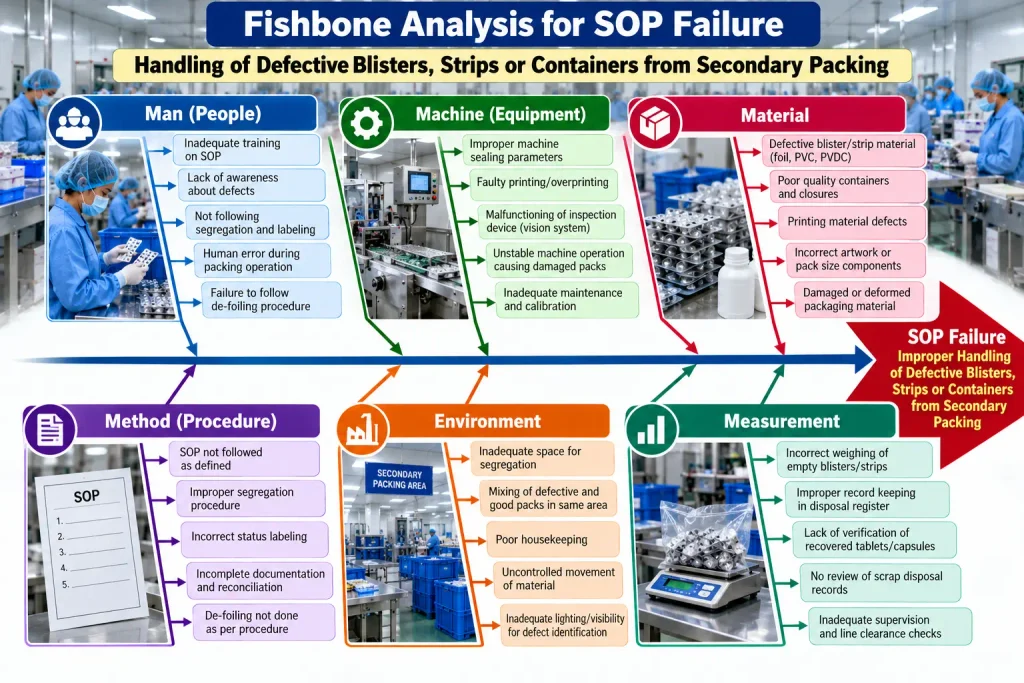
For defective containers, the SOP requires collection in a properly status-labeled polybag, transfer to the respective cubicle, opening of the containers, and checking of the tablets or capsules recovered from them. Material complying with specifications may be refilled, while the rejected containers and closures are de-shaped, labels are removed or defaced, and the waste is sent to the scrap yard. The fishbone analysis shows that SOP failure may arise from factors related to people, equipment, materials, procedures, environment, and measurement, such as inadequate training, poor segregation, incorrect labeling, incomplete documentation, defective packaging components, improper weighing, and weak supervision. Controlling these factors helps maintain GMP compliance, traceability, reconciliation, product quality, and controlled disposal of rejected packaging materials.
6. Handling of Defective Blisters, Strips or Containers from Secondary Packing:
The SOP for Handling of Defective Blisters, Strips or Containers from Secondary Packing defines the controlled handling of rejected packaging materials generated during secondary packing activities. Defective blisters or strips are identified during packing, removed from the line, collected in a crate, placed in a pre-labeled double polybag, transferred to the primary packing cubicle, and de-foiled as per the respective SOP. The empty de-foiled packaging is then collected, weighed, labeled, reconciled, documented, and sent to the scrap yard.
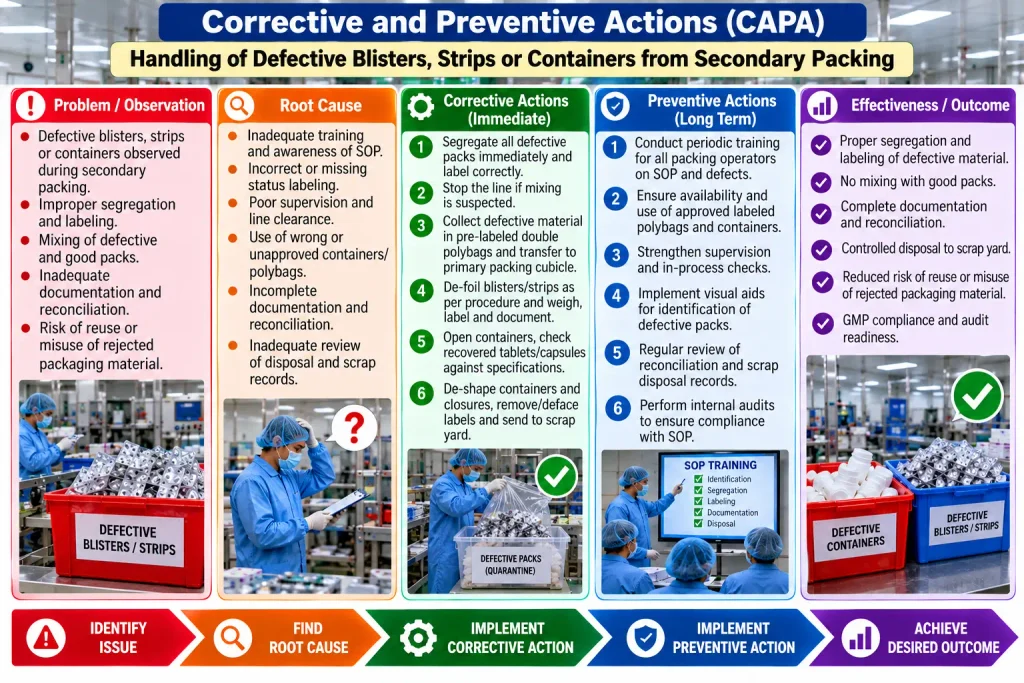
For defective containers, the SOP requires collection in a properly status-labeled polybag, transfer to the respective cubicle, opening of the containers, and checking of recovered tablets or capsules. Material found complying with specifications may be refilled. The rejected containers and closures are de-shaped, labels are removed or defaced, and the packaging waste is sent to the scrap yard. ,Effective CAPA for SOP failure should focus on correcting improper segregation, labeling, documentation, reconciliation, and disposal practices, while strengthening operator training, supervision, and routine record review. Proper implementation supports GMP compliance, traceability, product quality, controlled disposal, and prevention of reuse or misuse of rejected packaging materials.
7. Handling of Defective Blisters, Strips or Containers from Secondary Packing:
The SOP for Handling of Defective Blisters, Strips or Containers from Secondary Packing is intended to ensure that defective packaging materials are identified, segregated, controlled, documented, reconciled, and disposed of in a systematic manner. Failure to follow this SOP can have a significant impact on product quality, GMP compliance, patient safety, operations, documentation, environment, financial performance, and company reputation. Improper handling may result in mixing of defective and acceptable packs, product damage, contamination, or release of non-compliant material. It may also lead to regulatory observations, warning letters, product recalls, customer complaints, and loss of confidence. Incomplete documentation or poor reconciliation can reduce traceability of defective materials and recovered tablets or capsules. Operationally, such failures can cause line stoppage, rework, increased workload, and delays in batch release. Improper disposal can also create environmental concerns and the risk of unauthorized reuse of rejected packaging materials.
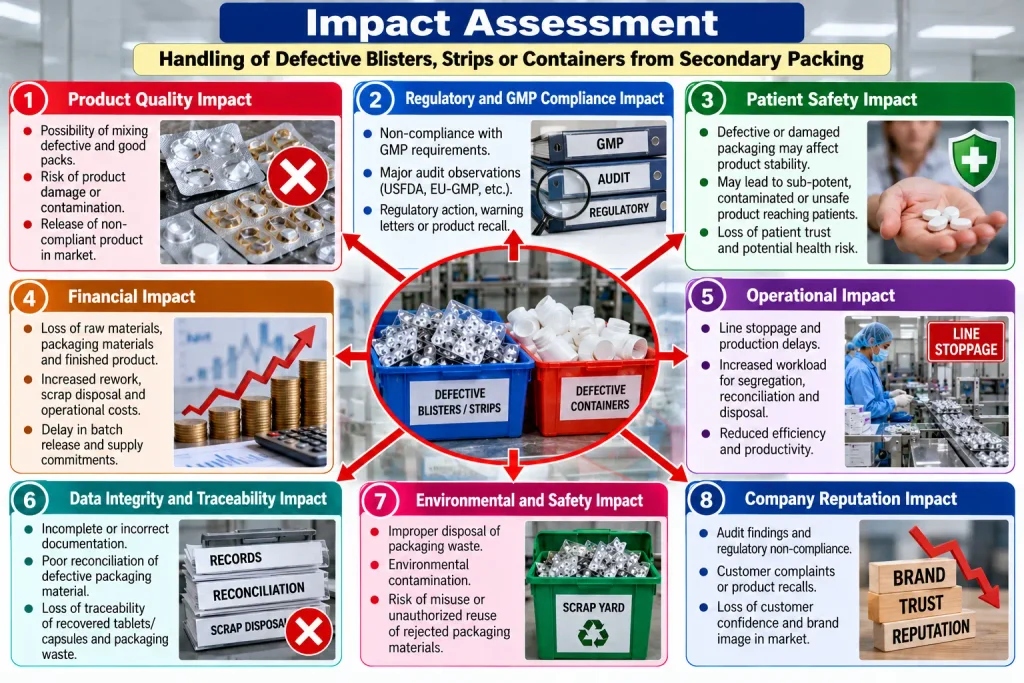
Therefore, strict compliance with this SOP is essential to maintain product quality, patient safety, data integrity, regulatory compliance, controlled disposal, and overall operational effectiveness.
Questions & Answers – Handling of Defective Blisters, Strips or Containers from Secondary Packing:
- What is the objective of this SOP?
The objective is to describe the procedure for handling defective blisters, strips, or containers generated from secondary packing operations - Who is responsible for supervising the handling of defective packaging?
The Packaging Supervisor is responsible for supervising the handling of defective blisters, strips, and containers from secondary packing. - Who confirms defects in blisters or strips?
The QA Chemist is responsible for confirming defects in strips or blisters. - What types of blister or strip defects may be generated during packing?
Examples include improper sealing, powder shedding, defective tablets or capsules, overprinting defects, and pack-size defects. - How should defective blisters or strips be handled initially?
They should be removed during the packing operation and kept in a crate. - How should accumulated defective blisters or strips be packed?
They should be collected and placed in a pre-labeled double polybag. - Where are defective blisters or strips transferred?
They are transferred to the primary packing cubicle for further handling. - What is done with defective blisters or strips after transfer?
De-foiling is carried out as per the respective Standard Operating Procedure. - What happens to empty de-foiled blister or strip material?
It is collected in a polybag, weighed, labeled, recorded, reconciled, and sent to the scrap yard. - How are defective containers handled?
Defective containers are collected from secondary packing, placed in a polybag with a proper status label, and transferred to the respective cubicle. - What is done with tablets or capsules removed from defective containers?
They are checked, and if found to comply with specifications, they may be refilled. - What should be done with rejected containers and closures?
Containers and closures should be de-shaped, labels should be removed or defaced where applicable, and the material should be sent to the scrap yard. - What record is maintained for disposal of rejected packaging material?
The SOP includes an annexure titled Rejected Empty Blister/Foil/PVC/PVDC Disposal Record. - Why is reconciliation important in this SOP?
Reconciliation helps ensure that rejected packaging materials are accounted for before disposal and supports traceability of scrap generated during packing. This purpose is reflected in the requirement to record weight and disposal details before sending material to the scrap yard. - What is the reference stated in the SOP?
The SOP states the reference as “As per GMP.”
Reference Guideline – Handling of Defective Blisters, Strips or Containers from Secondary Packing:
- Schedule M of Drugs and Cosmetics Rules, India – GMP requirements for pharmaceutical manufacturing and packaging operations.
- WHO Good Manufacturing Practices for Pharmaceutical Products – guidance on packaging operations, prevention of mix-ups, rejected materials, documentation, and waste handling.
- EU Guidelines for Good Manufacturing Practice, Part I, Chapter 5 – Production – requirements for packaging operations, line clearance, prevention of mix-ups, and control of printed packaging materials.
- EU GMP, Chapter 4 – Documentation – requirements for controlled and traceable documentation.
- 21 CFR Part 211.122 – Materials Examination and Usage Criteria – control and examination of labeling and packaging materials.
- 21 CFR Part 211.125 – Labeling Issuance – control and reconciliation of labels.
- 21 CFR Part 211.130 – Packaging and Labeling Operations – controls to prevent mix-ups and ensure proper packaging and labeling.
- 21 CFR Part 211.192 – Production Record Review – review and investigation of discrepancies and unexplained deviations.