




1. Introduction:
Returned goods are pharmaceutical products that come back from customers, depots, or the market for reasons such as expiry, damaged or broken containers, spoiled or unclear labels, commercial returns, or product recalls. Proper handling of these returned products is important because their quality, identity, storage history, and integrity may have been affected after leaving the company’s control. The SOP for Handling of Return Goods provides a systematic procedure for receiving, identifying, segregating, inspecting, evaluating, testing, and taking appropriate action on such products. According to the SOP, returned goods are received by the Warehouse along with supporting documents and the reason for return. Their details are recorded in the Return Goods Receipt Record and logbook, and the materials are transferred to a designated returned-goods area. Quality Assurance and Warehouse personnel then jointly inspect the consignment for quantity, container integrity, labeling, batch identification, and expiry status. Where required, the product may also be re-sampled and tested against applicable specifications. Expired products, products exposed to an unknown environment, or returned goods that fail current specifications are rejected or destroyed. Products with only superficial packaging or labeling issues may be redressed when their identity and quality remain acceptable, with the activity documented in the relevant batch records. The SOP therefore helps ensure that returned pharmaceutical products are controlled appropriately before any decision regarding rejection, destruction, redressing, or further disposition is made.
Skip to PDF content2. Flow Diagram:
The flow diagram explains the complete process for handling returned pharmaceutical goods in a controlled and documented manner. The process starts when returned goods are received by the Warehouse along with the invoice, challan, and reason for return. Details are recorded in the Return Goods Receipt Record and logbook, after which the goods are transferred to a designated “Returned Goods” area. Quality Assurance and Warehouse personnel jointly inspect the returned goods for quantity, package integrity, labeling, batch identification, and expiry status. If required, the product is re-sampled and tested according to the applicable specifications.
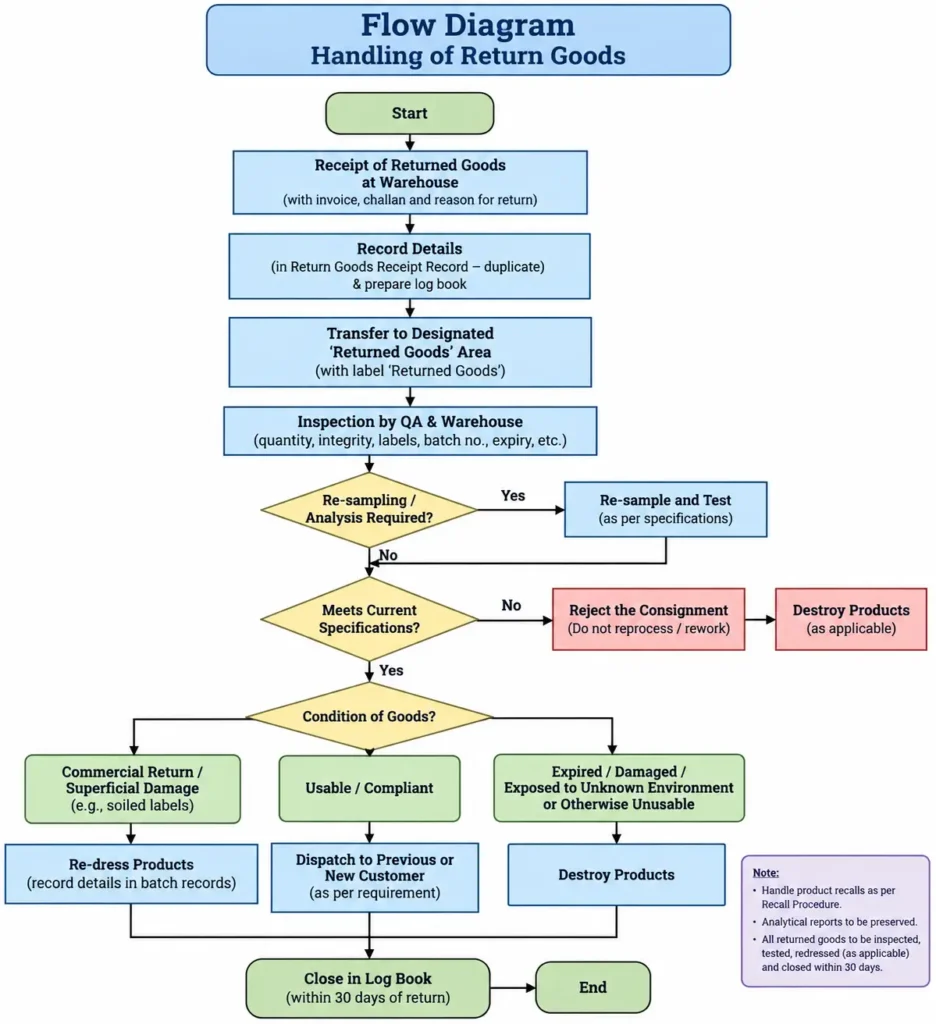
If the returned product does not meet current specifications, it is rejected. Expired, damaged, unsafe, or environmentally exposed products are destroyed. Products returned for commercial reasons or with superficial labeling problems may be redressed when their quality and identity remain acceptable, with the activity recorded in the batch documents. Acceptable products may then be dispatched as required. All returned-goods cases should be inspected, tested, redressed where applicable, and closed within 30 days of return.
2. Benefits of Following SOP:
The image shows how following the Handling of Return Goods SOP supports safe, controlled, and consistent pharmaceutical operations. In the manufacturing environment, trained personnel follow defined procedures while the illustrated devil characters emphasize discipline, correct practices, and GMP compliance. Following the SOP helps maintain product quality by ensuring returned goods are properly received, identified, segregated, inspected, evaluated, tested when required, and appropriately disposed of or redressed. It also improves personnel and product safety by preventing unsuitable returned materials from re-entering normal operations.
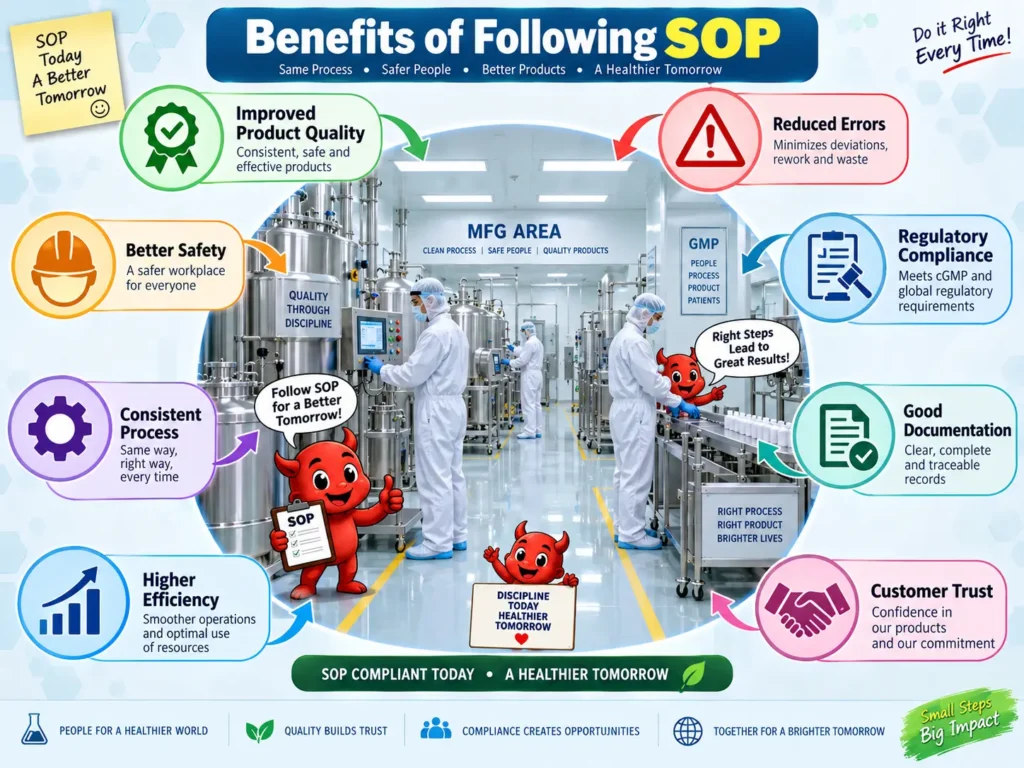
The image highlights additional benefits such as reduced errors, fewer deviations, better process consistency, higher operational efficiency, proper documentation, and improved traceability. Clear records also help Quality Assurance review each returned-goods case and support regulatory compliance. Overall, following the SOP improves control over returned pharmaceutical products, reduces the risk of mix-ups or inappropriate reuse, strengthens GMP practices, and builds confidence in the company’s quality system and products.
3. Brainstorming for SOP Failure:
The brainstorming image shows a team in the pharmaceutical manufacturing core area discussing possible reasons for failure of the Handling of Return Goods SOP. The purpose of brainstorming is to collect all possible causes before starting a detailed root-cause investigation. Major potential causes shown in the image include lack of training and awareness, poor understanding of the SOP, weak communication between Warehouse, QA and Production, inadequate manpower, commercial pressure, poor segregation of returned goods, unclear or damaged labels, insufficient inspection, skipping re-sampling or testing, poor logbook maintenance, weak QA review, improper disposal, and human error.
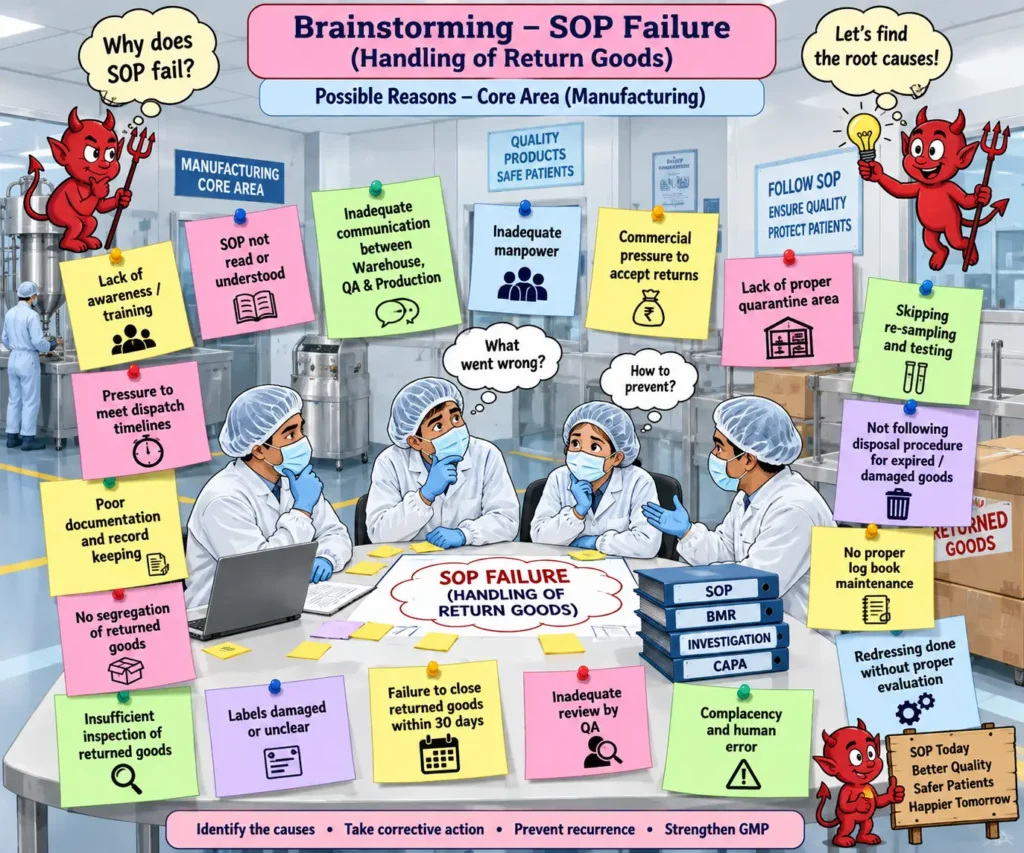
The SOP requires returned goods to be properly received, recorded, segregated, inspected jointly by Warehouse and QA, and re-sampled when required. It also requires unsuitable, expired, damaged, or exposed products to be appropriately rejected or destroyed, while acceptable superficial returns may be redressed with proper documentation. Overall, brainstorming helps the investigation team identify gaps related to people, procedure, documentation, communication, inspection, storage, testing, and QA oversight, so that effective CAPA can be developed and recurrence of SOP failure can be prevented.
5. 5-Why Analysis for SOP Failure:
The 5-Why analysis explains the possible root cause behind failure to follow the Handling of Return Goods SOP. The problem begins when returned goods are not handled according to the approved procedure. The first identified issue is that returned materials may not be properly segregated from regular stock. The analysis then goes deeper: improper segregation may occur because warehouse personnel are not fully aware of the SOP requirements. This lack of awareness can result from inadequate training and poor communication between Warehouse, QA, and management. Further investigation indicates that training may be ineffective because there is insufficient supervision, monitoring, and periodic review by Quality Assurance.
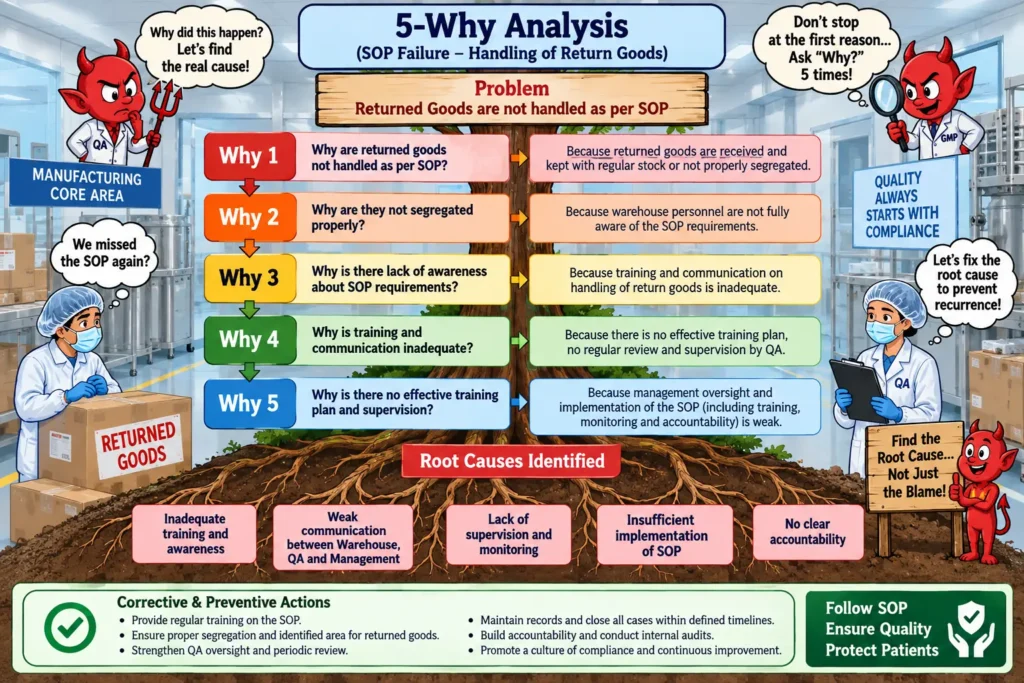
The final root cause points toward weak implementation and management oversight of the SOP, including unclear accountability and inadequate control of training and monitoring activities. The analysis therefore highlights key areas for improvement: regular SOP training, proper segregation of returned goods, stronger QA review, better communication, defined responsibilities, complete documentation, and periodic compliance checks. These actions help prevent recurrence and strengthen GMP control.
6. Fishbone Analysis for SOP Failure:
The Fishbone Analysis diagram identifies the possible causes behind failure of the Handling of Return Goods SOP in the pharmaceutical core area. The main problem is that returned goods are not handled according to the approved SOP. The possible causes are grouped into major categories such as Man/People, Method/Procedure, Material/Product, Machine/Area, Measurement/Documentation, and Management/Supervision. Under people-related causes, the diagram highlights lack of training, poor awareness, human error, and manpower shortage. Procedure-related causes include poor segregation, lack of SOP understanding, skipped re-sampling, and improper disposal steps.
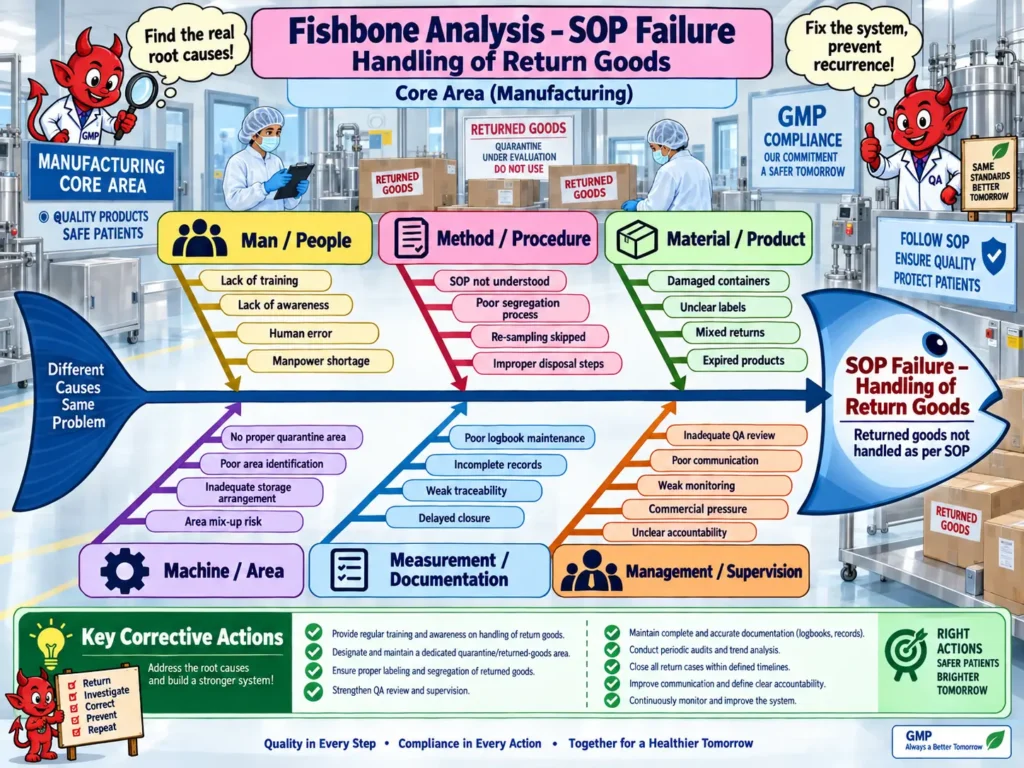
Material-related issues include damaged containers, unclear labels, mixed returns, and expired products. Area-related causes include absence of a proper quarantine area, poor area identification, inadequate storage arrangements, and risk of mix-up. Documentation causes include incomplete records, poor logbook maintenance, weak traceability, and delayed closure. Management causes include inadequate QA review, weak monitoring, poor communication, commercial pressure, and unclear accountability. The analysis helps the investigation team systematically identify root causes and develop suitable CAPA to strengthen returned-goods control and prevent recurrence.
7. Fault Tree Analysis for SOP Failure:
The Fault Tree Analysis shows how different failures can lead to the top event: “SOP for Handling of Return Goods is not followed.” The diagram breaks the problem into major branches covering receipt and recording, segregation and storage, inspection and testing, and final disposition of returned goods. Possible basic causes include lack of training, high workload, incomplete documentation, poor logbook maintenance, inadequate quarantine arrangements, mixing returned goods with regular stock, human error, insufficient supervision, lack of awareness, inadequate QA review, time pressure, manpower shortage, commercial pressure, poor risk assessment, and unclear disposal practices.
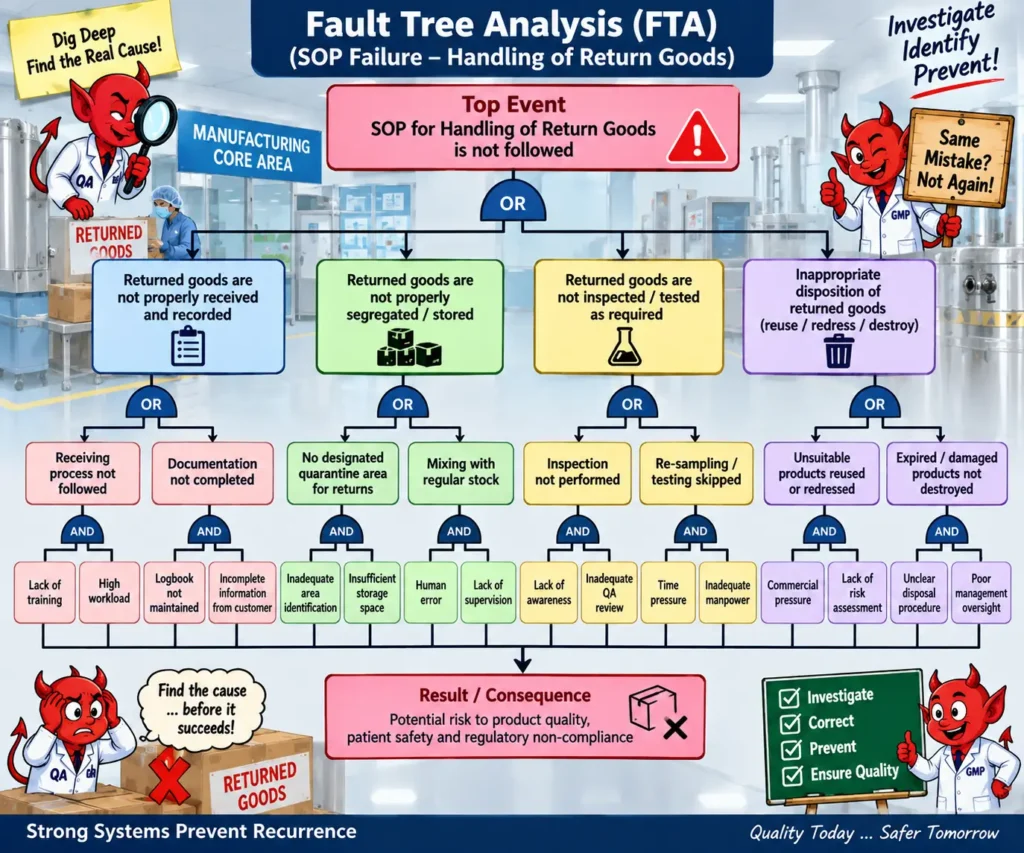
The SOP requires returned goods to be properly received, documented, transferred to a designated area, and inspected jointly by Warehouse and QA. Re-sampling and testing are performed when required. It also defines actions for damaged, exposed, rejected, expired, and redressed products. Overall, the FTA helps identify how several small control failures can combine and create risks to product quality, patient safety, traceability, and GMP compliance. It supports investigation, CAPA planning, stronger supervision, better training, and prevention of recurrence.
8. Impact Assessment:
The impact assessment image explains the possible consequences when the Handling of Return Goods SOP is not followed properly. The assessment focuses on major areas such as product quality, patient safety, segregation, testing, documentation, disposition, recall handling, closure timelines, and the overall quality system. Returned goods that are damaged, expired, exposed, or deteriorated may be incorrectly accepted if inspection and evaluation controls are weak. Poor segregation can lead to mix-ups with approved or saleable stock, while missed re-sampling or testing may result in an incorrect quality decision. Incomplete records or logbooks can reduce traceability and make investigation difficult.
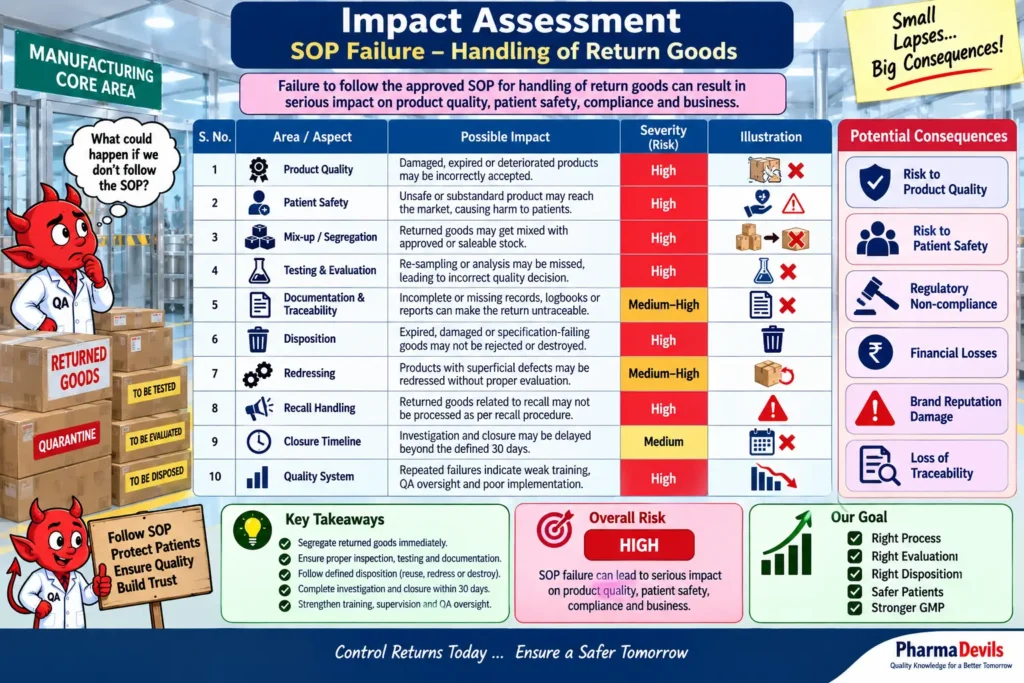
The SOP requires returned goods to be recorded, kept in a designated area, jointly inspected by Warehouse and QA, and re-sampled when necessary. It also requires unsuitable or specification-failing goods to be rejected or destroyed, with recall-related returns handled through the recall procedure and cases closed within 30 days. Overall, failure of the SOP may create significant risks to product quality, patient safety, GMP compliance, traceability, financial performance, and company reputation. Therefore, immediate segregation, proper evaluation, complete documentation, QA oversight, investigation, and suitable CAPA are essential.
Questions & Answers:
- What is the objective of the SOP?
The objective is to provide guidelines for proper handling of returned goods. - What is the scope of this SOP?
It applies to returned products received from the market or depots. - Who is responsible for execution of the SOP?
The Warehouse Department is responsible for execution of the SOP. - Who is responsible for effective implementation of the SOP?
The Quality Assurance Department is responsible for effective implementation. - What are the possible sources of returned goods?
Returned goods may come from customers, depots, expired stock, damaged or broken containers, spoiled or unclear labels, voluntary company recalls, or recalls directed by Drug Control Authorities. - What documents should accompany returned goods?
Returned goods should be received with a duly filled invoice, challan, and reason for return. - Where are returned-goods details recorded?
Details are recorded in the Return Goods Receipt Record in duplicate and also maintained in a returned-goods logbook. - Where should returned goods be stored after receipt?
They should be transferred to the designated returned-goods area and identified with a “Returned Goods” label. - Who inspects the returned goods?
Returned goods are jointly inspected by Quality Assurance and Warehouse personnel. - What should be checked during inspection?
Inspection includes quantity or weight shortage, integrity of the consignment, container and label condition, product and batch identification, and expiry date. - When is re-sampling performed?
Re-sampling may be carried out when required, followed by analysis according to the applicable specifications. - What action is taken for expired products?
Expired returned products are to be destroyed. - What happens if a primary container is damaged or broken?
The product is evaluated to determine whether the contents remain usable. If the damage has made the contents unsafe or unusable, the product is destroyed. - What action is taken when the contents have been exposed to an unknown environment?
Such returned products are to be destroyed. - Can returned products with only superficial label damage be redressed?
Yes. If the product remains clearly identifiable and the damage is only superficial, it may be redressed, with details recorded in the respective batch records. - What happens to redressed products?
They may be dispatched to the previous or a new customer depending upon the requirement. - What should be done with analytical reports of re-sampled products?
The analytical reports should be preserved. - What action is taken if the returned consignment does not meet current specifications?
The returned consignment is rejected. - Is reprocessing or reworking allowed for returned goods?
The SOP states that reprocessing or reworking is not carried out for returned goods, subject to product quality. - Within what time should returned-goods cases be closed?
Returned goods should be inspected, tested, redressed where applicable, and closed within 30 days of return. - How are returned goods related to product recalls handled?
They are handled according to the applicable Recall Procedure.
Reference Guidelines:
- US FDA – 21 CFR Part 211.204, Returned Drug Products: requires returned products to be identified and held, evaluated for storage/shipping history and product condition, destroyed when quality is doubtful unless investigation/testing demonstrates acceptability, and fully documented. (eCFR)
21 CFR 211.204 – Returned Drug Products - EU GMP, EudraLex Volume 4, Chapter 5 – Production, Section 5.67: products returned from the market after leaving manufacturer control should generally be destroyed unless their quality is unquestionably satisfactory following critical assessment according to a written procedure. (Public Health)
EU GMP Chapter 5 – Production - PIC/S GMP Guide PE 009, Part I, Chapter 5 – Rejected, Recovered and Returned Materials: requires returned products to be critically assessed considering product nature, storage requirements, condition, history, and elapsed time; actions taken should be recorded. (PIC Scheme)
PIC/S GMP Guide Part I - WHO GMP – Main Principles for Pharmaceutical Products: requires written SOPs and associated records for activities including returns and recalls. (World Health Organization)
WHO GMP Main Principles – TRS 986 Annex 2 - EU Guidelines on Good Distribution Practice (GDP), Section 6.9–6.12: provides controls for evaluating returned medicinal products before return to saleable stock, including packaging condition, documented storage/transport conditions, competent-person assessment, traceability, approval, and recording. (Public Health)
EU Good Distribution Practice Guidelines