




Brief Description
The SOP “Handling of the Spillage of Solid/Liquid Media Containing Growth” describes the procedure for safely removing microbial contamination from surfaces while minimizing health hazards. It applies to spillages of solid or liquid media containing microbial cultures in the Quality Control area. The Microbiologist is responsible for executing the procedure, while the Sr. Executive QC/Manager QC is responsible for its review and effective implementation.The procedure requires personnel to wear surgical gloves, spray the affected area with 70% isopropyl alcohol, allow a 5-minute contact time, and collect the spill debris using swabs and a dustpan. Contaminated material and the dustpan are then decontaminated by autoclaving. Contaminated cloths are soaked in 2.5% v/v Dettol, and any splash on the skin should be treated as soon as possible.The SOP also specifies training of Quality Control personnel under the Manager–Quality Control for a period of half an hour.
Skip to PDF content1. Flow Diagram:
The flow diagram summarizes the procedure for handling spillage of solid or liquid media containing microbial growth. It begins with wearing surgical gloves, followed by spraying the spilled area with 70% isopropyl alcohol and allowing a 5-minute contact time.
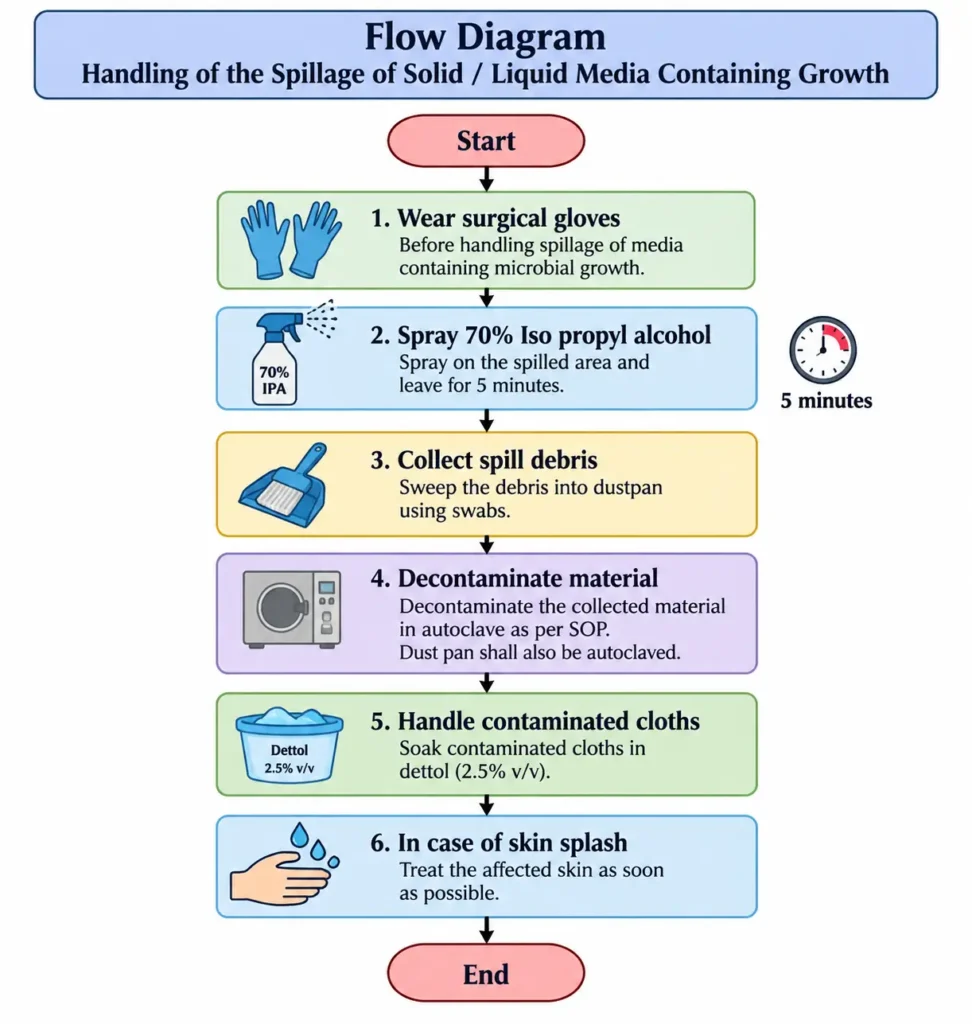
The spill debris is then collected using swabs and a dustpan. The collected contaminated material and dustpan are decontaminated by autoclaving, while contaminated cloths are soaked in 2.5% v/v Dettol. In case of any splash on the skin, the affected area should be treated as soon as possible.
2. Brainstorming Analysis for SOP Failure:
The Brainstorming for SOP Failure diagram identifies potential reasons why the procedure for handling spillage of solid or liquid media containing microbial growth may not be followed effectively. The SOP itself requires use of gloves, application of 70% isopropyl alcohol with a 5-minute contact time, collection of spill debris, autoclave decontamination, soaking contaminated cloths in 2.5% v/v Dettol, and prompt treatment of any skin splash.
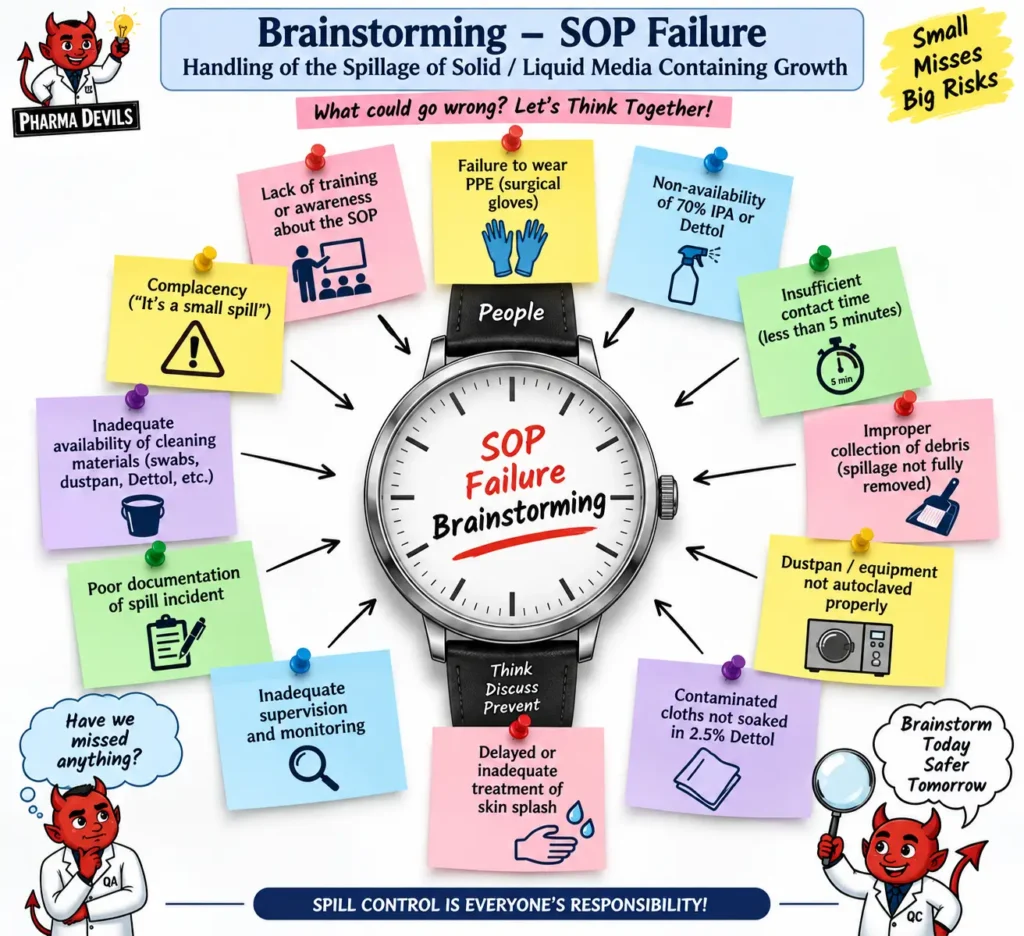
The brainstorming diagram expands these requirements into possible failure factors such as lack of training or awareness, failure to use PPE, non-availability of disinfectants or cleaning materials, inadequate contact time, incomplete spill collection, improper autoclaving, poor documentation, insufficient supervision, complacency, and delayed response to skin exposure. These are brainstorming-derived risk factors rather than items explicitly listed as failures in the SOP.The purpose of the analysis is to help the QC team identify procedural, personnel, material, training, and supervision-related weaknesses before they result in microbial contamination, personnel exposure, or ineffective spill control. The SOP assigns execution to the Microbiologist and review/effective implementation to QC supervisory personnel.
3. 5-Why Analysis for SOP Failure:
The 5-Why Analysis diagram evaluates the underlying reasons for failure to effectively follow the SOP for handling spillage of solid/liquid media containing microbial growth. The problem is traced from missed or incorrectly performed spill-handling steps to inadequate response according to the defined procedure, insufficient practical understanding, weak verification of training effectiveness, and inadequate periodic competency assessment and supervisory monitoring.
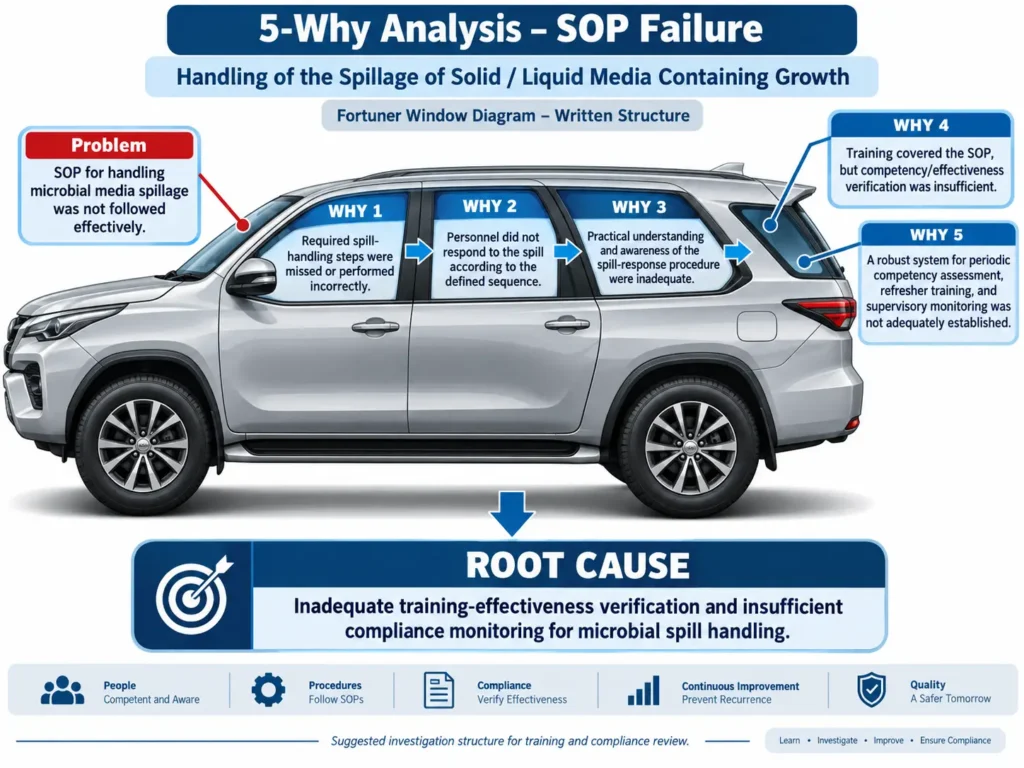
The analysis identifies the proposed root cause as inadequate training-effectiveness verification and insufficient compliance monitoring for microbial spill handling. This investigation structure supports identification of systemic gaps so that appropriate corrective and preventive actions can be established to improve SOP compliance, personnel competency, and safe handling of microbial spills.
4. Fishbone Analysis for SOP Failure:
The Fishbone Analysis evaluates possible causes for failure to effectively follow the SOP for handling spillage of solid/liquid media containing microbial growth. The potential causes are grouped under the 6M categories: Man, Method, Machine, Material, Measurement, and Environment.
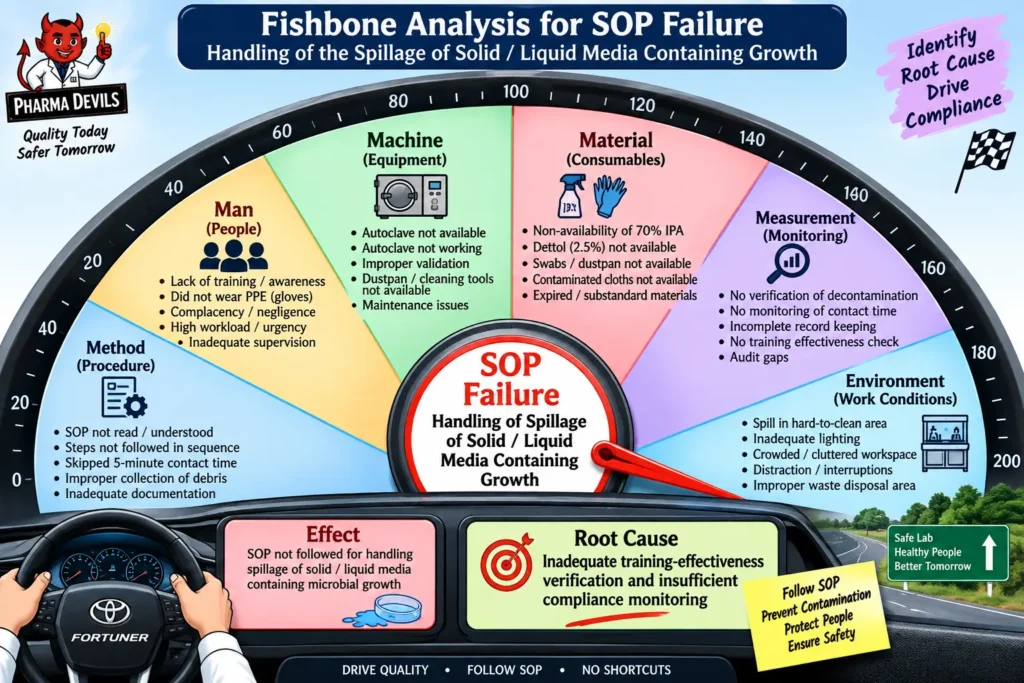
Key contributing factors include inadequate training and supervision, failure to follow the defined spill-handling sequence, non-availability or malfunction of decontamination equipment, shortage of disinfectants and cleaning materials, weak monitoring and documentation, and unsuitable workplace conditions. These factors may lead to incomplete decontamination and increased risk of microbial contamination or personnel exposure.The analysis highlights inadequate training-effectiveness verification and insufficient compliance monitoring as a proposed root-cause direction for further investigation. The SOP itself requires gloves, 70% IPA with a 5-minute contact time, debris collection, autoclave decontamination, treatment of contaminated cloths, and prompt action for skin splash.
5. Fault Tree Analysis for SOP Failure:
The Fault Tree Analysis (FTA) diagram evaluates how failure to follow the SOP for handling spillage of solid/liquid media containing microbial growth can arise from three major branches: procedural failure, resource/material failure, and operational/human failure. Contributing causes include the SOP not being read or understood, steps not being followed in sequence, inadequate training, non-availability of 70% IPA/Dettol, swabs, dustpan or gloves, incorrect disinfectant contact time, improper debris collection, and failure to autoclave contaminated material.
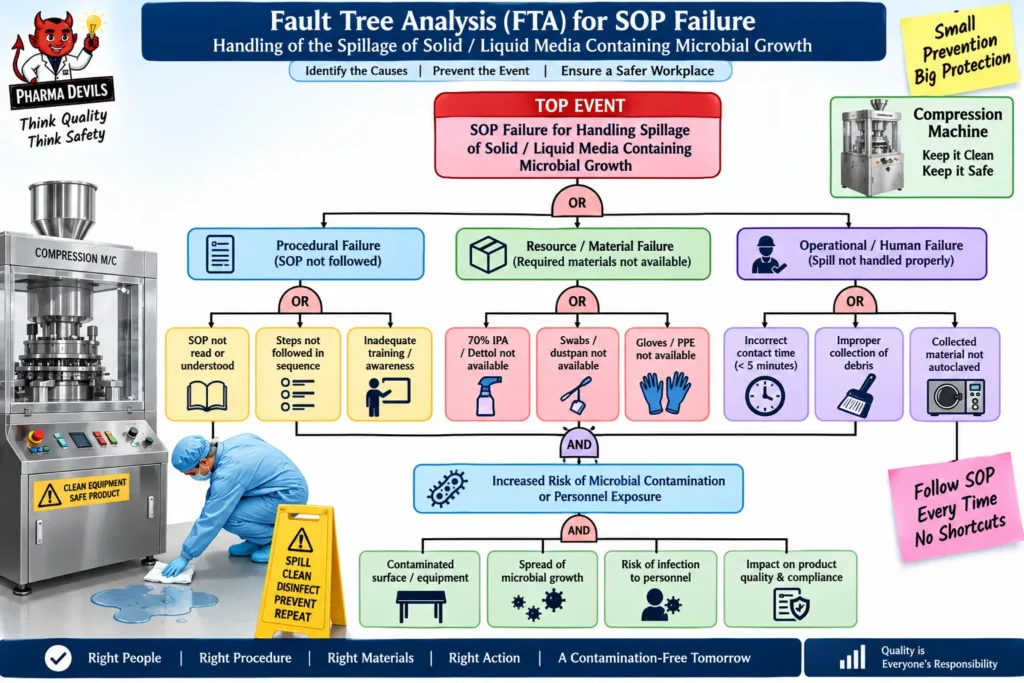
These failures can collectively increase the risk of microbial contamination and personnel exposure, potentially leading to contaminated surfaces or equipment, spread of microbial growth, infection risk to personnel, and impact on product quality and GMP compliance. The analysis helps identify where preventive controls, training, material availability, supervision, and adherence to the defined spill-handling procedure should be strengthened.
Questions & Answers – Handling of Spillage of Solid/Liquid Media Containing Growth
Q1. What is the objective of this SOP?
Answer: To lay down a procedure for removal of microorganisms from the surface without causing any health hazard.
Q2. What is the scope of this SOP?
Answer: This SOP is applicable to spillage of solid and liquid media containing microbial culture.
Q3. Who is responsible for execution of this SOP?
Answer: The Microbiologist is responsible for execution of the SOP.
Q4. Who is responsible for review and effective implementation of the SOP?
Answer: Sr. Executive QC / Manager QC are responsible for review and effective implementation.
Q5. What PPE should be worn before handling the spillage?
Answer: Surgical gloves should be worn before handling media containing microbial growth.
Q6. Which disinfectant is used for the spilled area?
Answer: The spilled area should be sprayed with 70% isopropyl alcohol.
Q7. What contact time is specified after spraying 70% IPA?
Answer: The sprayed area should be left for 5 minutes.
Q8. How should spill debris be collected?
Answer: Spill debris should be swept into a dustpan using swabs.
Q9. How should the contaminated material be decontaminated?
Answer: The contaminated material should be decontaminated by autoclaving as per the applicable SOP.
Q10. How should the dustpan be decontaminated?
Answer: The dustpan should also be decontaminated by autoclaving.
Q11. How should contaminated cloths be treated?
Answer: Contaminated cloths should be soaked in Dettol 2.5% v/v.
Q12. What action should be taken in case of a skin splash?
Answer: The skin splash should be treated as soon as possible.
Q13. Who conducts the training for this SOP?
Answer: The Manager – Quality Control is the trainer.
Q14. Who are the trainees?
Answer: Quality Control personnel are the trainees.
Q15. What is the training duration?
Answer: The specified training duration is half an hour.
Reference Guidelines:
- WHO Technical Report Series No. 961, Annex 2 – Good Practices for Pharmaceutical Microbiology Laboratories. Relevant to pharmaceutical microbiology laboratory operations, contamination control, personnel practices, equipment, media, and microbiological testing. (World Health Organization) WHO TRS 961 Annex 2
- CDC/NIH – Biosafety in Microbiological and Biomedical Laboratories (BMBL), 6th Edition. Provides risk-based biosafety principles for biological spills, including PPE, spill containment, selection of appropriate disinfectant, adequate contact time, decontamination, waste handling, and personnel training. (CDC) CDC BMBL 6th Edition
- EU GMP – EudraLex Volume 4, Annex 1: Manufacture of Sterile Medicinal Products. Useful where the microbiology laboratory or spill event can affect classified/controlled areas; it emphasizes contamination control, cleaning/disinfection, personnel practices, and documented procedures. (Public Health) EU GMP EudraLex Volume 4
- India – Drugs Rules, Schedule M / Revised Schedule M. Supports requirements for adequately designed QC/microbiology areas, prevention of cross-contamination, cleaning/disinfection, trained personnel, documentation, and suitable laboratory controls. (CDSCO) CDSCO Drugs Rules and Schedule M