




Brief Description:
This SOP describes the procedure for the safe handling and removal of solid or liquid microbiological media containing microbial growth, with the objective of removing microorganisms from contaminated surfaces without creating a health hazard. The procedure is applicable to microbiological culture-media spillages occurring within the Quality Control area. The Microbiologist is responsible for executing the procedure, while the Sr. Executive QC/Manager QC is responsible for review and effective implementation. During spill handling, personnel shall wear surgical gloves, spray the affected area with 70% isopropyl alcohol, and allow a 5-minute contact time. Spill debris is collected using swabs and a dustpan. Contaminated material and the dustpan are subsequently decontaminated by autoclaving. Contaminated cloths are soaked in 2.5% v/v Dettol, and any splash on the skin is to be treated as soon as possible. The SOP also specifies half-hour training for Quality Control personnel, conducted by the Manager–Quality Control.
Skip to PDF content1. Flow Diagram:
The flow diagram illustrates the systematic procedure for handling spillage of solid or liquid media containing microbial growth in the Quality Control area. The process begins with identification of the microbial media spill, followed by wearing appropriate protective gloves before handling the contaminated material. The affected area is sprayed with 70% isopropyl alcohol and allowed a contact time of 5 minutes to support decontamination.
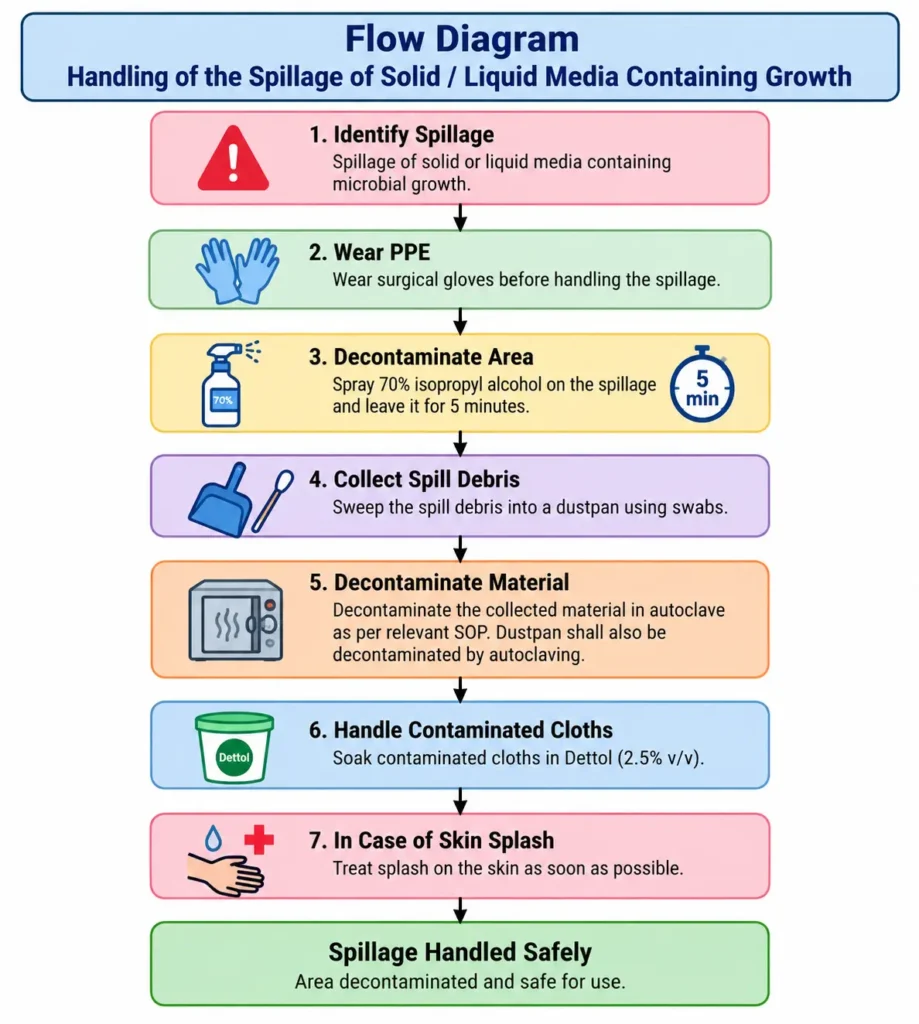
After disinfection, the spill debris is collected into a dustpan using swabs. The collected contaminated material and dustpan are then decontaminated by autoclaving as specified in the relevant SOP. Contaminated cloths are soaked in 2.5% v/v Dettol, while any accidental splash on the skin should be treated as soon as possible.The flow provides a clear sequence for controlling microbial contamination, minimizing personnel exposure, and ensuring that the affected area and contaminated materials are handled safely in accordance with the SOP.
2. Brainstorming for SOP Failure:
The brainstorming diagram presents possible causes of SOP failure in handling spillage of solid or liquid media containing microbial growth, using a worst-case granulation-area location to emphasize contamination and operator-safety risks. The central issue is surrounded by potential failure factors such as lack of training, PPE not worn, delayed spill response, incorrect use of 70% IPA, inadequate contact time, improper debris collection, failure to autoclave contaminated material, poor housekeeping, weak documentation, inadequate supervision, and delayed treatment of skin splashes.
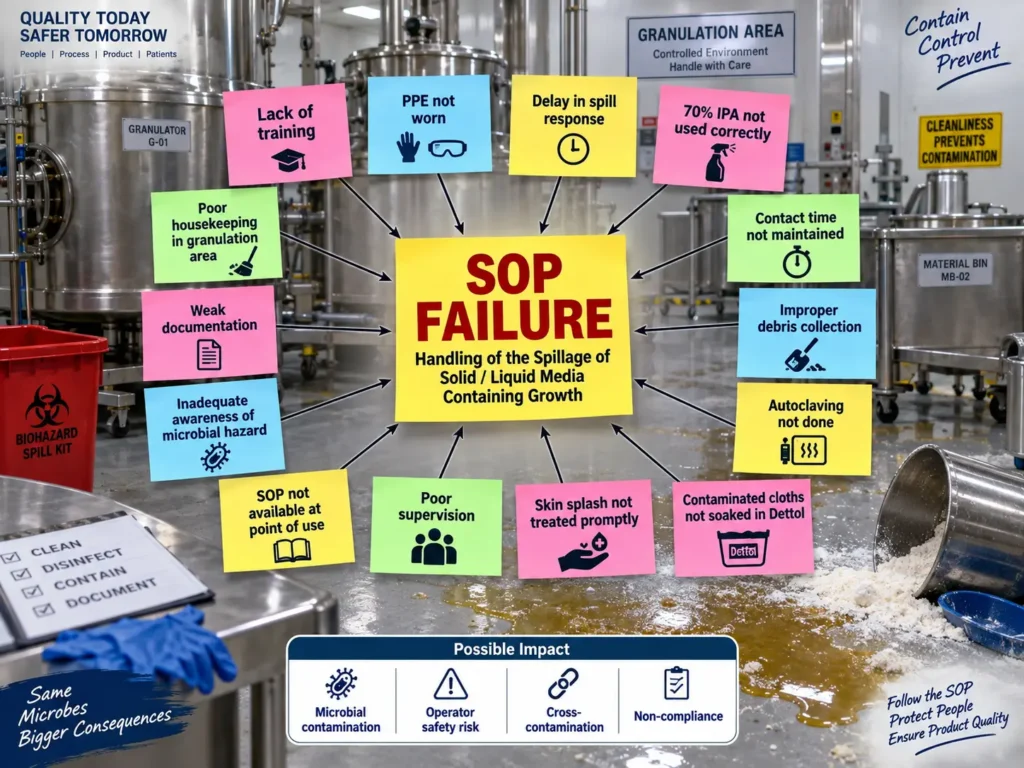
These brainstorming points are potential causes for investigation rather than confirmed causes. They are linked to the SOP requirements to wear gloves, apply 70% isopropyl alcohol for 5 minutes, collect spill debris, autoclave contaminated materials, soak contaminated cloths in 2.5% v/v Dettol, and promptly manage skin splashes. The diagram highlights potential consequences including microbial contamination, cross-contamination, operator safety risk, and GMP non-compliance, helping investigation teams identify areas requiring CAPA and stronger procedural control.
3. 5-Why Analysis for SOP Failure:
The 5-Why Analysis diagram evaluates a worst-case SOP failure scenario in the tablet compression area involving improper handling of spilled solid or liquid media containing microbial growth. The investigation begins with the observation that the microbial spill remained uncontrolled because the prescribed spill-handling SOP was not followed. It then traces the failure through lack of immediate operator response, inadequate awareness of the correct procedure, insufficient training and refresher programs, poor maintenance of training records, and weak supervision and QA oversight.
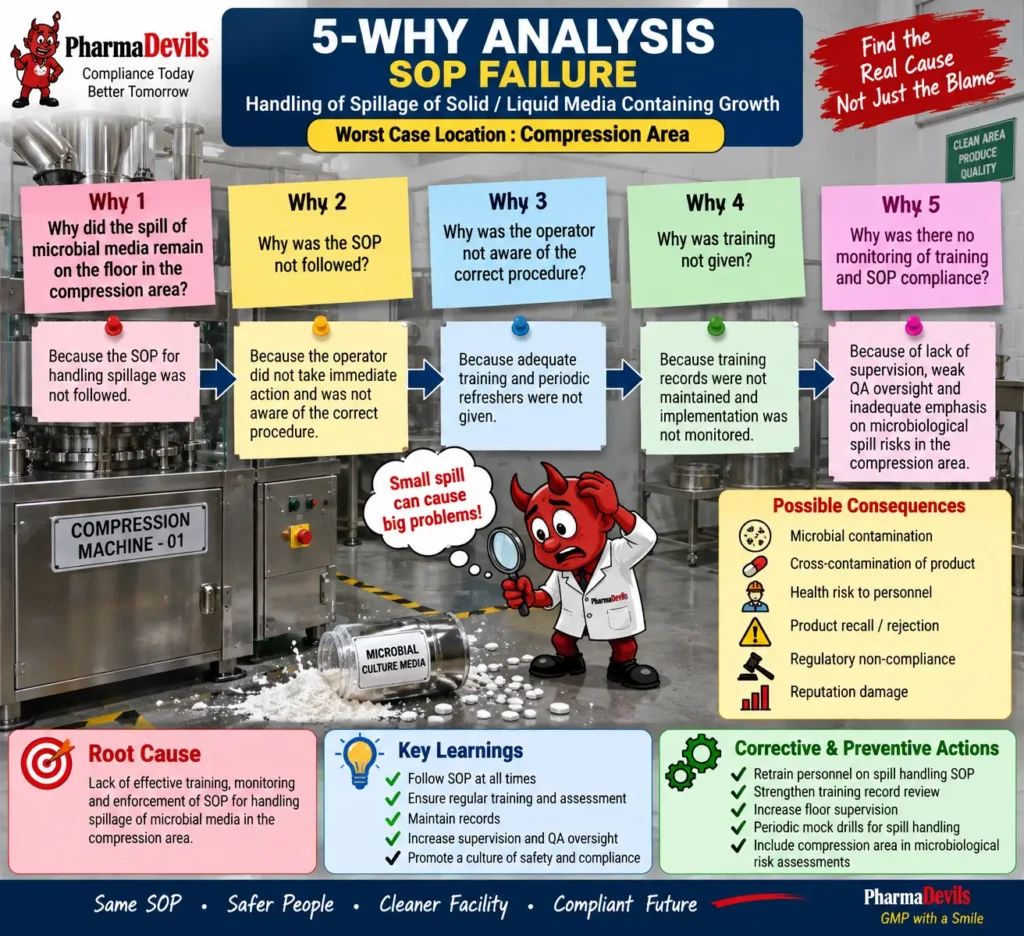
The analysis identifies the underlying root cause as ineffective training, monitoring, and enforcement of the spill-handling procedure. This is significant because the SOP requires personnel to wear gloves, apply 70% isopropyl alcohol for 5 minutes, collect contaminated debris, autoclave contaminated materials, and appropriately manage contaminated cloths and skin splashes. Potential consequences include microbial contamination, cross-contamination, personnel exposure, product rejection, and regulatory non-compliance. The diagram therefore emphasizes retraining, stronger supervision, periodic spill-response drills, training-record review, and continuous SOP compliance monitoring as key CAPA measures.
4. Fishbone Analysis for SOP Failure:
The Fishbone Analysis diagram presents the potential causes of SOP failure in handling spillage of solid or liquid media containing microbial growth, using the tablet compression area as a worst-case location. Possible causes are grouped under major categories such as Man, Machine, Method, Material, Measurement, Environment, and Management.
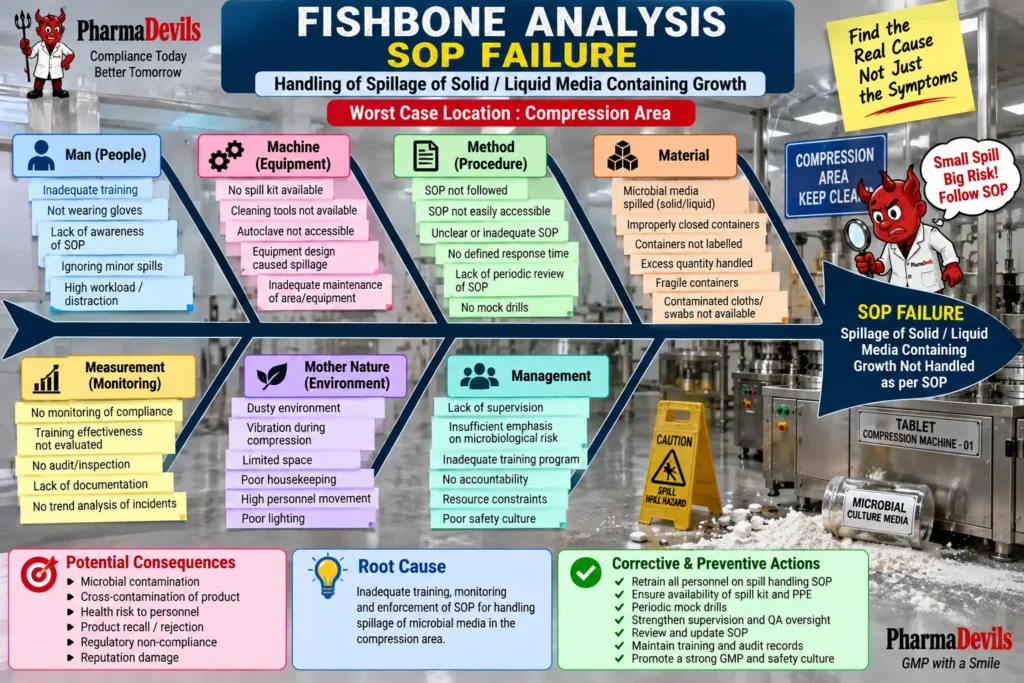
The analysis highlights factors including inadequate training, failure to wear gloves, poor SOP awareness, absence of spill-handling tools, unclear procedures, improper handling of microbial media, weak monitoring, poor housekeeping, insufficient supervision, and inadequate safety culture. These factors can contribute to delayed or incorrect spill response.The SOP specifically requires personnel to wear gloves, apply 70% isopropyl alcohol for 5 minutes, collect spill debris appropriately, autoclave contaminated materials, soak contaminated cloths in 2.5% v/v Dettol, and promptly manage skin splashes. The fishbone analysis helps identify potential root causes and supports development of CAPA such as retraining, improved supervision, availability of spill kits, mock drills, SOP review, documentation, and periodic compliance monitoring.
5. Fault Tree Analysis for SOP Failure:
The Fault Tree Analysis diagram evaluates a worst-case SOP failure during handling of solid or liquid media containing microbial growth, using the compression area as the critical scenario. The top event is failure to handle the microbial spill as required by the SOP, resulting in the spill remaining on the surface and potentially spreading within the area.
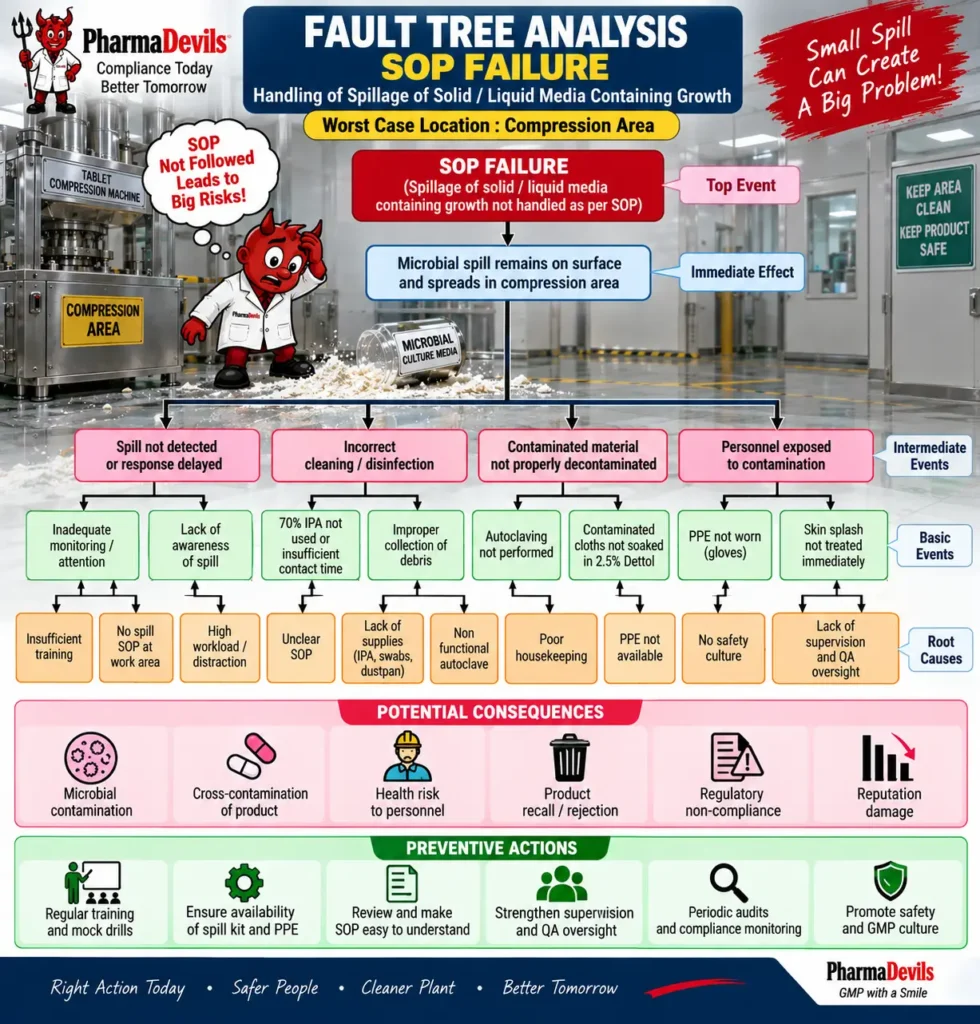
The analysis breaks the failure into intermediate events such as delayed spill detection, incorrect cleaning or disinfection, improper decontamination of contaminated materials, and personnel exposure. Basic causes include inadequate training, poor SOP awareness, insufficient contact time with 70% IPA, improper debris collection, failure to autoclave contaminated materials, failure to soak contaminated cloths in 2.5% v/v Dettol, lack of PPE, and delayed treatment of skin splashes. These directly relate to the required spill-handling steps described in the SOP. Potential consequences include microbial contamination, cross-contamination, personnel safety risk, product rejection, and regulatory non-compliance. The diagram supports preventive actions such as refresher training, spill-kit availability, improved supervision, mock drills, SOP review, and periodic compliance monitoring.
Questions & Answers – Handling of Spillage of Solid/Liquid Media Containing Growth
Q1. What is the objective of this SOP?
Answer: To define a procedure for removing microorganisms from contaminated surfaces without creating a health hazard.
Q2. Where is this SOP applicable?
Answer: It is applicable to spillage of solid or liquid media containing microbial culture.
Q3. Who is responsible for executing this SOP?
Answer: The Microbiologist is responsible for execution of the SOP.
Q4. Who is responsible for review and effective implementation?
Answer: The Sr. Executive QC / Manager QC is responsible for review and effective implementation.
Q5. What PPE is specified before handling the spill?
Answer: Surgical gloves shall be worn before handling media spillage containing microbial growth.
Q6. Which disinfectant is used for the spilled area?
Answer: 70% isopropyl alcohol (IPA) is sprayed on the spilled area.
Q7. What contact time is specified for 70% IPA?
Answer: The sprayed area should be left for 5 minutes.
Q8. How should the spilled debris be collected?
Answer: Spill debris shall be swept into a dustpan using swabs.
Q9. How should collected contaminated material be decontaminated?
Answer: The collected material shall be decontaminated in an autoclave as per the applicable SOP.
Q10. How should the dustpan be decontaminated?
Answer: The dustpan shall also be decontaminated by autoclaving.
Q11. How should contaminated cloths be handled?
Answer: Contaminated cloths shall be soaked in Dettol 2.5% v/v.
Q12. What action should be taken if the spill splashes on the skin?
Answer: Any splash on the skin should be treated as soon as possible.
Q13. Who conducts training on this SOP?
Answer: The Manager – Quality Control acts as the trainer.
Q14. Who are the trainees?
Answer: Quality Control personnel are the designated trainees.
Q15. What is the specified training duration?
Answer: The training period is half an hour.
Reference Guidelines:
- WHO Laboratory Biosafety Manual, 4th Edition (2020) — provides a risk-based framework for safe handling of biological agents in laboratories. (World Health Organization)
WHO Laboratory Biosafety Manual - WHO Laboratory Biosafety Manual – Decontamination and Waste Management (2020) — specifically covers cleaning, chemical disinfection, heat treatment, sterilization, biological waste management, and decontamination of materials potentially containing biological agents. (World Health Organization)
WHO Decontamination and Waste Management Guideline - WHO Good Practices for Pharmaceutical Quality Control Laboratories, TRS 1052, Annex 4 (2024) — applicable to pharmaceutical QC laboratories and provides guidance on laboratory quality systems, personnel, premises, equipment, documentation, and operating procedures. (World Health Organization)
WHO Good Practices for Pharmaceutical QC Laboratories - WHO Good Practices for Pharmaceutical Microbiology Laboratories, TRS 961, Annex 2 — a particularly relevant supporting reference for pharmaceutical microbiology laboratory operations and microbiological contamination control. WHO continues to list this guidance among its inspection resources. (WHO Extranet)
- WHO Quality Assurance of Pharmaceuticals – GMP Compendium, 10th Edition (2024) — provides broader pharmaceutical GMP and quality-system expectations applicable to personnel hygiene, contamination control, QC activities, documentation, and facility practices. (World Health Organization)