







1. Introduction – SOP for Handling & Usage of Rubber & Metallic Stereos:
The Standard Operating Procedure for Handling & Usage of Rubber & Metallic Stereos describes the controlled system for procurement, receipt, verification, storage, issuance, retrieval, use, and destruction of stereos used during pharmaceutical packing operations. The procedure applies to both rubber and metallic stereos and ensures that only correctly identified, verified, and approved stereos are used for the intended product and batch. Rubber stereos are checked for correct batch particulars, securely stored under lock and key, issued with proper documentation, retrieved after batch completion, and destroyed after yield reconciliation in the presence of IPQA. Metallic stereos are similarly controlled, verified, issued, retrieved, and securely stored for reuse, while damaged letters are destroyed appropriately. Proper implementation helps prevent printing errors, mix-ups, unauthorized use, and incorrect batch information on packaging materials.
Skip to PDF content2. Flow Diagram – SOP for Handling & Usage of Rubber & Metallic Stereos:
The SOP for Handling & Usage of Rubber & Metallic Stereos establishes a controlled sequence for ordering, receiving, verifying, storing, issuing, retrieving, and managing stereos used during pharmaceutical packing operations. Rubber stereos are ordered with approved batch details, checked through impression verification, stored securely under lock and key, issued to the machine operator, and returned after batch completion. After yield reconciliation, rubber stereos are destroyed in the presence of IPQA and the activity is documented. Metallic stereos are received as sets, securely stored, checked before use, issued to operators, retrieved after batch completion, and returned to controlled storage.
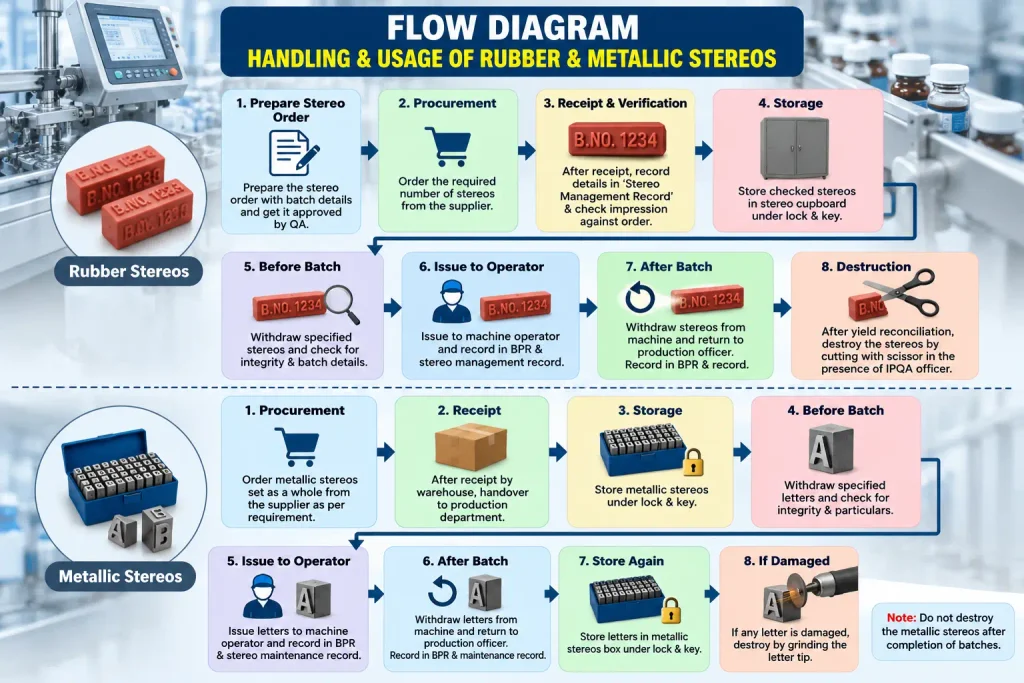
Damaged metallic letters are destroyed by grinding the letter tip, while usable metallic stereos are retained for future batches. Proper documentation in the BPR and stereo management or maintenance records ensures traceability, accountability, and prevention of mix-ups or incorrect printing.
3. Benefits of Following SOP – Handling & Usage of Rubber & Metallic Stereos:
Following the SOP for Handling & Usage of Rubber & Metallic Stereos ensures systematic control of stereos used during pharmaceutical packing operations. Proper ordering, receipt, verification, secure storage, controlled issuance, retrieval, and documented destruction help prevent use of incorrect or unauthorized stereos. The procedure supports accurate batch identification and reduces the risk of printing or embossing errors on packaging materials. Maintaining entries in the BPR and stereo management or maintenance records provides traceability and accountability throughout the stereo life cycle.
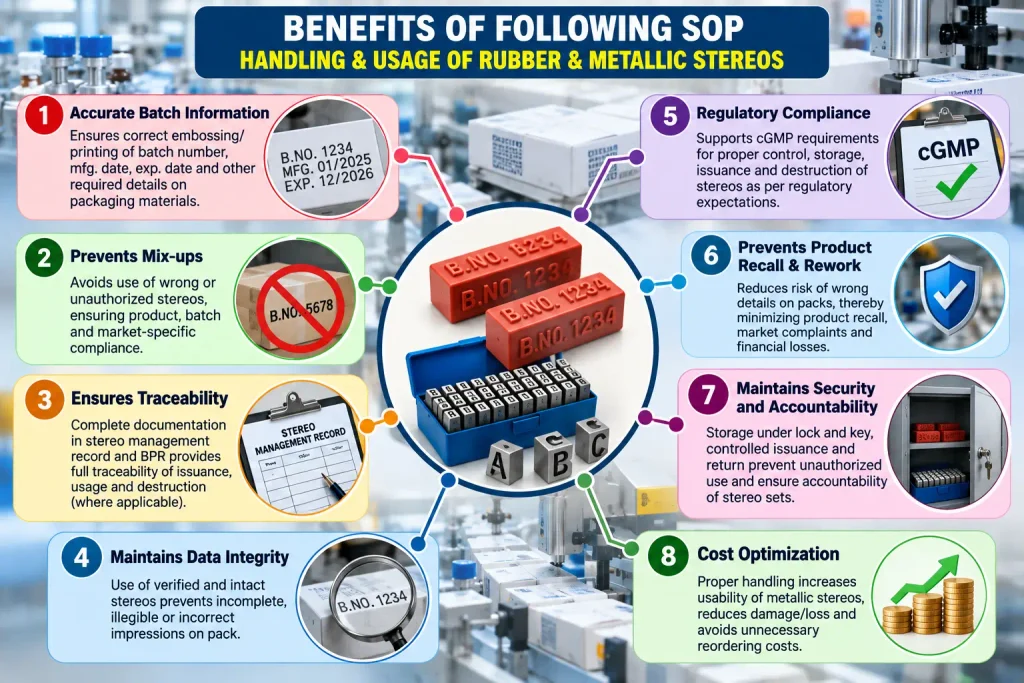
Storage under lock and key prevents unauthorized access, while verification before use confirms integrity and correct batch particulars. Rubber stereos are destroyed after batch completion and yield reconciliation, whereas metallic stereos are retained securely for reuse unless damaged. Overall, the SOP supports GMP compliance, minimizes mix-ups and rework, and strengthens packaging control.
4. Brainstorming for SOP Failure – Handling & Usage of Rubber & Metallic Stereos:
The brainstorming analysis for SOP failure in Handling & Usage of Rubber & Metallic Stereos identifies potential causes that may lead to errors, mix-ups, loss of traceability, or incorrect printing during pharmaceutical packing operations. Major concerns include selection of the wrong stereo, failure to verify batch details, improper storage, unauthorized access, use of damaged stereos, missing issuance records, operator handling errors, lack of QA approval, failure to return stereos after batch completion, and incomplete destruction of rubber stereos.
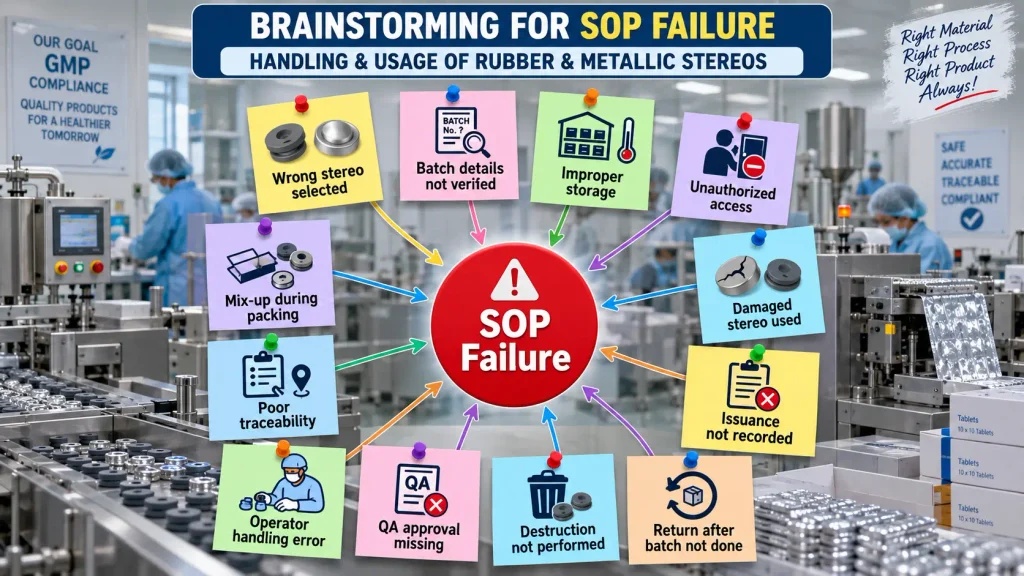
Poor documentation can also weaken traceability throughout the stereo life cycle. Since the SOP requires controlled receipt, verification, storage under lock and key, issuance, retrieval, and destruction where applicable, failure at any of these stages can affect packaging accuracy and GMP compliance.
5. 5-Why Analysis for SOP Failure – Handling & Usage of Rubber & Metallic Stereos:
The 5-Why Analysis for SOP Failure – Handling & Usage of Rubber & Metallic Stereos evaluates the underlying reasons that could lead to use of an incorrect stereo or wrong batch details during pharmaceutical packing. The analysis begins with improper stereo selection or use and traces the failure through inadequate verification of batch details and stereo integrity, weak control over issuance, retrieval and storage, incomplete entries in the BPR or stereo management record, and insufficient operator training or compliance monitoring.
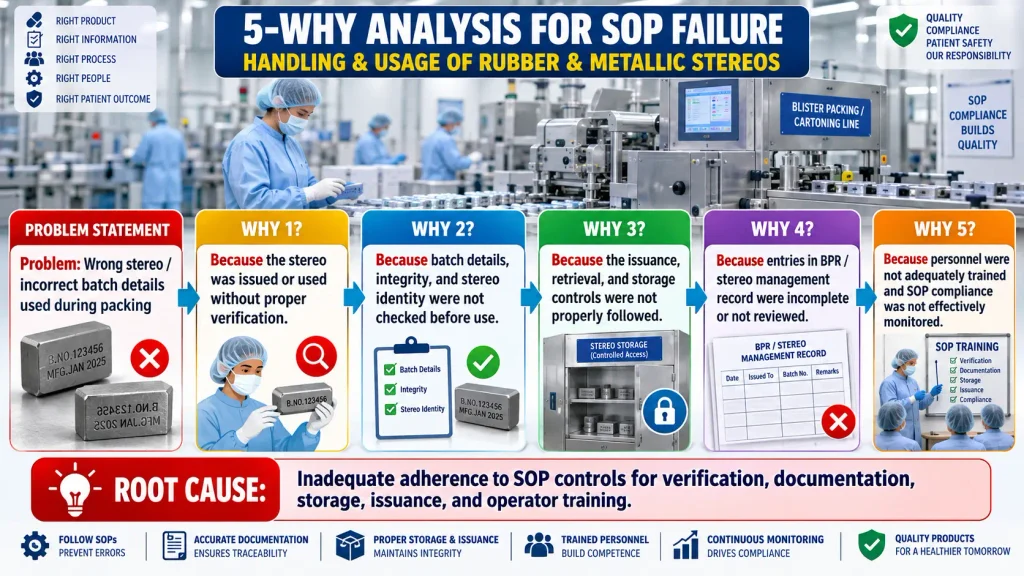
The SOP specifically requires verification before use, controlled storage under lock and key, documented issuance and return, and destruction of rubber stereos after batch reconciliation where applicable. The root cause is therefore linked to inadequate adherence to established SOP controls, documentation requirements, verification practices, and personnel training.
6. Fishbone Analysis for SOP Failure – Handling & Usage of Rubber & Metallic Stereos:
The Fishbone Analysis for SOP Failure – Handling & Usage of Rubber & Metallic Stereos identifies potential causes that may result in wrong stereo selection, incorrect batch details, poor traceability, or packing errors. The causes can be grouped under Man, Method, Material, Machine, Measurement/Documentation, and Environment/Storage. Personnel-related causes include inadequate training, handling errors, and failure to verify stereo integrity. Method-related failures include skipped SOP steps, incomplete verification, improper issuance or retrieval, and incorrect destruction or return practices.
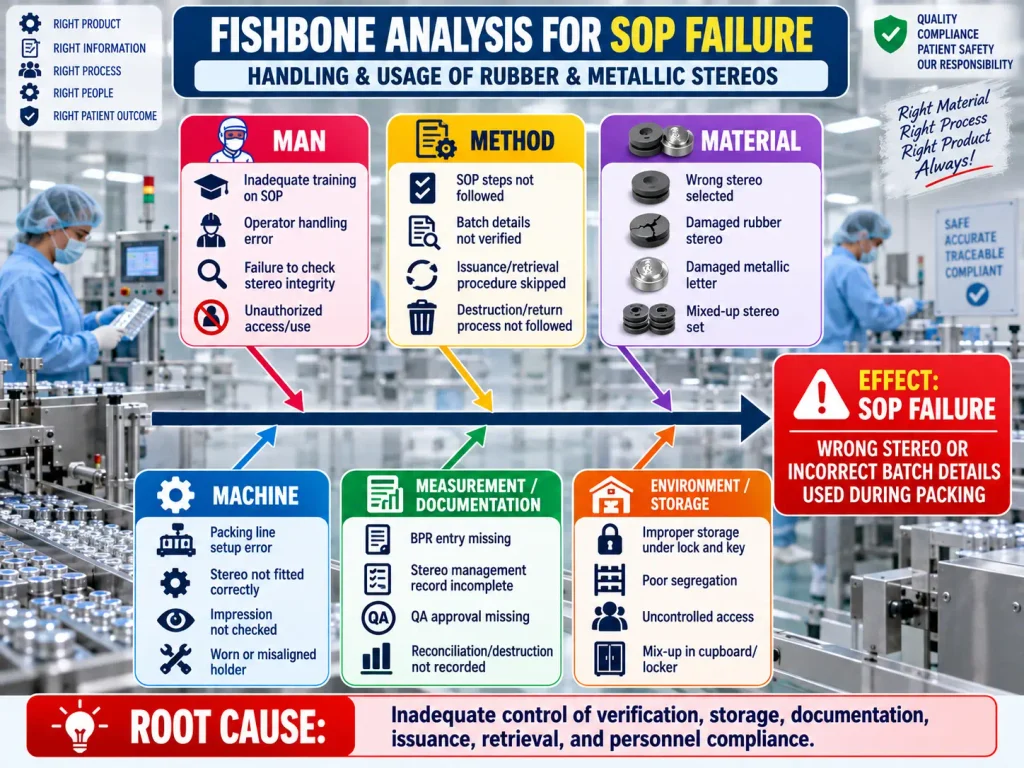
Material causes include damaged, mixed-up, or wrong stereos, while machine-related causes include improper fitting or unchecked impressions. Documentation failures such as missing BPR entries, incomplete stereo management records, and lack of QA verification further increase risk. Improper storage and uncontrolled access can also lead to mix-ups and unauthorized use.
7. Fault Tree Analysis for SOP Failure – Handling & Usage of Rubber & Metallic Stereos:
The Fault Tree Analysis for SOP Failure – Handling & Usage of Rubber & Metallic Stereos evaluates how different failures can combine to cause the top event of incorrect printing or wrong batch details on packaging material. Major contributing events include use of the wrong stereo, missing or unavailable stereos, use of damaged or defective stereos, and incorrect batch details fitted on the machine. These failures may arise from incorrect issuance, poor QA verification, inadequate training.
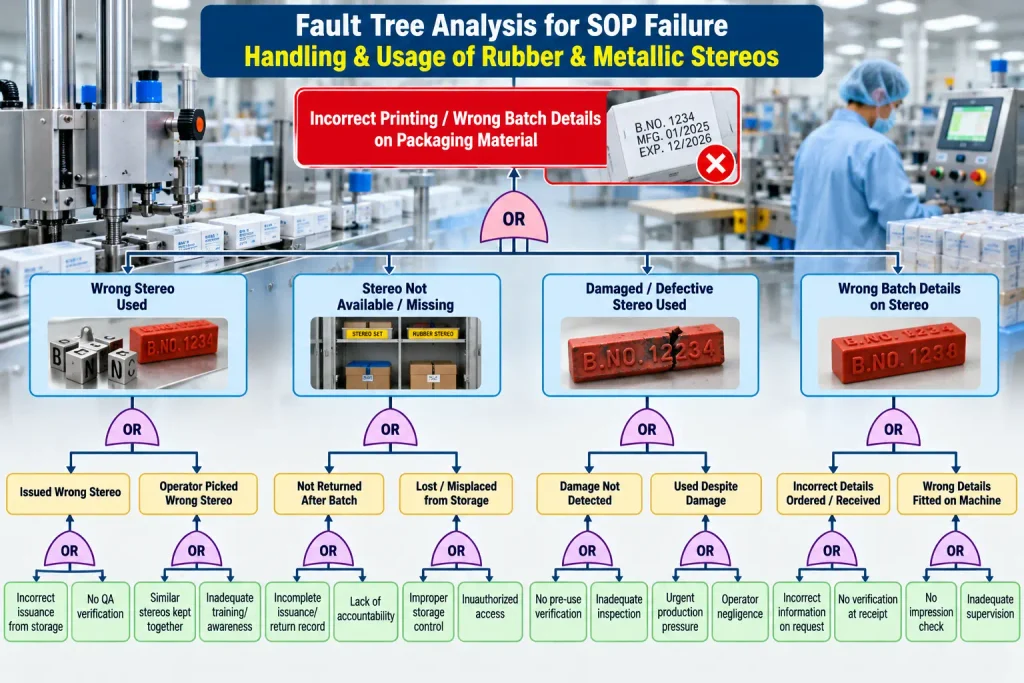
improper return after batch completion, weak storage control, unauthorized access, lack of pre-use inspection, or failure to verify impressions and batch particulars. The SOP requires stereos to be checked for integrity and batch details before issue, controlled under lock and key, properly documented in BPR/stereo records, and retrieved after batch completion.
8. Impact Assessment – SOP for Handling & Usage of Rubber & Metallic Stereos:
The Impact Assessment for SOP Failure – Handling & Usage of Rubber & Metallic Stereos evaluates the possible consequences of incorrect selection, handling, storage, issuance, retrieval, or destruction of stereos used in pharmaceutical packing operations. Failure to follow the SOP may result in incorrect batch details, unclear impressions, use of damaged stereos, and packaging errors. Such failures can affect product quality, traceability, documentation accuracy, and GMP compliance. Operational impacts may include line stoppage, rework, rejection of packaging materials, production delays, and additional investigation activities. In serious situations, incorrect printed information may contribute to product complaints.
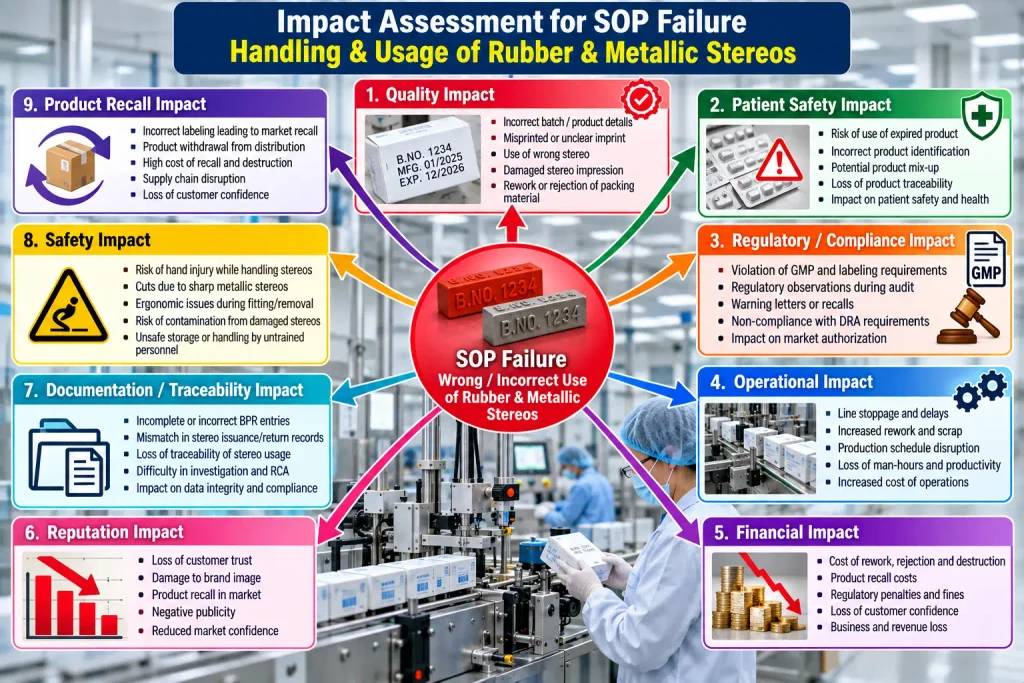
recall, regulatory observations, financial loss, or damage to company reputation. Poor control of stereo issuance and return may also create accountability and data-integrity concerns. Therefore, proper verification of stereo integrity and batch details, secure storage under lock and key, controlled issuance, documented return, and appropriate destruction of rubber stereos are essential to minimize risk and maintain compliant packing operations.
9. CAPA – SOP for Handling & Usage of Rubber & Metallic Stereos:
The Corrective and Preventive Action (CAPA) for SOP Failure – Handling & Usage of Rubber & Metallic Stereos is intended to eliminate identified failures and prevent their recurrence during pharmaceutical packing operations. Corrective actions include stopping the affected packing activity, isolating incorrectly printed material, verifying the correct stereo and batch particulars, checking stereo integrity, correcting documentation, investigating the deviation, and retraining concerned personnel. Preventive actions focus on strengthening the existing control system through proper verification before issuance and use, secure storage under lock and key, controlled segregation, complete entries in the BPR and stereo management record, periodic inspection of stereos, and regular personnel training.
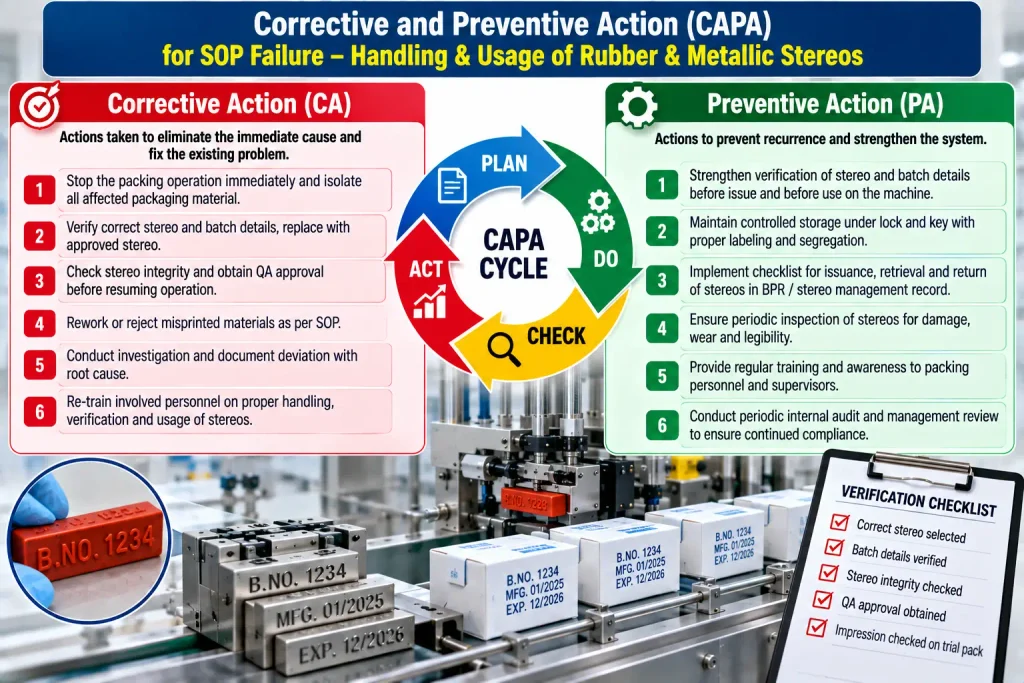
The SOP requires verified stereos to be stored securely, issued with documented control, returned after batch completion, and rubber stereos to be destroyed after yield reconciliation in the presence of IPQA. Effective CAPA therefore improves traceability, accountability, packaging accuracy, and continued GMP compliance.
Question & Answer – SOP for Handling & Usage of Rubber & Metallic Stereos:
- Q: What is the objective of this SOP?
A: The objective is to describe the procedure for proper handling and usage of rubber and metallic stereos. - Q: What activities are covered under the scope of this SOP?
A: The SOP covers procurement, receipt, storage, issuance, and destruction of rubber and metallic stereos. - Q: Who is responsible for execution of this SOP?
A: Production personnel are responsible for execution, while the Production Manager is responsible for effective implementation. - Q: Who approves the rubber stereo order?
A: The stereo order containing batch details is approved by Quality Assurance before procurement. - Q: What should be done after receipt of rubber stereos?
A: The stereos should be taken to Production, recorded in the Stereo Management Record, and their impressions checked against the ordering format. - Q: How should verified rubber stereos be stored?
A: Verified rubber stereos should be stored in stereo cupboards under lock and key until required for use. - Q: What checks are required before issuing a stereo for a batch?
A: The stereo should be checked for integrity and correct batch details before issuance. - Q: Where should stereo issuance be recorded?
A: Issuance should be recorded in the BPR where applicable and in the Stereo Management Record. - Q: What should be done with rubber stereos after batch completion?
A: They should be retrieved from the machine, returned to the Production Officer, and documented in the applicable records. - Q: When are rubber stereos destroyed?
A: After completion of batch yield reconciliation, rubber stereos are destroyed in the presence of an IPQA Officer by cutting them with scissors, with the activity recorded appropriately. - Q: How are metallic stereos received and stored?
A: Metallic stereo sets are ordered as required, handed over from Warehouse to Production after receipt, and stored under lock and key. - Q: What should be checked before metallic stereo letters are used?
A: The required letters should be checked for integrity and correct particulars according to the planned batch. - Q: What happens to metallic stereos after batch completion?
A: They are withdrawn from the machine, returned to the Production Officer, recorded, and stored again in the metallic stereo box under lock and key. - Q: What should be done if a metallic stereo letter is damaged?
A: The damaged letter should be destroyed by grinding its tip. - Q: Are metallic stereos destroyed after completion of each batch?
A: No. The SOP specifically states that metallic stereos should not be destroyed after completion of batches.
Reference Guideline – Handling & Usage of Rubber & Metallic Stereos:
For practical implementation of this SOP, the following GMP areas are relevant: control of printed packaging materials, prevention of mix-ups, secure storage and issuance, line clearance, batch documentation, reconciliation, destruction of obsolete or used printing components, personnel training, and traceability of packing operations.
Suitable regulatory references that may be used while strengthening this SOP include WHO GMP, EU GMP Part I – Chapter 5 (Production), PIC/S GMP Guide – Chapter 5, and Schedule M of the Drugs Rules, India, particularly provisions related to packaging operations and control of printed materials.