







Brief Description
This Standard Operating Procedure describes the requirements for implementing Good Laboratory Practice (GLP) within the Quality Control laboratory to ensure reliable, safe, traceable, and properly documented analytical activities. The SOP assigns responsibility to QC personnel for execution and to Lab QA and QA/QC management for effective implementation.The procedure emphasizes proper identification and labeling of reagents, solutions, and glassware; avoidance of damaged glassware; use of suitable personal protective equipment; safe chemical handling; prohibition of mouth pipetting, eating, drinking, tasting, or improper chemical disposal in the laboratory.The attached Lab QA GLP Checklist provides structured daily, weekly, monthly, and half-yearly monitoring of calibration status, documentation, analytical practices, working/reference standards, OOS/OOT investigations, CAPA, sample control, document management, and equipment calibration. This systematic GLP monitoring supports consistent laboratory control and compliance.
Skip to PDF content1. Flow Diagram:
The flow diagram presents a simplified step-by-step process for implementing Good Laboratory Practice (GLP) in the Quality Control laboratory. It begins with understanding the GLP SOP, assigning responsibilities, and providing appropriate training to QC personnel. Laboratory staff then prepare for analysis by using properly labeled reagents and solutions, identified and undamaged glassware, suitable PPE, and safe laboratory practices such as avoiding mouth pipetting. These requirements are defined in the SOP.
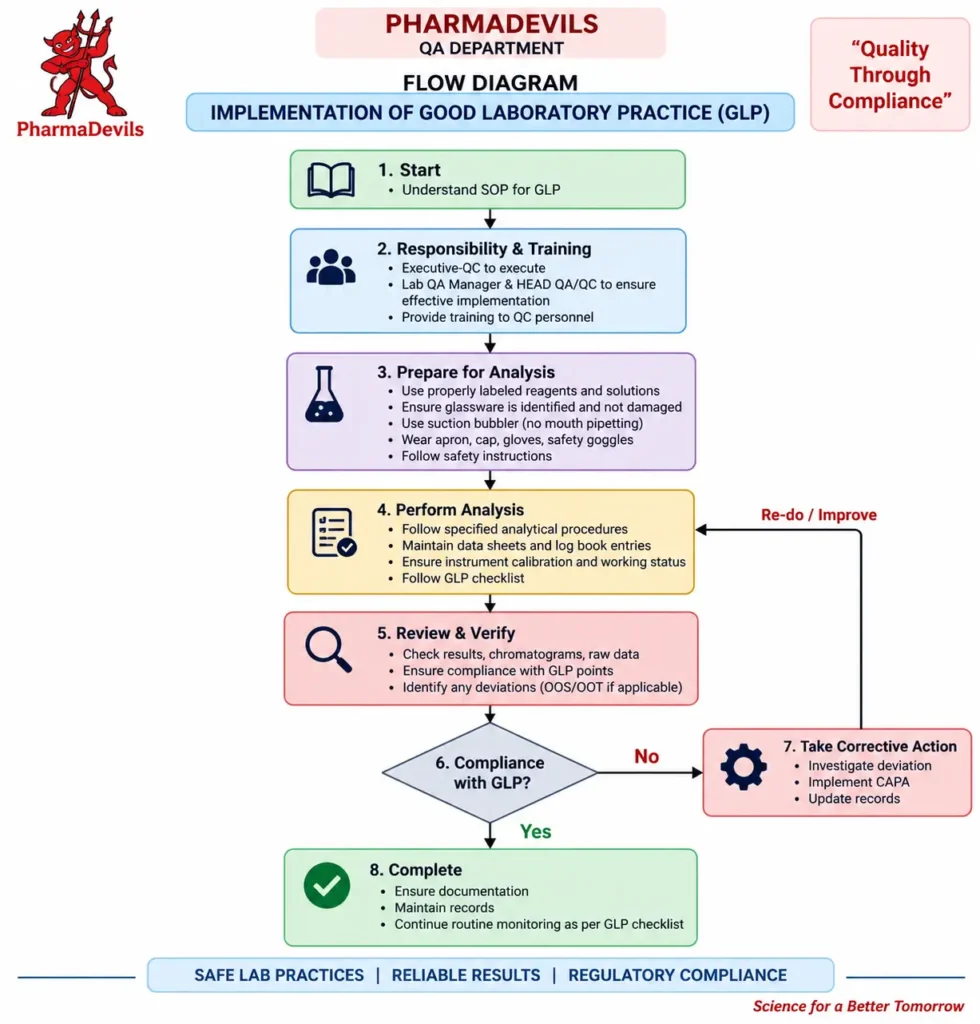
During analysis, approved procedures, instrument calibration status, logbook entries, data sheets, and GLP checklist requirements are followed. Results, chromatograms, raw data, calculations, and compliance points are subsequently reviewed and verified. The GLP checklist also requires monitoring of calibration status, analytical documentation, competency, and corrective follow-up.If non-compliance is identified, investigation and corrective action/CAPA are initiated; otherwise, documentation is completed and routine GLP monitoring continues.
2. Brainstorming for SOP Failure:
The brainstorming diagram presents a college-classroom style discussion to identify possible reasons why the SOP for Implementation of Good Laboratory Practice (GLP) may not be followed effectively. A PharmaDevils professor guides students to explore potential causes using colorful sticky notes, encouraging participation and root-cause thinking.
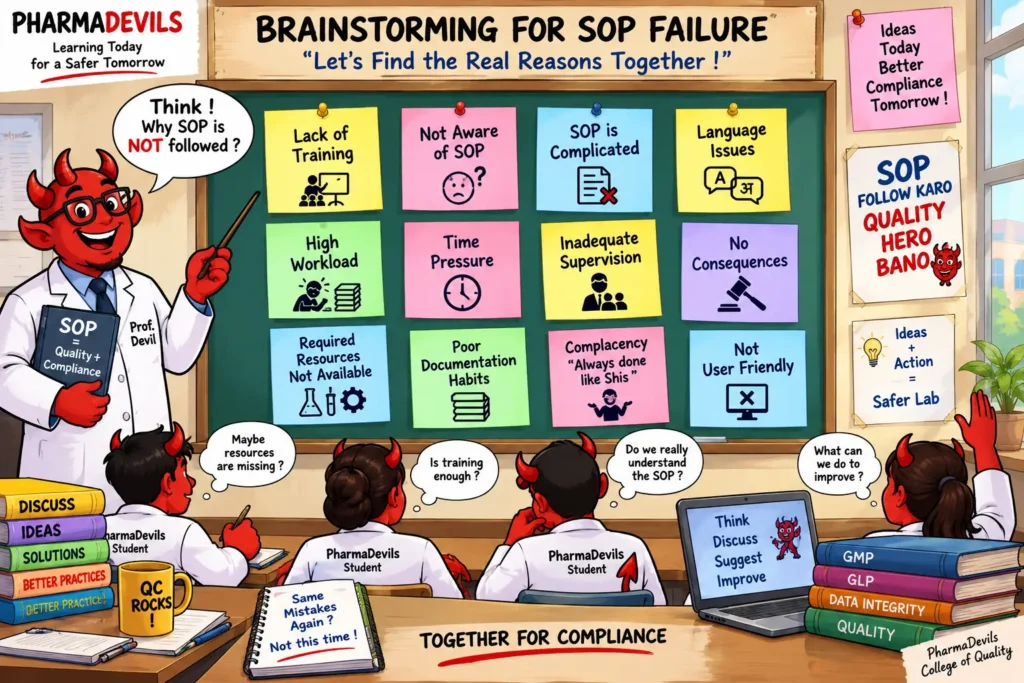
Key possible causes highlighted include lack of training, poor awareness of the SOP, complicated procedures, language difficulties, high workload, time pressure, inadequate supervision, insufficient resources, weak documentation habits, and poor user-friendliness of the SOP. These themes are relevant because the SOP assigns QC personnel responsibility for execution and requires Lab QA/QA-QC management to ensure proper implementation and training.The activity promotes discussion, identification of gaps, and development of practical corrective actions so laboratory personnel can improve GLP compliance, documentation discipline, safe working practices, and overall quality culture.
3. 5-Why Analysis for SOP Failure:
The 5-Why diagram shows a structured root-cause analysis for failure to follow the SOP for Implementation of Good Laboratory Practice (GLP). It begins with the problem that laboratory personnel did not follow GLP requirements, then progressively identifies possible causes such as insufficient SOP awareness, inadequate training and communication, lack of regular refresher training, and absence of a systematic training and monitoring program.
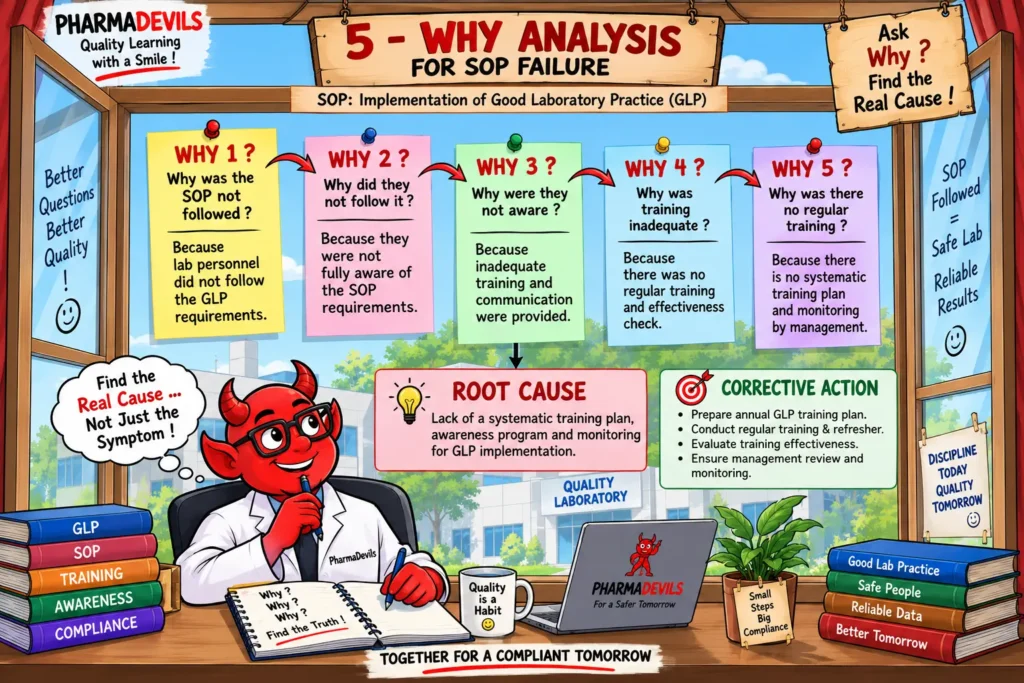
The analysis concludes that the likely root cause is a weak or poorly structured GLP training and awareness system with insufficient management monitoring. This is relevant to the SOP because QC personnel are responsible for execution, while Lab QA and QA/QC management are responsible for effective implementation, and the SOP specifically requires training of Quality Control personnel.Corrective actions may therefore include preparing a GLP training plan, conducting periodic refresher training, evaluating training effectiveness, and strengthening routine management review and compliance monitoring.
4. Fishbone Analysis for SOP Failure:
The Fishbone Analysis diagram identifies the major potential causes that can lead to failure in SOP implementation or compliance. The causes are grouped into six main categories: Man, Method, Machine, Material, Measurement, and Environment. People-related causes include inadequate training, lack of awareness, negligence, high workload, and poor supervision.
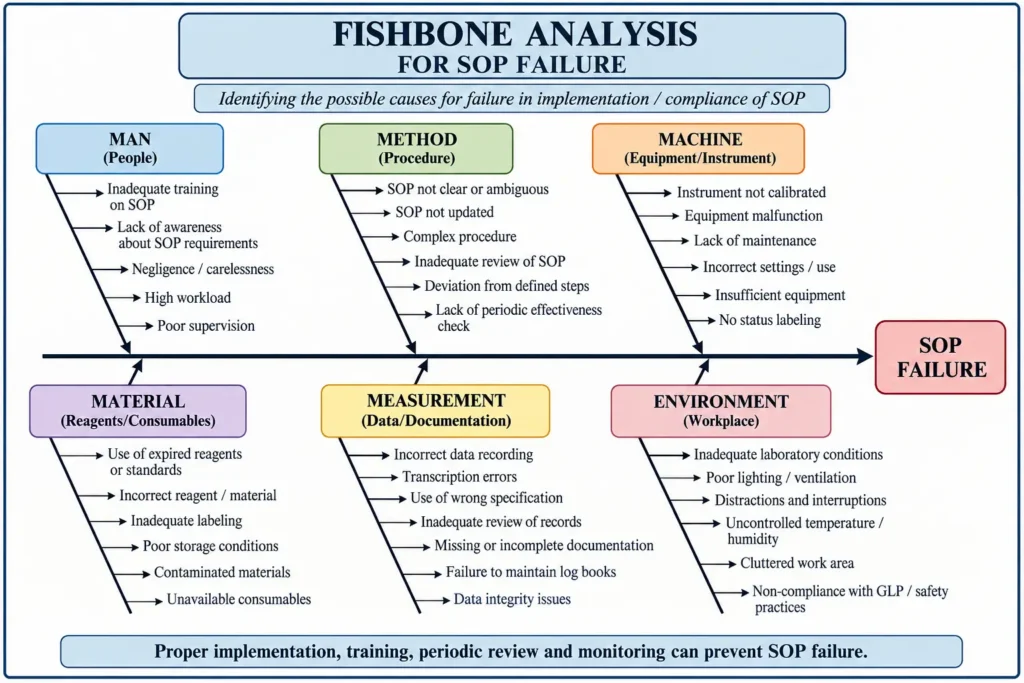
Method-related issues may include unclear or outdated SOPs, complex procedures, inadequate review, and deviation from defined steps. Equipment-related causes include calibration failure, malfunction, incorrect settings, and poor maintenance. Material issues may involve expired reagents, incorrect materials, poor labeling, or unsuitable storage. Measurement and documentation failures include incorrect data recording, wrong specifications, incomplete records, and logbook errors. Environmental factors such as poor laboratory conditions, distractions, uncontrolled temperature or humidity, and weak GLP practices may also contribute. The analysis helps identify root causes so that suitable CAPA, training, monitoring, and periodic SOP review can be implemented to prevent recurrence.
5. Fault Tree Analysis for SOP Failure:
The Fault Tree Analysis (FTA) for SOP Failure diagram systematically identifies the possible causes that can lead to an SOP being not followed or not effectively implemented. The top event, “SOP Failure,” is divided through logical OR gates into four major categories: Personnel-Related Failure, SOP/Process-Related Failure, Equipment & Facility-Related Failure, and Material & Documentation-Related Failure.
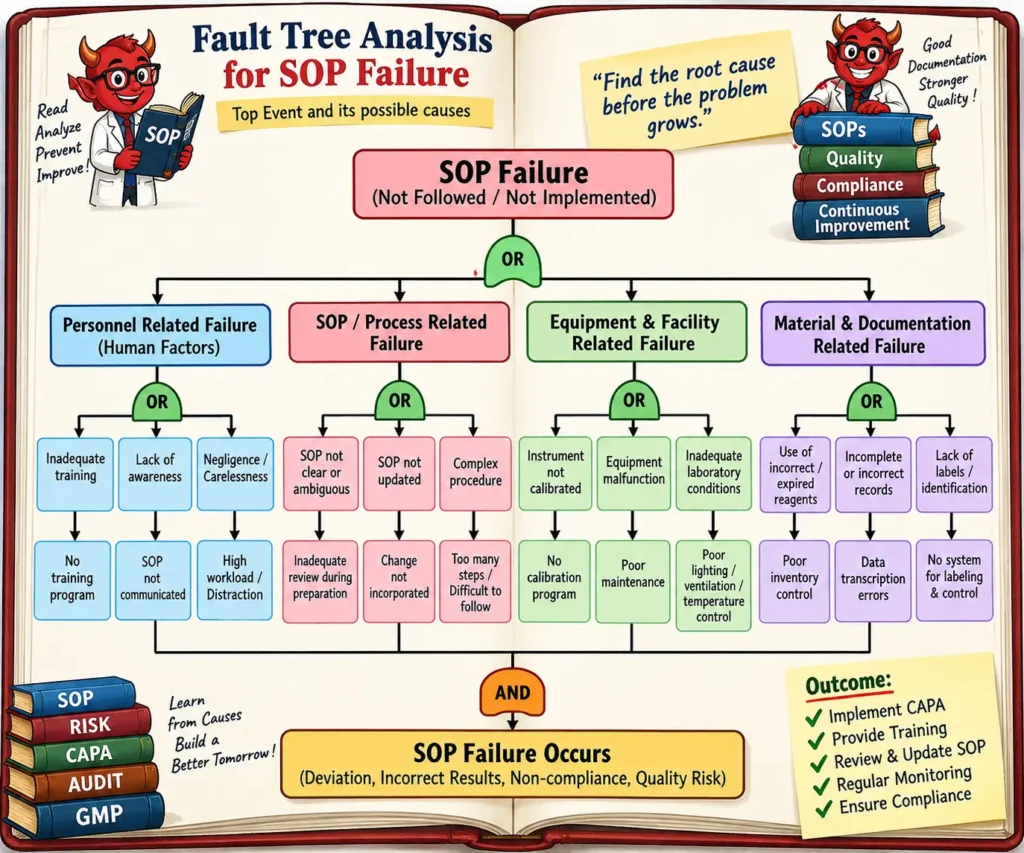
Personnel causes include inadequate training, lack of awareness, negligence, workload, and poor communication. Process-related causes include unclear or outdated SOPs, complex procedures, and inadequate review. Equipment and facility causes include lack of calibration, equipment malfunction, poor maintenance, and unsuitable laboratory conditions. Material and documentation causes include expired or incorrect reagents, incomplete records, transcription errors, and inadequate labeling. These areas align with the SOP’s emphasis on personnel responsibility, GLP practices, labeling, proper equipment status, and documentation controls.The analysis supports root-cause identification, CAPA implementation, training, SOP revision, monitoring, and improved GMP compliance.
Questions & Answers – SOP Failure, Good Laboratory Practice
Q1. What is the objective of this SOP?
Answer: The objective is to establish a procedure for the implementation of Good Laboratory Practice (GLP) in the Quality Control laboratory.
Q2. Who is responsible for executing the SOP?
Answer: The Executive-QC is responsible for execution of the SOP, while the Manager Lab QA and Head QC/QA are responsible for its effective implementation.
Q3. What can cause SOP failure in the laboratory?
Answer: Common causes include inadequate training, lack of awareness, outdated or unclear procedures, poor documentation, calibration failures, improper labeling, unsuitable storage, and weak supervision.
Q4. Why is proper labeling important in GLP?
Answer: Reagents, solutions, and glassware should carry complete identification to reduce the risk of mix-ups, incorrect use, and analytical errors.
Q5. What PPE is expected during laboratory analysis?
Answer: The SOP specifies appropriate apron, cap, gloves, and safety goggles when required.
Q6. Is mouth pipetting permitted?
Answer: No. The SOP specifically states not to pipette by mouth.
Q7. How can documentation-related SOP failure be detected?
Answer: Checks include verifying online logbook entries, correct specifications, raw-data reporting, calculation sheets, and ensuring there is no improper overwriting or cancellation in analytical records.
Q8. Why is instrument calibration important?
Answer: Calibration helps ensure that instruments and apparatus are suitable for use and that analytical results are reliable. The GLP checklist requires verification of calibration status and calibration labels.
Q9. How are OOS/OOT issues addressed?
Answer: The checklist requires that OOS/OOT results be investigated and root-cause analysis be performed, followed by action-plan and compliance follow-up.
Q10. Why should only current specifications and documents be used?
Answer: The checklist requires verification of updated specifications and database versions, and it also requires issuance and withdrawal controls to prevent the use of obsolete documents.
Q11. What role does training play in preventing SOP failure?
Answer: Training helps personnel understand the procedure and GLP requirements. The SOP identifies the Manager Lab QA as trainer, with Quality Control personnel as trainees, for a period of one and a half hours.
Q12. What corrective actions can be taken after an SOP failure?
Answer: Appropriate actions may include root-cause investigation, CAPA, retraining, SOP revision, improved supervision, calibration or maintenance, documentation correction, and effectiveness monitoring.
Q13. Why should expired reagents, standards, or samples be controlled?
Answer: The GLP checklist requires monitoring of validity, expiry, storage conditions, usage records, and removal or destruction of expired materials and samples.
Q14. What is the purpose of periodic GLP checks?
Answer: Daily, weekly, monthly, and half-yearly checks help identify compliance gaps early and ensure continued control of instruments, documentation, standards, samples, investigations, and laboratory activities.
Q15. What can be the impact of SOP failure?
Answer: SOP failure can contribute to deviations, incorrect analytical results, documentation errors, OOS/OOT events, GMP non-compliance, data-integrity concerns, and potential product-quality risks.
Reference Guideline:
For your uploaded SOP on Implementation of Good Laboratory Practice in a pharmaceutical QC laboratory, the most directly relevant external reference is the WHO guideline for pharmaceutical quality-control laboratories. Your SOP itself lists only “In House” as its reference.
- WHO TRS 957, Annex 1 – Good Practices for Pharmaceutical Quality Control Laboratories: covers documentation, personnel, reagents, reference standards, calibration, equipment, testing, records, and laboratory safety. (World Health Organization)
WHO official guideline page
WHO guideline PDF - OECD Principles of Good Laboratory Practice (GLP): useful as a broader GLP reference, particularly for non-clinical safety studies. (OECD)
OECD Principles of GLP – official page
For this pharmaceutical QC SOP, I would cite WHO TRS 957, Annex 1 as the primary external guideline.