







1. Brief Description:
The Installation Qualification Protocol Cum Report for the High Pressure High Vacuum (HPHV) Steam Sterilizer is designed to provide documented evidence that the equipment is installed correctly and complies with approved design specifications, supplier requirements, and intended pharmaceutical use. The protocol covers the sterilizer installed in the Unit Preparation Room and verifies equipment details, construction, utilities, piping, instrumentation, control systems, safety features, and supporting documentation. It defines responsibilities for Quality Assurance, Production, Quality Control, and Engineering during qualification activities. The sterilizer operates through vacuum-steam pulsing, sterilization hold, vacuum drying, and sterile-air vacuum break to ensure effective air removal, steam penetration, uniform temperature distribution, and load drying. Pre-qualification checks include approved design documents, P&ID, electrical drawings, technical specifications, calibration certificates, and material certificates. Installation acceptance criteria include proper mounting, leveling, adequate workspace, illumination, utilities, operating pressures, materials of construction, and component verification before final approval and release.
Skip to PDF content2. Flow Diagram:
The Flow Diagram for Installation Qualification (IQ) Protocol Cum Report of the High Pressure High Vacuum (HPHV) Steam Sterilizer presents a systematic sequence for verifying and documenting that the sterilizer has been installed correctly before operational use. The process begins with protocol initiation and pre-approval, followed by defining the objective, scope, and responsibilities of Quality Assurance, Production, Quality Control, and Engineering.
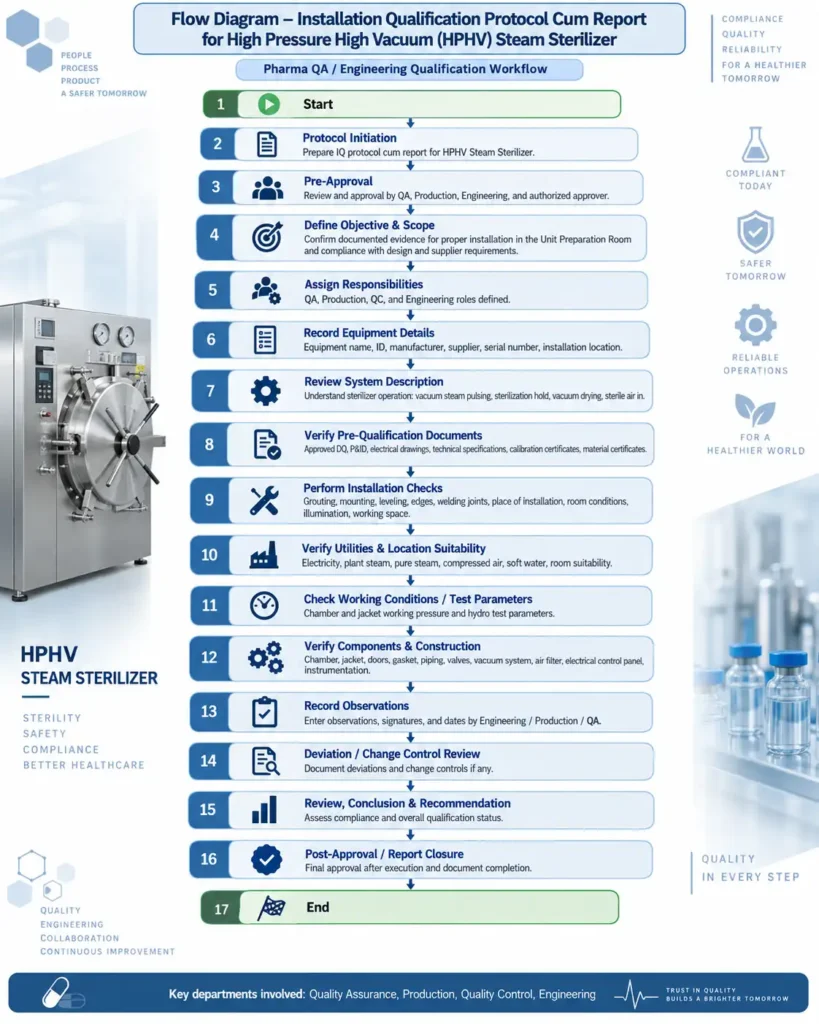
The workflow then covers recording equipment details, reviewing the sterilizer system, and verifying prerequisite documents such as approved DQ, P&ID, electrical drawings, technical specifications, calibration certificates, and material certificates. Installation checks include mounting, leveling, room conditions, illumination, utilities, pressure requirements, components, construction materials, control systems, and instrumentation. Observations are documented and any deviations or change controls are evaluated. The process concludes with review, recommendation, post-approval, and formal closure of the qualification report.
3. Brainstorming:
The Brainstorming Diagram for Installation Qualification (IQ) of the High Pressure High Vacuum (HPHV) Steam Sterilizer Not Performed systematically identifies potential reasons for failure to execute the required qualification activity. The diagram groups possible causes into key areas such as resource constraints, budget and cost issues, documentation gaps, vendor or supplier delays, infrastructure and utility deficiencies, planning and scheduling problems, communication gaps, inadequate training, regulatory awareness, and management-related factors.
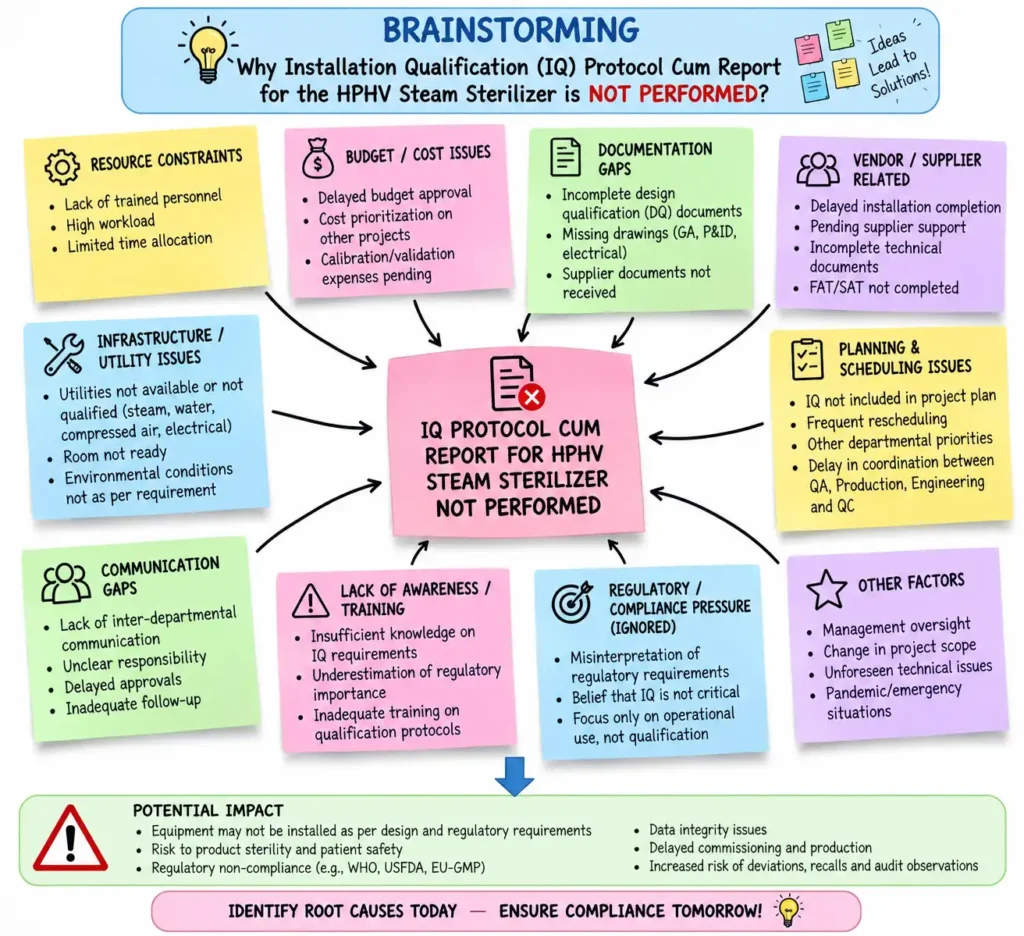
Major concerns may include unavailable approved DQ documents, missing P&IDs or electrical drawings, incomplete calibration records, utilities not being ready, delayed supplier support, unclear departmental responsibilities, insufficient trained personnel, and inadequate follow-up. These are brainstorming hypotheses and should be verified through investigation before assigning a root cause. Failure to perform IQ may result in uncertainty regarding correct equipment installation, delayed commissioning, qualification deviations, regulatory observations, and potential risks to sterility assurance. The analysis supports structured root-cause investigation and development of appropriate CAPA before proceeding to subsequent qualification stages.