







1. Introduction – SOP for Issuance of Polybag in Production:
The SOP for Issuance of Polybag in Production describes the controlled procedure for receipt, storage, inspection, issuance, use, reconciliation, and disposal of polybags used during pharmaceutical manufacturing. The primary objective is to ensure that suitable, clean, intact, and contamination-free polybags are issued for storage and handling of semi-finished products during manufacturing stages such as granulation, compression, and coating. Virgin polybags are received from the warehouse against the production department’s indent and stored in designated areas inside properly covered drums. Before issuance, the Production Chemist verifies that each polybag is free from stains, threads, dust, hair, foreign particles, and tears. Defective polybags are rejected and documented in the prescribed inspection and issuance log. Required quantities are issued at the start of batch manufacturing, while unused polybags are torn after completion of manufacturing and recorded in the reconciliation document before disposal. This SOP supports proper material handling, traceability, cleanliness, reconciliation, and prevention of product contamination.
Skip to PDF content2. Flow Diagram – Issuance of Polybag in Production:
The SOP for Issuance of Polybag in Production establishes a controlled sequence for receiving, storing, inspecting, issuing, reconciling, and disposing of polybags used during pharmaceutical manufacturing. Virgin polybags are received from the warehouse against an approved indent and stored in designated production areas inside a properly covered drum. The storage drum is maintained in a clean condition using a vacuum cleaner as specified in the SOP.
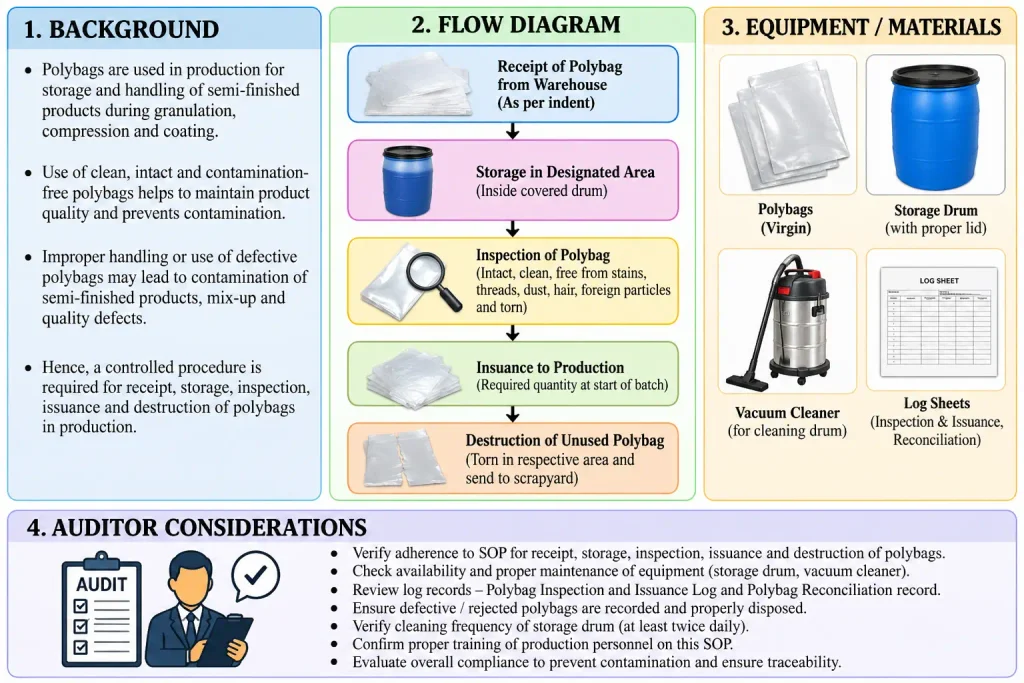
Before issuance, the Production Chemist inspects each polybag to confirm that it is intact and free from stains, threads, dust, hair, foreign particles, and tears. Any defective polybag is rejected and documented in the Polybag Inspection and Issuance Log. Required polybags are then issued to operators/helpers at the start of manufacturing activities such as granulation, compression, and coating. After manufacturing, unused polybags are torn in the respective area, sent for further destruction, and recorded in the Polybag Reconciliation Record. These controls support cleanliness, traceability, accountability, and prevention of contamination.
3. Benefits of Following SOP – Issuance of Polybag in Production:
Following the SOP for Issuance of Polybag in Production ensures that only clean, intact, and suitable polybags are used for handling and storage of semi-finished products during manufacturing. The SOP requires polybags to be received through a controlled process, stored in designated areas inside properly covered drums, and maintained in clean condition. Before issuance, each polybag is inspected for stains, threads, dust, hair, foreign particles, and tears. Defective polybags are rejected and documented, while acceptable polybags are issued according to batch requirements.
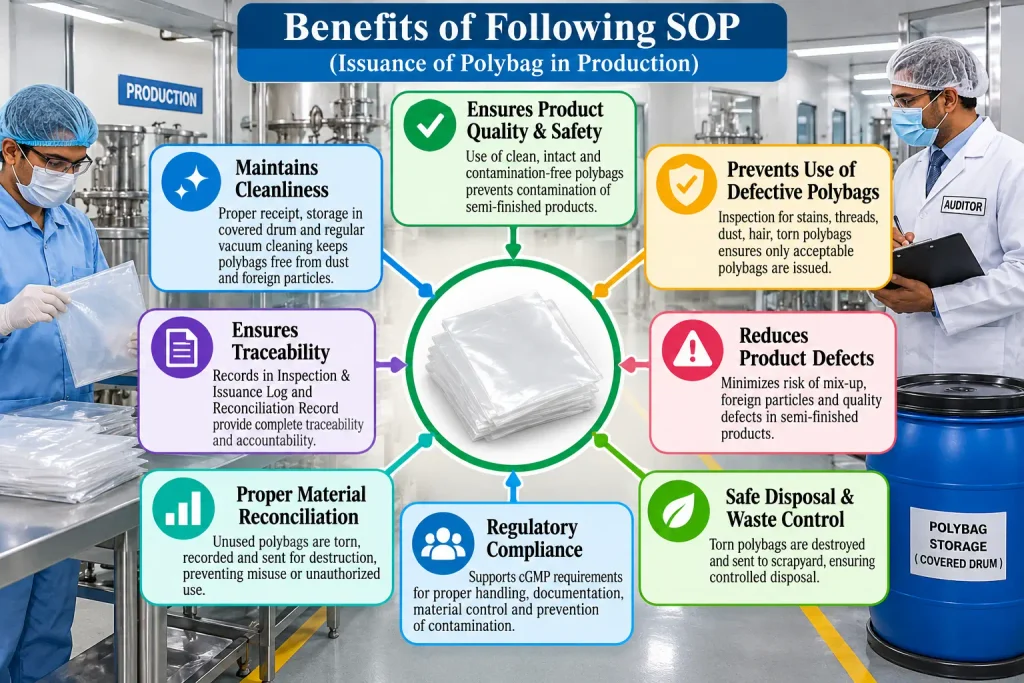
Proper implementation of this SOP helps prevent contamination, mix-up, and use of damaged polybags. It also improves traceability through inspection, issuance, and reconciliation records. Unused polybags are torn, recorded, and sent for destruction, which supports accountability and prevents unauthorized reuse. Overall, the SOP promotes cleanliness, controlled material handling, reliable documentation, and consistent production practices.
4. Brainstorming Analysis for SOP Failure – Issuance of Polybag in Production:
The brainstorming analysis for SOP failure in Issuance of Polybag in Production identifies potential causes that may lead to improper receipt, storage, inspection, issuance, reconciliation, or destruction of polybags. The SOP requires virgin polybags to be received from the warehouse, stored in designated areas inside covered drums, and the storage drums to be cleaned regularly. Possible failure causes include poor inspection of polybags, use of torn or contaminated bags, incorrect quantity issuance, incomplete documentation, insufficient training, improper housekeeping, and failure to maintain the Polybag Inspection and Issuance Log. The SOP specifically requires verification for stains, threads, dust, hair, foreign particles, and tears before use.
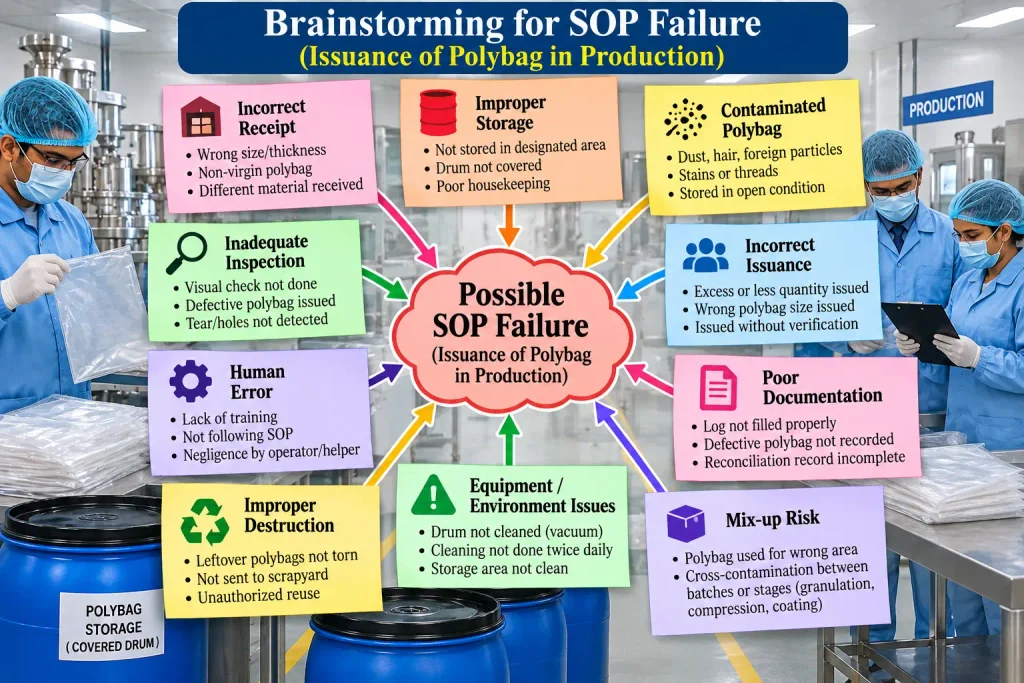
Another major risk is improper handling of unused polybags. Failure to tear, record, and send them for destruction can result in poor reconciliation or unauthorized reuse. Brainstorming helps identify these weaknesses in advance so that appropriate controls, training, monitoring, and documentation practices can be strengthened.
5. 5-Why Analysis for SOP Failure – Issuance of Polybag in Production:
The 5-Why Analysis for SOP Failure – Issuance of Polybag in Production is used to identify the underlying reason for failures such as issuance of defective, contaminated, or unsuitable polybags during manufacturing. The SOP requires the Production Chemist to verify that polybags are intact and free from stains, threads, dust, hair, foreign particles, and tears before issuance. A possible failure may begin when a defective polybag is issued because proper inspection was not performed. Further questioning may identify that the inspection criteria were not followed, personnel awareness or training was inadequate, training effectiveness was not verified, or supervisory monitoring of SOP implementation was insufficient. This analysis helps move from the immediate problem to the probable root cause.
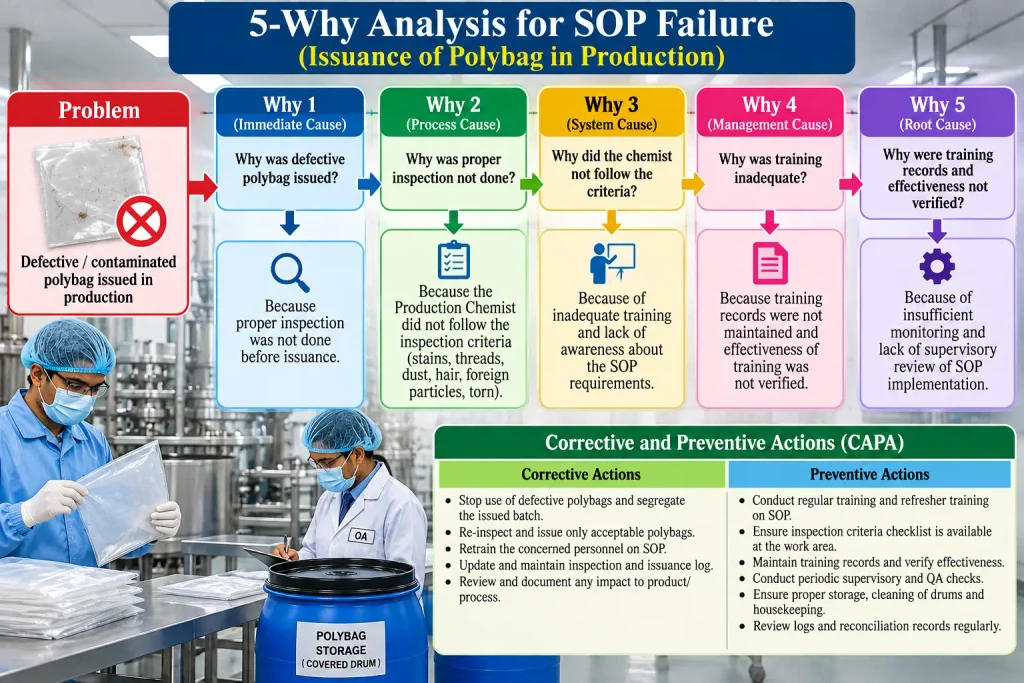
Appropriate corrective and preventive actions may include segregation of defective polybags, re-inspection, personnel retraining, reinforcement of inspection criteria, review of issuance records, and stronger supervisory checks. Regular review of the Polybag Inspection and Issuance Log and reconciliation records can help verify continued compliance and prevent recurrence.
6. Fishbone Analysis for SOP Failure – Issuance of Polybag in Production:
The Fishbone Analysis for SOP Failure – Issuance of Polybag in Production is used to systematically identify potential causes that may result in the issuance of defective, contaminated, or unsuitable polybags during pharmaceutical manufacturing. The analysis groups possible causes under major categories such as Man, Material, Method, Machine, Environment, and Measurement. Personnel-related causes may include inadequate training, lack of awareness, carelessness, or failure to follow the approved SOP. Material-related causes may involve torn, contaminated, stained, or otherwise defective polybags. Method-related failures can include improper inspection, incorrect issuance, poor storage, incomplete reconciliation, or improper destruction. The SOP specifically requires polybags to be checked for stains, threads, dust, hair, foreign particles, and tears before issuance.
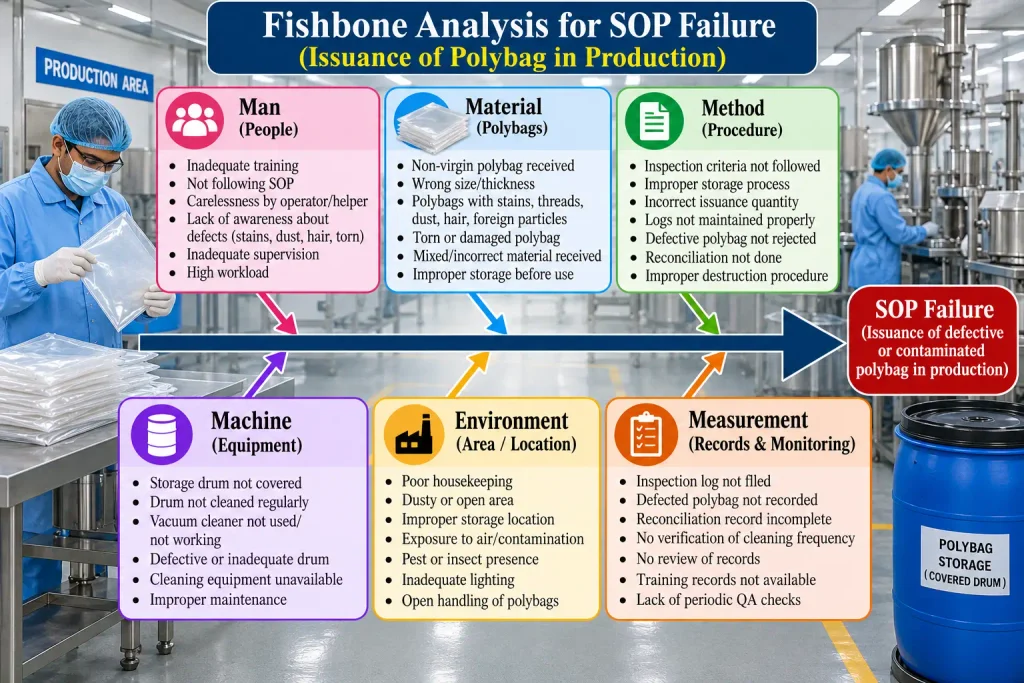
Equipment and environmental causes may include uncovered storage drums, inadequate cleaning, poor housekeeping, or unsuitable storage conditions. Measurement-related causes include incomplete inspection logs, missing reconciliation records, and inadequate monitoring. Identifying these causes helps strengthen controls, training, documentation, supervision, and overall SOP compliance.
7. Fault Tree Analysis for SOP Failure – Issuance of Polybag in Production:
The Fault Tree Analysis for SOP Failure – Issuance of Polybag in Production evaluates how different failures can combine and lead to the top event of a defective or contaminated polybag being issued in production. The major contributing branches include receipt of unsuitable polybags, improper storage, inadequate inspection, incorrect issuance, documentation failure, and improper handling of unused polybags.The SOP requires virgin polybags to be received from the warehouse, stored in designated areas inside properly covered drums, and the drums to be cleaned regularly. Failure of these controls can increase the possibility of contamination or use of unsuitable polybags. Before issuance, polybags must be checked for stains, threads, dust, hair, foreign particles, and tears. Defective bags are required to be rejected and recorded.
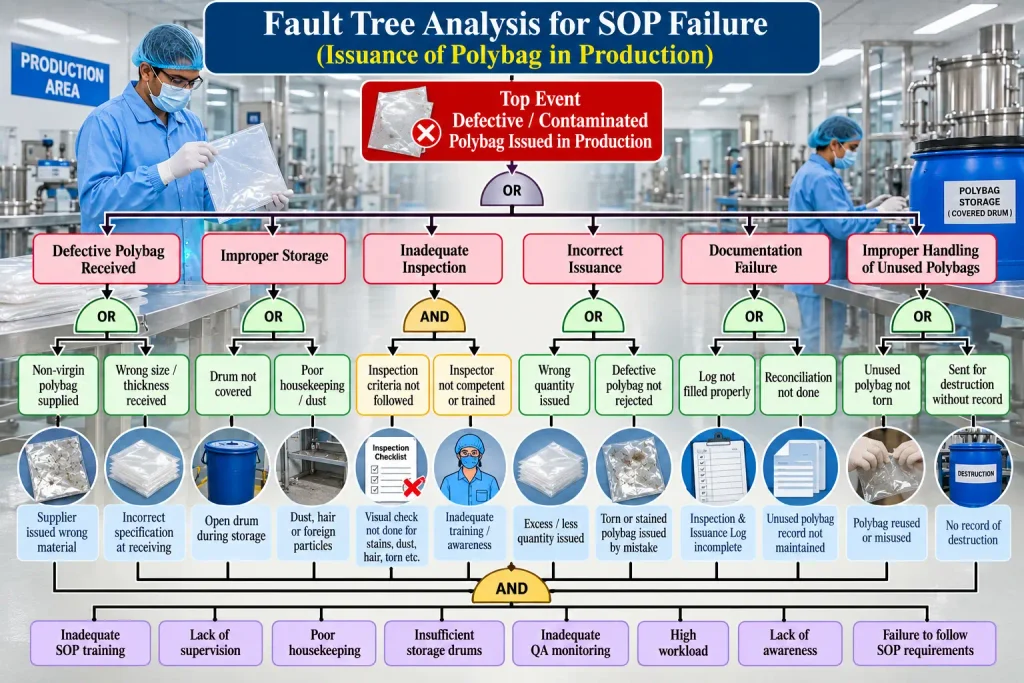
The fault tree also highlights failures such as incomplete inspection logs, incorrect quantities, inadequate supervision, poor housekeeping, and failure to reconcile or destroy unused polybags. After manufacturing, unused polybags are required to be torn, sent for destruction, and documented in the reconciliation record. This analysis helps identify critical failure pathways so that training, supervision, storage control, inspection, documentation, and QA monitoring can be strengthened to prevent recurrence.
8. Impact Assessment for SOP Failure – Issuance of Polybag in Production:
The Impact Assessment for SOP Failure – Issuance of Polybag in Production evaluates the possible consequences if defective, contaminated, or unsuitable polybags are issued during manufacturing. The SOP requires polybags to be inspected before issuance and rejected if stains, threads, dust, hair, foreign particles, or tears are observed. Failure to follow these controls may affect product quality, cleanliness, traceability, production continuity, documentation, and material reconciliation. Contaminated or torn polybags can increase the risk of foreign-particle contamination or improper protection of semi-finished products. Incorrect issuance or incomplete records may also make investigation and accountability more difficult.
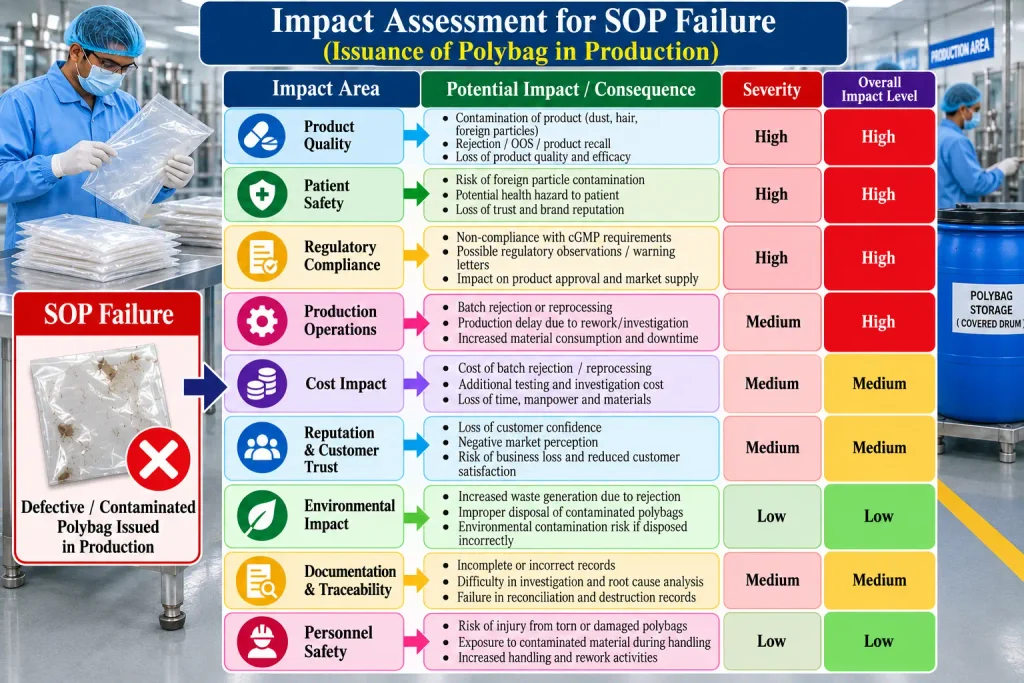
The SOP further requires unused polybags to be torn, sent for destruction, and documented in the reconciliation record. Failure in this activity can create risks of unauthorized reuse, incomplete reconciliation, and weak traceability. Overall, the impact of SOP failure can range from minor documentation gaps to significant product-quality concerns. Therefore, proper inspection, controlled storage, accurate issuance, complete records, reconciliation, and supervisory monitoring are essential for maintaining effective control of polybags in production.
9. Corrective and Preventive Action (CAPA) – Issuance of Polybag in Production:
The CAPA for SOP Failure – Issuance of Polybag in Production is intended to correct failures associated with the receipt, storage, inspection, issuance, reconciliation, and destruction of polybags and to prevent recurrence. If a defective or contaminated polybag is identified, the affected polybags should be segregated, further use should be stopped, and available stock should be re-inspected against the SOP acceptance criteria. The SOP requires polybags to be intact and free from stains, threads, dust, hair, foreign particles, and tears before issuance.
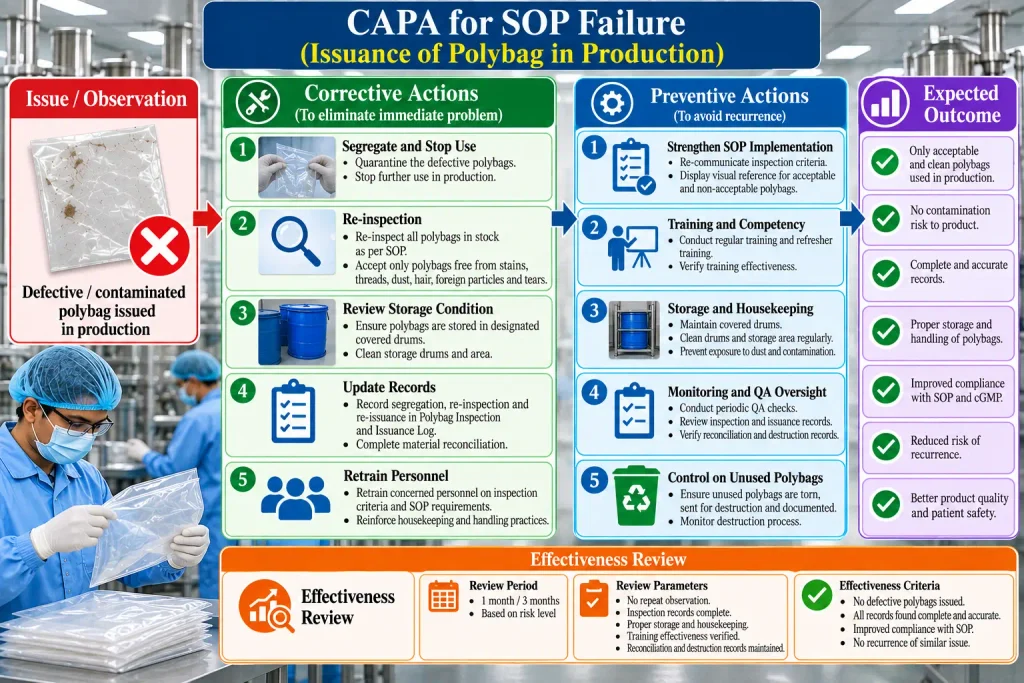
Corrective actions may include re-inspection, updating inspection and issuance records, reviewing storage conditions, completing reconciliation, and retraining concerned production personnel. Preventive actions should strengthen SOP implementation through periodic training, QA monitoring, proper housekeeping, use of covered storage drums, and regular review of records. The SOP also requires unused polybags to be torn, sent for destruction, and documented in the reconciliation record. Effectiveness should be verified through periodic review of inspection records, reconciliation records, storage practices, personnel compliance, and recurrence of similar observations.
Questions & Answers – Issuance of Polybag in Production:
- What is the objective of the SOP for Issuance of Polybag in Production?
The objective is to ensure a proper and controlled procedure for issuance of polybags in production. - What is the scope of this SOP?
The SOP applies to issuance of polybags used for storage of semi-finished products. - Who is responsible for execution of this SOP?
All concerned production personnel are responsible for execution of the SOP. - Who is responsible for effective implementation of the SOP?
Head-Production and Head QA/QC are responsible for effective implementation. - What is the role of QA in this SOP?
QA ensures implementation of the practices through random checks during IPQA rounds. - From where are virgin polybags received?
Virgin polybags are received from the warehouse according to the indent provided by the relevant production department. - Where should received polybags be stored?
They should be stored in designated areas, such as Sieve/FBD bag storage for granulation and dies-punches/tool room area for compression or coating. - How should polybags be stored during use?
Polybags should be stored inside a drum covered with a proper lid. - How frequently should the polybag storage drum be cleaned?
The drum should be cleaned from inside and outside using a vacuum cleaner at least twice a day. - What should be checked before issuing a polybag?
The Production Chemist should verify that polybags are intact and free from stains, threads, dust, hair, foreign particles, and tears. - What should be done if a polybag is defective?
The defective polybag should be rejected and recorded in the Polybag Cleaning and Issuance Log / Polybag Inspection and Issuance Log as specified in the SOP. - When should polybags be issued to operators and helpers?
Required polybags should be issued at the start of batch manufacturing in granulation, compression, and coating areas. - What should be done with leftover unused polybags after manufacturing?
Leftover unused polybags should be torn in the respective manufacturing area and sent to the scrapyard for further destruction. - Where should the quantity of torn unused polybags be recorded?
The quantity should be recorded in the Polybag Reconciliation document. - What annexures are included in this SOP?
Annexure-I is the Polybag Inspection and Issuance Log, and Annexure-II is the Polybag Reconciliation Record. - Why is polybag reconciliation important?
It ensures that issued, used, and unused polybags are properly accounted for and that unused polybags are documented before destruction. This supports traceability and accountability.
Reference Guidelines – Issuance of Polybag in Production:
- Approved In-House SOP – Issuance of Polybag in Production
- Polybag Inspection and Issuance Log – Annexure I
- Polybag Reconciliation Record – Annexure II
- Batch Manufacturing Record (BMR), since the reconciliation record is intended to be attached with the BMR
- Good Manufacturing Practices (GMP) requirements applicable to material handling, prevention of contamination, documentation, and traceability
- Good Documentation Practices (GDP)
- Approved procedures for housekeeping, cleaning, waste disposal, and material reconciliation
- Training records and departmental SOP training requirements