







1. Introduction – SOP for Issue of Formats in Production:
The SOP for Issue of Formats in Production defines a controlled system for the issuance, use, traceability, return, and revision of production formats used in pharmaceutical manufacturing. The purpose is to ensure that only approved and current formats are available for recording manufacturing activities, thereby supporting Good Documentation Practices and GMP compliance. Before issuing a format book, the authorized person affixes the issued seal and records the book number, date of issue, total number of pages, issuer’s signature, and receiver’s signature. Completed format books are returned to the Production Manager before a new book is issued, and issuance details are recorded in the designated register. Loose formats may also be issued under defined controls.Master copies of production formats are maintained under departmental control and are checked and approved by Production and Quality Assurance. Any revision or change to a format is processed through an approved change control system, with obsolete versions withdrawn and destroyed.
Skip to PDF content2. Flow Diagram – Issue of Formats in Production:
The Flow Diagram for Issue of Formats in Production represents the sequential controls followed for issuing, using, returning, and revising production formats. The process begins by affixing the issued seal on the covering page of the format book. The authorized person then records the book number, date of issue, and total number of pages, followed by signatures of both the issuer and receiver. After the format book is completely filled, it is returned to the Production Manager and a new book is issued. In the absence of the Production Manager, a nominated person may perform the issuance.
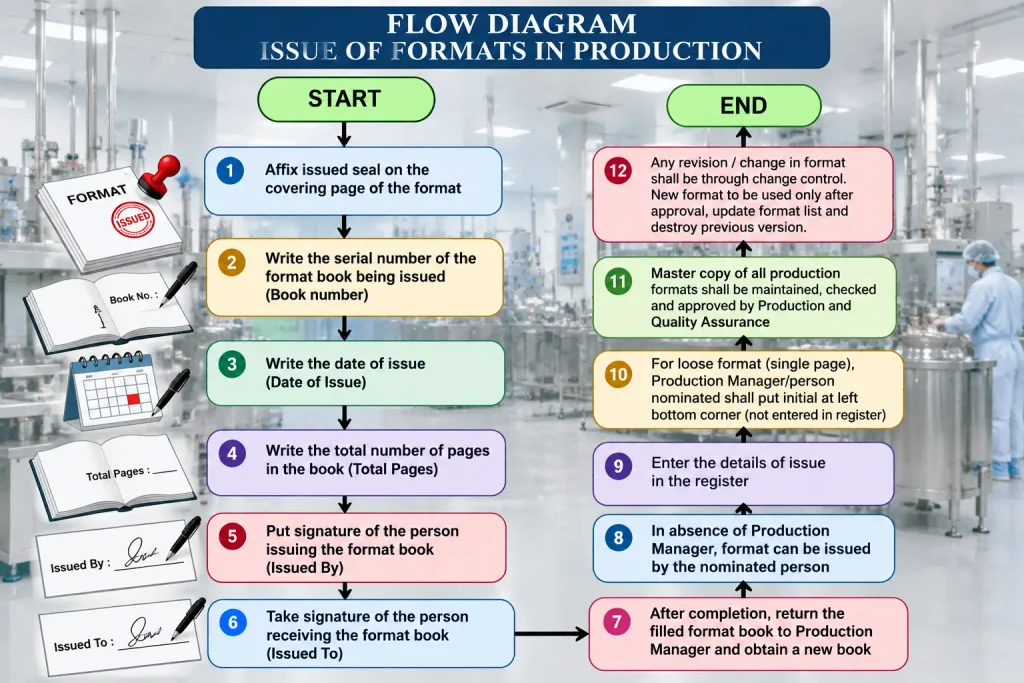
Details of issued format books are entered in the designated register. For a loose single-page format, the Production Manager or nominated person initials the lower-left corner. Master copies of all production formats are maintained under approved control. Any revision or modification is handled through change control, and obsolete formats are withdrawn and destroyed after approval of the new version.
3. Benefits of Following SOP – Issue of Formats in Production:
Following the SOP for Issue of Formats in Production ensures that production personnel use controlled and approved formats for recording manufacturing activities. The procedure establishes traceability by requiring details such as the format book number, date of issue, total pages, issuer’s signature, and receiver’s signature to be documented during issuance. Proper implementation of the SOP also provides accountability by defining responsibility for issuance, return, and control of format books. Completed books are returned to the Production Manager, while issue details are entered in the designated register.
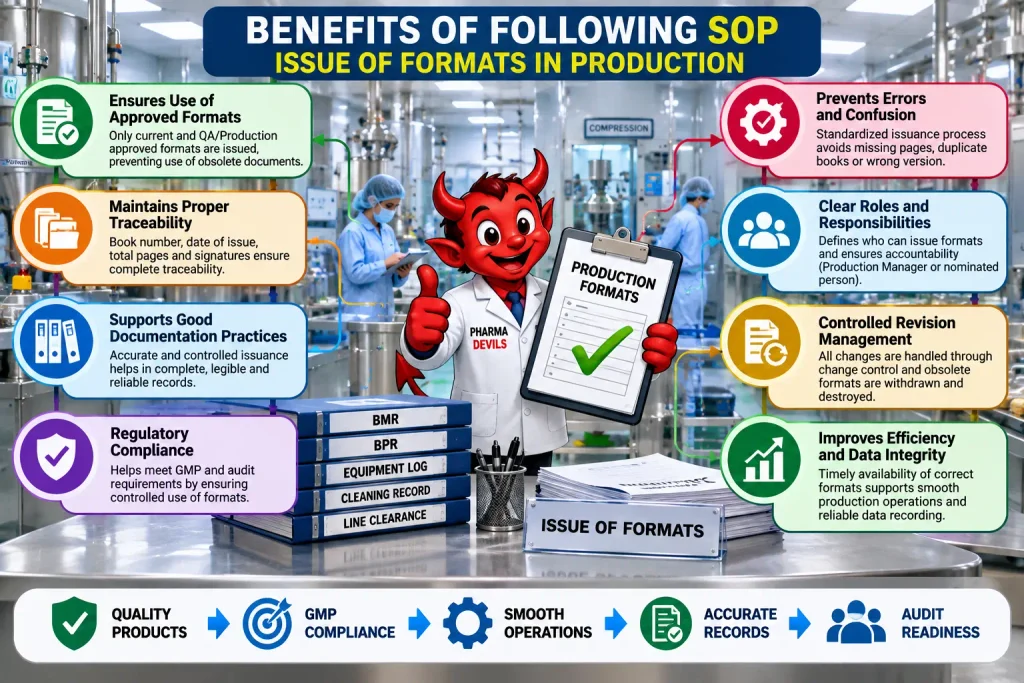
Another important benefit is effective document and revision control. Master copies of production formats are maintained and approved by Production and Quality Assurance, and any revision is implemented only through approved change control. Obsolete versions are withdrawn and destroyed. Overall, following this SOP supports Good Documentation Practices, data integrity, GMP compliance, traceability, audit readiness, and consistent production documentation.
4. Brainstorming Analysis for SOP Failure – Issue of Formats in Production:
The Brainstorming Analysis for SOP Failure – Issue of Formats in Production identifies possible failures that may occur during issuance, use, return, and control of production formats. Potential issues include failure to affix the issued seal, incorrect book number, wrong date of issue, incorrect total page count, missing issuer or receiver signatures, and failure to record issuance details in the register. These are directly related to the controls specified in the SOP.
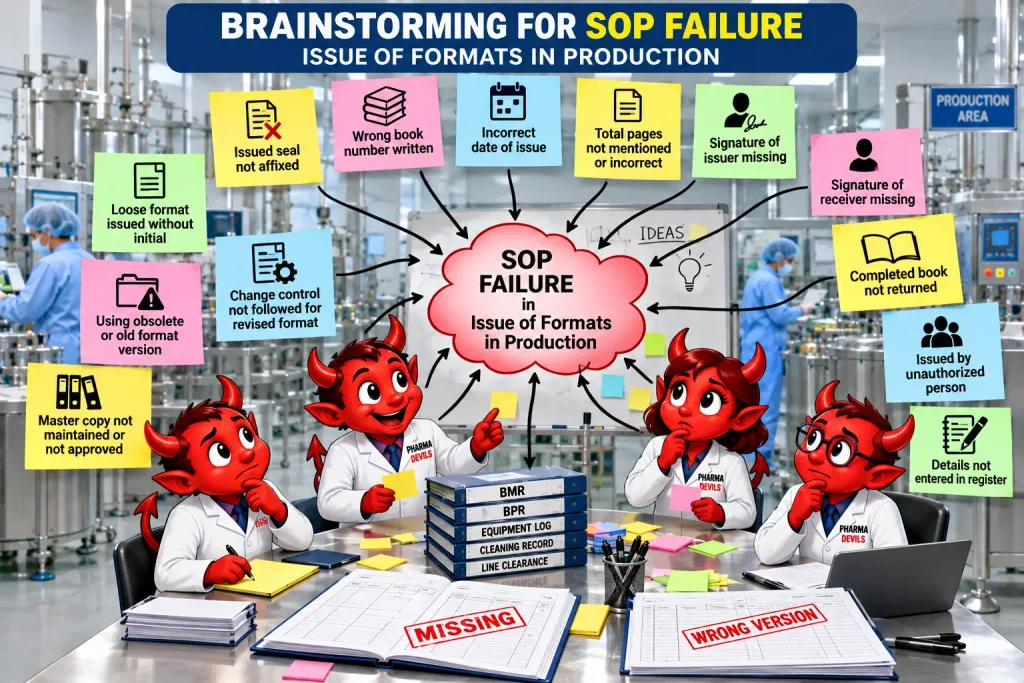
Other possible failures include issuance of loose formats without the required initial, use of an obsolete or uncontrolled format, failure to maintain an approved master copy, and implementation of a revised format without approved change control. The SOP requires master production formats to be checked and approved by Production and Quality Assurance, while any revision must be handled through change control and obsolete versions destroyed. This brainstorming exercise helps identify documentation risks early and supports improved traceability, accountability, data integrity, GMP compliance, and audit readiness.
5. 5-Why Analysis for SOP Failure – Issue of Formats in Production:
The 5-Why Analysis for SOP Failure – Issue of Formats in Production is used to identify the underlying causes of errors during issuance and control of production formats. Typical failures may include the issued seal not being affixed, incorrect book number or date, wrong total page count, missing signatures, or incomplete issuance records. These controls are specifically required by the SOP during format issuance.
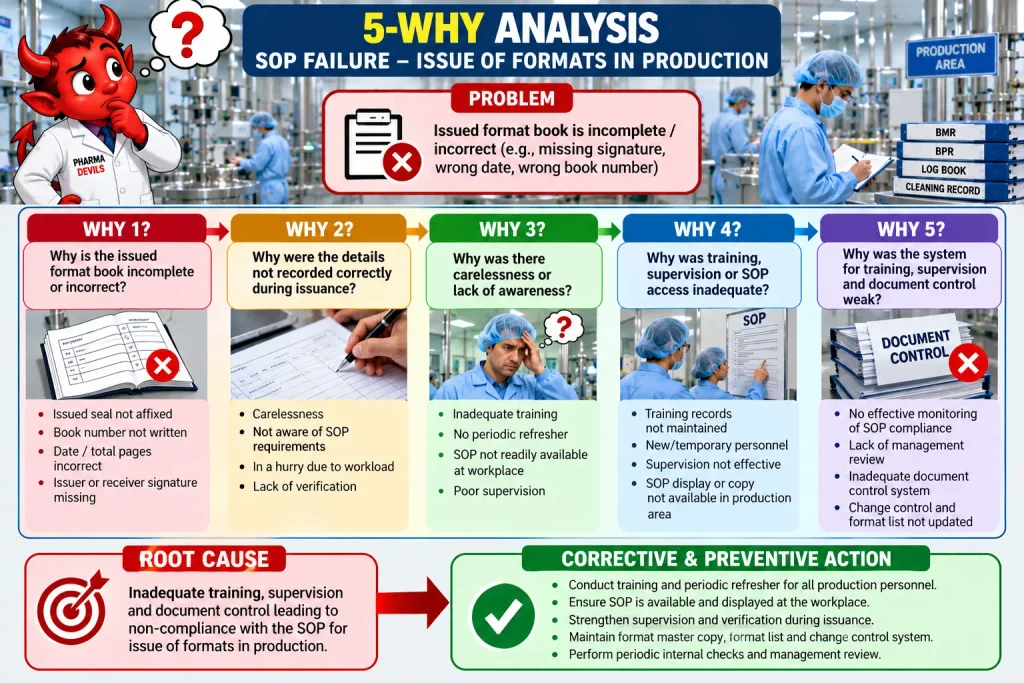
The analysis progressively investigates why these failures occurred. Possible contributing factors may include inadequate awareness of SOP requirements, insufficient verification during issuance, poor supervision, or weak control over approved formats. The SOP also requires the master copy of production formats to be maintained, checked, and approved, while any revision must be processed through an approved change-control system.The 5-Why approach helps identify the root cause of non-compliance so that suitable corrective and preventive actions can be established. This supports better document control, traceability, accountability, GMP compliance, and prevention of recurrence.
6. Fishbone Analysis for SOP Failure – Issue of Formats in Production:
The Fishbone Analysis for SOP Failure – Issue of Formats in Production is used to systematically identify the potential causes that can lead to failure in the issuance, control, use, and revision of production formats. The causes may be grouped under major categories such as Man, Method, Material, Machine, Environment, and Management. Under Man, possible causes include inadequate training, lack of SOP awareness, missing signatures, incorrect register entries, and insufficient supervision. Under Method, failures may include non-affixing of the issued seal, incorrect book number or date, unverified total pages, failure to obtain issuer/receiver signatures, or failure to update the issue register. These activities are specifically required by the SOP.
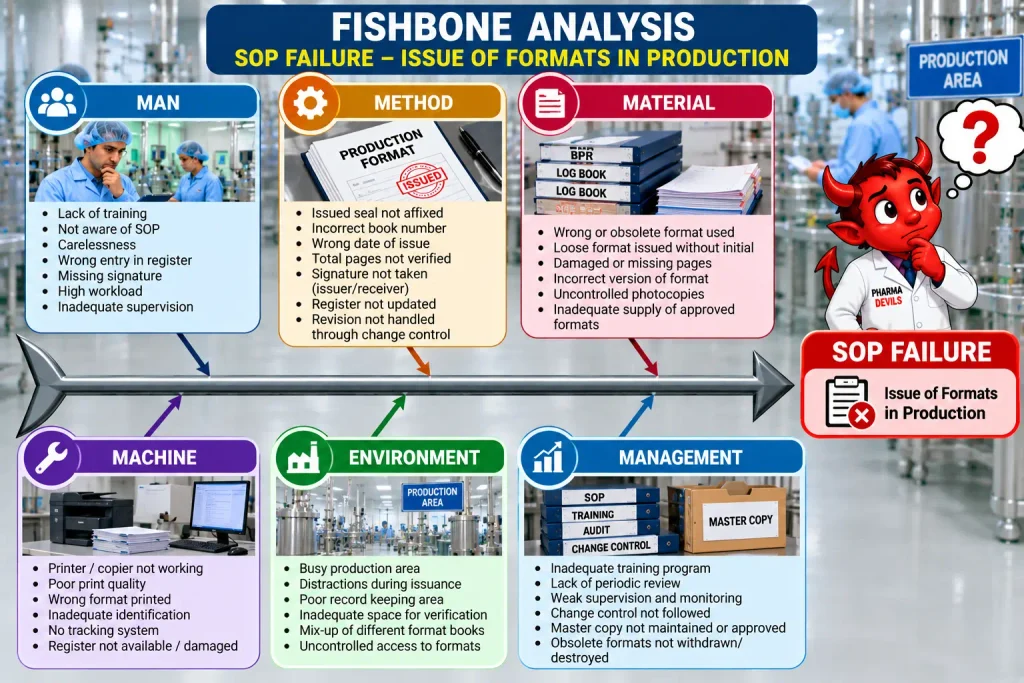
Under Material and Management, risks may include use of obsolete or uncontrolled formats, improper control of master copies, and failure to process revisions through approved change control. The SOP requires approved master formats to be maintained and obsolete versions to be withdrawn after an approved revision. This analysis helps identify contributing factors so that suitable CAPA can be implemented to strengthen document control, traceability, data integrity, GMP compliance, and audit readiness.
7. Fault Tree Analysis for SOP Failure – Issue of Formats in Production:
The Fault Tree Analysis for SOP Failure – Issue of Formats in Production evaluates the possible causes that may result in incorrect, incomplete, or uncontrolled issuance of production formats. The top event is SOP failure, which can arise from several contributing branches such as human error, process or method failure, format/document failure, support-system failure, and management failure. Human-related causes may include inadequate SOP awareness, carelessness, or missing verification during issuance. Process-related causes include failure to affix the issued seal, incorrect book number, wrong issue date, incorrect total pages, or missing issuer and receiver signatures. These are key controls specifically required by the SOP.
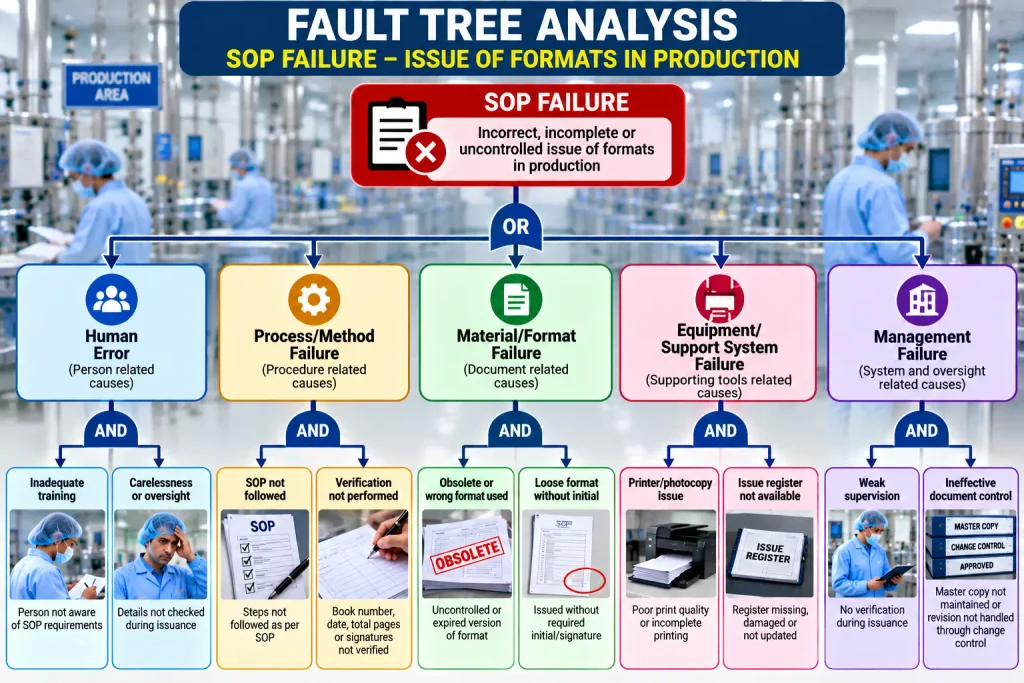
Document and management failures may include use of obsolete formats, improper control of loose formats, weak maintenance of approved master copies, or revision of formats without approved change control. The SOP requires approved master formats to be maintained and previous versions to be destroyed after authorized revision. The fault tree helps identify combinations of causes that can lead to SOP failure and supports targeted CAPA to improve document control, traceability, accountability, data integrity, and GMP compliance.
8. Impact Assessment – Issue of Formats in Production:
The Impact Assessment for SOP Failure – Issue of Formats in Production evaluates the possible consequences of incorrect, incomplete, or uncontrolled issuance of production formats. Since the SOP requires controlled issuance with the book number, date of issue, total pages, issuer signature, receiver signature, and issue-register entry, failure to follow these requirements can affect the reliability and traceability of production documentation. The impact may include incomplete production records, poor traceability of issued formats, unclear accountability, documentation errors, increased investigation workload, and reduced audit readiness. Failure to control loose formats or to maintain approved master copies can further increase the risk of using an incorrect or uncontrolled document.
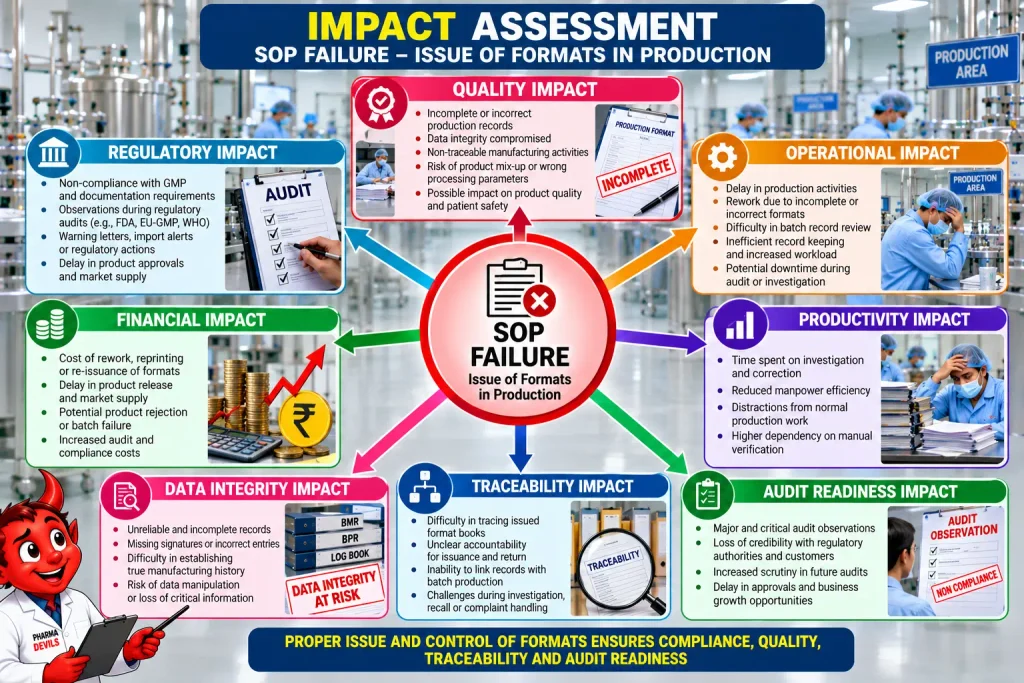
The SOP also requires revisions to be processed through approved change control, with the updated format list maintained and previous versions destroyed. Failure in this control may lead to use of obsolete formats and inconsistent records. Overall, proper implementation of the SOP supports data integrity, document control, GMP compliance, traceability, operational efficiency, and effective audit preparedness.
9. CAPA – Issue of Formats in Production:
The CAPA for Issue of Formats in Production is intended to eliminate the causes of incorrect, incomplete, or uncontrolled issuance of production formats and to prevent recurrence. Immediate corrective actions should focus on identifying affected format books, verifying issuance details, completing missing information where scientifically and procedurally justified, updating the issue register, and removing any obsolete or uncontrolled formats from use.
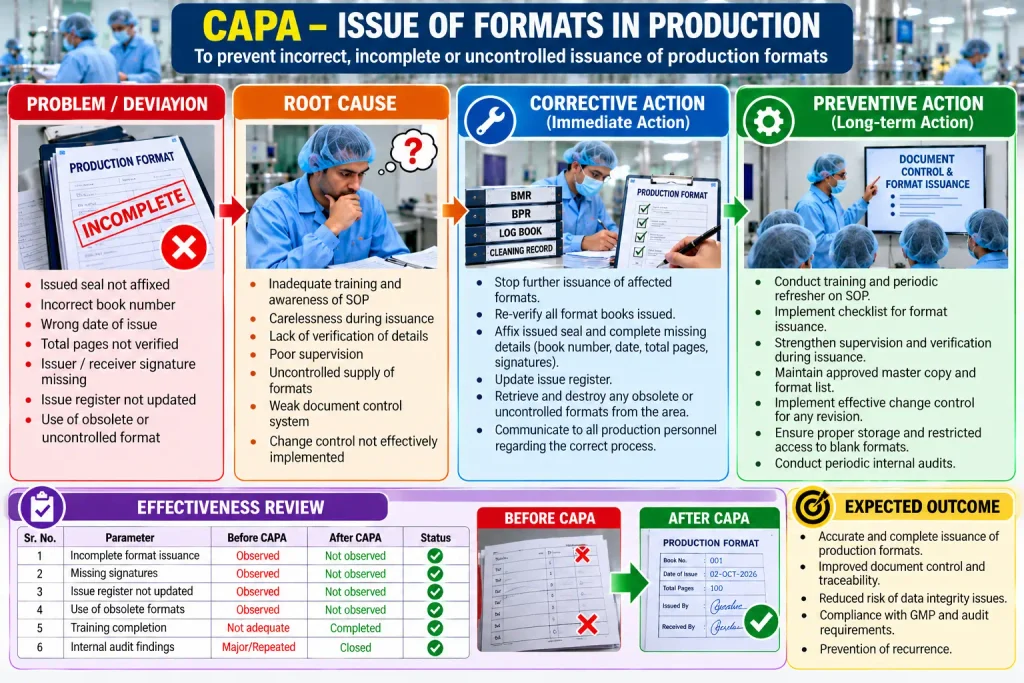
Preventive actions should strengthen the system through training and periodic refresher training, verification of format issuance, proper supervision, maintenance of approved master copies, controlled format lists, and effective change control. These controls are consistent with the SOP requirements for recording the book number, date of issue, total pages, issuer and receiver signatures, maintaining issue records, and controlling loose formats. The SOP further requires that master production formats be checked and approved and that any revision be implemented only through approved change control, with obsolete versions destroyed. CAPA effectiveness should be verified through periodic review of issued formats, register accuracy, training completion, absence of obsolete formats, and internal audit findings. Successful implementation should improve document control, traceability, data integrity, GMP compliance, and prevention of repeated SOP failures.
Questions & Answers – Issue of Formats in Production:
Q1. What is the objective of the SOP for Issue of Formats in Production?
Answer: The objective is to define the procedure for issuing formats used in manufacturing activities.
Q2. What is the scope of this SOP?
Answer: The SOP covers the issue of formats used in manufacturing.
Q3. Who is responsible for implementation of this SOP?
Answer: The concerned Production Chemist and Production Manager are responsible for preparation and execution of the SOP.
Q4. What should be done before issuing a format book?
Answer: The issued seal should be affixed on the covering page of the format book.
Q5. Which details should be recorded during issue of a format book?
Answer: The book number, date of issue, total number of pages, signature of the issuing person, and signature of the receiving person should be recorded.
Q6. What should be done when a format book is completely filled?
Answer: The completed format book should be returned to the Production Manager, after which a new book may be issued.
Q7. Who can issue a format in the absence of the Production Manager?
Answer: A person nominated for this activity may issue the format in the absence of the Production Manager.
Q8. Where should the details of format issuance be recorded?
Answer: Details of issuance should be entered in the designated issue register.
Q9. How should a loose single-page format be issued?
Answer: The Production Manager or nominated person should place an initial on the left bottom corner of the loose format. According to this SOP, the loose format is not entered in the issue register.
Q10. How are master copies of production formats controlled?
Answer: Master copies are maintained in the department and are checked and approved by the Production Head and Quality Assurance respectively.
Q11. How should a revision or change in a production format be handled?
Answer: Any revision or change should be processed through change control, and the revised format should be used only after the change control is approved.
Q12. What should be done with the previous version after format revision?
Answer: The format list should be updated with the new format/version number, and the previous version should be destroyed.
Q13. What is the reference mentioned in the SOP?
Answer: The SOP states the reference as “As per GMP.”
Q14. What annexure is specified in the SOP?
Answer: The SOP specifies Annexure: Nil.
Q15. Who receives the controlled and master copies of the SOP?
Answer: The controlled copy is distributed to the Head of Department – Production, while the master copy is maintained by the Head of Department – Quality Assurance.
Reference Guidelines – Issue of Formats in Production:
- WHO Good Manufacturing Practices (GMP) – Requirements for controlled documentation, records, issuance, approval, revision, and retention.
- EU Guidelines for Good Manufacturing Practice – EudraLex Volume 4, Part I, Chapter 4: Documentation – Requirements for controlled documents, approved formats, record completion, document review, and prevention of obsolete-document use.
- PIC/S Guide to Good Manufacturing Practice, PE 009 – Part I, Chapter 4: Documentation – Principles for document approval, issuance, revision control, distribution, and traceability.
- US FDA – 21 CFR Part 211, Subpart J: Records and Reports – Requirements for maintaining complete and accurate pharmaceutical manufacturing and control records.
- US FDA – 21 CFR 211.100: Written Procedures; Deviations – Requires written procedures for production and process control to be drafted, reviewed, approved, and followed.
- US FDA – 21 CFR 211.180: General Requirements – Requirements for retention and availability of manufacturing, control, and distribution records.
- ICH Q10 – Pharmaceutical Quality System – Supports controlled documentation, change management, CAPA, management oversight, and continual improvement.
- Good Documentation Practices (GDP/GDocP) – Principles supporting attributable, legible, contemporaneous, original, accurate, complete, consistent, enduring, and available records.