







1. Introduction to Levocetirizine Tablets IP 5 mg – Batch Manufacturing Record (BMR):
Levocetirizine Tablets IP 5 mg are film-coated oral solid dosage forms containing Levocetirizine Dihydrochloride IP, a second-generation antihistamine used to relieve allergic symptoms such as sneezing, runny nose, itching, watery eyes, and urticaria. Levocetirizine acts by selectively blocking peripheral histamine H1 receptors, helping reduce allergic reactions. The Batch Manufacturing Record (BMR) provides comprehensive documentation of manufacturing activities, ensuring product quality, consistency, traceability, and compliance with Good Manufacturing Practices (GMP). As described in the BMR, the manufacturing process involves raw material dispensing, sifting, binder preparation, wet granulation, drying, milling, blending, lubrication, compression, dedusting, and film coating. Each operation is performed according to established manufacturing instructions using suitable equipment and controlled processing conditions. The theoretical batch size is 50,000 tablets, with an average uncoated tablet weight of 120 mg. Critical in-process quality checks include granule moisture content, tablet weight variation, thickness, hardness, friability, disintegration time, and physical appearance. The BMR also includes equipment clearance, environmental monitoring, material reconciliation, sampling records, quality control testing, and Quality Assurance verification. Proper execution and documentation of manufacturing activities help maintain batch-to-batch consistency, minimize manufacturing deviations, and support the production of safe, effective, and quality-compliant Levocetirizine Tablets IP.
Skip to PDF content2. Manufacturing Process Flow Diagram – Levocetirizine Tablets IP 5 mg:
The flow diagram illustrates the systematic manufacturing process of Levocetirizine Tablets IP 5 mg, highlighting essential production stages and quality control requirements in accordance with Good Manufacturing Practices (GMP). The process begins with raw material dispensing and weighing, followed by sifting to ensure uniform particle size. Binder preparation and wet granulation are performed using suitable equipment to achieve the required granule characteristics.
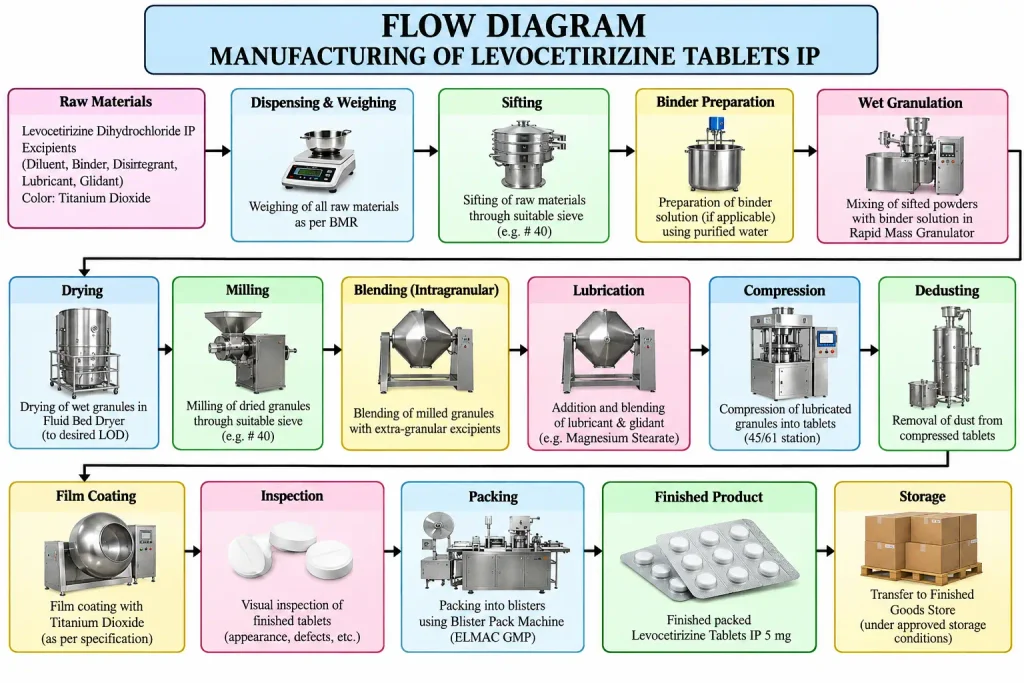
The wet granules undergo drying in a Fluid Bed Dryer (FBD), followed by milling, blending, and lubrication to ensure uniform distribution of ingredients and satisfactory powder flow. The lubricated granules are compressed into tablets using a rotary compression machine. In-process quality checks include tablet weight variation, hardness, thickness, friability, and disintegration time. Subsequently, the tablets undergo dedusting, film coating, visual inspection, and blister packaging. Finally, the finished product is subjected to quality assurance verification, batch reconciliation, and approved storage procedures to maintain product quality, traceability, and regulatory compliance.
3. Critical Process Parameters (CPP) and Critical Quality Attributes (CQA) of Levocetirizine Tablets IP 5 mg:
The infographic illustrates the Critical Process Parameters (CPP) and Critical Quality Attributes (CQA) associated with the manufacturing of Levocetirizine Tablets IP 5 mg, ensuring consistent product quality and compliance with Good Manufacturing Practices (GMP).
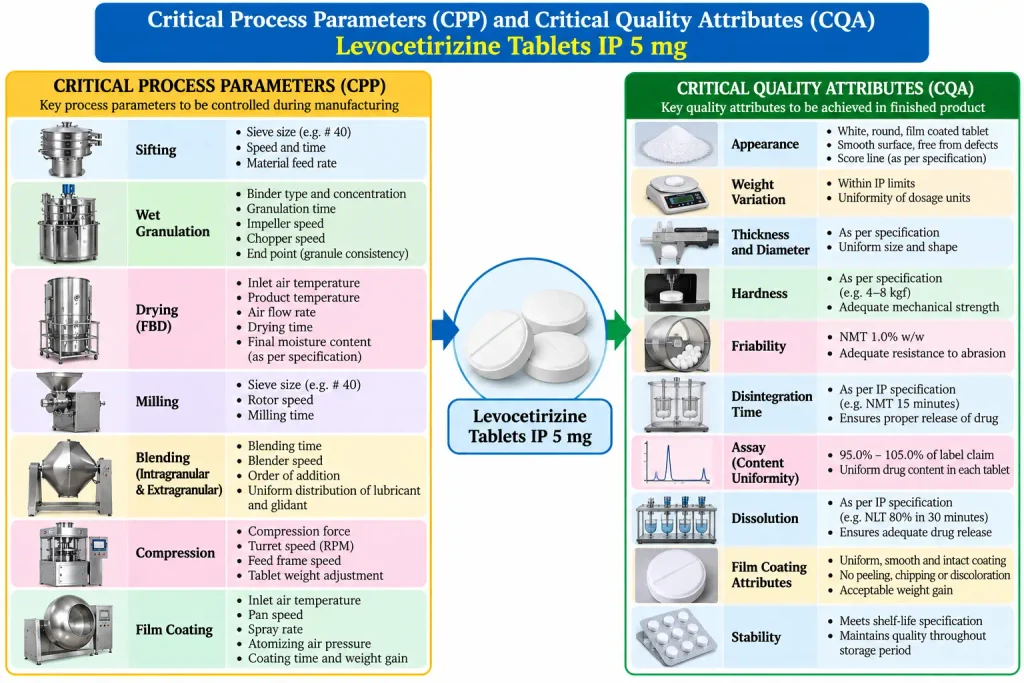
Critical Process Parameters (CPP) include sifting mesh size, granulation time, binder preparation conditions, drying temperature, moisture content, blending time, lubrication, compression force, and film-coating parameters. Effective monitoring of these parameters helps maintain manufacturing consistency and minimize process variability.
Critical Quality Attributes (CQA) include tablet appearance, weight variation, thickness, hardness, friability, disintegration time, assay, content uniformity, dissolution, coating uniformity, and stability. The Batch Manufacturing Record specifies an average uncoated tablet weight of 120 mg, friability not more than 1%, and disintegration time not more than 15 minutes. Systematic monitoring, in-process testing, and Quality Assurance verification help ensure that finished tablets meet approved specifications, patient safety requirements, and established pharmaceutical quality standar