





Brief Description
The SOP for Maintenance and Cleaning of the Quality Control Laboratory defines the routine requirements for maintaining cleanliness, good laboratory practices, and orderly working conditions within the QC laboratory. It assigns responsibility to QC personnel and the Head QA/QC for implementation and supervision.The procedure requires daily removal of dust and marks from instruments, cleaning of instrument platforms, furniture, doors and glass surfaces, and cleaning of laboratory floors with disinfectant three times a day. Sophisticated instruments such as HPLC, FTIR and UV are excluded from routine wiping by the lab attendant and should not be touched unnecessarily. Personnel must follow proper gowning and Good Laboratory Practices (GLP), restrict unauthorized entry, keep doors closed during working, and switch off electrical and water points before leaving the laboratory.The SOP also provides a Cleaning and Sanitisation Record covering daily, weekly and fortnightly cleaning of floors, walls, doors, electrical fixtures, ceilings, pallets and racks.
Skip to PDF content1. Flow Diagram:
The flow diagram illustrates the maintenance and cleaning process of the Quality Control Laboratory in a simple step-by-step sequence. It begins with personnel entering the QC laboratory using proper gowning and footwear and following Good Laboratory Practices (GLP). Routine cleaning includes removing dust and dirty marks from instruments with lint-free cotton, cleaning instrument platforms, doors, glass surfaces, furniture, and disinfecting the laboratory floor three times daily. Sophisticated instruments such as HPLC, FTIR, and UV systems should not be handled or cleaned unnecessarily.
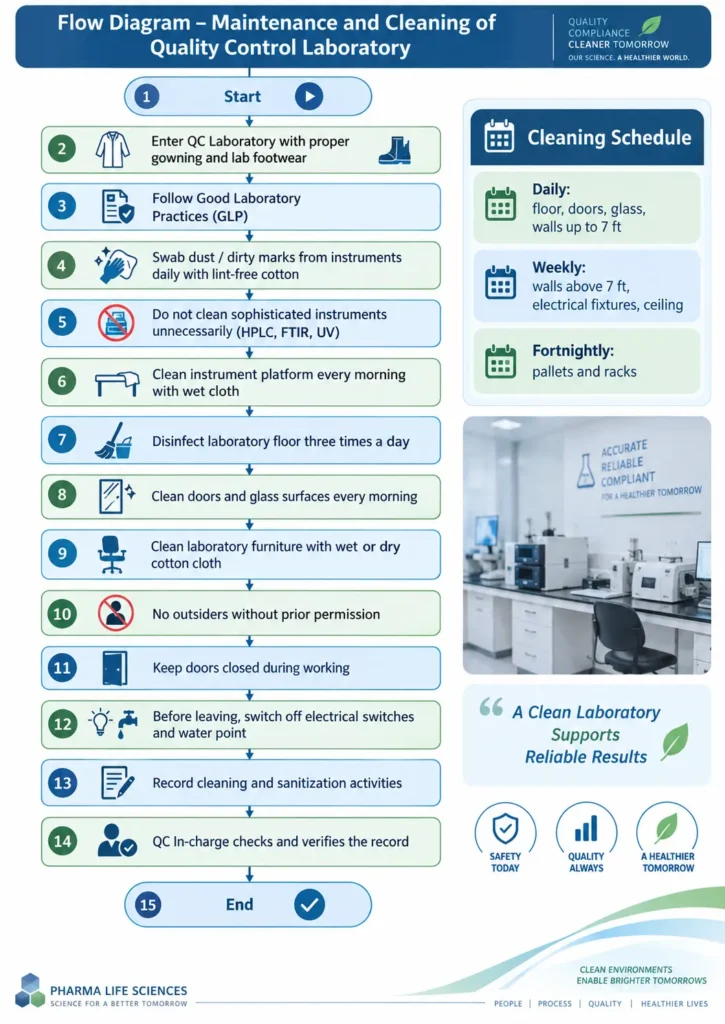
The flow also emphasizes restricted entry of unauthorized persons, keeping doors closed during laboratory operations, and switching off electrical and water points before leaving. Cleaning activities are documented and verified by the QC In-charge. The schedule covers daily cleaning of floors, doors, glass and walls up to 7 ft; weekly cleaning of higher walls, electrical fixtures and ceilings; and fortnightly cleaning of pallets and racks.
2. Brainstorming for SOP Failure:
The brainstorming diagram identifies the main reasons why the SOP for Maintenance and Cleaning of the Quality Control Laboratory may fail. It groups potential causes into key areas such as human error, instruments and equipment, cleaning activities, facility and utilities, documentation, and cleaning schedule compliance.
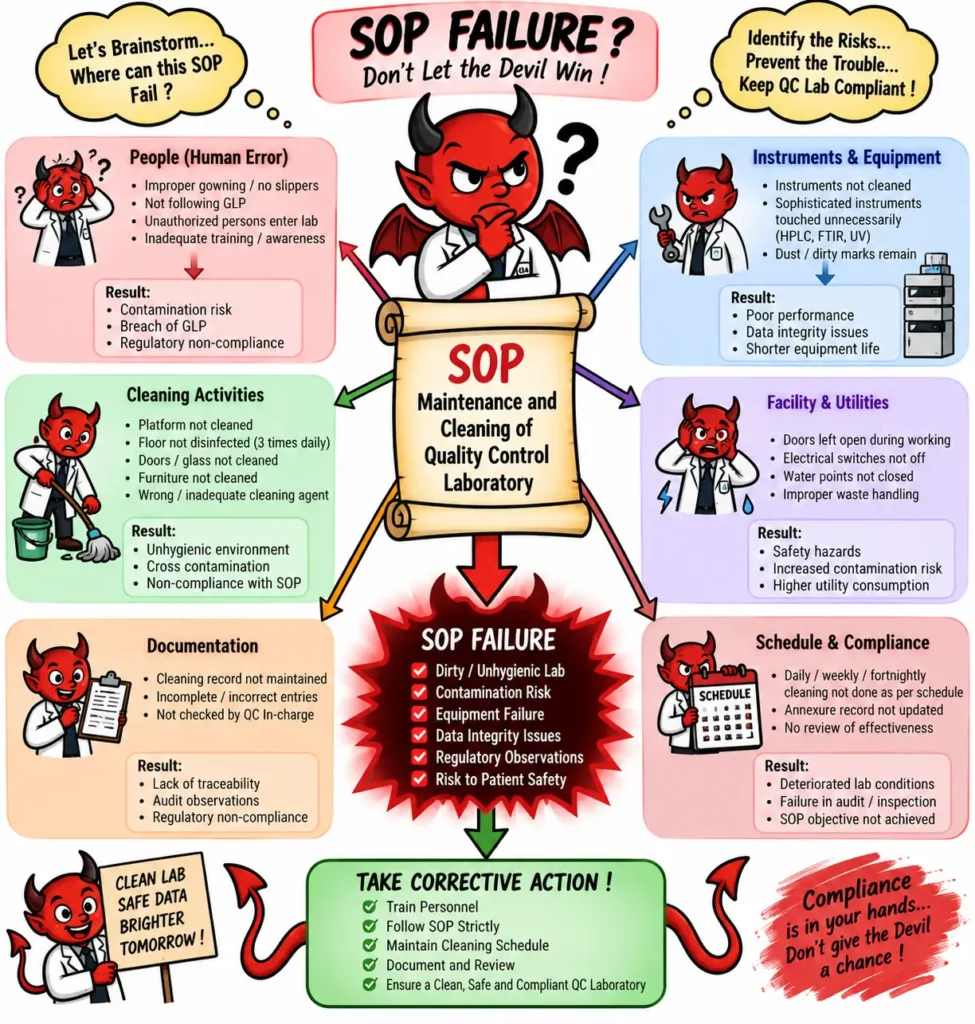
Possible failures include improper gowning, poor adherence to GLP, inadequate training, incomplete cleaning, unnecessary handling of sophisticated instruments, failure to disinfect floors as scheduled, doors being left open, utilities not being switched off, incomplete cleaning records, and missed daily, weekly, or fortnightly activities. These failures can lead to an unhygienic laboratory, contamination risk, equipment problems, data integrity concerns, audit observations, and regulatory non-compliance.The diagram also emphasizes corrective actions such as training personnel, following the SOP strictly, maintaining the approved cleaning schedule, documenting activities properly, and ensuring QC verification to maintain a clean, safe, and compliant laboratory.
3. 5-Why Analysis for SOP Failure:
The 5-Why diagram explains the possible root cause behind failure to follow the SOP for Maintenance and Cleaning of the Quality Control Laboratory. The analysis starts with the problem that the cleaning and maintenance SOP is not being followed. It then traces the failure through missed scheduled cleaning activities, lack of awareness of detailed SOP requirements, inadequate training or refresher training, and insufficient monitoring of training effectiveness and SOP compliance.
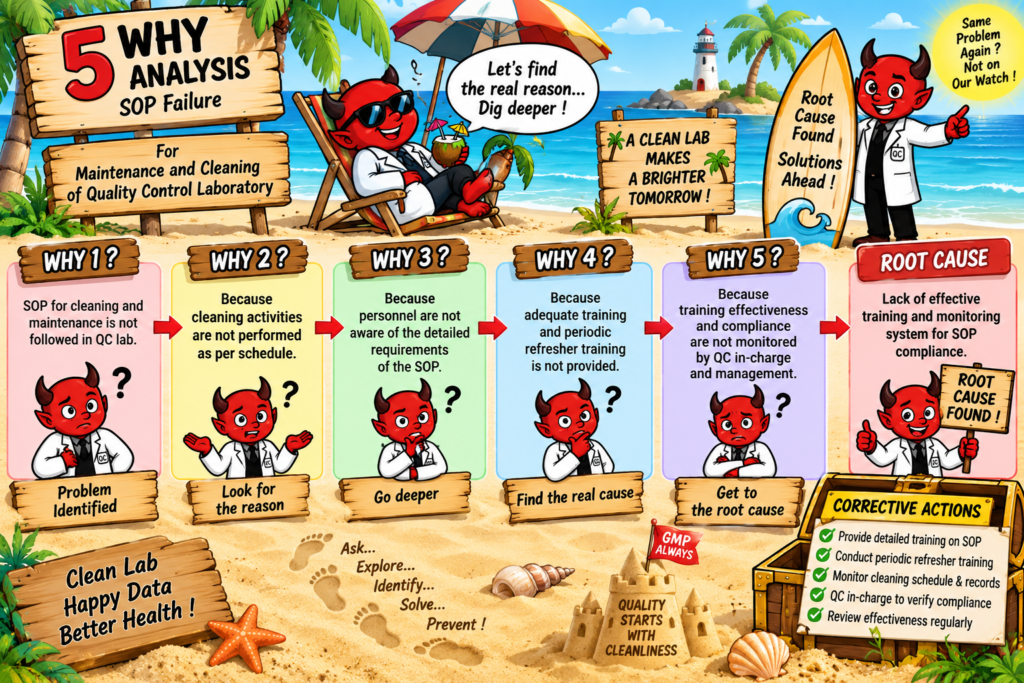
The analysis identifies the likely root cause as an ineffective training and compliance-monitoring system. Corrective actions include providing detailed SOP training, conducting periodic refresher training, monitoring cleaning schedules and records, ensuring verification by the QC In-charge, and regularly reviewing training effectiveness and compliance. These actions help maintain a clean, controlled, and compliant QC laboratory and reduce the risk of repeated SOP failures.
4. Fishbone Analysis for SOP Failure:
The Fishbone Analysis diagram identifies the major causes that can lead to failure of the SOP for Maintenance and Cleaning of the Quality Control Laboratory. The possible causes are grouped into six categories: Man, Machine, Method, Material, Environment, and Measurement.
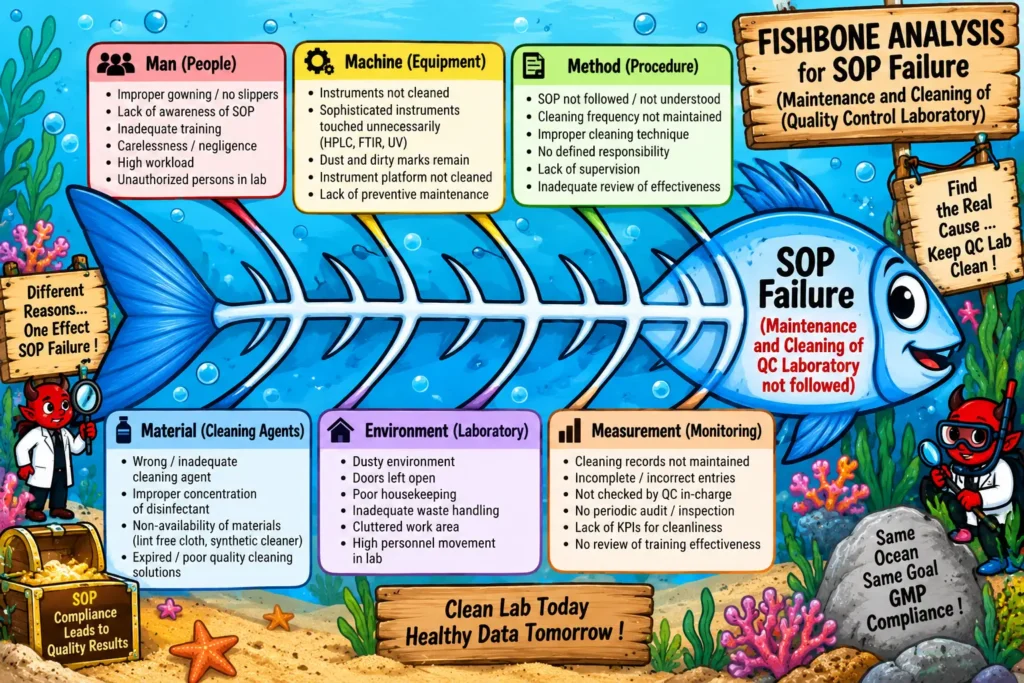
Human-related causes include inadequate training, lack of SOP awareness, improper gowning, negligence, and unauthorized entry. Equipment-related causes include poor instrument cleaning, unnecessary handling of sophisticated instruments, and unclean instrument platforms. Method failures include not following the SOP, missed cleaning frequencies, poor supervision, and incorrect cleaning techniques. Material-related issues involve unsuitable or incorrectly prepared cleaning agents. Environmental causes include dusty conditions, open doors, poor housekeeping, and cluttered work areas. Measurement-related causes include incomplete cleaning records, lack of QC verification, insufficient audits, and failure to review training effectiveness.The diagram helps systematically identify potential root causes so that appropriate CAPA, training, monitoring, and SOP compliance controls can be implemented.
5. Fault Tree Analysis for SOP Failure:
The Fault Tree Analysis diagram explains the possible causes behind failure to follow the SOP for Maintenance and Cleaning of the Quality Control Laboratory. The top event, “SOP not followed,” is broken down into major contributing areas such as people-related failures, procedure-related failures, equipment/material failures, and facility/management failures.
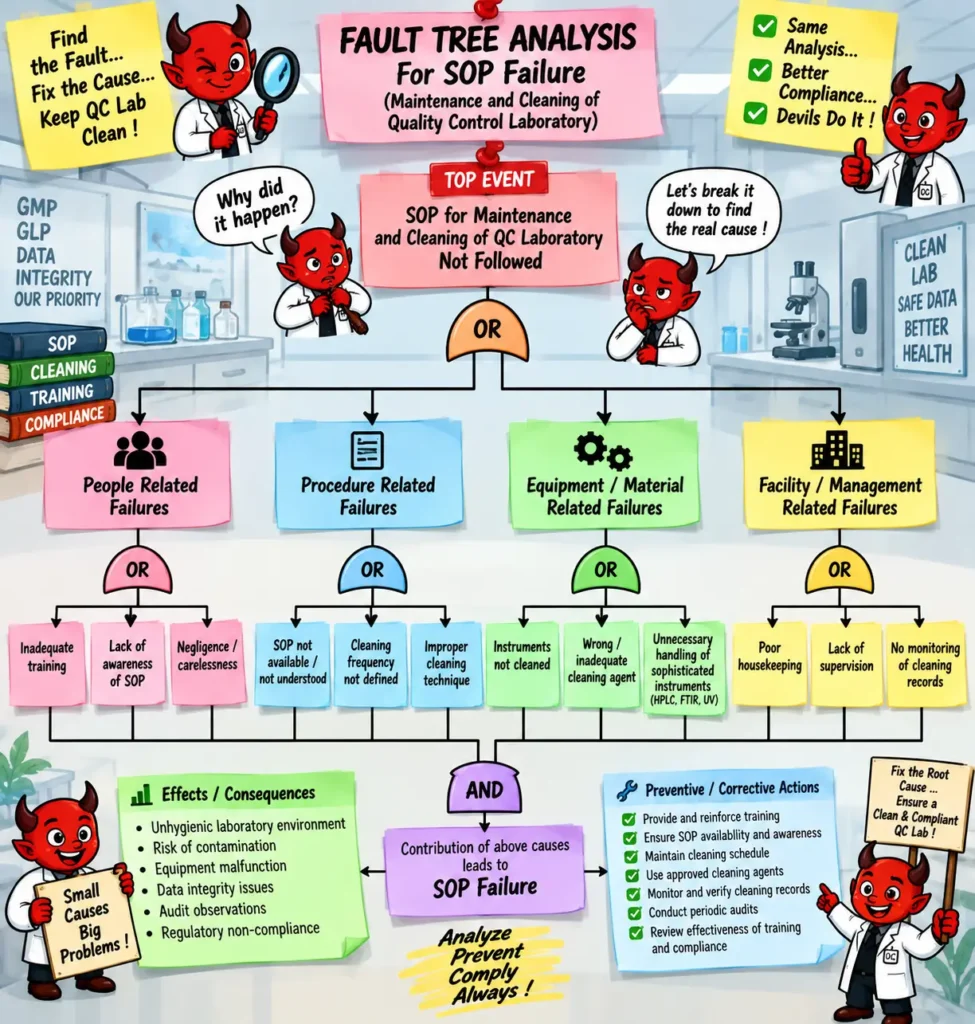
Potential causes include inadequate training, lack of SOP awareness, negligence, unclear cleaning frequency, improper cleaning techniques, instruments not being cleaned, use of unsuitable cleaning agents, unnecessary handling of sophisticated instruments, poor housekeeping, lack of supervision, and incomplete cleaning records. These failures can result in an unhygienic laboratory, contamination risk, equipment malfunction, data integrity concerns, audit observations, and regulatory non-compliance.The diagram also highlights preventive and corrective actions such as training reinforcement, SOP availability, cleaning schedule control, use of approved cleaning agents, record verification, periodic audits, and effectiveness review to prevent recurrence and maintain a compliant QC laboratory.
Questions & Answers – Maintenance and Cleaning of Quality Control Laboratory
- What is the objective of this SOP?
To define the procedure for maintenance and cleaning of the Quality Control Laboratory. - Where is this SOP applicable?
It is applicable to maintenance and cleaning activities performed in the Quality Control Laboratory. - Who is responsible for this SOP?
Chemist QC and Head QA/QC are responsible. - How are routine instruments cleaned?
Dust or dirty marks are removed daily in the morning using lint-free cotton. - Which sophisticated instruments are specifically mentioned?
HPLC, FTIR, and UV instruments are mentioned in the SOP. - How often should the instrument platform be cleaned?
It should be cleaned every morning with a wet cloth. - How frequently should the laboratory floor be cleaned?
The laboratory floor should be cleaned with disinfectant-containing water three times a day. - How often should door glass be cleaned?
Door glass should be cleaned every morning using a synthetic cleaner. - How should laboratory furniture be cleaned?
Laboratory furniture should be cleaned using wet or dry cotton cloths. - What should personnel follow while entering the laboratory?
Personnel should enter with proper gowning and laboratory footwear and follow Good Laboratory Practices. - Can sophisticated instruments be touched unnecessarily?
No. Sophisticated and other instruments should not be touched unnecessarily. - Are outsiders allowed inside the QC laboratory?
Outsiders are not allowed without prior permission. - What should be done with laboratory doors during working hours?
All doors should remain closed during working. - What should be checked before leaving the laboratory?
Electrical switches and water points should be switched off. - Who provides training on this SOP?
The Head QA/QC is identified as the trainer, and Quality Control personnel are the trainees. - What is the training period mentioned in the SOP?
The training period is one hour. - What record is maintained for laboratory cleaning?
The SOP includes an annexure titled Cleaning and Sanitisation Record of Quality Control. - What cleaning frequencies are defined in the annexure?
The annexure specifies daily, weekly, and fortnightly cleaning activities.
Reference Guidelines:
The uploaded SOP currently lists its reference simply as “In House.” For stronger regulatory alignment, the following official references are appropriate:
- WHO TRS 1052, Annex 4 (2024) – Good Practices for Pharmaceutical Quality Control Laboratories
This is the most directly applicable reference for pharmaceutical QC laboratories and covers laboratory organization, premises, equipment, personnel, documentation, reagents, safety, and good laboratory practices. (World Health Organization)
WHO – Good Practices for Pharmaceutical Quality Control Laboratories - Revised Schedule M – Drugs Rules, 1945, India, G.S.R. 922(E), 28 December 2023
Relevant for Indian pharmaceutical manufacturers. Schedule M addresses GMP requirements for premises, equipment, sanitation, Quality Control areas, documentation, personnel, and maintenance of pharmaceutical facilities. (CDSCO)
CDSCO – Official Gazette Notifications / Revised Schedule M - EU GMP Guide – EudraLex Volume 4
Particularly relevant sections are Chapter 3 – Premises and Equipment and Chapter 6 – Quality Control. Chapter 3 requires premises and equipment to be maintained so that effective cleaning can be performed and contamination or accumulation of dirt is prevented. (Public Health)
European Commission – EudraLex Volume 4 GMP Guidelines - PIC/S GMP Guide PE 009-17 – Part I
Chapter 3 states that premises should be properly maintained and cleaned, and where applicable disinfected, according to detailed written procedures. It is useful for cleaning schedules, facility controls, contamination prevention, and GMP inspection readiness. (PIC/S)
PIC/S GMP Guide PE 009-17 Part I - US FDA – 21 CFR Part 211
§211.56 Sanitation requires written procedures defining cleaning responsibilities, schedules, methods, equipment, and materials. §211.67 requires written equipment-cleaning and maintenance procedures and records, while §211.160 covers laboratory controls and documentation. (eCFR)
21 CFR 211.56 – Sanitation
21 CFR 211.67 – Equipment Cleaning and Maintenance - ISO/IEC 17025:2017 – Testing and Calibration Laboratories
Provides internationally recognized requirements for laboratory competence, controlled operations, equipment, environmental conditions, records, and reliable laboratory results. The 2017 edition was confirmed as current in 2023. (ISO)
ISO/IEC 17025:2017 – Official ISO Page
Recommended Reference Section for Your SOP
References: WHO TRS 1052 Annex 4 – Good Practices for Pharmaceutical Quality Control Laboratories; Revised Schedule M of Drugs Rules, 1945; EU GMP Guide Chapters 3 and 6; PIC/S GMP Guide PE 009; 21 CFR Part 211; and ISO/IEC 17025:2017, as applicable.