





Brief Description
This SOP describes the controlled receipt, storage, preparation, sterilization, labeling, use, and maintenance of dehydrated microbiological media used in the Quality Control laboratory. Its purpose is to ensure that culture media are prepared correctly and remain suitable for microbiological analysis. On receipt, media containers are physically verified against the Certificate of Analysis, assigned container numbers, and stored according to the manufacturer’s recommended conditions. Each prepared medium undergoes growth promotion testing before release for routine use. During preparation, the microbiologist verifies the media condition and expiry, accurately weighs the required quantity, dissolves it in purified water, checks and adjusts pH where required, and sterilizes the prepared medium in an autoclave. After sterilization, media may be poured under LAF, pre-incubated, and stored under specified temperature conditions. Complete records are maintained for preparation, usage, receipt, physical verification, and media inventory.
Skip to PDF content1. Flow Diagram:
The flow diagram explains the complete process for maintenance and preparation of microbiological media in a pharmaceutical Quality Control laboratory. It starts with the receipt of dehydrated media, verification against the Certificate of Analysis, physical inspection, container numbering, and Growth Promotion Testing before approval and storage.
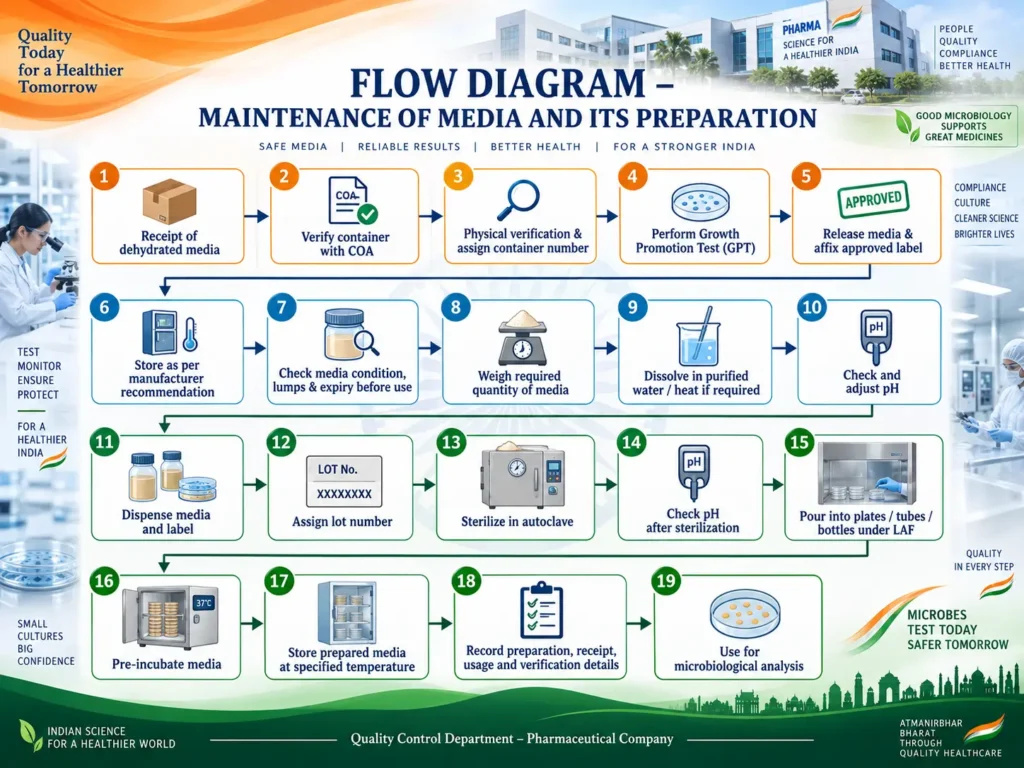
Before preparation, the media is checked for physical condition and expiry, then the required quantity is accurately weighed and dissolved in purified water. The pH is checked and adjusted when necessary, followed by dispensing, labeling, lot-number assignment, and sterilization in an autoclave. After sterilization, the pH is rechecked and the media is poured into plates, tubes, or bottles under LAF conditions. Finally, the prepared media is pre-incubated, stored at the specified temperature, properly documented, and released for microbiological analysis. The Indian tricolor and pharmaceutical company theme emphasizes quality, compliance, safety, and reliable microbiological testing.
2. Brainstorming for SOP failure:
The brainstorming diagram identifies the major factors that may lead to failure of the SOP for Maintenance of Media and Its Preparation. It uses green, yellow, and red flag sticky notes to classify good practices, potential risks, and critical failures.
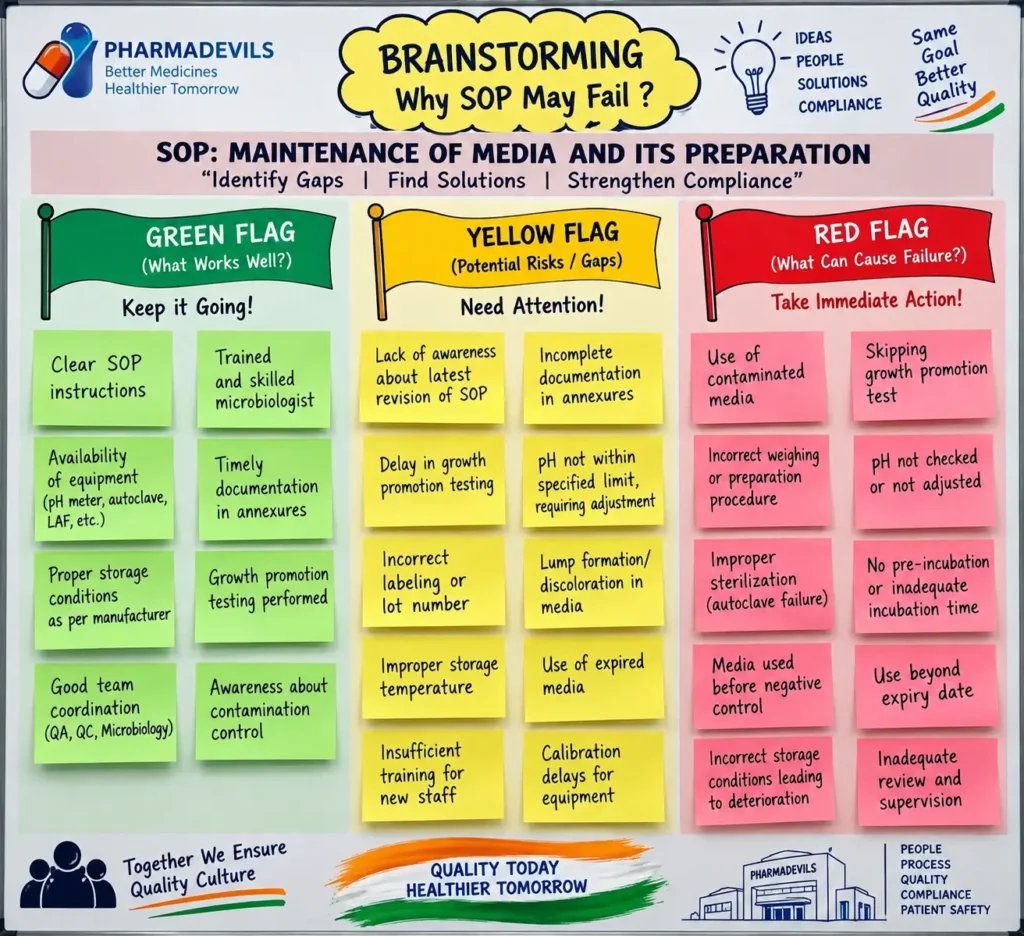
The green flag section highlights effective controls such as trained microbiologists, clear SOP instructions, proper storage, calibrated equipment, timely documentation, and growth promotion testing. The yellow flag section shows areas requiring attention, including incomplete records, delayed GPT, incorrect labeling, improper storage temperature, use of expired media, and insufficient staff training. The red flag section represents serious failures such as contaminated media, incorrect weighing, improper sterilization, pH not being checked, inadequate pre-incubation, and use of media beyond expiry.This brainstorming approach helps the QA, QC, and Microbiology teams identify weaknesses, prioritize risks, and implement corrective actions to improve compliance and microbiological reliability.
3. 5-Why Analysis for SOP failure:
The 5-Why analysis explains the root cause of failure in the SOP for Maintenance of Media and Its Preparation. The problem begins when contaminated or non-compliant prepared media is used for microbiological analysis. The first why identifies failure of the Growth Promotion Test or contamination of the prepared media. Further questioning shows that the media may not have been prepared or maintained according to the approved SOP, such as incorrect weighing, improper pH adjustment, inadequate sterilization, or unsuitable storage conditions.
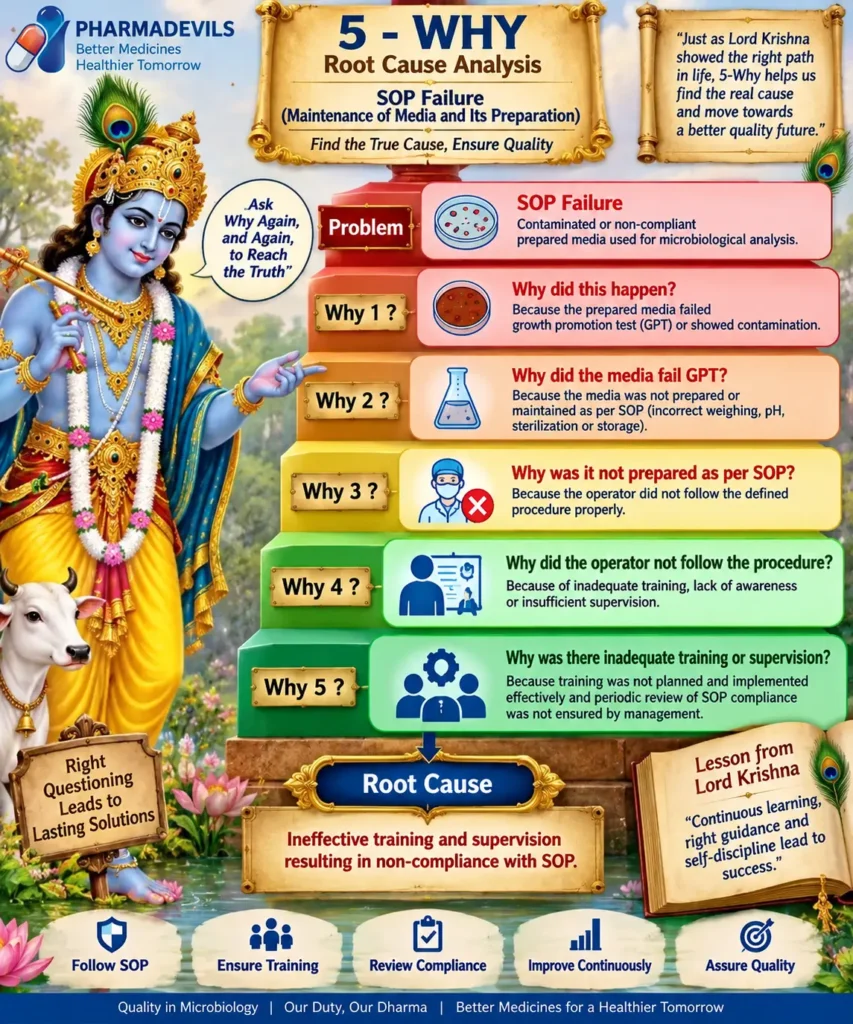
The analysis then traces the failure to improper execution of the procedure, inadequate operator training, poor awareness, or insufficient supervision. The final root cause is identified as ineffective training and supervision leading to SOP non-compliance. The Lord Krishna theme symbolizes guidance, disciplined questioning, and finding the correct path toward lasting corrective actions, improved compliance, and reliable microbiological results.
4. Fishbone Analysis for SOP failure:
The Fishbone Analysis for SOP Failure identifies the major causes that may result in non-compliant or contaminated microbiological media during the Maintenance of Media and Its Preparation process. The causes are grouped into six key categories: Man/Personnel, Method, Machine/Equipment, Material, Measurement, and Environment/Storage.
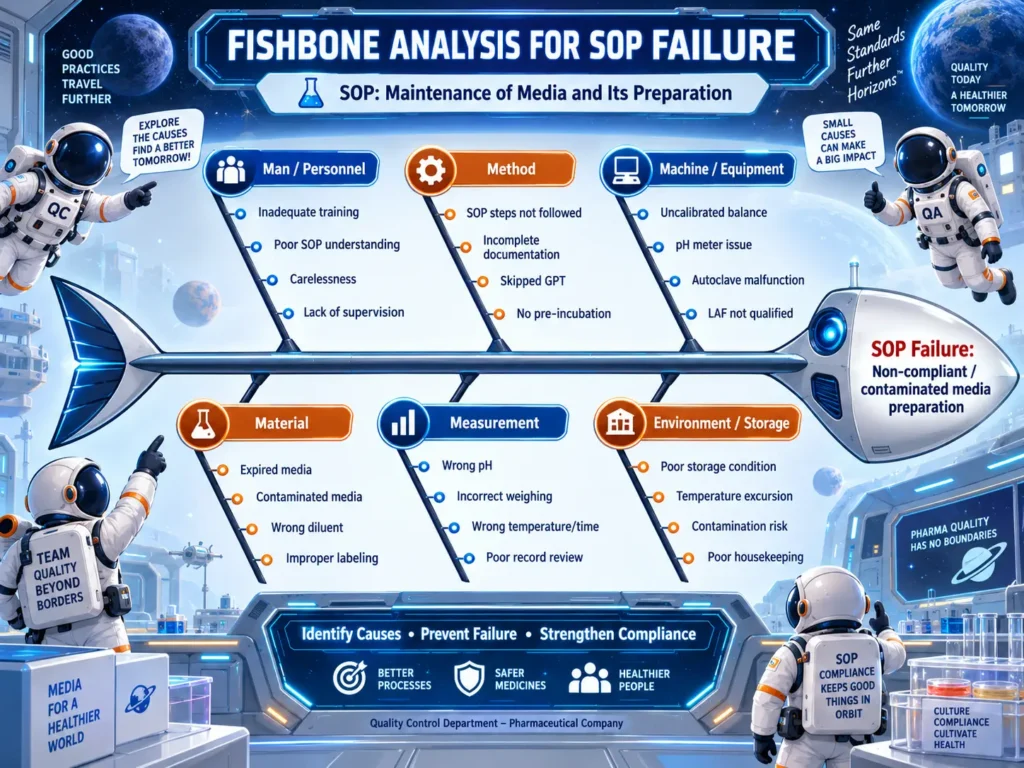
Personnel-related causes include inadequate training, poor SOP understanding, carelessness, and insufficient supervision. Method failures may involve skipped Growth Promotion Testing, incomplete documentation, or failure to follow preparation and pre-incubation steps. Equipment-related causes include problems with balances, pH meters, autoclaves, or LAF systems. Material causes include expired, contaminated, incorrectly labeled media or wrong diluents. Measurement failures may involve incorrect weighing, pH, temperature, or time. Environmental causes include poor storage conditions, temperature excursions, contamination risks, and poor housekeeping.The analysis supports systematic root-cause identification and helps strengthen SOP compliance, microbiological reliability, and product quality.
5. Fault Tree Analysis:
The Fault Tree Analysis (FTA) shows how failure of the SOP for Maintenance of Media and Its Preparation can result in non-compliant, contaminated, or unsuitable microbiological media. The top event, “SOP Failure,” is broken down into major failure pathways such as incorrect media preparation, improper sterilization, contamination during preparation or dispensing, and improper storage or use.
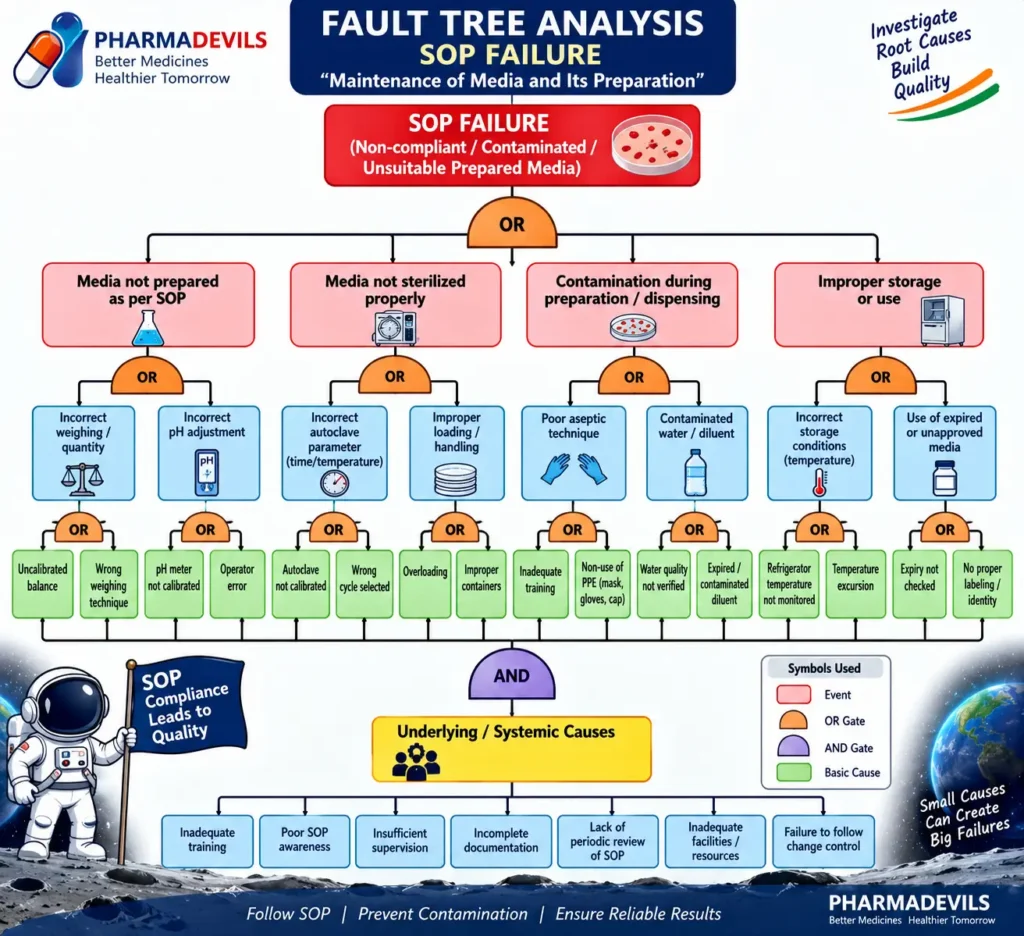
Basic causes include incorrect weighing, improper pH adjustment, uncalibrated equipment, incorrect autoclave parameters, poor aseptic practices, contaminated water or diluent, unsuitable storage temperature, and use of expired media. These causes are consistent with the SOP requirements for weighing, pH control, sterilization, LAF handling, pre-incubation, storage, and expiry checks.The analysis also highlights systemic causes such as inadequate training, weak SOP awareness, insufficient supervision, incomplete documentation, and poor periodic review. FTA helps identify both immediate and underlying causes so that effective CAPA can be implemented to prevent recurrence and ensure reliable microbiological results.
Questions & Answers – Maintenance of Media and Its Preparation
- What is the objective of this SOP?
The objective is to define the procedure for the receipt, storage, preparation, and maintenance of dehydrated microbiological media. - Who is responsible for execution of this SOP?
The Microbiologist is responsible for execution, while the Lab Manager QA, Manager-QC, and Head-QA/QC are responsible for review and effective implementation. - What should be checked when dehydrated media is received?
The media containers should be physically verified against the Certificate of Analysis (COA), and receipt details should be recorded. - When can received media be released for microbiological analysis?
Media can be released after it passes the Growth Promotion Test (GPT) and is appropriately approved and labeled. - How should dehydrated media be stored?
It should be stored according to the manufacturer’s recommendations stated on the label, instructions, or COA. - What should be checked before using dehydrated media?
The microbiologist should check for lump formation, physical changes, and expiry, and use appropriate protective wear before preparation. - How is the required quantity of media weighed?
The required quantity should be weighed on a calibrated balance using a clean spatula. - How is the pH of prepared media controlled?
The pH is checked using a pH meter and, when required, adjusted with 0.1 M HCl or 0.1 M NaOH. - How is prepared media sterilized?
Prepared media is sterilized in an autoclave according to the applicable SOP and manufacturer’s recommendations. - What happens if the pH after sterilization is outside the specified limit?
The media should be discarded. - Where is sterilized media poured into plates, tubes, or bottles?
It is poured under Laminar Air Flow (LAF) conditions. - What is the pre-incubation requirement for prepared media?
Prepared media should generally be pre-incubated for at least 24 hours before use. Media used for environmental monitoring should be pre-incubated for at least 48 hours at 30–35°C. - How long can prepared media be stored after pre-incubation?
The SOP states that it may be stored at 20–25°C or 2–8°C for up to 7 days. - When should dehydrated media not be used?
It should not be used if it is expired, contaminated, deteriorated, discolored, or shows lump formation. - What records are maintained under this SOP?
Records include Media Preparation Record, List of Media, Media Usage Record, Media Receipt Details Record, and Physical Verification of Dehydrated Media.