







Brief Description
The SOP for Management of Test Raw Data Sheet defines the procedure for receiving, distributing, analyzing, reviewing, and documenting laboratory samples and their associated test data in the Quality Control Department. It assigns responsibility to the QC Assistant Manager/Manager for execution and to the Head QA/QC for effective implementation. The SOP covers samples from tablets, liquids, raw materials, packing materials, purified water, and microbiological testing. Samples are received with complete testing information, forwarded to the appropriate QC personnel, assigned to an analytical chemist or microbiologist, and tested according to approved procedures. Test observations, calculations, working standards, weights taken, results, analyst details, dates, and reviewer checks are recorded on the applicable raw data sheet.The SOP also includes specific annexures for product testing, liquids, raw materials, packing materials, purified water, and microbial limit testing, ensuring systematic and traceable documentation of laboratory analysis.
Skip to PDF content1. Flow Diagram:
The Flow Diagram for Management of Test Raw Data Sheet explains the complete sequence followed for receiving, sampling, testing, reviewing, and recording laboratory samples. The process starts with receipt of testing intimation and verification of the completeness of the receiving report. If the information is incomplete, it is returned for correction before further processing.
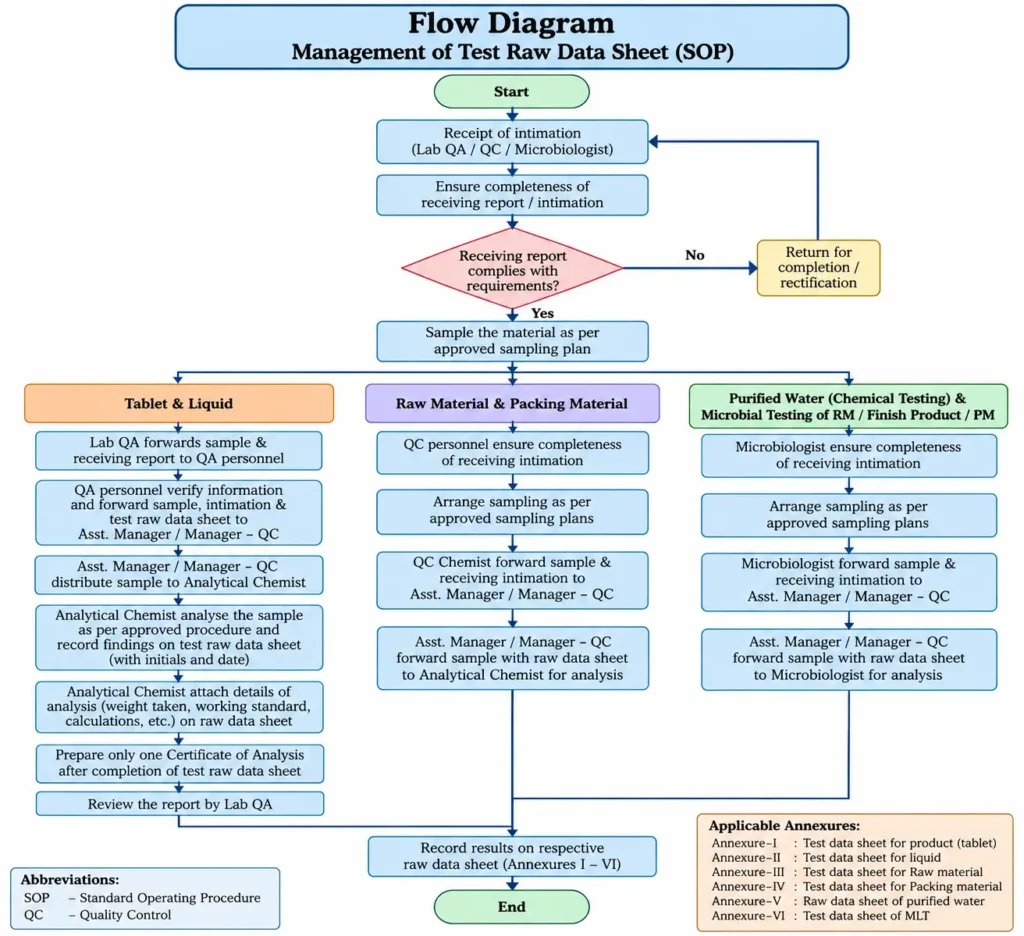
After verification, samples are handled according to their category, including tablets and liquids, raw and packing materials, purified water, and microbiological samples. Samples are forwarded to the QC Assistant Manager/Manager and then assigned to an analytical chemist or microbiologist for analysis according to approved procedures. Test observations, calculations, working standards, weights taken, analyst initials, and dates are recorded on the appropriate raw data sheet.The completed results are documented in the applicable annexures and reviewed to ensure proper traceability, accuracy, and controlled laboratory documentation.
2. Brainstorming for SOP Failure:
The Brainstorming Diagram for SOP Failure – Management of Test Raw Data Sheet highlights possible reasons why the procedure may not be followed effectively. The professor-led sticky-note format encourages the QA/QC team to identify failures such as incomplete receiving information, incorrect sampling, use of outdated raw data sheets, sample mix-up, missing analyst initials or dates, calculation errors, inadequate review, and incomplete recording of analytical details.
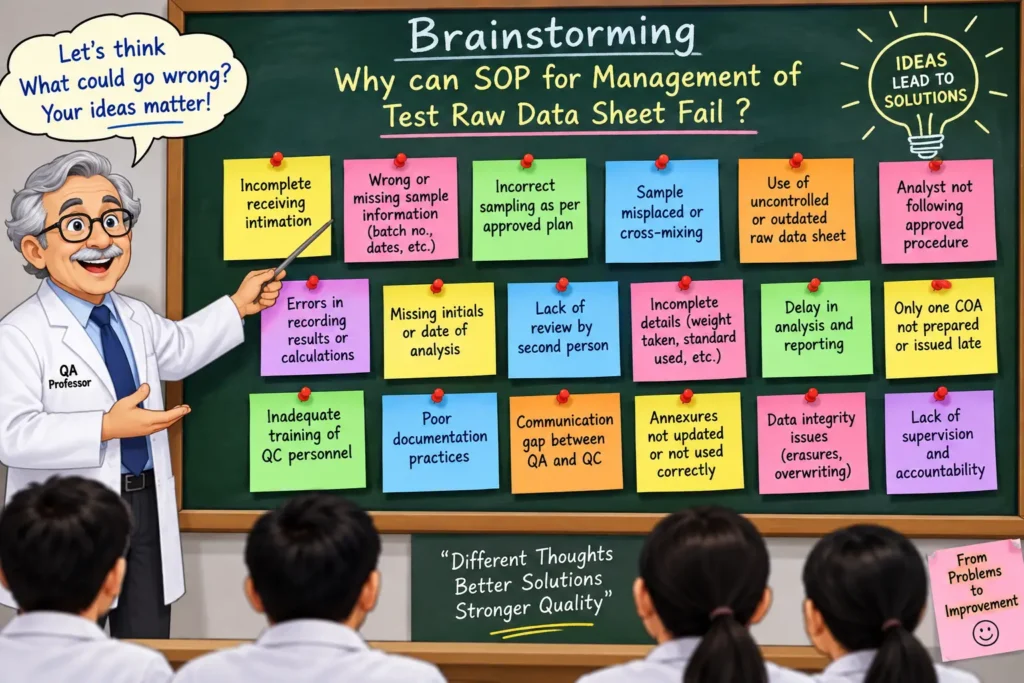
The discussion also considers broader causes including insufficient training, poor documentation practices, communication gaps between QA and QC, incorrect use of annexures, delayed analysis, data integrity issues, and lack of supervision. Since the SOP requires complete receiving information, proper sample forwarding, approved testing procedures, documentation of analytical details, and review of completed raw data sheets, these brainstorming points directly relate to potential weaknesses in SOP execution.This brainstorming approach helps identify risks early and supports suitable corrective and preventive actions.
3. 5-Why Analysis for SOP Failure:
The 5-Why Analysis for SOP Failure – Management of Test Raw Data Sheet is used to identify the underlying cause when the SOP is not followed correctly. The analysis begins with the problem of an incomplete or incorrect receiving report and progressively asks “Why?” to trace the failure back through missing sample information, inadequate verification, failure to check SOP requirements, and insufficient training or awareness.
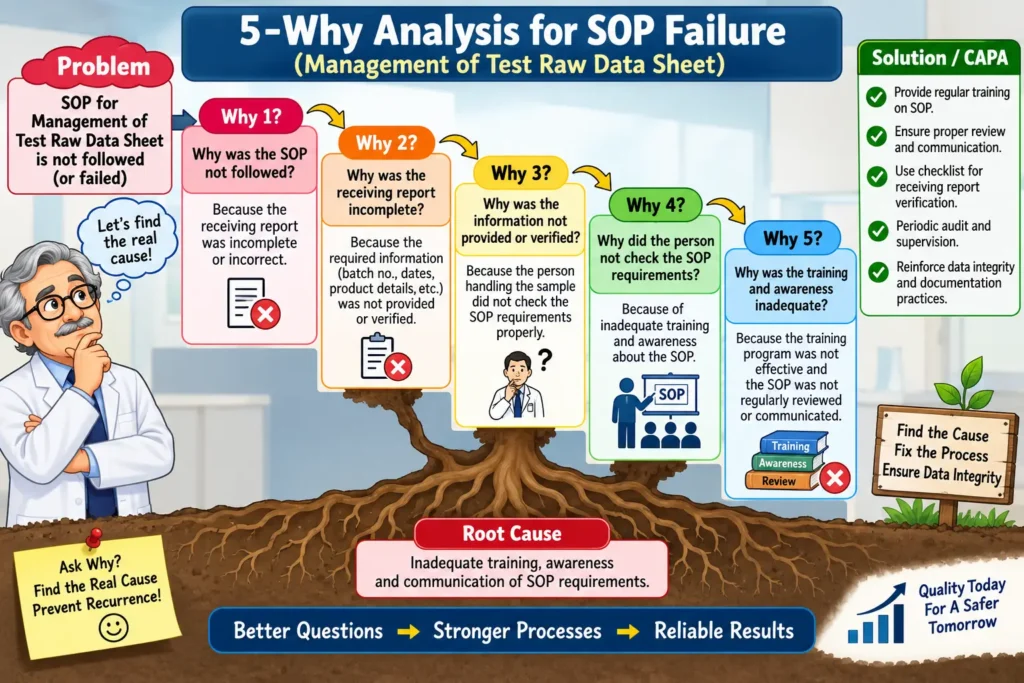
The SOP requires the receiving report to contain key details such as reference number, product name, batch number, batch size, manufacturing date, expiry date, and stage of material before the sample is processed. It also requires the sample to be forwarded, analyzed according to the approved procedure, and the findings to be recorded with initials and date.The analysis identifies the likely root cause as inadequate training, awareness, review, and communication of SOP requirements. Suitable CAPA includes refresher training, verification checklists, periodic review, supervision, and stronger documentation controls.
4. Fishbone Analysis for SOP Failure:
The Fishbone Analysis identifies the possible causes responsible for failure of the SOP for Management of Test Raw Data Sheet. The SOP is intended to ensure proper control, recording, review, and handling of analytical raw data, with QC responsible for execution and QA/QC management responsible for effective implementation.
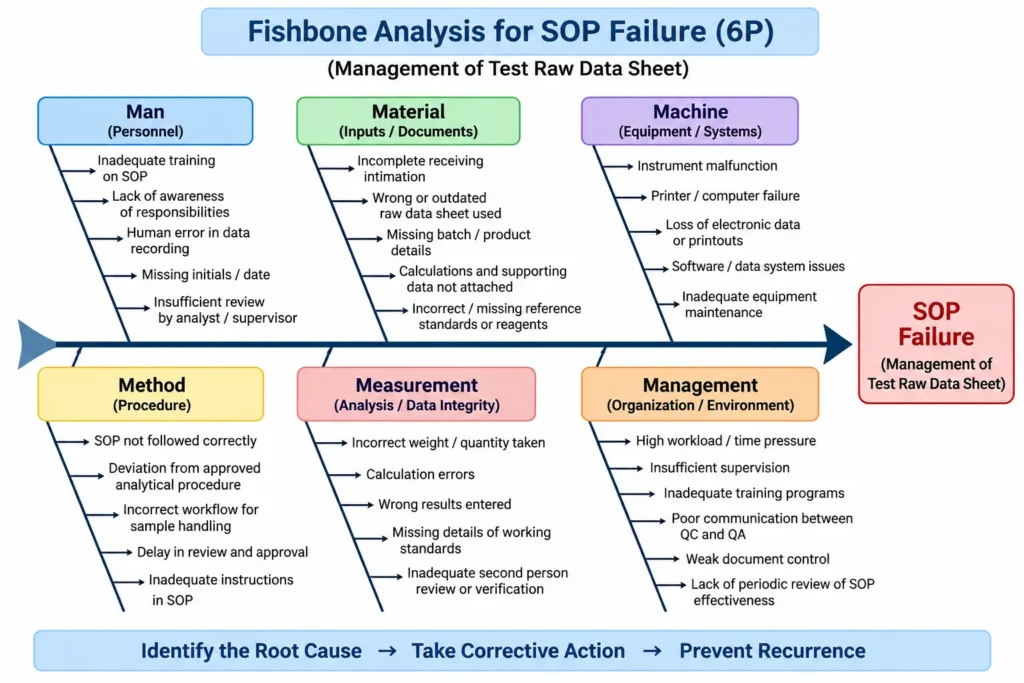
The diagram evaluates six major cause categories: Man, Method, Material, Machine, Measurement, and Environment. Potential causes include inadequate training, human error, failure to sign or date records, incorrect SOP steps, use of wrong or outdated raw data sheets, incomplete receiving information, equipment or computer failure, calculation errors, incorrect transcription, weak review, poor supervision, and high workload. These causes can lead to incomplete or unreliable analytical documentation. Since the SOP also requires analysts to record findings, attach supporting calculations and working-standard details, and complete review activities, weaknesses in these controls may directly contribute to SOP failure.
5. Fault Tree Analysis for SOP Failure:
The Fault Tree Analysis (FTA) diagram explains how failure of the SOP for Management of Test Raw Data Sheet may occur through multiple contributing events. The top event is “SOP Failure,” which is connected through OR gates to major failure modes such as incomplete or inaccurate raw data, improper review and approval, and loss or uncontrolled handling of records.
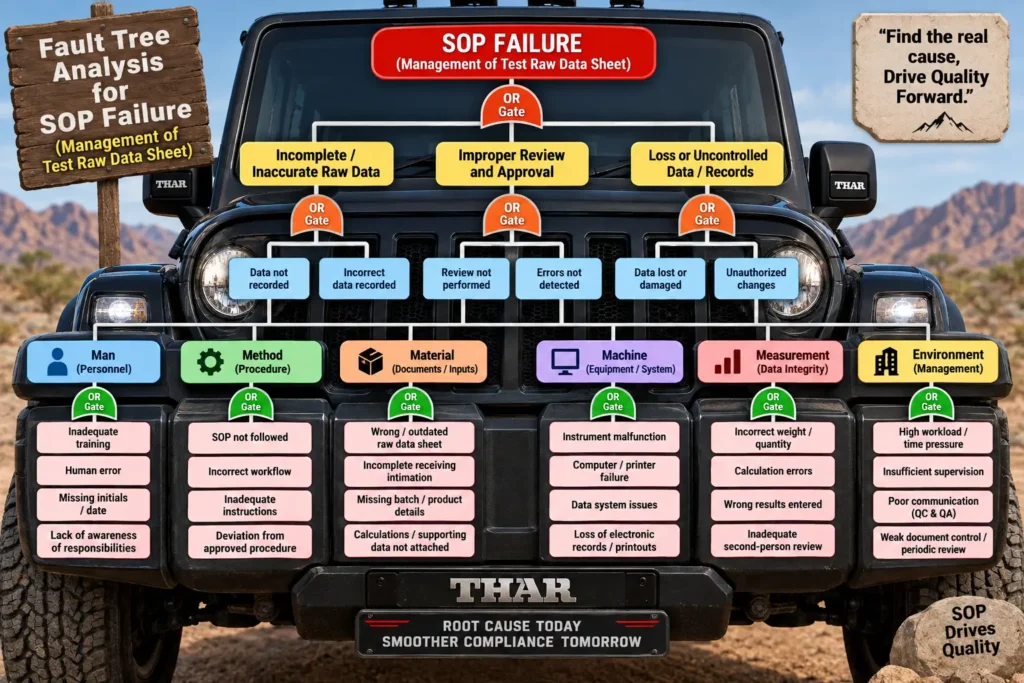
The SOP requires samples to be forwarded with the appropriate raw data sheet, analysts to record test findings, initials and date, and supporting details such as weights, working standards, and calculations. It also requires review of analytical records before completion.The FTA further breaks the problem into causes related to Man, Method, Material, Machine, Measurement, and Environment, including inadequate training, human error, incorrect workflow, outdated forms, equipment or computer failure, calculation errors, weak review, poor supervision, and high workload. This analysis helps identify the root causes of SOP failure so that suitable CAPA can be implemented to strengthen data integrity and prevent recurrence.
Questions & Answers – SOP for Management of Test Raw Data Sheet
Q1. What is the objective of this SOP?
Answer: The objective is to define the procedure for proper management of test raw data sheets.
Q2. Who is responsible for execution of this SOP?
Answer: The Asst. Manager-QC and Manager-QC are responsible for execution of the SOP.
Q3. Who is responsible for effective implementation of the SOP?
Answer: The Head-QA/QC is responsible for effective implementation.
Q4. What information should be checked in the receiving report?
Answer: The receiving report should contain details such as reference number and date, product name, batch number, batch size, manufacturing date, expiry date, and product stage.
Q5. Who distributes the sample to the Analytical Chemist?
Answer: The Asst. Manager-QC or Manager-QC distributes the sample to the Analytical Chemist.
Q6. What should the Analytical Chemist record during analysis?
Answer: The chemist should record analytical findings on the test raw data sheet and provide initials and the date of analysis.
Q7. What supporting analytical details should be attached to the raw data sheet?
Answer: Details such as weight taken, working standard used, calculations, and other relevant analytical records should be attached.
Q8. What happens after completion of the test raw data sheet?
Answer: A certificate of analysis is prepared and the report is reviewed by Lab QA.
Q9. How are raw materials and packing materials handled?
Answer: QC personnel ensure completeness of the receiving intimation, arrange sampling according to the approved sampling plan, and forward the sample and documents for analysis.
Q10. Who handles purified water and microbiological testing samples?
Answer: The Microbiologist ensures completeness of the receiving intimation, arranges sampling, and forwards the sample through QC management for analysis.
Q11. Who provides training for this SOP?
Answer: The Manager-Quality Control is the trainer, and Quality Control personnel are the trainees.
Q12. What can cause failure of this SOP?
Answer: Possible causes include incomplete documentation, incorrect data entry, missing signatures or dates, failure to attach calculations, inadequate review, wrong raw data sheets, equipment or system issues, and inadequate training.
Q13. Why is review of raw data important?
Answer: Review helps detect incorrect entries, missing information, calculation errors, and incomplete supporting records before finalization of the analytical report.
Q14. What may be the impact of SOP failure?
Answer: SOP failure may lead to unreliable analytical records, data integrity concerns, delayed material or product release, deviations, investigation, and regulatory observations.
Q15. What CAPA can be taken after SOP failure?
Answer: Appropriate CAPA may include retraining of QC personnel, strengthening reviewer checks, controlling current raw data sheet formats, improving document control, investigating system failures, and monitoring CAPA effectiveness.