





Brief Description
Operational Qualification (OQ) of a pharmaceutical facility provides documented evidence that critical facility systems, utilities, environmental controls, safety features, and operational functions perform consistently within predefined specifications under anticipated operating conditions. If facility OQ is not performed, there is insufficient documented assurance that systems such as HVAC, pressure differentials, temperature and humidity controls, alarms, interlocks, utilities, and cleanroom operational conditions function as intended.Failure to perform OQ may increase the risk of contamination, cross-contamination, environmental excursions, equipment or utility malfunction, and non-compliance with GMP requirements. The issue should be formally investigated through deviation and root-cause analysis. A risk assessment should evaluate potential impact on products manufactured or stored in the affected facility. Appropriate CAPA should include preparation and approval of an OQ protocol, execution of operational tests, resolution of deviations, documentation of results, and final QA approval before routine GMP operation.
Skip to PDF content1. Flow Diagram:
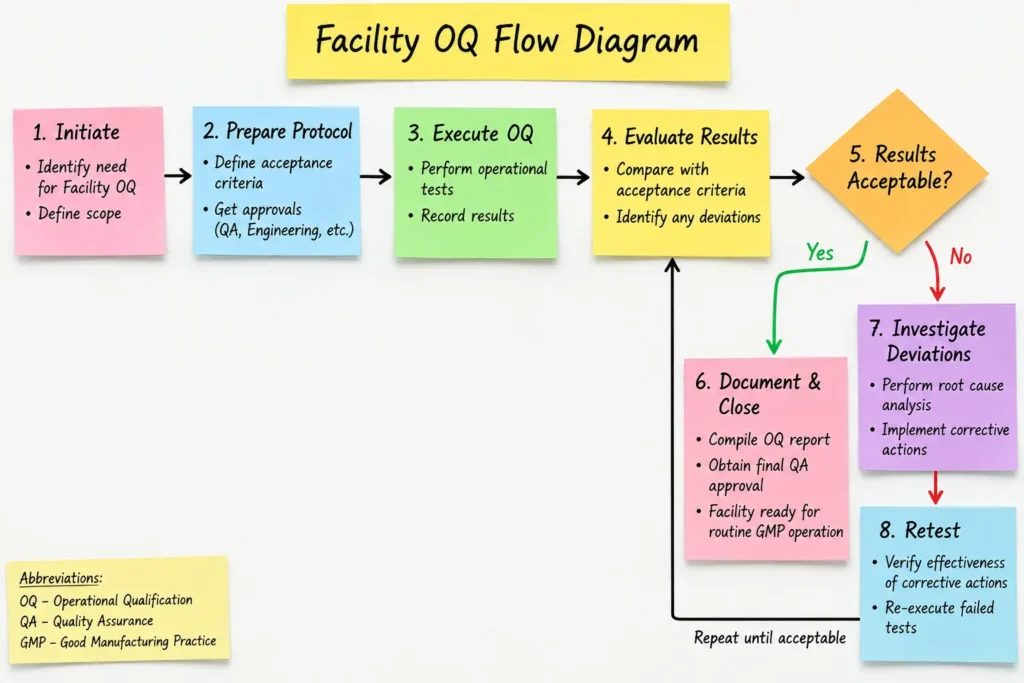
The Facility Operational Qualification (OQ) Flow Diagram presents the qualification process in a simple sticky-note format. The process begins by identifying the need and scope for Facility OQ, followed by preparation and approval of the OQ protocol with predefined acceptance criteria. Approved tests are then executed to verify that critical facility systems and controls operate as intended.
2. Brainstorming for SOP Failure:
Test results are evaluated against the approved acceptance criteria. If the results are acceptable, an OQ report is prepared, reviewed, and approved by Quality Assurance, allowing the facility to proceed toward routine GMP operation. If any result is unacceptable, the deviation is investigated, root cause is identified, corrective actions are implemented, and the failed tests are repeated. The cycle continues until all requirements are satisfactorily met. This structured approach ensures documented evidence of facility performance, GMP compliance, traceability, and effective control of qualification-related deviations.
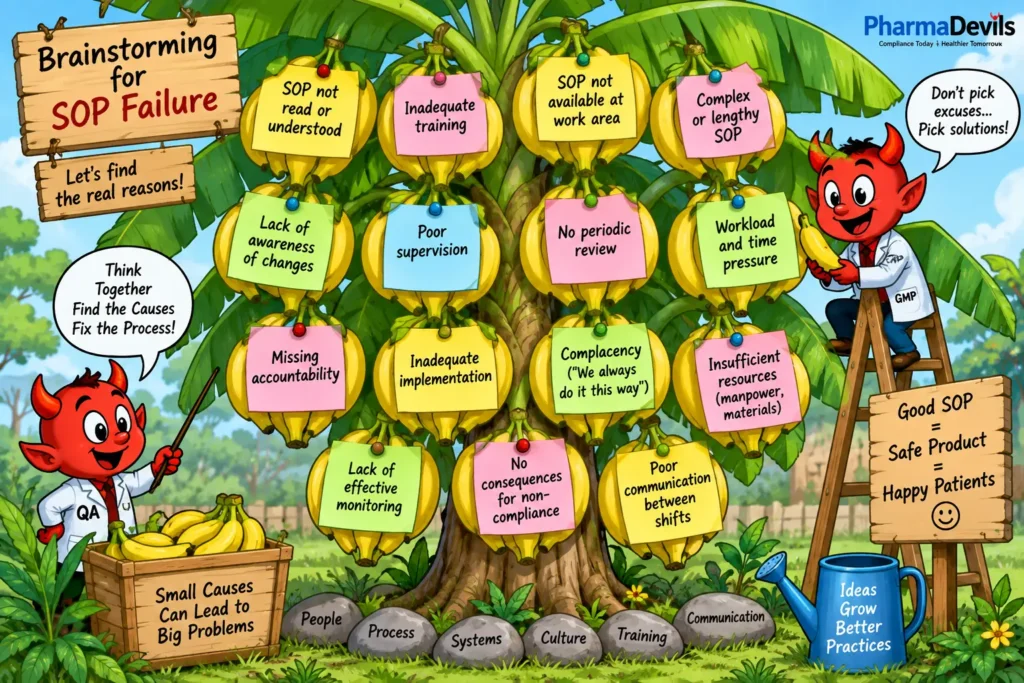
The Brainstorming for SOP Failure diagram illustrates potential reasons why an approved Standard Operating Procedure may not be followed effectively in a pharmaceutical operation. The banana-tree sticky-note concept groups common causes in a simple and engaging manner to support team discussion and root-cause identification.Possible causes include inadequate training, poor understanding of the SOP, SOP unavailability at the work area, complex or lengthy procedures, weak supervision, lack of awareness of revisions, workload pressure, poor communication between shifts, insufficient resources, complacency, ineffective monitoring, and unclear accountability. These factors may individually or collectively lead to repeated SOP non-complianceThe brainstorming exercise helps Quality Assurance and operational teams identify people-, process-, system-, training-, communication-, and culture-related weaknesses. The identified causes should then be evaluated using suitable root-cause analysis tools, followed by corrective and preventive actions to strengthen SOP compliance and reduce recurrence.
3. 5-Why Analysis for SOP Failure:
The 5-Why Analysis for SOP Failure diagram demonstrates a systematic approach for identifying the underlying cause of an SOP non-compliance event. The analysis begins with the immediate problem—an approved SOP was not followed—and progressively asks “Why?” to move beyond the visible error.
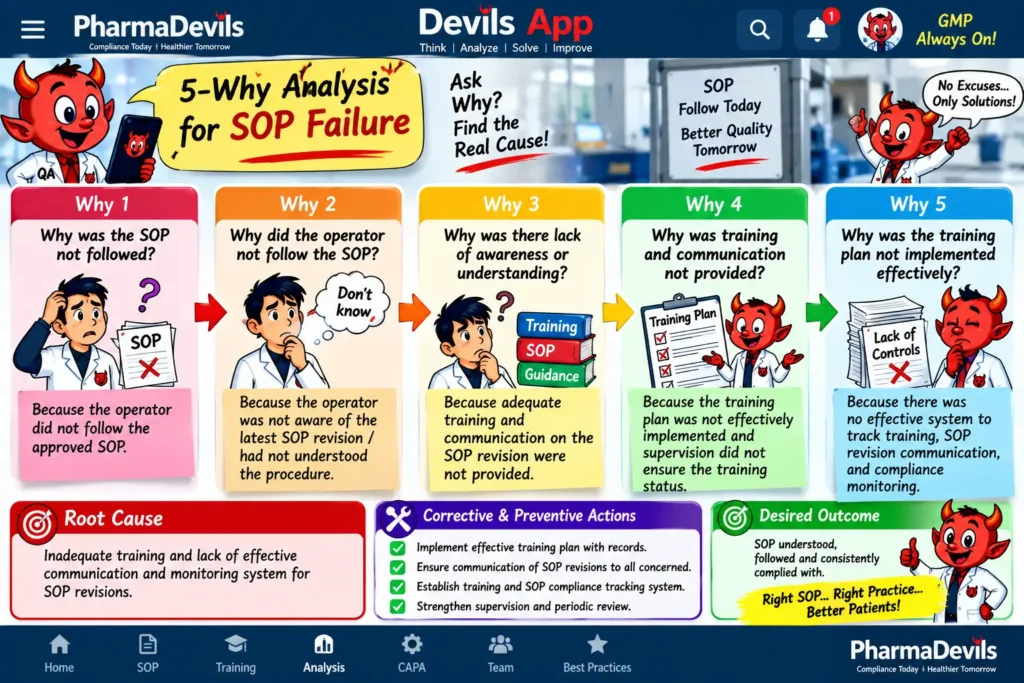
The investigation may reveal that the operator was not aware of the latest SOP revision or did not fully understand the procedure. Further analysis can identify inadequate training, ineffective communication of SOP changes, weak supervision, and absence of a reliable system for monitoring training completion and SOP compliance.The probable root cause is therefore linked to weaknesses in the training, communication, supervision, and compliance-tracking system rather than only individual operator error. Appropriate CAPA should include effective SOP training, documented communication of revisions, strengthened supervisory checks, training-status tracking, and periodic compliance monitoring. This approach helps prevent recurrence and supports consistent GMP compliance.
4. Fishbone Analysis for SOP Failure:
The Fishbone Analysis for SOP Failure diagram provides a structured method for identifying possible causes of SOP non-compliance in pharmaceutical operations. The analysis groups contributing factors into major categories such as Man (People), Method (Process), Machine (Equipment), Material, Measurement, and Mother Nature (Environment).
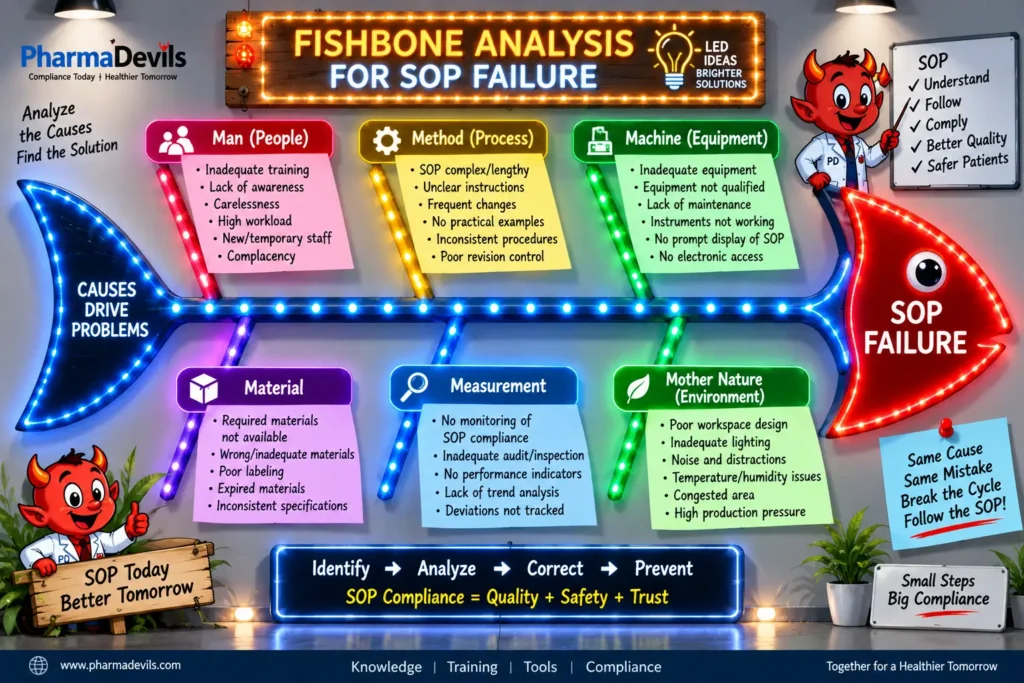
People-related causes may include inadequate training, lack of awareness, excessive workload, and complacency. Process-related causes may involve unclear instructions, lengthy SOPs, frequent revisions, or weak document control. Equipment factors can include unqualified or poorly maintained equipment and limited access to current SOPs. Material-related issues may involve incorrect, unavailable, or improperly labelled materials. Measurement causes can include inadequate monitoring, weak audits, poor trend analysis, and failure to track deviations. Environmental factors may include distractions, poor workplace design, inadequate lighting, congestion, or production pressure. This fishbone approach helps investigation teams systematically identify, analyze, correct, and prevent the underlying causes of SOP failure.
5. Fault Tree Analysis for SOP Failure:
The Fault Tree Analysis (FTA) for SOP Failure diagram identifies the potential pathways that can lead to non-compliance with an approved Standard Operating Procedure. The top event is defined as SOP Failure, which may result from several major contributing factors such as training failure, document control failure, supervision failure, resource or time pressure, and communication failure.
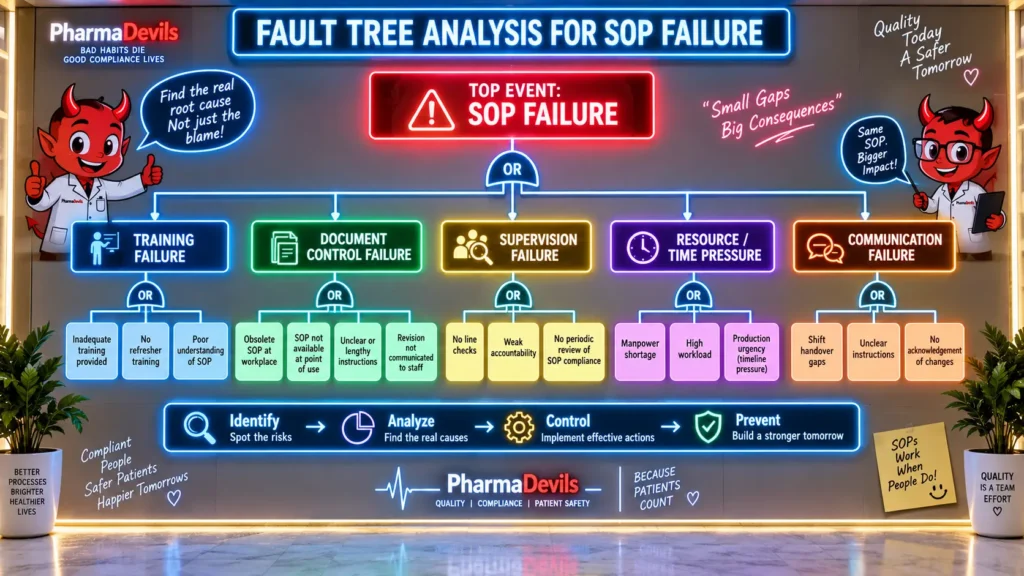
Training-related causes may include inadequate training, lack of refresher training, or poor understanding of the SOP. Document control issues can involve obsolete procedures, unavailable SOPs, unclear instructions, or poor communication of revisions. Supervision failures may arise from weak accountability, lack of line checks, and insufficient periodic review. Resource-related causes include manpower shortages, excessive workload, and production urgency. Communication failures may include ineffective shift handovers, unclear instructions, and lack of acknowledgement of changes. FTA helps teams trace failures systematically, identify critical control gaps, and establish targeted CAPA to prevent recurrence.
Questions & Answers
- What is an SOP failure?
SOP failure is a situation where an approved Standard Operating Procedure is not followed correctly or completely. - What are common causes of SOP failure?
Inadequate training, unclear instructions, poor supervision, outdated SOPs, workload pressure, and communication gaps. - Why is SOP compliance important in pharmaceuticals?
It ensures consistent operations, product quality, patient safety, data integrity, and GMP compliance. - What should be done when an SOP failure is identified?
The event should be documented, assessed for impact, investigated, and handled through appropriate CAPA. - How can the root cause of SOP failure be identified?
Tools such as 5-Why Analysis, Fishbone Analysis, Fault Tree Analysis, and brainstorming can be used. - Can inadequate training cause SOP failure?
Yes. Poor or incomplete training can result in misunderstanding or incorrect execution of the procedure. - How can document control contribute to SOP failure?
Use of obsolete SOPs, delayed revision distribution, or unavailable procedures can lead to non-compliance. - What is the role of supervision in preventing SOP failure?
Supervisors should verify understanding, monitor compliance, provide guidance, and address deviations promptly. - What is the impact of repeated SOP failure?
It may lead to deviations, batch rejection, product-quality risks, regulatory observations, and recurring compliance problems. - What CAPA may be implemented after SOP failure?
Retraining, SOP revision, improved document distribution, enhanced supervision, electronic tracking, and periodic compliance checks. - Should every SOP failure undergo impact assessment?
Yes. The potential impact on product quality, patient safety, process control, data integrity, and regulatory compliance should be evaluated. - How can recurrence of SOP failure be prevented?
Through effective training, clear SOPs, strong supervision, proper change communication, periodic audits, and CAPA effectiveness verification. - Who is responsible for SOP compliance?
All personnel performing the activity are responsible, while department heads and Quality Assurance provide oversight. - What is the role of Quality Assurance in SOP failure investigation?
QA reviews the event, evaluates impact, verifies root-cause analysis, approves CAPA, and ensures effectiveness checks are completed. - How should CAPA effectiveness be verified?
By reviewing repeat deviations, training effectiveness, audit observations, compliance trends, and actual adherence to the revised controls.
Reference Guidelines:
- US FDA – 21 CFR 211.100, Written Procedures; Deviations: Requires approved written production/process-control procedures to be followed and deviations from them to be documented and justified. (Legal Information Institute)
21 CFR 211.100 - US FDA – 21 CFR 211.25, Personnel Qualifications: Requires personnel to receive appropriate job-specific and continuing CGMP training so they remain familiar with applicable procedures and requirements. (eCFR)
21 CFR 211.25 - EU GMP – EudraLex Volume 4, Chapter 4: Documentation: Covers preparation, approval, control, availability, revision, and proper use of GMP documents and procedures. This is particularly relevant to obsolete, unclear, unavailable, or improperly controlled SOPs. (Public Health)
EU GMP Chapter 4 – Documentation - EU GMP – Chapter 2: Personnel: Establishes requirements for adequate numbers of qualified personnel, responsibilities, initial and continuing training, and assessment of training effectiveness. (Public Health)
- EU GMP – Chapter 1: Pharmaceutical Quality System: Supports investigation of deviations, root-cause determination, CAPA, quality-risk management, and continual improvement of the pharmaceutical quality system. (Public Health)
- WHO GMP – TRS 986, Annex 2: WHO Good Manufacturing Practices for Pharmaceutical Products – Main Principles: Provides GMP expectations covering personnel, documentation, production, quality systems, written procedures, training, and investigation of quality problems. (World Health Organization)
WHO TRS 986 Annex 2 - WHO Quality Assurance of Pharmaceuticals, Volume 2, 10th Edition (2024): A comprehensive GMP reference covering pharmaceutical quality systems, personnel, documentation, manufacturing controls, validation, inspection, deviations, and related quality-management practices. (World Health Organization)
WHO GMP Compendium – Volume 2