







1. Introduction:
The Batch Packing Record (BPR) for Mefenamic Acid & Dicyclomine Hydrochloride Tablets is a critical document maintained by the QA Department to ensure compliance, traceability, and quality assurance during the pharmaceutical packing process. This record serves as an official log that captures every detail of the packaging operation, from the transfer of inspected tablets to the dispensing of packaging materials, equipment usage, line clearance, and in-process checks. It provides a systematic framework to monitor and verify that all procedures are carried out according to Good Manufacturing Practices (GMP) and regulatory standards. The document begins with product identification, including batch number, batch size, manufacturing and expiry dates, and composition details—each uncoated tablet contains Mefenamic Acid IP 250 mg and Dicyclomine Hydrochloride IP 10 mg. It also specifies storage conditions, such as maintaining temperature below 30℃ and protection from light and moisture. Subsequent sections detail the packaging material dispensing sheet, equipment lists, overprinting details, line clearance protocols, machine setup, and in-process checks like leak tests, blister weight verification, and carton/shipper filling accuracy. Additionally, the BPR includes reconciliation records to account for packaging materials, rejection analysis to identify defects (e.g., torn blisters, smudging, missing tablets), and final release slips for finished products. By documenting every stage, the BPR ensures product integrity, minimizes errors, and provides a reliable audit trail for regulatory inspections. This structured approach safeguards patient safety and reinforces the pharmaceutical company’s commitment to delivering high-quality medicines.
Skip to PDF content2. Flow Diagram:
The Batch Packing Record (BPR) for Mefenamic Acid & Dicyclomine Hydrochloride Tablets is a comprehensive document designed to ensure that every stage of the packaging process meets strict quality assurance (QA) and Good Manufacturing Practice (GMP) standards. It serves as a detailed checklist and logbook for production and QA teams to verify that all operations—from material dispensing to final product release—are performed accurately and consistently.
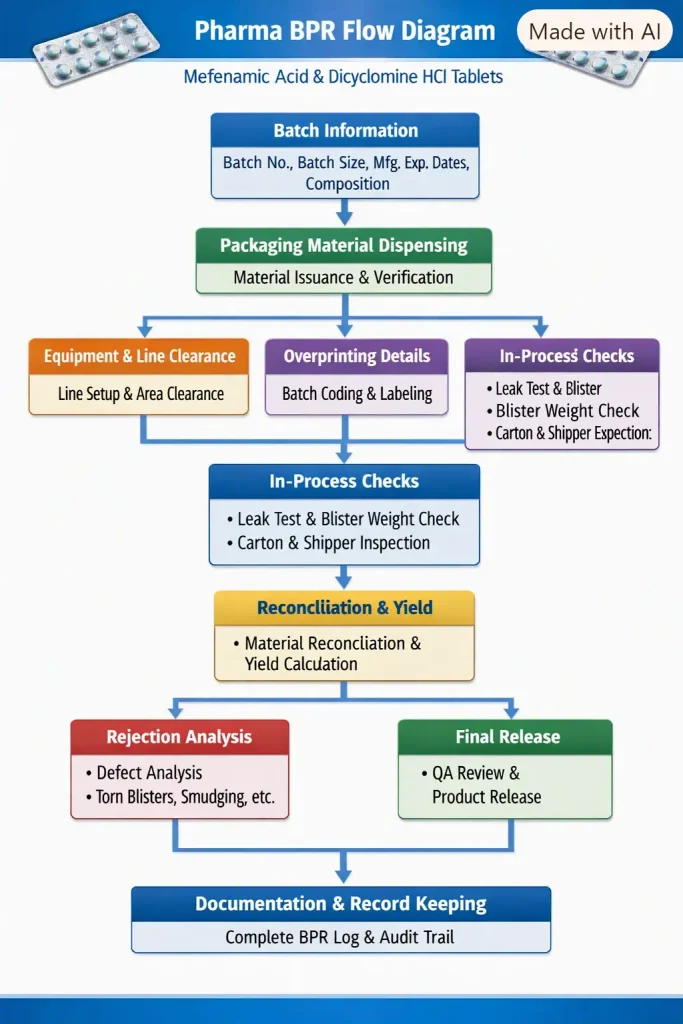
This record begins with essential product details such as batch number, batch size, manufacturing and expiry dates, and tablet composition (Mefenamic Acid IP 250 mg and Dicyclomine Hydrochloride IP 10 mg). It outlines the packaging material dispensing sheet, listing materials like blister foil, PVC, cartons, and shippers, along with their quantities and verification signatures. Subsequent sections include equipment lists, line clearance forms, and machine setup details to confirm cleanliness and readiness before packing begins. The BPR also documents in-process checks such as leak tests, blister weight verification, and carton/shipper fill accuracy at defined intervals. Finally, the record covers reconciliation of packing materials, rejection analysis for defects (e.g., torn blisters, smudging, missing tablets), and finished product release slips. Each entry is verified by production and QA chemists, ensuring traceability and compliance. This structured documentation guarantees product integrity, minimizes errors, and provides a transparent audit trail for regulatory review—upholding the pharmaceutical company’s commitment to quality and patient safety.
3. CPP and CQA:
The CPP and CQA diagram illustrates the vital relationship between Critical Process Parameters (CPP) and Critical Quality Attributes (CQA) in pharmaceutical manufacturing. It visually represents how process control directly influences product quality, safety, and compliance throughout the production lifecycle. On the left side, CPP (Critical Process Parameters) highlights key operational factors such as Mixing Speed, Granulation Time, Compression Force, and Coating Temperature. These parameters must be precisely monitored and controlled to maintain consistency in the manufacturing process.
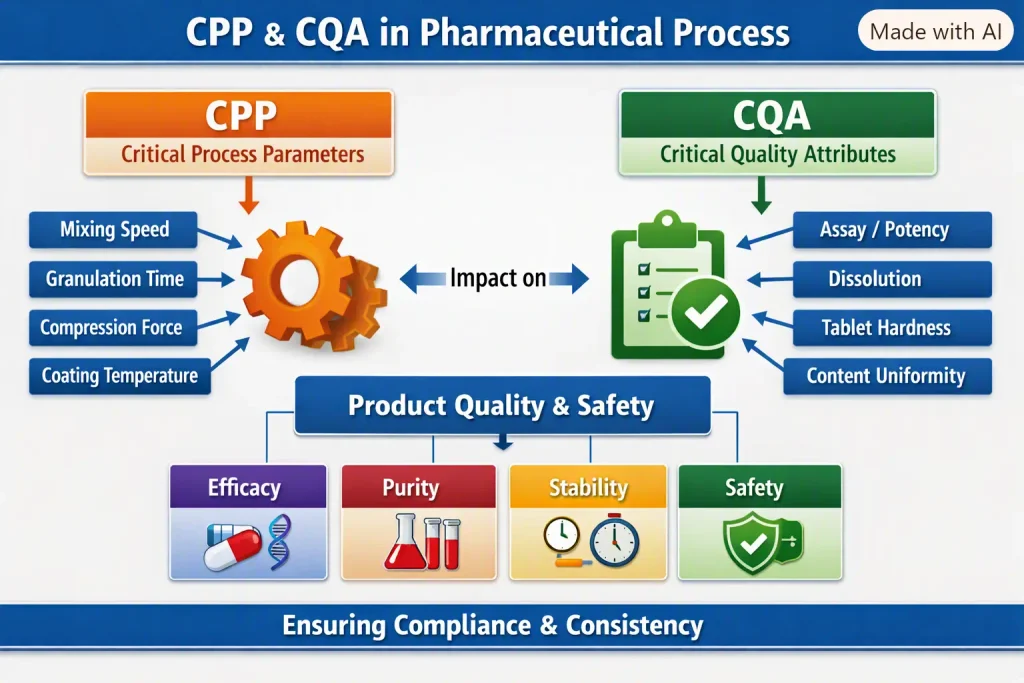
On the right side, CQA (Critical Quality Attributes) focuses on essential product characteristics including Assay/Potency, Dissolution, Tablet Hardness, and Content Uniformity. These attributes define the final product’s performance, ensuring therapeutic efficacy and patient safety. A central arrow labeled “Impact on” connects CPP and CQA, emphasizing their interdependence. Together, they determine Product Quality & Safety, which is further supported by four pillars — Efficacy, Purity, Stability, and Safety. At the bottom, the phrase “Ensuring Compliance & Consistency” reinforces the goal of maintaining pharmaceutical standards through continuous monitoring, validation, and adherence to regulatory guidelines. This diagram serves as a concise visual summary of how process parameters and quality attributes work in harmony to achieve reliable, high-quality pharmaceutical products.